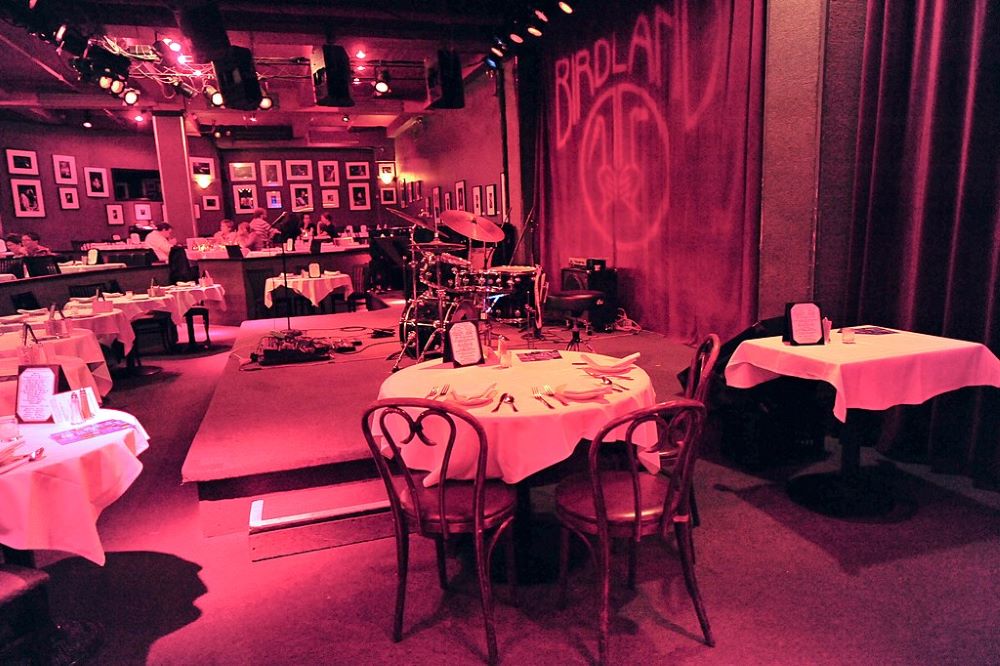
Birdland Jazz Club in New York's theater district (Wikimedia Commons/CC-By-SA-2.0/Jazz Guy)

by Jim McDermott
Sometimes on a Friday evening I sit at the bar at New York City's Birdland Jazz Club and listen to their in-house big band company do its weekly 75-minute set. Tucked away, often in the far corner of the room — "way out in New Jersey," Birdland Big Band leader David DeJesus sometimes kids — sits the band's pianist, Kenny Ascher. Like the rest of this highly accomplished band, Ascher does not give off VIP vibes. In fact, if you get to the club early you'll likely find him chatting warmly with a bartender or others. He seems so unassuming and yet so at home here, you might think he's a longtime patron, or perhaps the owner.
But in truth Ascher is an Oscar-nominated composer who has played with Woody Herman, John Lennon and Barbra Streisand, among many others. Every once in a while near the end of the band's set, DeJesus will turn the room over to him. And for a few minutes Ascher will quietly play his most famous composition, "The Rainbow Connection."
Written for the 1979 film "The Muppet Movie," "Rainbow Connection" served as that movie's opening number and the introduction to its main character, Kermit the Frog. As the camera slowly descends and a banjo plunks, we come upon this quirky green figure sitting on a log in a swamp, yearning to connect with a bigger world. Lyricist Paul Williams told Vanity Fair that the song was meant to "show that Kermit has an inner life, a spiritual life." Sitting there singing to himself, "Kermit [was] not the mentor, not the teacher, not the preacher. He became a seeker with the audience."

Ascher doesn't sing as he plays his song, but each performance is its own gentle search for meaning. As though performing it for the first time, or just for himself, Ascher explores the tune as he plays, shifting tempo and rhythm, adding new colors to the chords, listening for surprises and following them wherever they might lead. One night the song ends with paired notes that sound like a streetcar traveling away into the night. On another, Ascher conjures a whole different experience filled with bittersweet finality, but also fruition.
While each performance is its own unique moment, the feeling it generates in the room is always the same. The audience grows very still. Ascher's fellow band members put down their instruments. Some lower their heads or close their eyes as they listen. And somehow we all find ourselves transported into a space that feels raw and sacred.
The Nativity of Mary, Joseph and Jesus resonates not because the Holy Family are somehow unique, but precisely because they're not.
When I look back on these moments, I tend to imagine them as happening at Christmastime, which is odd, as I'm not sure I have ever seen Ascher perform during the holidays. But somehow in his performance I feel like I get a glimpse of the Nativity. I don't mean the nativities of Hollywood, with their cavalcades of livestock and supporting characters; nor even the nativity of Luke's Gospel, with its choirs of angels added in so as to make sure we understand that this baby is someone special, no matter his appearance.
Advertisement
No, Ascher's performance puts me in mind of what I think of as the real Nativity, the one experienced every day all over the world by ordinary couples, exhausted, frightened and far from any spotlight. For me, the Nativity of Mary, Joseph and Jesus resonates not because the Holy Family are somehow unique, but precisely because they're not. The birth of every child is an in-breaking into the world of something so normal but also so radically new that it is on some level impossible to comprehend. It makes perfect sense that God would choose to come into the world as an infant; every newborn child is an announcement that the universe and our lives are more wondrous and strange than we dared hope.
A dark room in a tiny New York jazz club tucked away from the lights of Broadway may not sound like a likely spot for revelation — or, not religious revelation anyway. Certainly "The Rainbow Connection" is far more a hymn to Judy and Jim (that is, Garland and Henson) than to any image of Jesus. But each time Ascher's hands muse once again over the so-famous song he wrote long ago, there is the sense in the room of something inexpressibly fragile and tender being born, something familiar and yet impossibly new. And like the shepherds in the night, I find myself dumbstruck and grateful.