
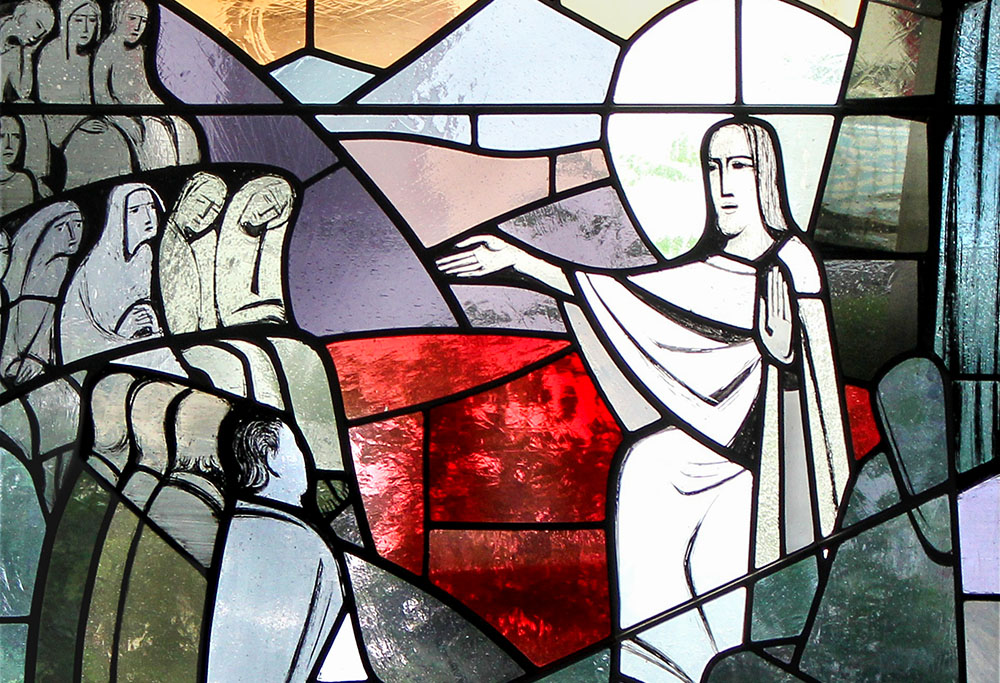
"The Sermon on the Mount," a circa 1970 stained glass window by Swiss artist Helmut Ammann in the Church of the Redeemer in Bad Wörishofen, Germany (Wikimedia Commons/Lothar Spurzem)

by Mary M. McGlone
In many Middle Eastern cultures, guests are offered far more food than they can consume. Families regard visitors as honored guests, according to them the privileges of members of the family. Just remember Abraham, who invited his visitors to a meal of more than 60 pounds of beef and about the same amount of bread. We hope that Sarah offered them enough milk to wash it all down! (Genesis 18:1-8)
Some people of modern cultures might be embarrassed by such extravagance, feeling that they have to reciprocate in kind, an attitude that would be insulting to the original host. Being a sumptuously entertained guest or receiving undeserved gifts can be a humbling experience. For some people, even expressing gratitude can be hard, it can make them feel out of control or incapable of providing for themselves.
We might say that learning to receive is one underlying theme of today's readings.
The beatitudes are very familiar, yet they're still puzzling and mysterious. When we come up against their reversal of normal expectations and measures of status, they are bewildering almost to the point that we might wonder if Matthew misremembered what Jesus said. But befuddlement opens a door into the mystery of God's ways.
When we feel like bragging, we might remember how Paul began his first letter to the Corinthians. He told them that not many of them were wise, powerful or noble. Nope, instead they were foolish, weak, lowly, despised and maybe considered irrelevant. Wouldn't that be a great list to put on your résumé? But think about it. Paul's list echoes what Jesus called blessings.
If we want to begin to understand the beatitudes, the best way would be to see how Jesus' life reflected them. He said, "Blessed are the poor in spirit." The word Matthew used for "poor," designates someone cringing or begging.
That is someone who, as Paul said of Christ, does not grasp at equality with God, but is obedient, empty of egoism. For Jesus, poverty of spirit had nothing to do with self-denigration. In his life, poverty of spirit sustained the relationship with the Father that allowed Jesus to be the channel of God's lavish love. Having nothing to prove for himself freed him to keep growing in unity with the Father and that relationship led him to announce and fulfill the Father's hopes for creation.
Advertisement
Jesus' union with God impelled him to mourn with God over anything that prevented human flourishing. He mourned with the widows and mothers who lost children, he mourned the death of a friend, he mourned the conditions that caused dehumanizing poverty. In union with God, he lived in constant vulnerability, grieving with any and all who suffered.
This mourning simultaneously expressed a hunger, an insatiable desire for justice or righteousness. Another word for such an attitude is meekness: the ability to endure with an even temper, to be tender and remain free from haughty self-sufficiency.
Because he had no need for defensiveness or self-righteousness, Jesus could express the mercy that springs from purity of heart. His consecration to the Father's will not only set his personal agenda but oriented his approach to others. He never needed to blame anyone, but only to encourage others to become all God made them capable of being.
Following Jesus, we need to grow in our awareness of God's lavish love for us.
These attitudes endowed Jesus with extraordinary freedom. Because his energy, his mission and his very identity sprang from his union with God, no adversity, no fear, nor petty authority could cause him to diverge from living as the earthly incarnation of God's endless love and self-giving.
One of the mysteries we encounter in this is that we need not aspire to practice the virtues Jesus outlined in the beatitudes. Presuming that we can decide to live the spirit of the beatitudes misses the whole point. Jesus did not set out to practice virtues. His blessed way of living flowed as the natural result of the love of God in his life.
If we aspire to live as Jesus, we're headed down the wrong path if we begin with efforts to better ourselves; that will only lead to self-righteousness. Grace is a gift, not an accomplishment.
Following Jesus, we need to grow in our awareness of God's lavish love for us. We need to nurture gratitude for and acceptance of the thoroughly undeserved gift and privilege of being born and created capable of loving. The more we dwell in awareness of our undeserved blessedness, the more we learn to humbly accept what we do not deserve, the more natural it will be for us to give lavishly with humble, compassionate, generous and merciful love.
Blessed are those who bask in God's extravagant love. They will be like Jesus.