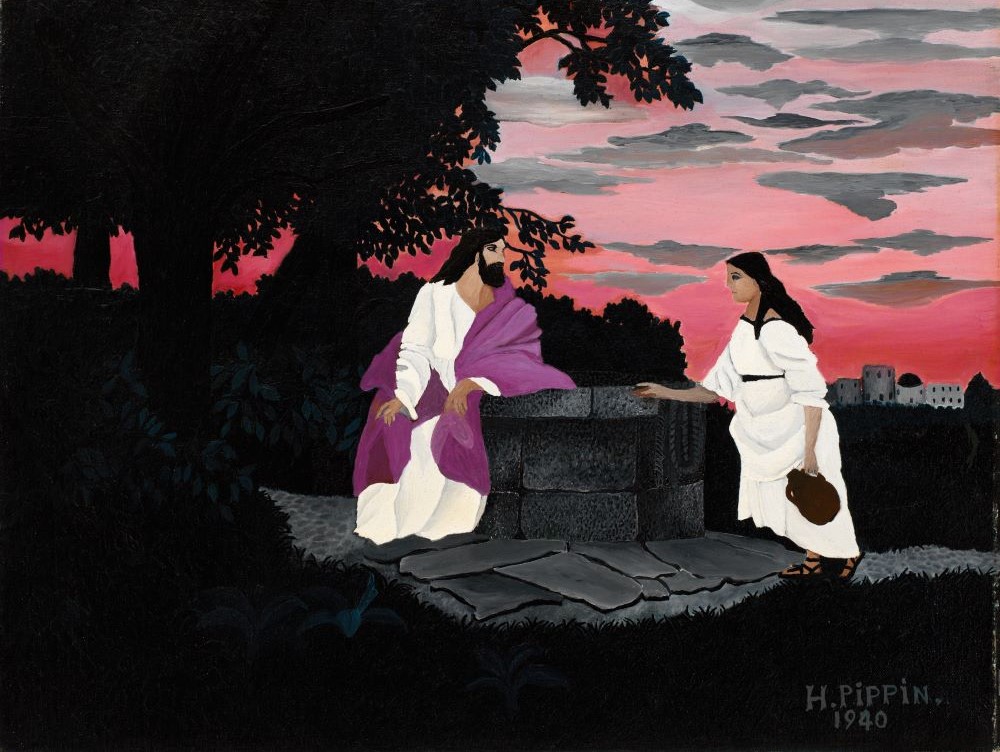
"Christ and the Woman of Samaria" (1940) by Horace Pippin (Artvee)

by Mary M. McGlone
Traditional stories of the saints often paint their prayers in tones of perfect piety, so submissive they make the Virgin Mary appear brash. In contrast, our biblical ancestors' prayers demonstrate grace-filled contention.
Look at Moses in today's incident. Abandoning his own plans so he could serve God, he became the target of people's anger over the effort to become free. Refusing to accept blame for what he hadn't started, Moses let God have it: "What would you have me do with this people?" As he confronted God, Moses learned how God remained with him and could act through him. God led him to open the spring that satisfied his people's thirst.
Moses shows us that prayers of passionate complaint and questioning express faith, deepen our relationship with God and lead us to unanticipated solutions.
This leads into the story of Jesus and the Samaritan woman known in Eastern traditions as Photini. Commentators often begin their interpretation of this story with the assumption that she was a notorious sinner. They assert that people shunned her as a fivefold adulteress, the proof being that she had to go alone to the well at noon rather than when other women collected their water. This view reinforces the notion that Jesus focused on sin and repentance more than on transformative metanoia. St. John's text can lead us in another direction.
John designed his stories to be complex and confusing enough to lead us into deeper insight. Today's scene opens in contentious terrain. Jesus was traveling in the adversarial territory of Samaria. He rested at the well of Jacob, the ancestor of both Samaritans and Jews. Jesus and Photina (whose name means "the enlightened one") represent their clashing peoples. John specified that their encounter occurred at midday. On John's theological clock, noon represents the highest point of the light, a time of exceptional revelation. It was also a moment when Jesus felt real thirst and saw someone who could help him.
The theological banter begins when Jesus puts himself at the mercy of a woman with a water jar. Hearing his request for a drink, she retorts, "You? You Jews scorn us and yet you want something from me?" Reminding her that humans thirst for more than liquid, he tells her that he's got something greater to offer her. Keeping safely on the superficial level she says, "OK, give it to me so I don't have to keep working like this!"
Jesus then dove into the heart of things, the level of deepest commitments. He addressed her as a Samaritan representing children of Abraham who had worshipped the idols of five Babylonian cities. They had been untrue spouses of the God of Jacob. Jesus wanted more than five false husbands for her and her people. She asked where faithful people should worship, and he replied that praise of God happens wherever people are guided by the Spirit and truth. He then told her that God seeks just such people.
Still staying safe, she says, "Yes, someday we'll know the Messiah." He says, "This is the moment. I am." With that, she drops the jar representing physical needs and runs to evangelize her people. Rather than refer to Jesus as a Jew, she moves beyond partisanship and calls him "the man who explained everything to me." On her word they come to meet him and invite him to stay among them.
What had happened? Metanoia. She had allowed Jesus to open her mind. She saw beyond her prejudices. She became able to lead her people out of the narrow confines of their religion into the realm of the Spirit who calls each and all human beings into full communion with one another and God.
Advertisement
Paul tells the Romans that we are justified by faith. That's what God taught Moses and Jesus taught Photina. No religious tradition can contain God. God wants to contend with us in order to open our minds and hearts to more than we might imagine. Photina received the light of the Gospel and led her people to experience the soul-expanding love of God.
Photina and Paul urge us beyond all religious boundaries into mysticism, inexpressible experiences of God's love. Rather than focus on commandments or sin, Christ invites us to be the sort of people God is seeking. We can grow as faith-filled disciples, unafraid to allow grace to free us from certainty or fear. We can dare to let ourselves be drawn into the realm of God's disruptively unruly Spirit.
Jesus reveals that God has no interest in sin. Our God thirsts for real presence, for contentious or questioning prayer, for genuine interaction that opens us to more than we could dream of. Moses discovered flowing water, Photina received living water. We need both.