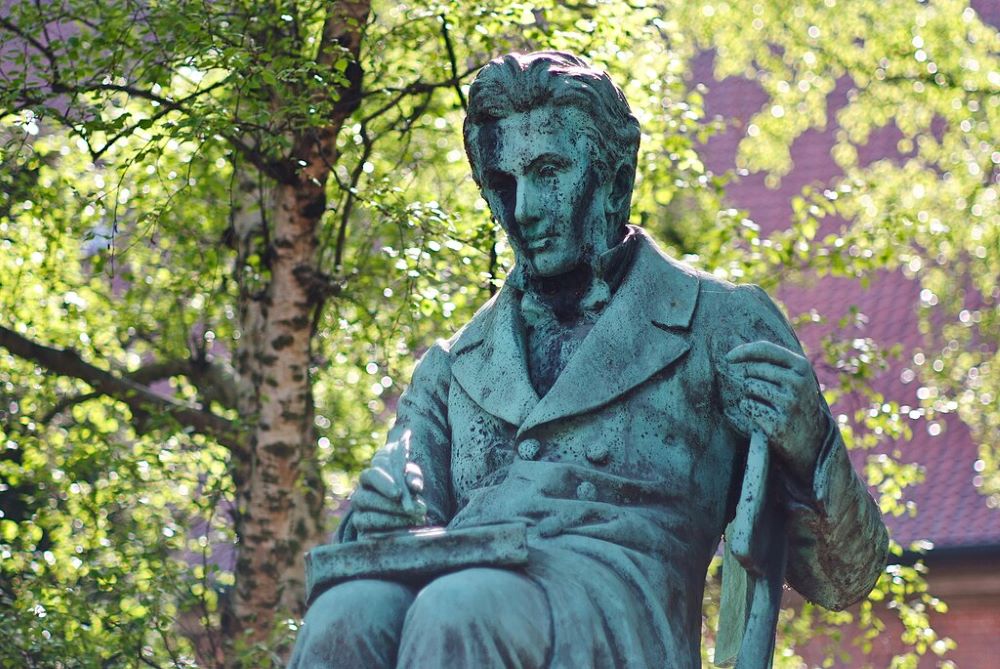
A bronze statue depicting Danish philosopher Soren Kierkegaard by the sculptor Louis Hasselriis stands in the Royal Library Garden in Copenhagen, Denmark. (Wikimedia Commons/CC Attribution-Share Alike 3.0/Arne List)

by Michael Leach
Soren Kierkegaard, a Danish philosopher who died at 42 in 1855, is a friend of mine. I like his hair. I like everything he wrote. Like this for instance: "I have just now come from a party where I was its life and soul. Witticisms streamed from my lips, everyone laughed and admired me, but I went away — yes, the dash should be as long as the radius of the earth’s orbit ——————————— and wanted to shoot myself."
You have to love a guy like that.
I've spent a lifetime trying to be the life of the party and getting people to like me, and got really good at it. But I've learned the hard way that all admiration does for me is swell my ego to the size of a tumor, and that words of praise turn to broken vowels before they reach my heart. Like Soren K, I'm sure I've spent as much time in Dante's inferno as I have on cloud nine.
The Irish aristocrat and theater producer Terence Gray (1895-1986) was also familiar with the rush of adrenalin that comes from being "somebody" in the world. And he, too, experienced its flip side, the hush of despair, and gave it up later in life to seek wisdom instead. He studied Eastern philosophy and wrote books under the pen name Wei Wu Wei. I love this line: "Why are you unhappy? Because 99.9 percent of everything you think, and everything you do, is for yourself — and there isn't one." The ego is an empty costume.
Not everyone looks for renown to lighten the pain of being human. Just as tempting is money or sex or food or knowledge or power or personal relationships. We think they will make us happy, or at least forget just how deep our sadness lies. Truth is, as "Endgame" playwright Samuel Beckett wrote, "You're on earth. There's no cure for that."
Nothing here lasts. All things must pass. Easy come, easy go. The world is no more real than our ego.
One day the world tosses us a bouquet of roses, the next it crowns us with thorns. That's the nature of this valley of tears.
We experience it as a dualistic dream of happy and sad, good and bad, up and down, light and dark, hot and cold, pleasure and pain, friend and foe, war and peace, life and death, love and fear, Laurel and Hardy, Democrat and Republican, Red Sox and Yankee, the joy of victory and the agony of defeat. One day the world tosses us a bouquet of roses, the next it crowns us with thorns. That's the nature of this valley of tears.
The story of Adam and Eve is not a story about then but now. It is the story of us. We're making this world up as we go along as a hiding place from God. We believe we have sinned against God by partaking of the dualistic knowledge of good and evil. We think he has thrown us out of Eden and wants to punish us. Our guilt says we deserve it. Our fear says, find the nearest foxhole. We don fig leaves of personality to disguise ourselves. It doesn't matter that God says, "Who told you that you were naked?" We have exiled ourselves to a world of duality that is a perfect distraction.
Original sin is the belief that we have done the impossible: separated ourselves from our Source. But we can no more separate ourselves from God than a sunbeam can separate itself from the sun. "We live and move and have our being in God" (Acts 17:28). We only imagine that we're outlaws on the run, like Harrison Ford hiding in a Chicago basement in "The Fugitive." There is no basement, there is no foxhole, and, believe it or not, there isn't even a Chicago! We have everything upside down. We live "in the secret place of the Most High" (Psalm 91:1) where there is no duality or "shifting shadows" (James 1:17). There is only Light, Oneness and Love.
Those are three beautiful words, but words have never been enough to change this guy for long. I know that even if I get the words right, it doesn't mean I get my life right. "Wake up, sleeper!" Paul shouts at us. "And Christ will give you light" (Ephesians 5:14).
Well easy for you to say, Paul. Christ had to toss you off a horse and slam you to the ground before you saw the light. And still you had relationship problems with your congregations! And you didn't even have social media!

Michael Leach wears a T-shirt depicting the Danish philosopher Soren Kierkegaard. (Courtesy of Michael Leach)
Just as we are all Adam and Eve, we are all Paul. My therapist in the 1970s used to say, "We begin the journey to enlightenment through one of two ways: wisdom or suffering. And for most of us, it's through suffering."
Suffering always — eventually — works for me.
Yet no matter how many times I fall off the horse, soon enough I'm back in the saddle and riding back into the dream. How many times have I cried out to God and asked for mercy when the dream turned to nightmare (Psalm 142:1)? How much suffering must all of us endure before we choose to set our sights permanently on the "things that are above, not the things that are of this world" (Colossians 3:2)?
The world of form can never make us happy.
Jesus wants us to know the truth of where we really are because only the truth can set us free: "I am in my Father, and you are in me, and I am in you" (John 14:20). That means that we too are in the Father — which means we are literally, permanently, in Love!
Jesus comes into the dream to teach us that God is not a fickle person who gets angry and vengeful but is unconditional, unchanging Love, and nothing can ever separate us from this Love (Romans 8:28). "Only thinking makes it so" (William Shakespeare, "Hamlet").
Centuries later, in 1968, Thomas Merton reminded us: "We are already one. But we imagine we are not. And what we have to recover is our original unity. What we have to be is what we are."
Only then can we take a first step out of the foxhole and return to the Eden we never left. Only then can we begin to follow Jesus and love God who is Love, and love ourselves (perhaps the most difficult love of all) and love our neighbor — including our enemy — as Love loves us, with no strings attached.
Advertisement
I've been learning my whole life that when life slams me to the ground or my heart saddens at all the suffering in the world, the only intelligent response is compassion, loving kindness — to myself, to others, to the world. Buddha came up with this noble truth in 528 BCE. Five hundred years later Jesus assured us, "In this life you shall have trials and tribulation, but be of good cheer for I have overcome the world" (John 16:33). And how did he transcend the world? With love, through love, and in love.
The world doesn't change when we love, we do. We learn to see the world with the eye of our soul. Our eye and God's eye become one. We see love, goodness, oneness, beauty, peace. The world becomes a place of astonishing beauty, if only for a moment. If we took a photo of what is in front of our eyes, it would appear the same as it did just before that blessed moment, but our soul's eye has beheld "a new heaven and a new earth" (Revelations 21:1) and never forgets it.
My old friend Soren K. deserves the last word, from his book Works of Love: "When one has once fully entered the realm of love, then the world — no matter how imperfect — becomes rich and beautiful, it consists solely of opportunities for love."