
(Unsplash/Myznik Egor)

by Liam Myers
"God told me not to listen to music through headphones because it isolates us from the world."
A young man on a packed D train spoke this aloud to uninterested ears covered with headphones, including my own. But upon hearing his proclamation, I paused what I was listening to so that I could hear more clearly the words of this unlikely prophet. The truth of his statement, his prayer, was self-evident: Almost everyone on the train was looking down at their phones. No one seemed affected by his plea.
I'm sure some of the people on the train were wearing their headphones to reduce their anxiety or to protect their ears. I'm not concerned by this, but rather by my own tendency to thoughtlessly put on my headphones as a way of drowning out the world around me. If this rings true to your experience, would you join me in taking off your proverbial headphones for a moment?
When Dominican Fr. Gustavo Gutiérrez, the late beloved "father" of Latin American liberation theology, wrote in We Drink From Our Own Wells that "poverty means death," he was not writing metaphorically. His lifework powerfully conveyed that any spirituality must be communal, contextual and connected to the material conditions of the people one is in community with.
In the same text, Gutiérrez further clarifies his understanding of poverty:
It means death due to hunger and sickness, or to the repressive methods used by those who see their privileged positions being endangered by any effort to liberate the oppressed. It means physical death, to which is added cultural death, inasmuch as those in power seek to do away with everything that gives unity and strength to the dispossessed of the world.
Gutiérrez clearly communicates the Gospel call for the church to care for the poor, and compels us to all join in these efforts. But I must read Gutiérrez with a different lens than those experiencing poverty in Peru, his original audience. Rather, it is essential for myself — and all of us living in the Global North — to understand his theology within our context.
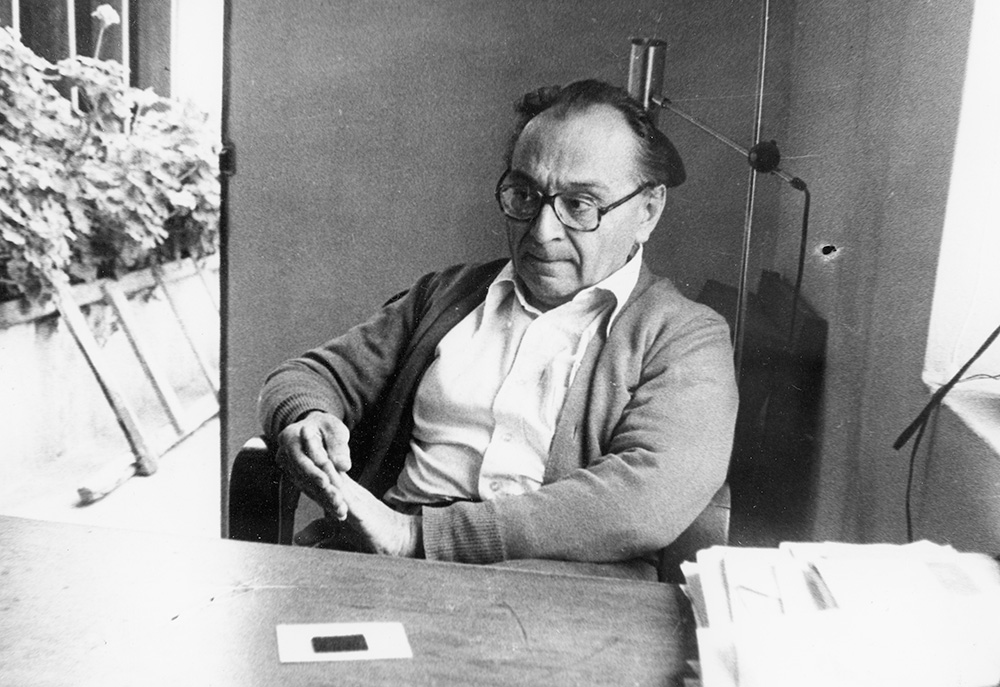
Dominican Fr. Gustavo Gutiérrez in 1983 ( NCR photo/Mark Day)
New York City is facing an affordability crisis. Our newly elected mayor won by running on the promise of making NYC affordable for those who call it home. This beautiful city, where I have lived since 2020, is home to both the ultra rich and those struggling to get by. From Billionaire's Row to Hudson Yards, this city is home — or, often, second home — to some of the wealthiest people in the world.
But take a ride on the subway, and you will encounter people experiencing homelessness trying to find a place to rest. Oftentimes on walks in the East Village, I see well dressed young professionals eating at high-end restaurants on the same block as our neighbors struggling with food insecurity.
In Harlem, I often see the NYPD on the corner or at the bus stop, harassing black residents. In this concrete jungle we are awake but not aware; close but not always connected.
It's all too easy to not act with urgency to address these wrongs when we believe we are not personally under attack. But the truth is, while some will be affected sooner and more drastically by oppressive systems and rulers, the impending death due to oppressive conditions that Gutiérrez described is not reserved for the most marginalized — it will come to us all.
I think of the resonant quote from Martin Niemöller, a German pastor who at first sympathized with Nazi ideas but then became an outspoken critic of Hitler's regime. Niemöller said, "First they came for the socialists, and I did not speak out — because I was not a socialist." He goes on to list the other groups of people that they, the Nazis, came for. Then finally he laments, "Then they came for me — and there was no one left to speak for me."
Advertisement
We are in a moment wherein our federal government is "coming for" certain groups of people. Federal Immigration and Customs Enforcement agents continue to increase their violent tactics, notably killing Renee Nicole Good in Minneapolis last week. Our country's Department of War has kidnapped the leader of Venezuela, and now our president is speaking openly about his interest in taking over Greenland. Over the past months, millions of Americans who depend on SNAP and Medicaid have gone without sufficient food and medical care. But recognizing our situation alone is not enough.
In a documentary about his life titled "A Cloud Never Dies," Thich Nhat Hanh talks about how he would pray in the temple during the Vietnam War. He describes hearing bombs drop in the neighborhood around the meditation hall and felt a call to respond to the needs of the community. "You get out of the meditation hall in order to help people," he said.
Likewise, Gutiérrez knew that the suffering of the oppressed is not something the church should be comfortable with; we cannot stay in the proverbial meditation hall. In The Power of the Poor in History, Gutiérrez wrote, "The poor are a by-product of the system in which we live and for which we are responsible. ... Hence the poverty of the poor is not a call to generous relief action, but a demand that we go and build a different social order."
At the moment the prophet spoke on that D train, the song I was listening to was "Joy and Grief," by the Bengsons. During the COVID-19 pandemic, this album helped soften my heart and carried me deeper into community. In this song, Abigail Nessen Bengson beautifully guides listeners through grief, into joy, and back again. The album, called "The Keep Going Song," was and is a blessing. And yet, the headphones isolated me, in that moment, from my neighbors and their particular concerns.
I ask you these questions that I'm asking myself: Can you hear the bombs dropping, or your neighbors asking for a few dollars to buy lunch? Are you able to hear the prophets on the subway?
Like the angels at the empty tomb, Gutiérrez reminds us that "Jesus is not to be sought among the dead: He is alive." As we seek Jesus, as we move toward liberation, let us try to keep our headphones off for a little while longer; let us listen to the noise as well as to the silence; let us meet the God-in-us through the God-in-you.