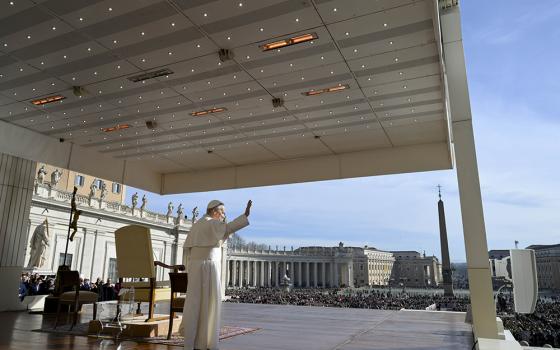
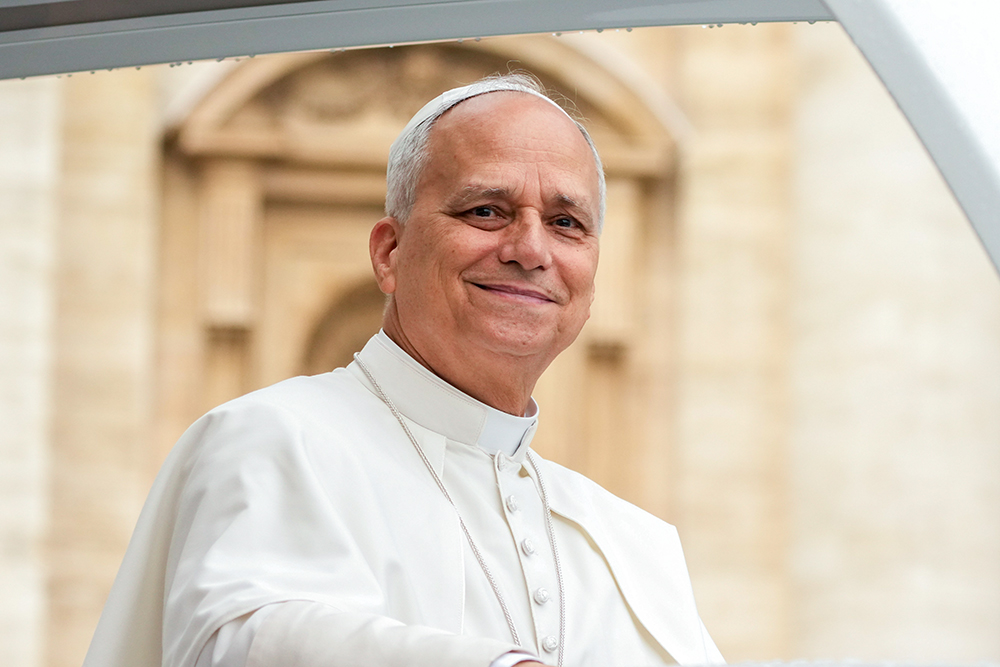
Pope Leo XIV smiles as he greets visitors and pilgrims from the popemobile under the rain in St. Peter’s Square at the Vatican before his weekly general audience Sept. 10, 2025. (CNS/Lola Gomez)

Pope Leo XIV's wide-ranging interview with a veteran Vatican journalist offered the world the first chance to hear the new pope speak on several hot-button issues in his own words.
Leo's comments provide insight into how he sees his role as pope: a bridge-builder, engaging but uncontroversial, and acting as an astute administrator. The direction he proposes for the church is one where dialogue reigns supreme but doctrinal changes, for the time being, appear to be off the table.
Crux released the interview transcripts of the second of two 90-minute conversations in July with Elise Ann Allen, a journalist with the Catholic news outlet Crux, given for a biography she was preparing on the pope.
Here are five takeaways from the interview:
1. Pope Leo gives interviews
That Leo gave a lengthy interview so soon into his pontificate marks a departure from the quiet media profile he maintained as prefect of the Dicastery for Bishops. As pope, he has given doorstep interviews to journalists stationed outside of the papal summer residence near Rome. The newest interview — the second of two 90-minute on-the-record conversations with Allen — provides the first sustained look at Leo addressing issues in his own words.
Allen told The Washington Post that the pope was able to review the book before its publication. The interview therefore offered Leo a rare platform to speak directly on hot-button topics, ranging from LGBTQ+ inclusion to the future of the pre-Vatican-II liturgy, without relying on the more opaque medium of papal homilies or exposing his message to the scrutiny that often accompanies off-the-cuff remarks.
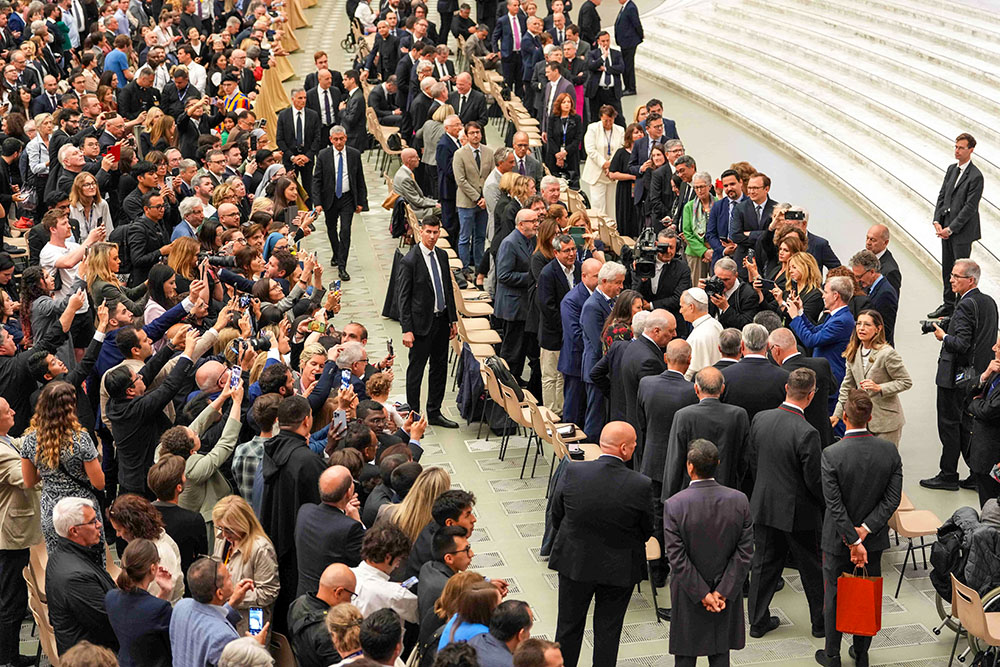
Pope Leo XIV greets representatives of the media who covered his election in the Paul VI Audience Hall at the Vatican May 12, 2025. (CNS/Lola Gomez)
The timing is also striking. Leo's willingness to sit for a formal interview within two months of his election contrasts with Pope Francis, who waited about six months before offering his first in-depth media exchange. Yet Leo had, until now, been viewed by many as media-shy — a perception shaped by his quiet demeanor in curial roles and limited press interaction.
In this regard, Leo inherits both a platform and a predicament. He follows Francis, who over the course of a 12-year pontificate gave interviews with increasing frequency to a wide range of outlets. That steady media presence reshaped expectations for how a pope might get his message across in a digital age. Leo's early engagement suggests he is willing, at least cautiously, to meet those expectations on his own terms.
2. The US pope will challenge US bishops
While Leo played down expectations that his American background would afford him special influence with President Donald Trump, he suggested it might carry more weight with U.S. bishops, who could more easily dismiss Francis for being out of touch with their reality.
"People can't say, like they did about Francis, 'He doesn't understand the United States, he just doesn't see what's going on,' " Leo said. "I think that's significant in this case."
Though he has not yet met the president, Leo said he is monitoring developments in U.S. politics. "Obviously, there's some things going on in the [United] States that are of concern," he said.
Still, he was clear that it is not the role of the pope to intervene directly in national politics: "I don't plan to get involved in partisan politics. That's not what the church is about."
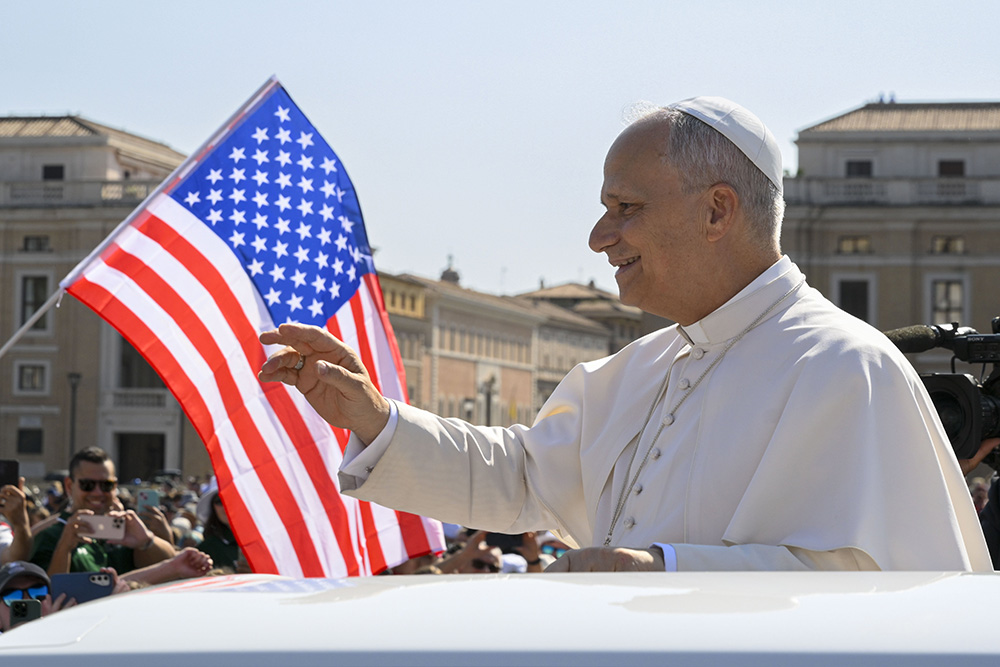
With a U.S. flag in the background, Pope Leo XIV waves to the crowd from the popemobile as he rides around St. Peter's Square at the Vatican before his weekly general audience Aug. 6, 2025. (CNS/Vatican Media)
Instead, Leo appeared to signal that his approach will mirror a strategy employed by his predecessor: issuing strong messages from Rome to prompt episcopal action. He praised Francis' 2024 letter to U.S. bishops on immigration as "very significant," noting that some U.S. bishops had been "courageous enough to go with that."
Such moments, he suggested, demonstrate a way of engaging political realities without direct papal involvement — by putting the onus on the local hierarchy to respond prophetically.
In that light, Leo's early episcopal appointments will offer clear signals about how he hopes the U.S. church will engage its political landscape. His first — naming San Diego Auxiliary Bishop Michael Pham to head that diocese — has already drawn attention. Pham, installed in July, is the first Vietnamese American bishop to head a U.S. diocese and a former refugee himself.
Whether American bishops — long wary of aspects of Francis' vision for the church — will respond differently under a pope who knows their terrain remains uncertain. But Leo shows little sign of shrinking from the challenge
3. Leo's vision of the church is forged in synodality
Whether discussing polarization, LGBTQ+ inclusion, the role of women in the church or tensions over liturgy, the pope consistently referenced the synod on synodality as a touchstone. For Leo, the synodal process appeared not merely as an event he participated in, but as the framework through which he will discern the church's future.
Advertisement
Leo's synodal outlook was formed not only during his high-profile role at the 2024 synod assembly at the Vatican as prefect of the Dicastery for Bishops, but also earlier, in 2022, when he launched the synodal process at the diocesan level as bishop of Chiclayo, Peru.
Leo, who described synodality in the interview as "an attitude, an openness, a willingness to understand," has already demonstrated his synodal ethos through his actions.
Leo held private audiences with two figures emblematic of opposing poles within U.S. Catholicism: Cardinal Raymond Burke, a prominent Francis critic who denounced synodality as a threat to the integrity of the church, and Jesuit Fr. James Martin, an advocate for LGBTQ+ inclusion in the church whose ministry of LGBTQ+ outreach received repeated signs of support from Francis.
On Sept. 6, more than a thousand people participating in an LGBTQ+ Jubilee pilgrimage walked through the Holy Door of St. Peter's Basilica, an event that had the pope's tacit approval and that organizers described as a historic moment of welcome.
Just days later, organizers of a traditionalist pilgrimage announced that Leo had approved the celebration of the traditional Latin Mass in the basilica, to be offered by Burke. That move would have been nearly unthinkable under Francis, who had sharply curtailed such permissions.
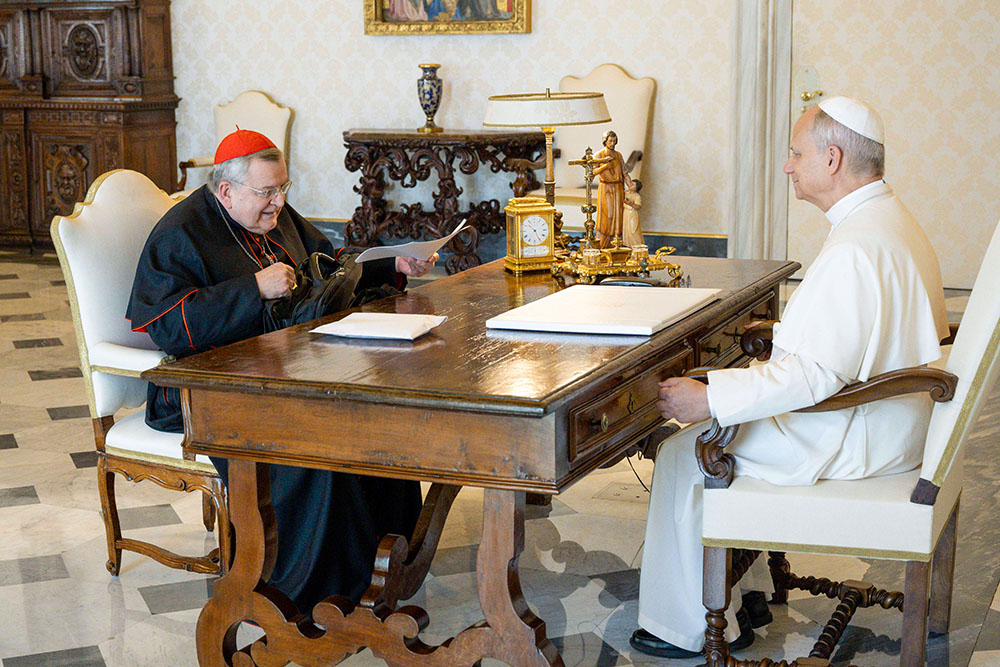
Cardinal Raymond Burke and Pope Leo XIV meet in the library of the Apostolic Palace at the Vatican Aug. 22, 2025. (CNS/Vatican Media)
Rather than signal a doubling-down or a reversal of Francis, these gestures suggest something more characteristic of Leo's emerging style: a synodal approach to governing the church.
Whether the question is liturgy, LGBTQ+ issues or the role of women in church leadership, Leo has signaled that such matters will not be settled by fiat. Instead, they will be engaged synodally. For all the criticism Francis' synodal process received, it may well have served as an incubator for his successor.
4. An apostle of administration
The state of the Vatican's finances was a top concern among cardinals leading into the conclave that elected Leo. Chicago Cardinal Blase Cupich told America magazine that the ongoing reform of the Curia, including getting the Vatican's finances in order and long-term management of its pension fund, was the issue of greatest concern at the beginning of the papacy.
Leo, for his part, projected calm. "Things are going to be OK," he said in the interview, acknowledging the need for continued reform but rejecting the narrative of a financial crisis.
Part of that confidence stems from experience. Before his election, Leo said, he had served on multiple Vatican financial councils. He had earned a reputation among curial colleagues as a steady, capable administrator — one reason that his name rose quickly among papal prospects. As prefect of the Dicastery for Bishops, he led one of the Holy See's most consequential departments and he now brings that organizational knowledge to the papacy.
One of the administrative problems he singled out was the siloed nature of curial governance and the need for greater collaboration between dicasteries.
Although Francis issued a sweeping reform of the Curia with the 2022 apostolic constitution Praedicate Evangelium, Leo is already signaling that more adjustments may be on the horizon. Just over two months into his pontificate, he is already proposing legislative changes to how Vatican governance operates — particularly around interdicastery collaboration.
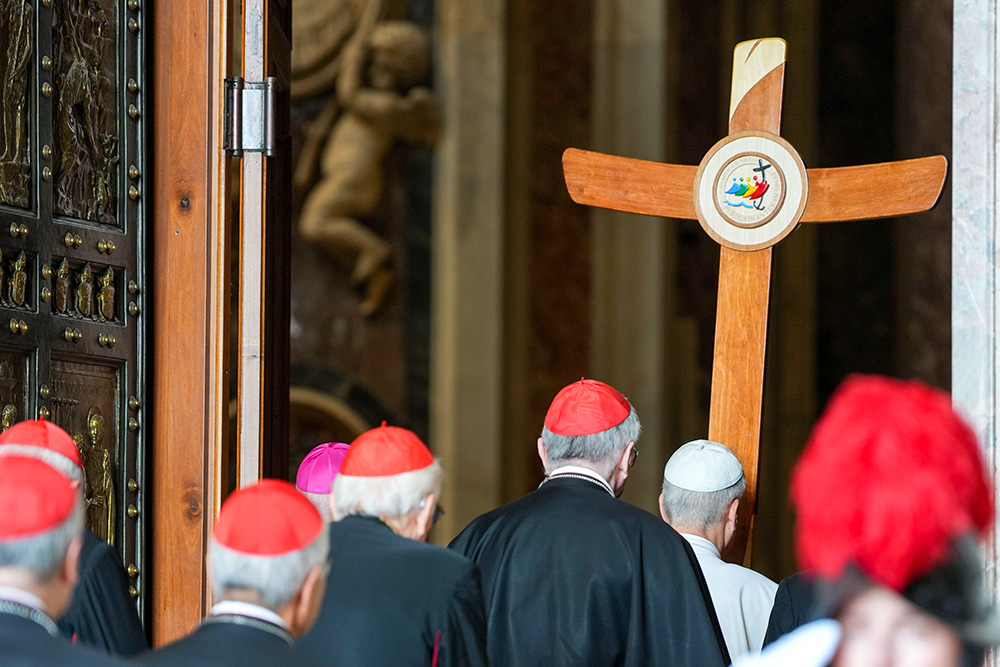
Carrying the Jubilee cross, Pope Leo XIV leads a procession of members of the Roman Curia through the Holy Door of St. Peter’s Basilica during the Jubilee of the Holy See at the Vatican June 9, 2025. (CNS/Lola Gomez)
That early ambition reflects an awareness of why he was chosen. Leo appears to recognize that part of his mandate is to get the Vatican running more effectively, not only financially but also administratively. If the initial signs hold, the Leo papacy could usher in a next phase of curial reform that institutionalizes the synodal attitude he repeatedly returns to.
5. Hosting dialogue while holding doctrine
Unity has emerged as one of Leo's defining priorities. He has touched on the theme time and again in his early remarks as pope, and it seems he will continue to place a premium on it when engaging with thorny doctrinal questions.
In the interview, Leo expressed openness to ongoing conversations around topics such as LGBTQ+ inclusion, the role of women in the church, and the reception of pre-Vatican-II liturgy. But he also made clear that such conversations will not result in a change of church teaching, at least immediately.
"I at the moment don't have an intention of changing the teaching of the church," he said when talking about the ordination of women.
On LGBTQ+ issues he stressed the importance of learning "to understand how to accept others who are different than we are," but he later said in reference to people calling for the recognition of gay marriage and transgender identities in church teaching: "I think that the church's teaching will continue as it is, and that's what I have to say about that for right now."
Where Francis broke new ground by opening space for discussion, Leo may represent a next step: sustaining the conversation while signaling that church teaching remains intact. How that tension will manifest in practice is not yet clear. But for now, it appears to be a balancing act that offers something to both reform-minded Catholics and those concerned about doctrinal stability.
The National Catholic Reporter's Rome Bureau is made possible in part by the generosity of Joan and Bob McGrath.