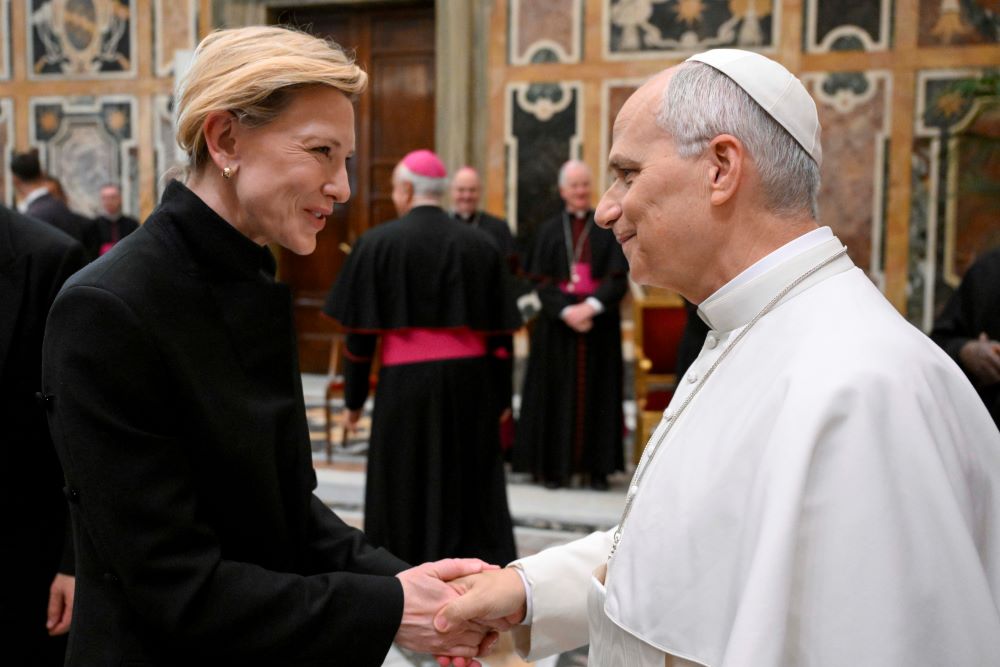
Pope Leo XIV greets Australian actor Cate Blanchett during a meeting with film directors and actors in the Clementine Hall of the Apostolic Palace at the Vatican Nov. 15. (CNS/Vatican Media)

Before some of the biggest names on the silver screen, Pope Leo XIV, a noted film aficionado, praised the prophetic power of cinema and lamented what he called the "troubling decline" of movie theaters in cities and neighborhoods worldwide.
"More than a few people are saying that the art of cinema and the cinematic experience are in danger," the pope told the international group Nov. 15. The group included directors Spike Lee, Greta Gerwig and Gus Van Sant, and actors Cate Blanchett, Viggo Mortensen, Chris Pine and Dave Franco. "Cultural facilities, such as cinemas and theaters, are the beating hearts of our communities because they contribute to making them more human."
Leo is known to be a film lover. Ahead of the encounter the Vatican released a short video of the pope naming his favorites: Frank Capra's "It's a Wonderful Life" with Jimmy Stewart; the 1965 musical "The Sound of Music"; Robert Redford's "Ordinary People," set in his native Chicago; and Roberto Benigni's 1997 "Life is Beautiful."
And the pope's brother, John Prevost, shared that Leo watched the 2024 film "Conclave" shortly before entering the real-life conclave that elected him pope. Sergio Castellitto, who portrayed the conservative Cardinal Tedesco in the movie, was among the attendees who met the pope.
Pope Francis met with a group of artists in the Sistine Chapel in 2023 and a group of comedians in 2024.
Throughout his remarks, read in Italian, Leo contrasted the contemplative experience of cinema with the speed and superficiality that he said often accompany digital culture.
"We live in an age where digital screens are always on. There is a constant flow of information. However, cinema is much more than just a screen; it is an intersection of desires, memories and questions," he said. "The logic of algorithms tends to repeat what 'works,' but art opens up what is possible."
"When cinema is authentic, it does not merely console, but challenges," he continued. "It articulates the questions that dwell within us, and sometimes, even provokes tears that we did not know we needed to express."
'Cinema is much more than just a screen; it is an intersection of desires, memories and questions.'
—Pope Leo XIV
Blanchett, speaking to reporters after the audience, said the pope "really spoke to our common humanity" in his address, and that he challenged filmmakers to remember that "of course filmmaking is about entertainment, but it's about including the voices that are often marginalized."
She said Leo urged them "not to shy away from the pain and complexity that we're all living through right now," and recalled that going to the theater, or "sitting in the dark with strangers, is a way in which we can reconnect to what unites us rather than what divides us," she told reporters after the meeting.
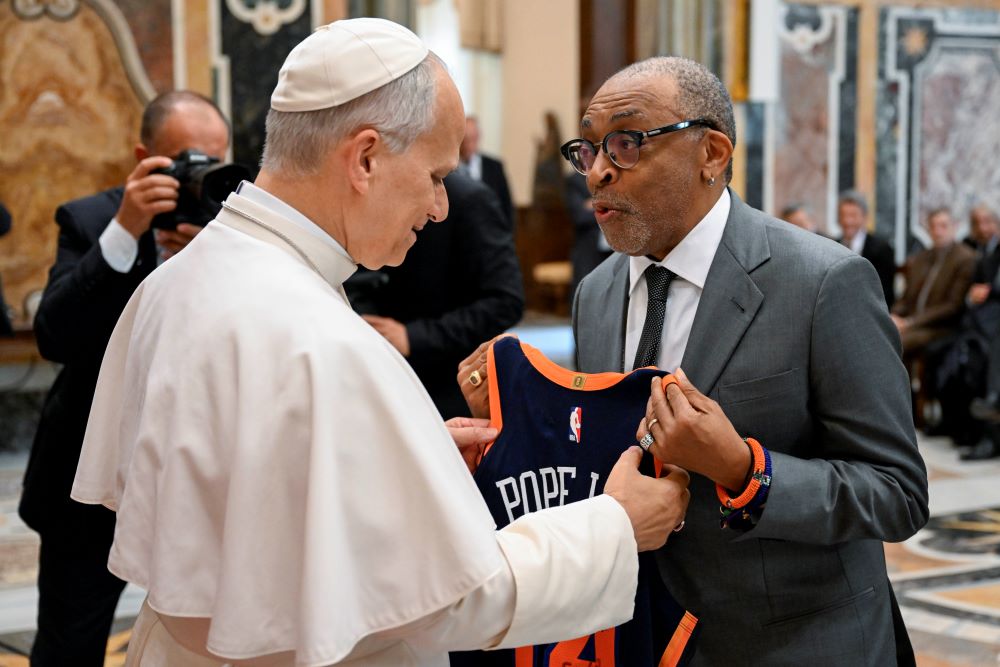
Pope Leo XIV receives a New York Knicks jersey from director Spike Lee during a meeting with film directors and actors in the Clementine Hall of the Apostolic Palace at the Vatican Nov. 15. (CNS/Vatican Media)
The delegation exited the meeting by way of a green carpet laid through the Vatican's Lapidary Gallery, a long corridor lined with ancient inscribed stones.
Judd Apatow, director of comedies such as "The 40-Year-Old-Virgin" and "This is 40," echoed the pope's concern that shared cultural spaces are increasingly rare. "It's important that people get together and have common experiences," he said. "The movie theater is one place that we do that in a big way, so we need everyone to spend more time at the movie theater, less time on the La-Z-Boy ."
Leslie Mann, who starred in movies including "Knocked Up" and "Funny People," said she told the pope her desire to spread hope through her work. "He said we all have to work together," she told reporters. "We all feel very hopeful and excited about our jobs now after leaving that."
Advertisement
Bishop Paul Tighe, secretary for the Dicastery for Culture and Education, which organized the meeting, said the selection process for the participants was "very random," driven by who the Vatican was able to reach. Even so, he said, the response was "extraordinary."
"We weren't selecting people, we wanted representatives, and we have a very good cross-section of representatives from the world of cinema."
Tighe said the goal of the meeting was "to show appreciation and to celebrate, really, the importance of the work of these artists."
Cinema in particular, he said, plays a vital role "in enlivening people's lives, not just in entertaining them, but in challenging them, making them think, giving them space for reflection."
The National Catholic Reporter's Rome Bureau is made possible in part by the generosity of Joan and Bob McGrath.