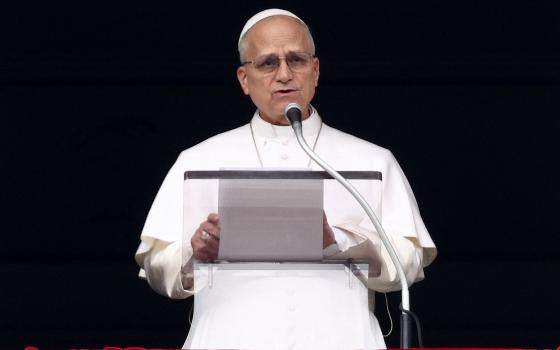

Pope Leo XIV, center, attends the International conference "Raising Hope for Climate Justice" in Castel Gandolfo, Italy, Oct. 1. The conference marks the 10-year anniversary of "Laudato Si'," Pope Francis' landmark document that encapsulated church teaching on the environment. (AP/Alessandra Tarantino)


Catholics and all people committed to protecting the planet must keep climate action from slipping into trends or tribalism, Pope Leo XIV said as he opened a global church summit on climate change aimed at advancing his predecessor's advocacy on environmental issues.
While the world has become increasingly engaged in understanding the ecological and spiritual crisis of climate change thanks to Pope Francis and his 2015 encyclical Laudato Si', Leo asked a packed audience hall on the grounds of the papal summer residence outside Rome "what must be done now to ensure that caring for our common home and listening to the cry of the earth and the poor do not appear as mere passing trends or, worse still, are seen and felt as divisive issues?"
The pope cast that shift primarily as a matter of the heart, calling for a "true ecological conversion" that moves "from collecting data to caring, and from environmental discourse to an ecological conversion that transforms both personal and communal lifestyles."
"The challenges identified in Laudato Si' are in fact even more relevant today than they were 10 years ago," Leo told an audience that included bishops, religious, lay Catholics, scientists and government officials. "These challenges are of a social and political nature, but first and foremost of a spiritual nature: they call for conversion."
Yet he also called on all people to "put pressure on governments to develop and implement more rigorous regulations, procedures and controls."
"Citizens need to take an active role in political decision-making at national, regional and local levels," he said.
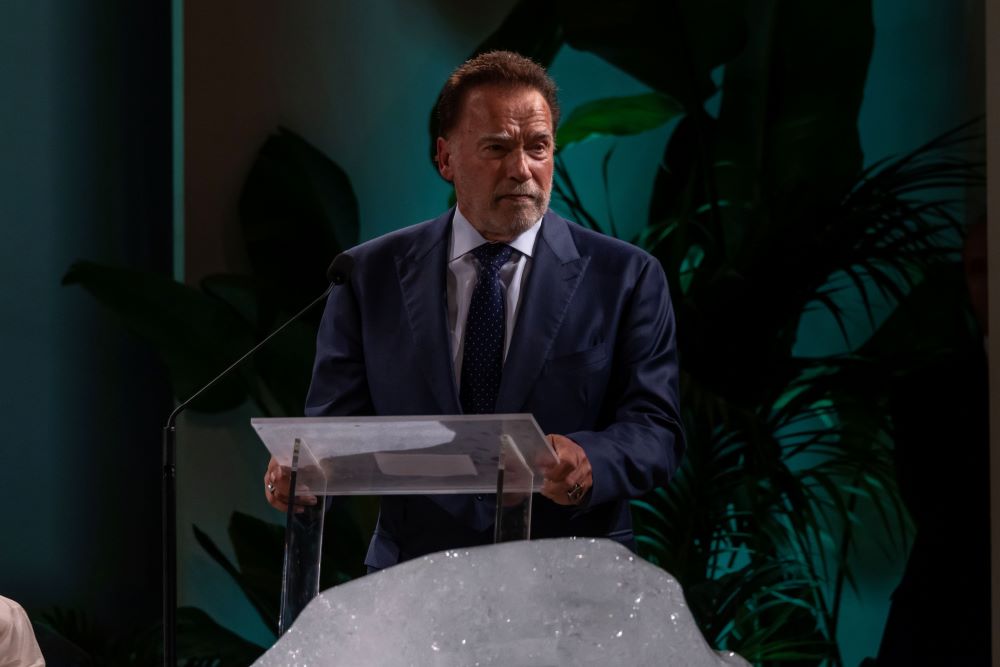
Arnold Schwarzenegger, actor and former California governor, speaks during the opening session of an international conference celebrating the 10th anniversary of Pope Francis' encyclical "Laudato Si', on Care for Our Common Home," at the Mariapolis Center in Castel Gandolfo, Italy, Oct. 1. (CNS/Pablo Esparza)
The pope delivered the speech Oct. 1 at the start of a conference marking the 10-year anniversary of Laudato Si', Francis' landmark document that encapsulated church teaching on the environment.
The first U.S.-born pope spoke from a stage adorned with a tapestry of lush green plants and a block of glacial ice from Greenland. From that perch he listened to creation-inspired songs and comments from other speakers, among them Marina Silva, Brazil's minister for climate and environment; Laudato Si' Movement board chair Yeb Sano; and actor-turned-politican-turned-environmental activist Arnold Schwarzenegger. A day earlier at the Vatican Schwarzenegger sought to recruit more of the church's 1.4 billion members to help "terminate pollution" from fossil fuels that is driving climate change and harming human health.
The pope's message, citing both Laudato Si' and Laudate Deum, reinforced that Leo intends to keep alive Francis' vision of ecological conversion and environmental action, said Franciscan Br. Michael Perry, director of the Laudato Si' Center for Integral Ecology at Siena College, in New York.
"He's saying this is consistent with our faith. It's consistent with who we say we are as Catholics," Perry said.
'There is no room for indifference or resignation.'
—Pope Leo XIV
Leo's speech formally opened the Laudato Si' anniversary conference here in Castel Gandolfo, the centuries-long summer escape for popes. More than 1,000 people have descended upon this lakeside villa nestled in the hills outside Rome, a setting fitting for a conference marrying faith and ecology.
Marianne Comfort, justice coordinator for Earth, anti-racism and women for the Sisters of Mercy of the Americas, said that the pope set up the conference well, "because he was talking about [how] we act together." The next two days, she said, will be a chance for hundreds of Catholics to discuss how they have done that already on environmental issues and how to do so moving forward.
"What are the things we've been doing, what made them successful? What are the obstacles?" she said.
Titled "Raising Hope for Climate Justice," the conference is being facilitated by the Laudato Si' Movement, the global network of Catholic organizations working to live out the encyclical's message. The Vatican's Dicastery for Promoting Integral Human Development is among the supporting organizations, along with Caritas Internationalis, the International Union of Superiors General, the U.S.-based Catholic Climate Covenant and numerous Catholic relief and development groups.
The three-day conference is set to celebrate and assess a decade of sustainable actions and ecological spirituality spurred by Francis and his encyclical. But it also presents what organizers see as a moment to recommit the church to do more around climate change and other environmental plights facing the planet.
"Let's celebrate 10 years of Laudato Si'," Lorna Gold, executive director of Laudato Si' Movement, said in opening remarks. "It has been a journey to get here, but we are just at the beginning."
The conference comes at the 10-year mark not just for Laudato Si', but the adoption of the Paris Agreement, the first international accord committing all nations — including the Holy See — to reduce heat-trapping greenhouse gas emissions in an effort to limit global warming to 1.5 degrees Celsius (2.7 degrees Fahrenheit). Doing so, scientists have stated, would put tens of millions fewer people at risk from more extreme heatwaves and storms, severe droughts, increasing wildfires and rising seas.
"For us, the difference between the 1.5 degrees and anything beyond is not an abstract number," Maina Talia, Tuvalu climate and environment minister, said at a press conference at the Vatican Sept. 30. "It is the difference between survival and erasure. It is forced migration, food and water insecurity, the loss of our lands and our way of life," he said. That includes its cultures, languages, traditions, faith "and indeed, our very identity."
Sitting just two meters above the sea, the Pacific island nation is among the most vulnerable to climate change, where rising seas have already swallowed parts of its land and begun to displace people from their homes.
"For my people in Tuvalu and for many other low-lying atolls around the world, this is not a distant threat. It is here," Talia said.
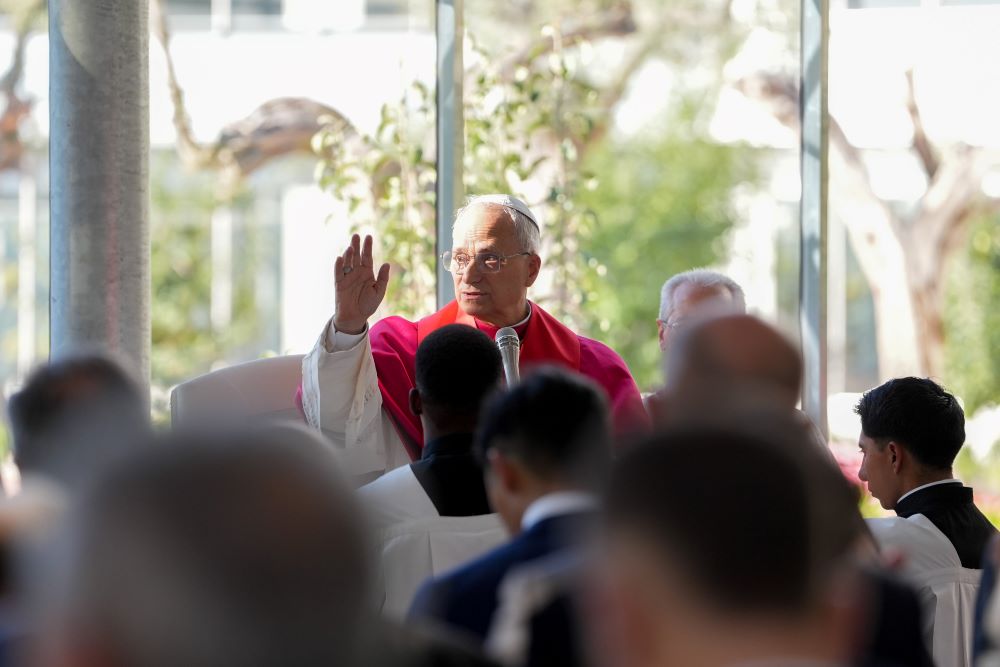
Pope Leo XIV delivers his blessing at the conclusion of a prayer service at a greenhouse that is part of Borgo Laudato Si' in Castel Gandolfo, Italy, Sept. 5, The pope inaugurated the site the same day, opening the historic papal residence as a center dedicated to the principles of care for creation and human dignity outlined in Pope Francis' encyclical "Laudato Si'." (CNS/Lola Gomez)
A large portion of the conference schedule focuses on looking back at how Laudato Si' has animated Catholics within the church along with people in other faith traditions and in the worlds of science, academia, politics and environmental activism.
All day Oct. 1, a Laudato Si' Festival highlighted a multitude of initiatives, like Borgo Laudato Si' in Castel Gandolfo and Terra Laudato Si' in Assisi projects as well as the Vatican's Laudato Si' Action Platform. Further discussions on the impact of Laudato Si' will take place Oct. 2, with a keynote delivered by Cardinal Jaime Spengler, president of both the Brazilian bishops' conference and the Latin American Episcopal Council, or CELAM.
Other notable speakers at the conference include leading climate scientist and evangelical Katharine Hayhoe; climate activist and writer Bill McKibben; Caritas secretary-general Alistair Dutton; Indigenous leader Patricia Gualinga; and Kumi Naidoo, president of the Fossil Fuel Non-Proliferation Treaty.
Several discussions and presentations focus on the upcoming U.N. climate summit, known as COP30, to be held in November in Belem, Brazil. Church leaders in the world's second most populous Catholic country have been prepping for more than a year on how they might wield a sizable and more vocal faith voice into the international climate negotiations, with the major focus this year assessing nations' new emissions reduction targets.
Silva, the Brazilian environmental minister who is heading COP30's ethical stocktake, reiterated President Luiz Inácio Lula da Silva's invitation for Leo to attend the Brazil summit. Preserving all forms of life within God's creation, she said, "is a mission for all of us, one greatly amplified by the Catholic Church's unique power to bring people together and by the moral authority of His Holiness, Pope Leo XIV."
"We already have the technical solutions," Silva added. "What is lacking is the ethical commitment to use that knowledge and those tools to confront climate change, to fight inequality, and to build a world that is prosperous, just and sustainable. It is incoherent: we say we love the creator and we destroy creation. The encyclical Laudato Si' calls on us to make that integration."
Advertisement
In his speech, Leo expressed hope that COP30 and other upcoming U.N. gatherings on food and water "will listen to the cry of the Earth and the cry of the poor" and encouraged all citizens of the world to take an active role in political discussions at all levels to minimize damage to the environment.
"There is no room for indifference or resignation," he said.
A day earlier at the Vatican press conference, Gold called on all nations to submit ambitious climate targets and the necessary financing to deliver them. Despite the worrisome trajectory on climate — the past decade has seen the hottest 10 years on record, while nations' climate plans have fallen well short of the 1.5 C target — the Laudato Si' Movement leader said the conference did not intend to dwell in despondence, but as its name suggests, serve as an oasis of hope that nations and peoples will ultimately act in time.
"Pope Francis urged us to not give in to despair, but 'to sing as we go,' " Gold said, quoting a passage from Laudato Si', "believing that even in the most challenging times, hope can prevail and things can change."
The National Catholic Reporter's Rome Bureau is made possible in part by the generosity of Joan and Bob McGrath.