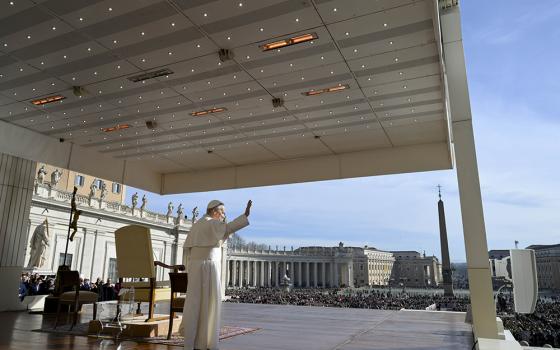
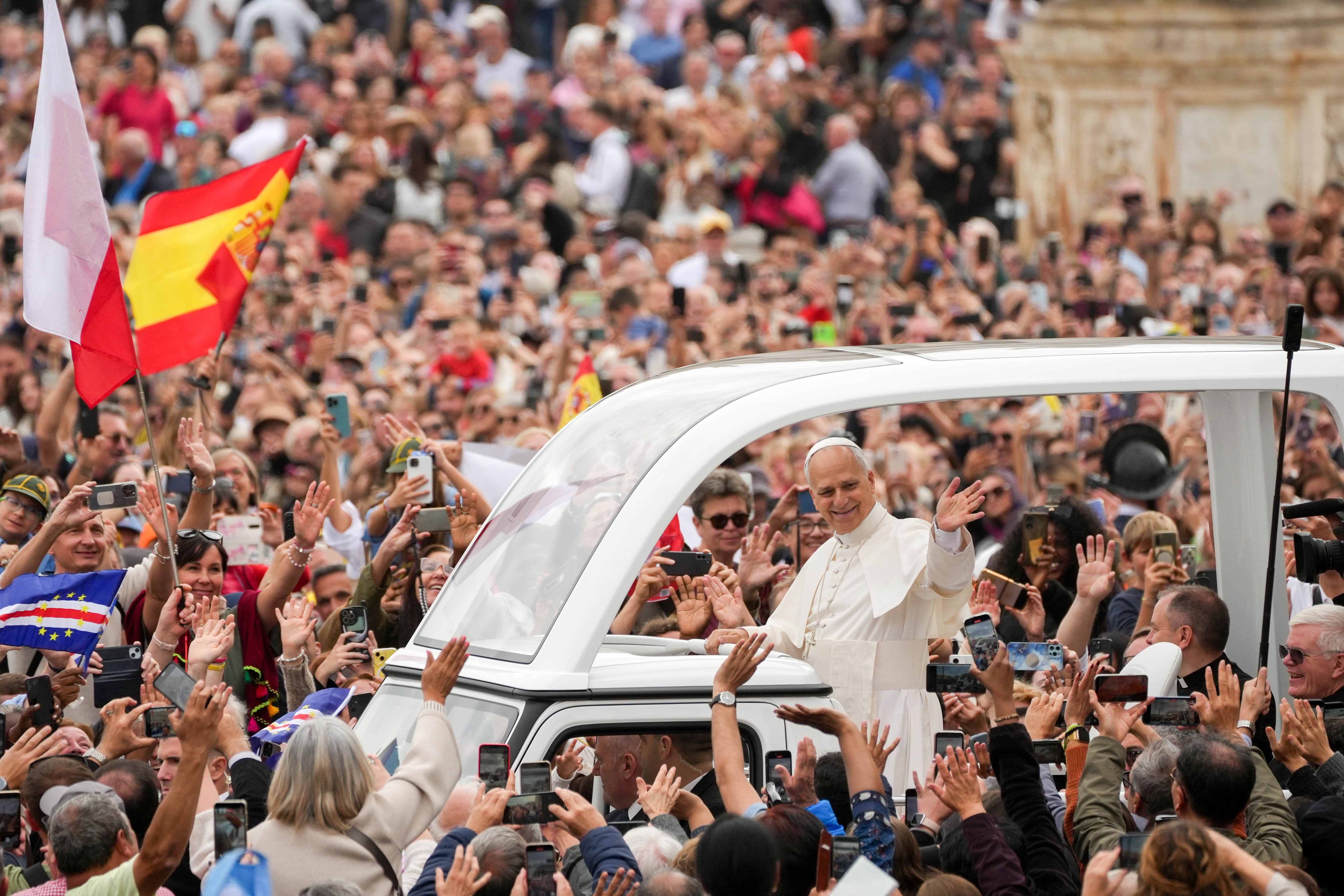
Pope Leo XIV greets people from the popemobile as he rides around St. Peter’s Square following Mass for the Jubilee of Migrants and the Jubilee of the Missions in St. Peter’s Square at the Vatican Oct. 5, 2025. (CNS photo/Lola Gomez)

Pope Leo XIV will travel to Turkey and Lebanon for the first international trip of his pontificate, the Vatican announced on Tuesday, positioning him as a bridge-builder in a region with ongoing political and religious tensions.
The pope will visit Turkey from Nov. 27-30 and Lebanon from Nov. 30-Dec. 2. The Vatican said Leo will travel to Iznik, the site of ancient Nicaea, to mark the 1,700th anniversary of the Council of Nicaea. While he is there, he is expected to meet with Ecumenical Patriarch Bartholomew of Constantinople, the spiritual leader of the world's 300 million Orthodox Christians, in what is expected to be a major sign of Catholic–Orthodox dialogue.
The full itinerary for the trip was not announced.
Catholic-Orthodox unity in Turkey
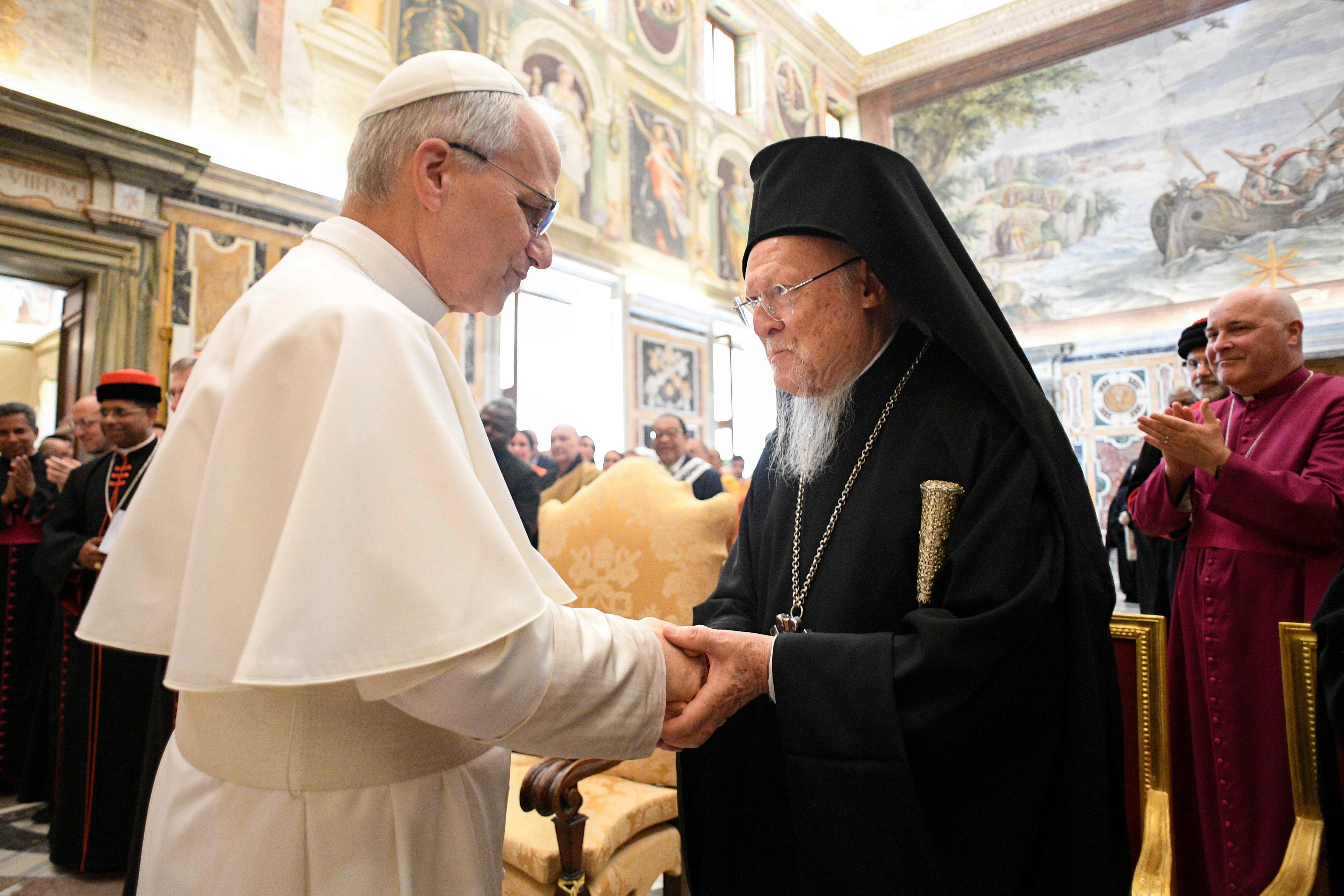
Pope Leo XIV greets Orthodox Ecumenical Patriarch Bartholomew of Constantinople during a meeting with religious leaders at the Vatican, May 19, 2025. The leaders had come to Rome for the pope's inauguration Mass. (CNS photo/Vatican Media)
A papal trip to Turkey was openly discussed by Pope Francis prior to his death to mark the 1,700th anniversary of the Council of Nicaea — the first ecumenical council in Christian history. The gathering, convened by the Roman Emperor Constantine in 325, rejected the heresy that held Jesus was a being created by God the Father and laid the groundwork for the Nicene Creed.
Leo's likely meeting with Bartholomew will be the third between the two leaders. The patriarch attended Leo's inauguration Mass in St. Peter's Square on May 18 and they met privately afterward; the two met again on May 30 and discussed the trip to Turkey.
In 2024, Pope Francis said he wanted to visit Turkey to mark the anniversary of the Council of Nicaea. After Francis' death, Bartholomew expressed his hope that he and the late pope's successor would "go together to Nicaea to send a message of unity, love, brotherhood, and shared path toward the future of Christianity."
In a meeting with a delegation of the Ecumenical Patriarchate in June, Leo affirmed his commitment to "restore full visible communion between our churches."
Advertisement
Leo in Lebanon
While no agenda for the pope's trip to Lebanon was announced, the pope is expected to meet with both government officials and faith leaders, including representatives of the country's Maronite Catholic community which forms the largest share of Lebanon's Christian population.
Christians make up an estimated 30% of Lebanon's citizens, and the country's political structure reserves key offices by religious affiliation: the presidency for a Maronite Christian, the prime minister's post for a Sunni Muslim and the speakership of parliament for a Shiite Muslim.
The Vatican had long been expected to announce the Turkey visit, but the Lebanon leg was confirmed only with the Oct. 7 statement. Lebanese President Joseph Aoun met with Leo at the Vatican in June and formally invited the pope to visit.
The dual visit reflects the unity and dialogue that have already come to define Leo's early papacy.
Pope Francis had long expressed his desire to visit Lebanon, hailing the nation as an example of religious pluralism. In August 2024 he met with the family members of victims of a 2020 blast in Beirut that killed some 200 people and injured more than 6,000 others.
Then, Francis called for "truth and justice" to be delivered on the cause of the blast, which had been stymied by the government.
The ongoing war in Gaza is likely to cast a shadow over the pope’s visit to Lebanon, which has faced repeated cross-border clashes between Israel and Hezbollah, the Iran-backed political and militant group that operates in the country. Israel invaded southern Lebanon in October 2024 in an offensive that left Hezbollah severely weakened and is estimated to have displaced more than 1 million people.
Nehmat Aoun, wife of President Joseph Aoun of Lebanon, shows Pope Leo XIV a bust of Lebanese St. Charbel during a meeting in the library of the Apostolic Palace at the Vatican June 13, 2025. (CNS photo/Vatican Media)
Papal precedent
That Leo's first trip will be to the Muslim world is significant as a sign of global outreach and casts him as a potential bridge-builder, even though it was a trip largely determined by his predecessor.
Francis last traveled to Turkey in 2014, meeting both Bartholomew and Turkish President Recep Tayyip Erdoğan. That visit built on decades of papal engagement with the region: Paul VI was the first pope to visit Turkey in 1967, John Paul II followed in 1979 and Benedict XVI made his first trip to the Muslim world there in 2006.
Then, Benedict was met with protests for comments he made at a lecture at the University of Regensburg in Bavaria just weeks before, where he quoted a 14th-century Byzantine emperor who said that the prophet Muhammad had brought about "things only evil and inhuman."
Benedict was the last pope to visit Lebanon in 2012.
Leo's journey will come amid a crowded Vatican calendar leading up to his first Advent as pope and the close of the Holy Year 2025, which has already limited opportunities for papal travel. His visit to the sites of early Christian history — and to a region still marked by war, migration and interreligious tension — could set the tone for his pontificate's global outreach.
The National Catholic Reporter's Rome Bureau is made possible in part by the generosity of Joan and Bob McGrath.