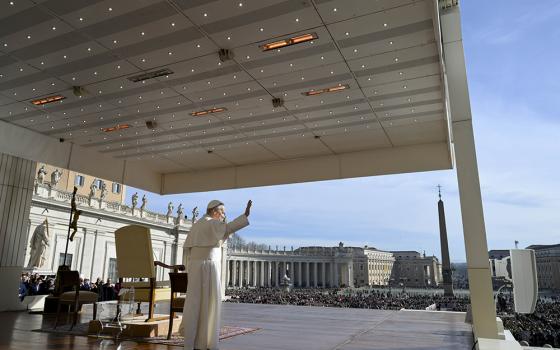
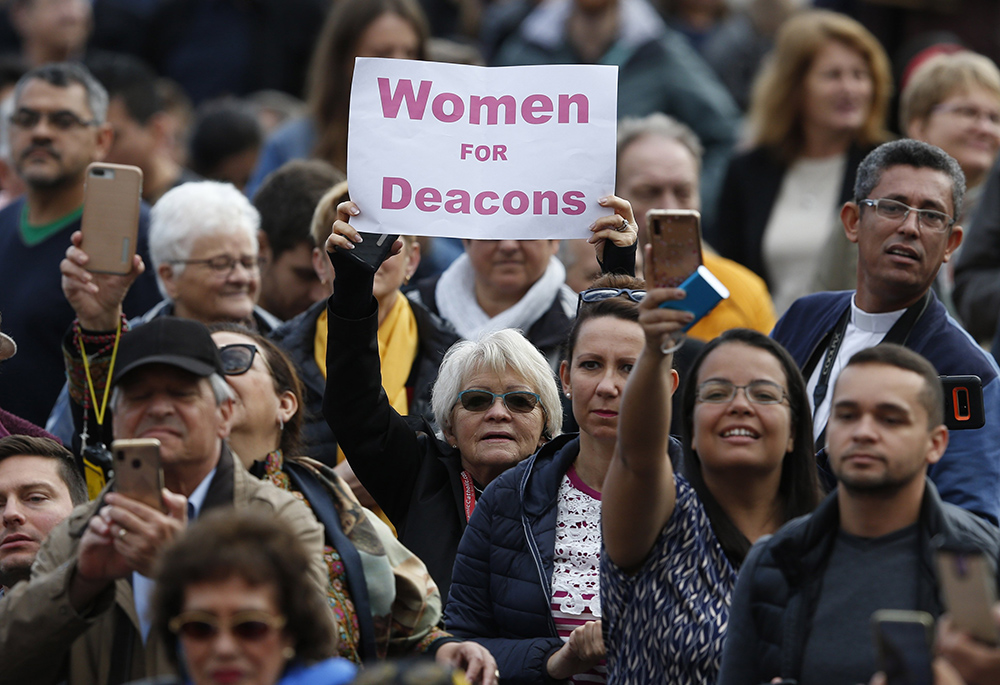
A woman holds a sign in support of women deacons as Pope Francis leads his general audience in St. Peter's Square at the Vatican Nov. 6, 2019. (CNS/Paul Haring)

A Vatican study group formerly expected to address questions surrounding the possibility of women serving as deacons in the Catholic Church will not take up the issue, according to one of several interim reports released Monday (Nov. 17) by the Vatican's synod office and a clarification from a Vatican official.
The study group, established by Pope Francis in 2023 to study ministerial forms in the church, will instead cede study of women and the diaconate to a commission dedicated to the matter that was first established in 2020 and revived in 2023.
Catholic News Agency reported that Msgr. Armando Matteo, secretary for the Dicastery for the Doctrine of the Faith who signed the study group's interim report, confirmed that it is no longer studying women and the diaconate and that contributions from the study group have been forwarded to the commission on the female diaconate for its consideration.
The synod study group is examining accounts of women in church leadership, the nature and exercise of ecclesial power and what it describes as "critical tensions regarding clericalism and male chauvinism," which will be addressed in its final report.
The group is one of 12 study groups that were established to examine some of the most sensitive issues raised at the first assembly of the synod on synodality in 2023 — a gathering of Catholics in Rome from across geography and hierarchy to discuss becoming a more listening, participatory church. The groups are examining a wide range of issues, from listening to the cries of the poor to the church's mission in the digital environment, the role of papal nuncios and developing methodologies for discerning doctrinal issues.
The synod office said the interim texts reflect a "synodal method" of work that includes expert consultation, dialogue with bishops' conferences and analysis of contributions submitted over the past year. Members of the public were also invited to send material to the synod office during parts of the process.
The study groups had originally been asked to submit their final conclusions by June 2025. After the death of Pope Francis on April 21 and the election of Pope Leo XIV on May 8, the new pope extended the deadline, requesting that the final reports be delivered "insofar as possible" by Dec. 31, 2025.
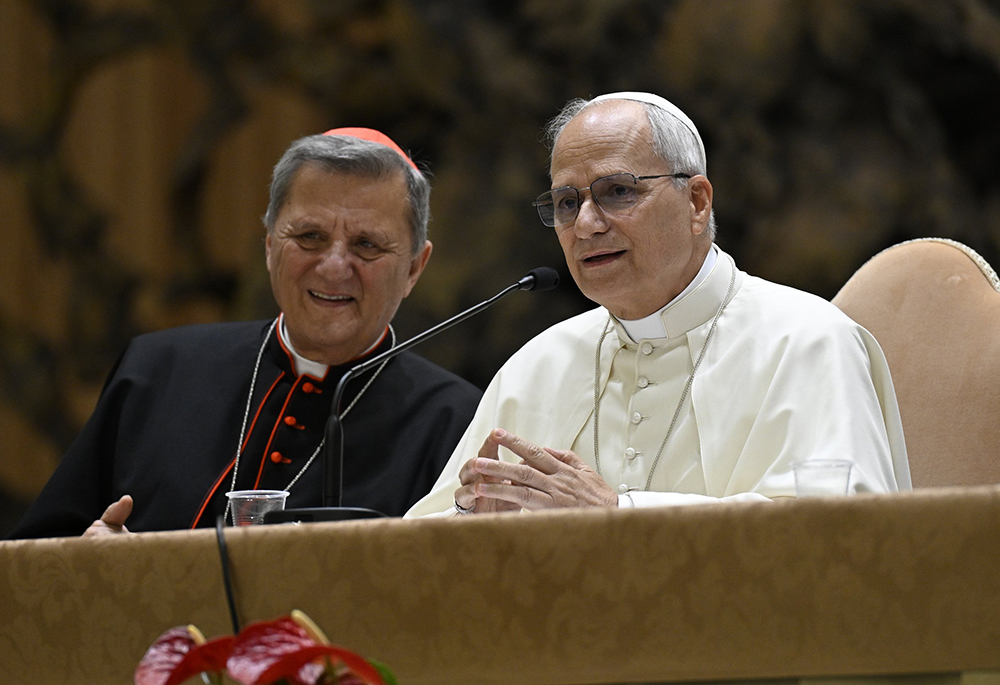
Pope Leo XIV, with Cardinal Mario Grech, secretary-general of the Synod of Bishops, listens to and answers questions from participants in the Jubilee of Synodal Teams and Participatory Bodies in the Vatican audience hall Oct. 24, 2025. (CNS/Vatican Media)
Formation of priests
The study tasked with reviewing the universal guidelines for priestly formation, said a full rewrite of the Ratio Fundamentalis Institutionis Sacerdotalis, the Vatican's 2016 global framework for seminary formation, "does not currently seem appropriate," noting that many regions are still finalizing their local Ratio Nationalis.
Yet the group highlighted calls from the synod's 2023 and 2024 assemblies to "deepen the identity of ordained ministry in relational terms" and to ensure formation is "rooted in the lived experience of the People of God with its various charisms and ministries." The study group also noted calls for "greater participation of all components of the People of God — especially women and families — in the formation of ordained ministers."
Its consultations also prompted reflection on the structure of seminaries, which the report says still "largely reflects a context where formation occurred apart from the People of God, in isolated settings and homogeneous communities."
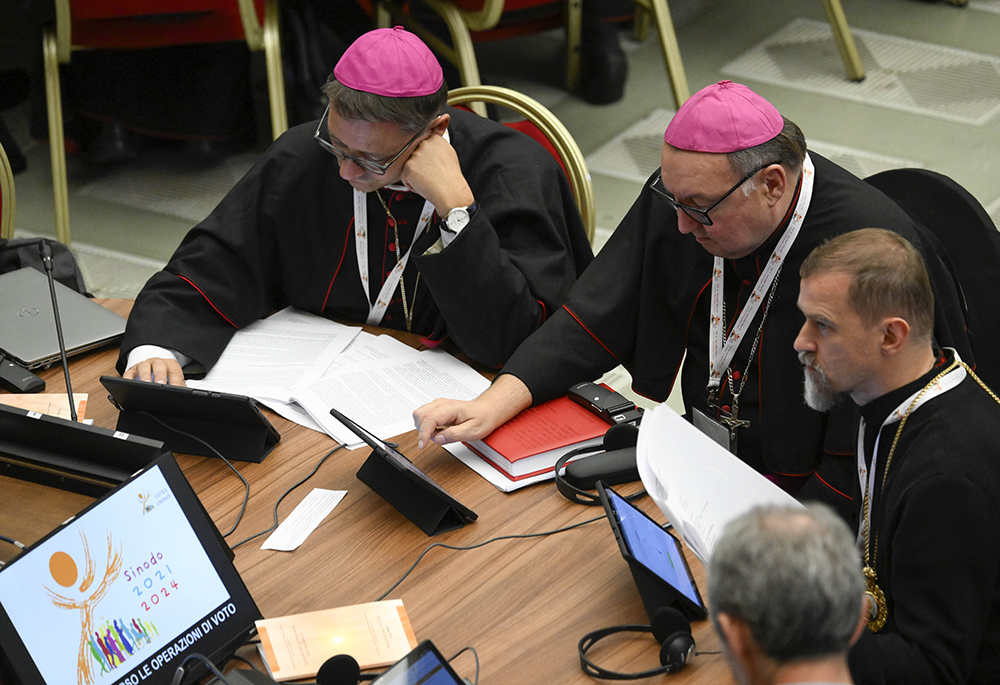
Members of the assembly of the Synod of Bishops use tablets to vote on the gathering's synthesis document Oct. 28, 2023, in the Paul VI Hall at the Vatican. (CNS/Vatican Media)
Selection of bishops
The synodal assembly explicitly called for greater participation of all Catholics in the opaque process of selecting bishops. The study group responsible for reviewing the church's practices on selecting and forming bishops said that it recognizes "the opportunity to reconsider the confidential questionnaires currently in use and to supplement them with more flexible forms of consultation of the members of the People of God."
The group stressed the need to strengthen the role of the local church as "the natural setting for discernment" when evaluating prospective episcopal candidates and said it also aims to form local church communities to better assist in selecting their bishop.
It added that among its consultations the study group sought outside expertise from an executive recruiter for international companies "with the aim of drawing useful insights from procedures employed in civil society."
Advertisement
Liturgy, African report on polygamy
In its mandate, the newly formed study group on the liturgy instituted by Leo raised questions about how the church might promote greater recognition of women within liturgical life, including "where they continue to suffer forms of discrimination" and suggested exploring how scriptural accounts of women could be highlighted in salvation history.
An interim report released by SECAM, the symposium of bishops' conferences of Africa and Madagascar, outlines the work underway by a group of experts studying the pastoral challenges surrounding polygamy. The group, which was explicitly requested by several African members of the synodal assembly, said it will focus on identifying forms of pastoral care for people in polygamous unions and developing initiatives to support Christians in embracing monogamous marriage.
Cardinal Mario Grech, head of the Vatican's synod office, said the interim texts mark the current stage of the groups' work and are intended to make the ongoing process more transparent. Several groups, he said, are nearing completion, while others will continue meeting into 2026.
The National Catholic Reporter's Rome Bureau is made possible in part by the generosity of Joan and Bob McGrath.
Editor's note: An earlier version of this article stated that the synod study group was expected to continue study of women and the diaconate, which Msgr. Armando Matteo confirmed to Catholic News Agency is not the case. The first two paragraphs have been replaced with four new paragraphs to reflect this correction.