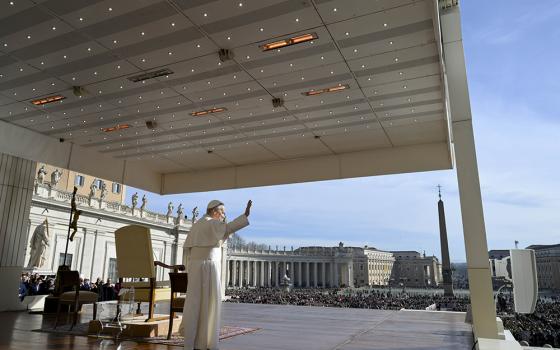
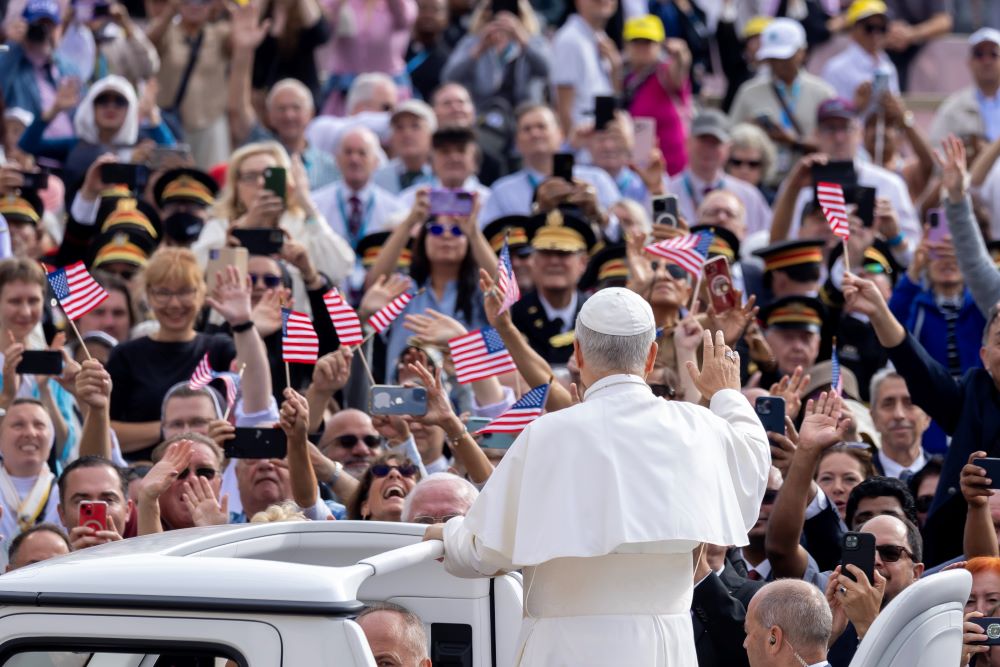
Pope Leo XIV greets visitors and pilgrims from the popemobile before his weekly general audience in St. Peter's Square at the Vatican Oct. 1. (CNS/Pablo Esparza)

Pope Leo XIV, the first American pope, addressed controversy over Chicago Cardinal Blase Cupich's decision to honor longtime Illinois Sen. Dick Durbin, again signaling his attentiveness to debates in his native country and a willingness to comment on them.
Durbin, a Democrat with a long record of supporting legalized abortion, had been slated to receive a "Lifetime Achievement Award" from the Archdiocese of Chicago in recognition for his work on immigration issues. But after backlash directed at Cupich, the senator announced Sept. 30 he would not accept the award, according to a statement from the cardinal.
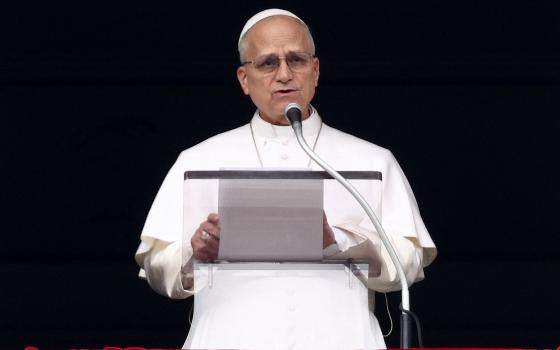
Leo was asked about the award during his now-customary Tuesday evening doorstep remarks at Castel Gandolfo, where he has repeatedly had brief exchanges with journalists as he returns to the Vatican after spending the day at the papal summer residence.
"I'm not terribly familiar with the particular case," the pope began. "I think that it's very important to look at the overall work that a senator has done during, if I'm not mistaken, 40 years of service in the United States Senate."
'Someone who says, "I'm against abortion, but I'm in favor of the inhuman treatment of immigrants in the United States," I don't know if that's pro-life.'
—Pope Leo XIV
"I understand the difficulties and the tensions," Leo added, "but I think, as I myself have spoken in the past, it's important to look at many issues that are related to what is the teaching of the church."
He continued: "Someone who says, 'I'm against abortion but I'm in favor of the death penalty,' is not really pro-life. Someone who says, 'I'm against abortion, but I'm in favor of the inhuman treatment of immigrants in the United States,' I don't know if that's pro-life."
"They're very complex issues," Leo said. "I don't know if anyone has all the truth on them, but I ask that first and foremost there be greater respect for one another, and that we search together — first as human beings, and in this case as American citizens or citizens of the state of Illinois, as well as Catholics — to really look closely at all of these ethical issues and to find the way forward as church. Church teaching on all of those issues is very clear."
Leo's comments on the controversy demonstrate a broader pattern emerging in his pontificate: The U.S.-born pope is tracking developments in American public life and is not shying away from commenting on them.
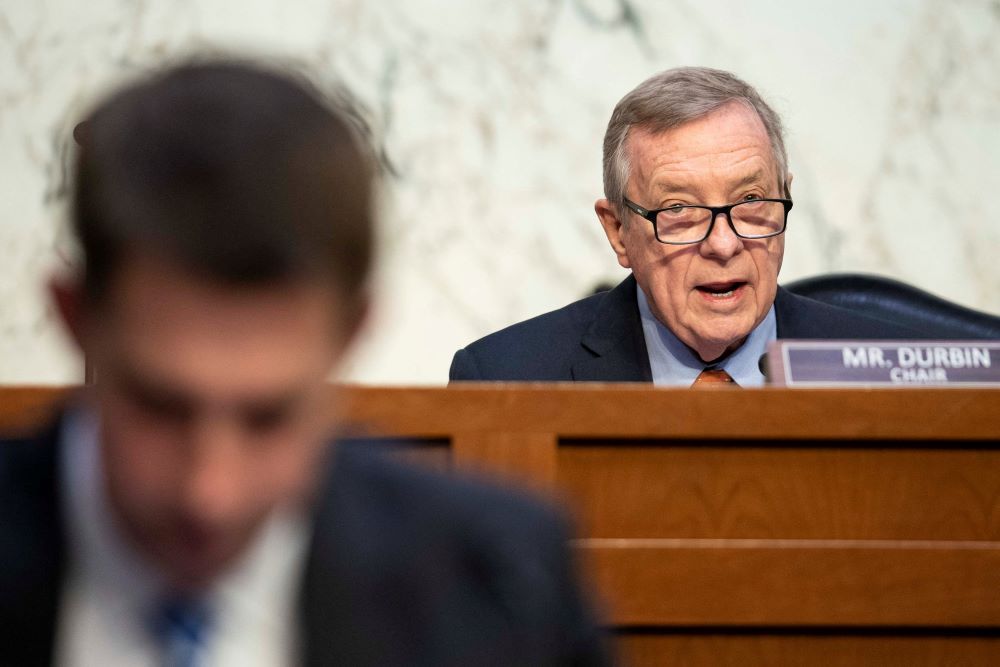
U.S. Sen. Dick Durbin, Democrat of Illinois, then chair of the Senate Judiciary Committee, speaks at a hearing on Capitol Hill in Washington March 1, 2023. (OSV News/Reuters/Sarah Silbiger)
In the same exchange with journalists on Sept. 30, Leo commented on President Donald Trump's meeting with military generals in Virginia by calling Trump's bellicose language "worrying." Unprompted, he went on to raise concern over the Trump administration's decision to rename the Department of Defense to the "Department of War."
"Let us hope it is just a way of speaking," Leo said. "Of course, you have a style of government that wants to show its strength to put on pressure. Let us hope that it works but not that there is war. One must always work for peace."
Advertisement
That Leo is able to draw on distinctly American examples when making a point positions him to be a more regular player in the American news cycle than his predecessor.
He did so, for instance, in a wide-ranging interview for his biography in Spanish, citing projections that Elon Musk could become the world's first trillionaire as an example of misplaced priorities fueling global inequality.
And in a more formal setting, after the Aug. 31 Angelus in St. Peter's Square, Leo prayed, in English, for the victims of the shooting at Annunciation Catholic School in Minneapolis: "Let us plead God to stop the pandemic of arms, large and small, which infects our world."
By referencing American headlines in his so-far limited media interactions, as well as in formal prayers, Leo has shown that his papacy will not hold the United States at arm's length. For U.S. Catholics, that means a papal voice that could surface more frequently in the public debates that shape American society.
The National Catholic Reporter's Rome Bureau is made possible in part by the generosity of Joan and Bob McGrath.