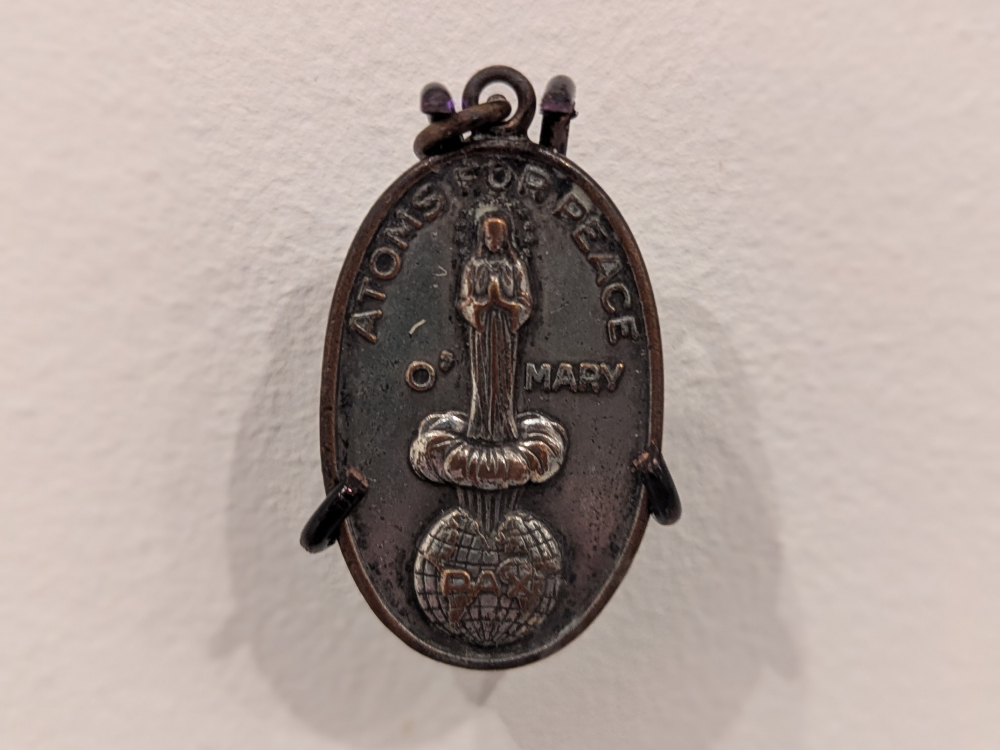
Resembling a Miraculous Medal, this pendant was most likely government propaganda aimed at American Catholics according to an explanatory sign at the "Fallout: Atoms for War & Peace" exhibit. (Mary Ann Cejka)

by Mary Ann Cejka
The greatest of destructive forces can be developed into a great boon for the benefit of all mankind.
—U.S. President Dwight D. Eisenhower, Atoms for Peace Speech, 1953
I made one great mistake in my life, when I signed a letter to President Roosevelt recommending that atom bombs be made ...
—Albert Einstein, speaking to Nobel Prize-winning chemist Linus Pauling, 1954
The above two quotations exemplify both the optimism and anxieties brewing within the United States population and the world beyond in the months and years following the U.S. government's detonation of the hydrogen bomb in 1952. Likewise, the words frame and reflect the flow of the exhibit "Fallout: Atoms for War & Peace," currently on display at the Poster House in New York City's Chelsea neighborhood until Sept. 7.
President Dwight Eisenhower was inaugurated just a few months after that hydrogen bomb test; the first-in-the-world detonation of a thermonuclear weapon, carried out in an operation cheerfully dubbed "Ivy Mike." As a former general and Supreme Commander of the Allied Expeditionary Force in Europe during World War II, Eisenhower was well versed in the destructive powers, direct and indirect, of modern weaponry. The end of his first year in office found him at the United Nations, promoting a plan to "adapt [atomic energy] to the arts of peace."
The idea would be for nations to eschew any endeavor to obtain atomic weaponry in exchange for receiving aid from the U.S. in the development of reliable and cost-effective nuclear power. It soon became clear within both government circles and the corporate world that, in addition to humanitarian implementations, a good deal of profit stood to be made from the diverse applicability of emerging nuclear technologies.
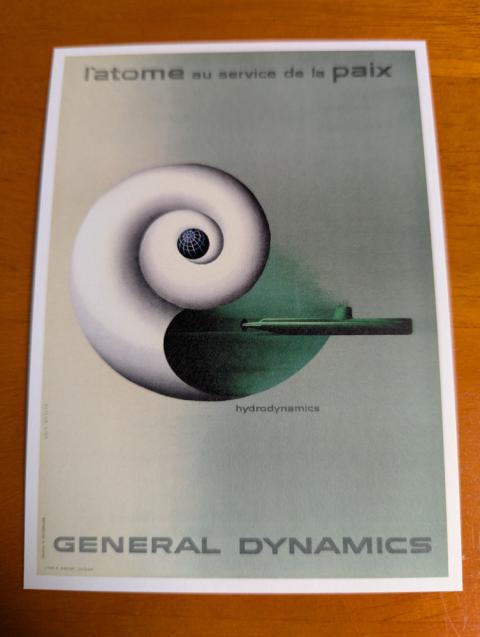
Erik Nitsche's rendition of the first nuclear submarine, Nautilus, emerging from a nautilus shell — ironically, as part of General Dynamics' "Atoms for Peace" poster series. Nitsche wasn't privy to the appearance of an actual nuclear submarine, so this sleek version was entirely his conjecture. (Mary Ann Cejka)
A major, interested collaborator in what became the "Atoms for Peace" program was General Dynamics, a global aerospace and armaments producer, which employed Swiss designer Erik Nitsche as its art director. His poster creations drew upon visual innovations in modern art, elegantly showcasing his company's contributions to the program in such fields as agriculture, medicine, outer space and deep sea exploration, communications and energy infrastructure — and were regarded as revolutionary works of industrial graphic design. As such, they were compelling conveyors of the "Atoms for Peace" message.
Even Disney (then known as Walt Disney Productions) got in on the act, creating children's programming promoting the "Atoms for Peace" vision and agenda. General Dynamics was an episodic sponsor of one such program, and also of an accompanying illustrated book, Our Friend the Atom. While the "Fallout" exhibit is largely composed of posters, this book is also on display.
But the most remarkable non-poster item in the exhibit is a circa 1960 pendant designed to resemble the Miraculous Medal — at the time, a ubiquitous Catholic devotional accoutrement. The Atoms for Peace pendant depicts the Virgin Mary atop a mushroom cloud spouting upwards from a globe emblazoned with the Latin word Pax ("Peace").
An explanatory sign posted next to the medal offers context: "This pendant features an unusual combination of iconography, and is most likely a work of American propaganda in favor of a presidential policy. It would not have been authorized by the Vatican…"
Advertisement
Catholics at the time were eager to be regarded as part of the American mainstream and accepted into the middle class by asserting their anti-communist bona fides. At that point, they comprised a substantial 25% of the U.S. population and would have been eyed as a valuable and potentially malleable audience for such a manufactured faith/patriotism conflationary spin.
All of these efforts took place against the somber backdrop of the Cold War, a period of geopolitical competition between two superpowers and their respective allies. By the late 1950s, Americans were being encouraged to build fallout shelters on their properties to shield their families in the event of a nuclear attack. Government-sponsored posters urged citizens to take protective action by calling their local civil defense offices, which would supposedly guide them in how to prepare for such circumstances. In New York City, members of the Catholic Worker movement, led by Dorothy Day, refused to participate in compulsory air raid drills; their resistance to these civil defense exercises, part of a strategy called "Operation Alert," was in protest of nuclear weapons and the futility of government messaging that a nuclear attack would be conceivably survivable.
As the Cold War intensified during the 1980s following the 1979 Soviet invasion of Afghanistan, so did the nuclear arms race. Anti-nuclear activism was fueled by a sense of betrayal at the promotion of neutron bombs — built to do more damage to living beings than to structures or property — by U.S. President Jimmy Carter, who had, ironically, been voted into office in part for his advocacy of a peaceful foreign policy anchored in human rights.
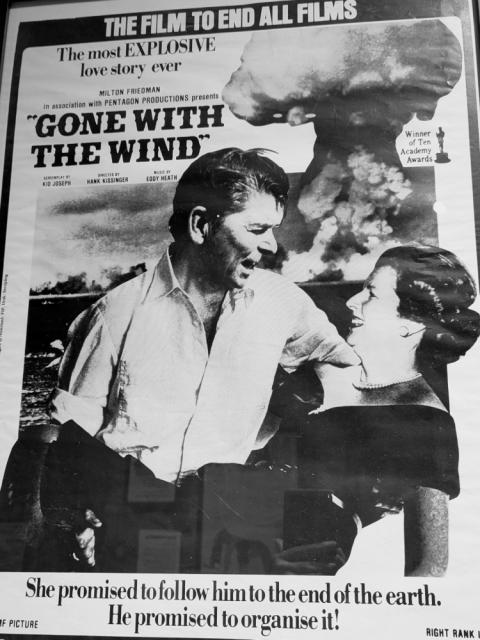
In this 1985 poster, then U.S. President Ronald Reagan and British Prime Minister Margaret Thatcher are satirically depicted as Rhett Butler and Scarlett O'Hara of "Gone with the Wind," parodying their close strategic partnership during the Cold War. (Mary Ann Cejka)
Ronald Reagan's presidency further heightened tensions with a more confrontational stance toward the Soviet Union and escalated military buildup. Accidents at nuclear plants — from the 1952 meltdown of a reactor at the Chalk River Laboratories in Ontario, Canada, to an exploded reactor at Chernobyl in the Ukraine (then part of the Soviet Union) in 1986 — stoked public anxieties about the risks involved in the production of nuclear power, even for peaceful purposes.
Poster artists responded to all of these developments with the most persuasive weapons in their creative arsenals: comic humor, as in cows ruminating on the 1979 Three Mile Island nuclear accident, satire, such as a rakish Ronald Reagan ravishing a happily compliant Margaret Thatcher in a parody of a "Gone with the Wind" movie poster, and horror, like a skeleton poring over a nuclear attack survival booklet.
In this digital age, posters are less prevalent as instruments of influence than they once were. But the posters of the past are windows into history — and often, uncanny oracles of the present. Jon Wolfsthal of the Federation of American Scientists recently stated on National Public Radio that nuclear weapons are "more central, more relevant, and (many people consider them) more usable now than any time in fifty years."
As the world marks the 80th anniversary of the U.S. atomic bombings of Hiroshima and Nagasaki, the posters of the Fallout exhibit help us gain insight into the complexities of human motivation, denial and aspiration as they pertain to the uses — and abuses — of nuclear technology.