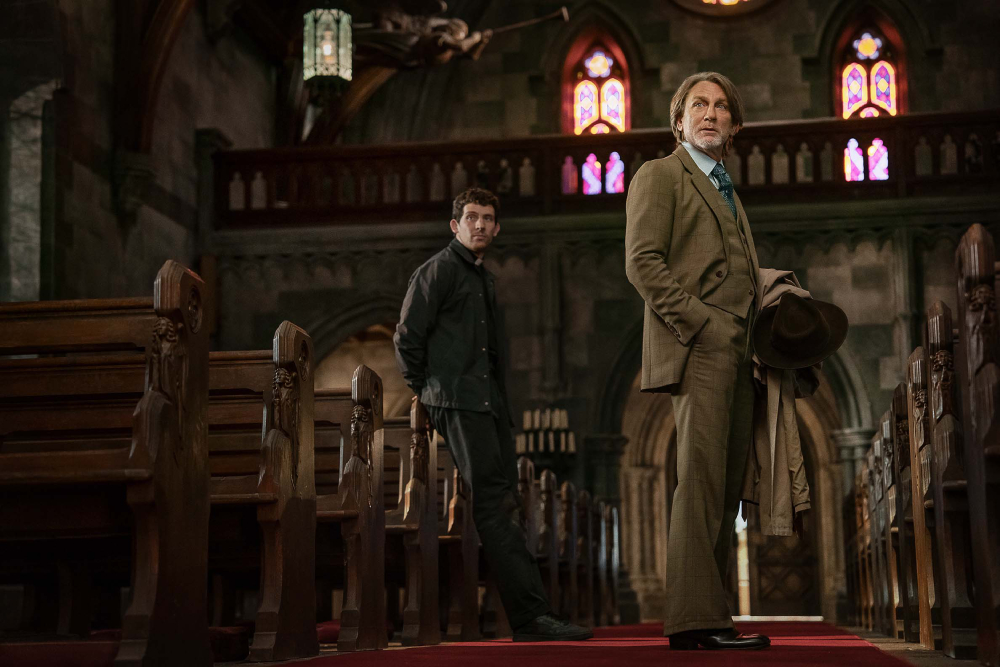
"Wake Up Dead Man" gives us two opposing Catholic visions of how to engage with the world. The two priests' competing stories about the church and whether we relate to God through fear or through love are as central to this film as the murder that brings Blanc to the parish in the first place. (Netflix)

by Michael O'Connell
Catholic priests are having a cinematic moment. One would need to go back to the end of World War II, when Bing Crosby starred as Father O'Malley in "Going My Way" (1944) and "The Bells of St. Mary's" (1945), to find successive years with a priest as the protagonist of popular, critically acclaimed movies. But 2024 gave us "Conclave," and this year we have Josh O'Connor as Fr. Jud Duplenticy in "Wake Up Dead Man", the third film in Rian Johnson's ongoing "Knives Out" series.
Like "Going My Way," "Wake Up Dead Man: A Knives Out Mystery" pits an idealistic younger priest (O'Connor) against an aging, set-in-his ways pastor. In the mid-century movie, the pastor is a cantankerous traditionalist who, after a few heartfelt songs from Crosby, is willing to modernize. But in Johnson's movie, the intra-church divide is much starker. Here, at the pointedly named Our Lady of Perpetual Fortitude, O'Connor's progressive Fr. Jud is juxtaposed against the inflexible Monsignor Jefferson Wicks (played by a domineering, and at times downright frightening, Josh Brolin), who delights in alienating newcomers to the parish, humiliating Fr. Jud and preaching fire-and-brimstone, us-against-the-world sermons. While most people are driven away by his abrasiveness, Wicks rules over a small gaggle of loyal parishioners.
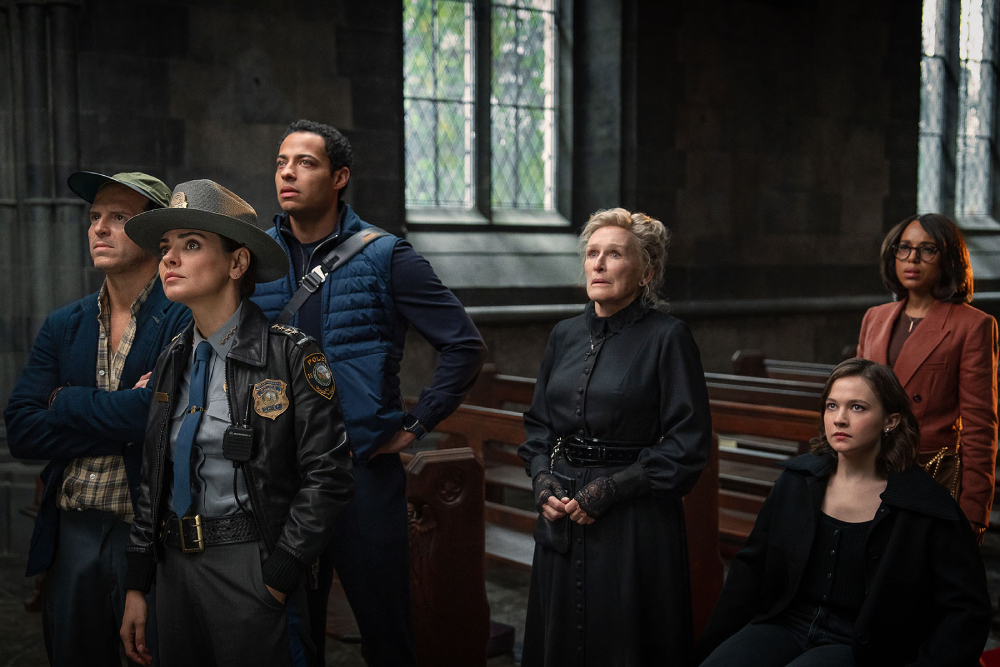
As in the two "Knives Out" films before it, "Wake Up Dead Man" boasts another impressive ensemble assembled by director Rian Johnson. (Netflix)
Johnson has assembled another impressive ensemble, the standout being Glenn Close in the role of Wicks' devoted assistant who keeps the parish running. Other supporting roles are played by Thomas Haden Church as the groundskeeper; Jeremy Renner as a local doctor whose wife has left him; Kerry Washington as Wicks' lawyer; Daryl McCormack as an aspiring right-wing media empire builder; Cailee Spaeny as a former concert cellist desperate for Wicks's prayers to heal her chronic pain; and Andrew Scott as a former bestselling novelist turned conspiracy theorist. (Casting Scott, whose "hot priest" character in "Fleabag" is one of the most compelling television depictions of a Catholic priest, in this movie about another hot priest, doesn't feel coincidental.) Mila Kunis as the police chief and Jeffrey Wright as the local bishop round out the main cast. All are excellent, though most have too little to do. The focus of the movie is on the two priests and, eventually, Daniel Craig's detective Benoit Blanc. Craig is, once again, excellent in the role — funny, clever and entirely captivating on the screen.
If Bing Crosby's sentimental films were about how the church can be an effective force for good by uniting youthful idealism with traditional values, "Wake Up Dead Man" gives us two opposing Catholic visions of how to engage with the world. Wicks is hostile to modernity, proclaiming "The world wants to destroy us!" Jud believes in the mercy and redemptive love of God. Their competing stories about the church and whether we relate to God through fear or through love are as central to this film as the murder that brings Blanc to the parish in the first place.
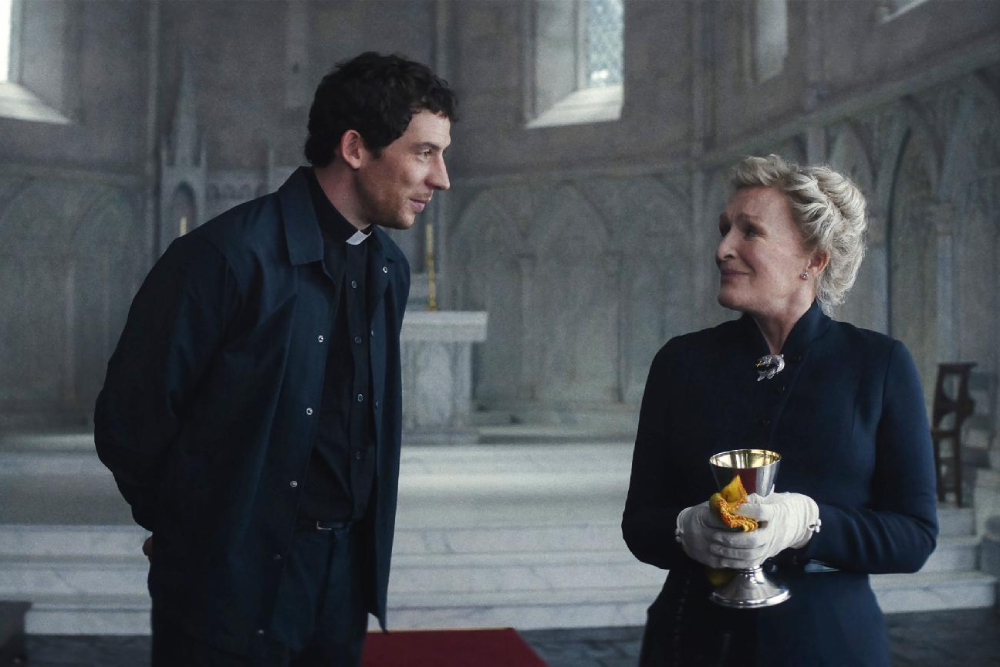
Josh O'Connor and Glenn Close star in a scene from the movie "Wake Up Dead Man: A Knives Out Mystery." (OSV News/Netflix)
This murder mystery (of the locked room, "impossible crime" sort) is deftly handled: Johnson parses out enough clues to keep the audience guessing and provides a few marvelous twists. But the reason the film works so well and is so satisfying is that Johnson is clearly as interested in interrogating questions of faith as he is in crafting a compelling mystery.
At their initial meeting, Jud asks Blanc how being in the physical space of the church makes him feel; Blanc delivers an eloquent monologue on his distrust for the type of story the church tells. Jud responds that the church is always telling a story — that at times we need to show, through the architecture and the decor, in order to tell; and that we need to tell stories in order to get at the ineffable nature of faith and grace.
Later in the movie, while in the midst of trying to track down important evidence that might exonerate him, Jud ends up talking to a receptionist who asks Jud to pray for her. He stops pursuing the mystery and responds to her as a priest should; he is fully present, asking her questions that draw her out, that allow her to feel heard and not alone. The scene isn't necessary for the arc of the mystery, but it is central to the movie's moral vision. It is Johnson showing us how grace works.
Advertisement
There is a long tradition of Catholic mysteries (at one point Blanc calls Jud "Father Brown," an allusion to Chesterton's priest detective) because the arc of these stories, which ultimately find meaning and clarity amidst chaos, and bring justice to sinful disorder, fits with the Catholic view of the cosmos. Mysteries often build to a confessional moment, where all things become clear. "Wake Up Dead Man" culminates in a sacramental confession, where absolution and grace are present. The epilogue shows us that sin persists as well, but the church itself, now renamed Our Lady of Perpetual Grace, indicates that Jud's story of the faith is the one that prevails.
"Knives Out: Wake Up Dead Man" is now on Netflix.