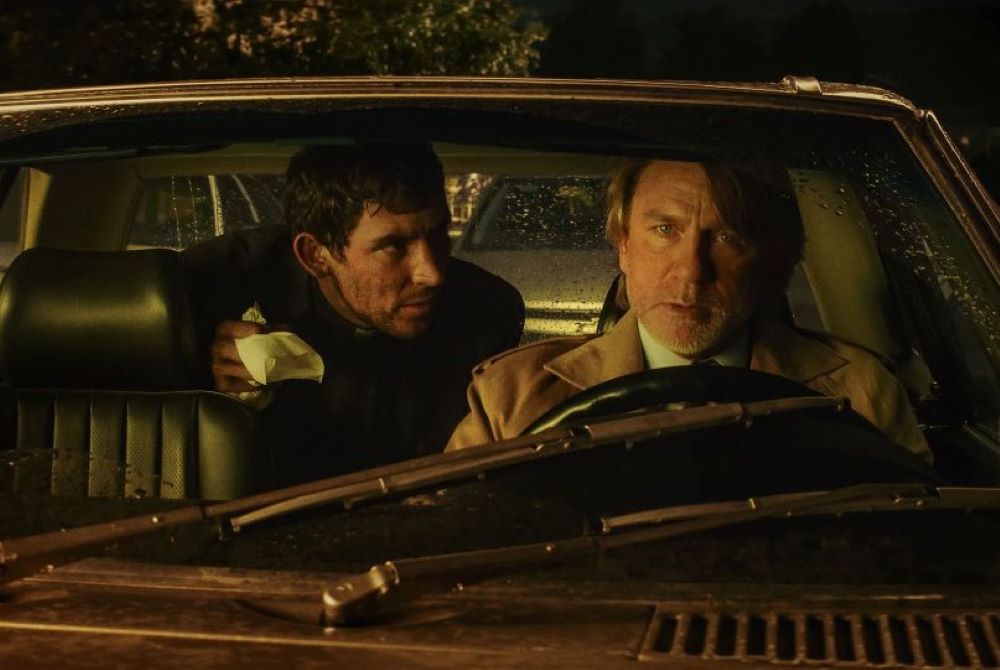
The characters Fr. Jud Duplencity (Josh O'Connor) and Benoit Blanc (Daniel Craig) "are very much on opposite sides of the [faith] fence, but they've learned from each other," says Rian Johnson, writer and director of "Wake Up Dead Man: A Knives Out Mystery." (Netflix)

by Zachary Lee
You won't see a better portrait of a clergy person striving to embody Jesus' selfless love than in Rian Johnson's "Wake Up Dead Man," the third in his "Knives Out" whodunit series.
The film follows Fr. Jud Duplenticy (Josh O'Connor), a priest assigned to a small-town parish led by Msgr. Jefferson Wicks (Josh Brolin). Once there, Jud realizes that Wicks is radicalizing his congregation, making them fear the corrupting influence of the world. Things reach a fever pitch; soon after, Wicks is murdered, with Jud a prime suspect. Private investigator Benoit Blanc (Daniel Craig) must solve the mystery of Wicks' murder, and the investigation forces both men to confront not just the sins of the congregants around them, but their own demons and faith crises.
Johnson, writer and director, spoke with the National Catholic Reporter over Zoom about how his uncle's Catholic faith influenced the film's most powerful scene, and how he views his own Christian background with grace.
This conversation has been edited and condensed for length and clarity.
NCR: We get a little more of Benoit Blanc's backstory here to build on the previous two movies, specifically when it comes to his relationship with his mother, who's revealed to be a person of faith. How do you decide how much of Blanc's backstory to reveal or withhold?
Johnson: Those pieces of backstory are always revealed in a way that will serve the specific story I'm telling. The whole stake of the movie is about his relationship with Jud and how that weaves through the film. It's implied that his mother is very Christian, maybe a kind of hardline fundamentalist, and the fact that from "Glass Onion," we know that Blanc is gay, you can assume there was some kind of conflict there. As an adult, we see that Blanc is very angry and cynical about the church; that makes for a foil for someone like Jud. It's never interesting to just have a big flashback to learn about the character. It's only interesting insofar as it informs the story that you're telling at that moment.
In the scene where Wicks and Jud are sparring, Wicks taunts, "Are you gonna get angry?" He views himself as a soldier fighting a battle for God, and he reminded me of how the church often employs the language of war and battle. Was this kind of vernacular in your mind as you created scenes like this one?
[Wicks is] a distillation of a cloud of things that I experienced growing up in an evangelical household. I would say Jud, in contrast, is an example of all the positive things I heard growing up in church services and represents the beauty of Christ's love. I thought it would be interesting to pit those two against each other.
You summed it up very well; The language that's used is that of warfare. It's against "them," it's building walls, we're under attack, we are persecuted, we have to fight back and defend ourselves. That's something that I absolutely grew up feeling, and the tension between those two poles extends obviously to our present moment. It's found in the church, but it extends beyond that.
A big part of what's wrong with the world in general right now is people convincing themselves they're under siege. If you convince yourself you're under siege, you'll start doing some pretty terrible things.
There's that great moment where Cy Draven (played by Daryl McCormack) shares that he thinks he's persecuted like the Rebel Alliance in "Star Wars," when in fact, he's very much the Empire.
(Laughs) Everybody thinks they're the Rebels, man. Trust me. Part of the therapy for making this movie was to reckon with the ways it's so easy for us to get caught up in that "us vs. them" game. There's that scene in the middle of this movie where Jud has been caught up in this gamified conflict, where he thinks it's him and Blanc against this group of suspects, and they're going to get to the bottom of who the guilty person is. At that point, I think the audience would be caught up in that mindset just like Jud. But that's why he has that hard reset moment in the middle of the film where he talks with Louise. He has that revelation of "Hold on a second … that us vs. them game is the opposite of what I'm here to do."
That scene came out of research and conversations I had with my uncle, who is Catholic. I'm very close to him, and he lives in Denver, and he invited me out. I sat down and had a great dinner with his priest, Father Scott, and Father Scott invited five young Denver-based priests. It was a big "Ask Me Anything" session where I asked them about what their lives were like.
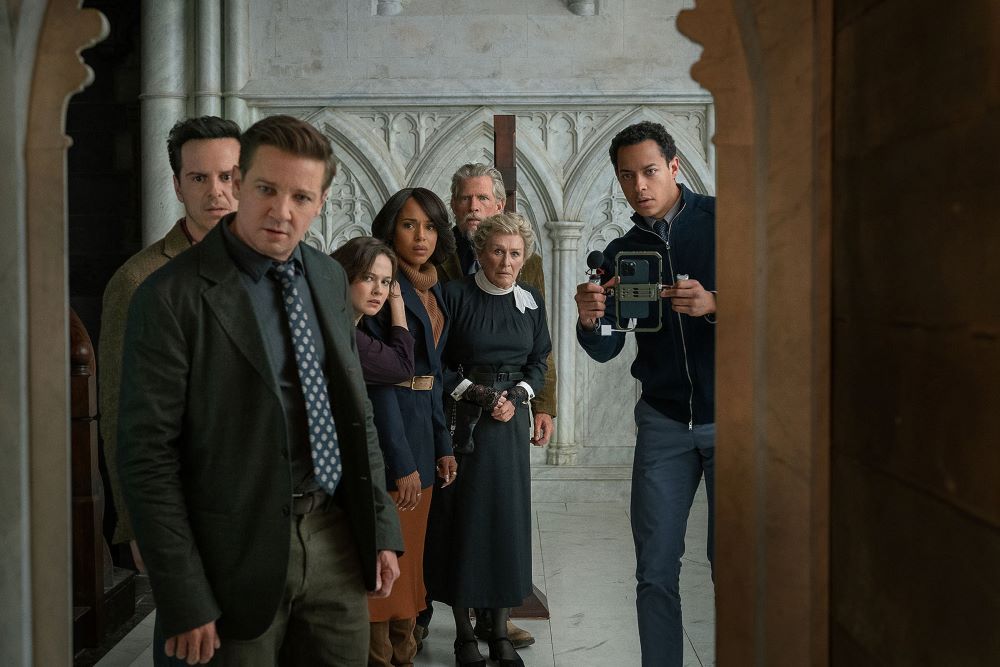
The supporting cast of "Wake Up Dead Man" includes Jeremy Renner, Andrew Scott, Cailee Spaeny, Kerry Washington, Glenn Close, Thomas Haden Church and Daryl McCormack. The movie is playing in theaters and on Netflix. (Netflix)
One of the things that came out of that was this notion that priests always have to be present in a way for human service. The priests would tell me stories about how they'd go to the grocery store in the middle of the day, and because they're wearing their clerical collar, they'd be trying to get some grapefruit and someone would come up to them sobbing, asking them to pray for their sick family member. Conversely, sometimes people would go up to them and start screaming at them out of anger, perhaps due to church hurt. Hearing those stories directly influenced the scene, with Jud pausing the case to pray. I just felt like "My God, that's the place we all should be." But it’s hard to be "on" all the time.
A detail I loved about that scene was how you showed the passage of time. By the time Jud wraps up his prayer, it's nighttime. It could have been a quick call, but it's implied he took the time to really listen to Louise's struggles.
Exactly. I didn't script any more to that prayer, because for me, the importance of that scene is when the change happens. Right at the moment where, as an audience, you're thinking, "Come on! Let's get the mystery going!" The film then has this hard stop of the emotional truth hitting. I wanted to give it time so that it felt like an actual stop, in a way that it shouldn't feel when you're halfway through a murder mystery. It is a crashing halt, but hopefully it's seen as having an emotionally resonant purpose.
That moment dovetails beautifully with the end, where we expect Blanc to have this ostentatious moment of revelation, but instead it's a quiet and meek moment of confession.
For me, Jud pausing for prayer goes right back to that moment you're talking about because it shows Blanc showing that he's learned from Father Jud. It would have felt dishonest for him to have a conversion at the end or to accept God. Jud and Blanc are very much on opposite sides of the fence, but they've learned from each other. I think one of the most Christian acts in the movie is that Blanc gives up what's most important to him. The purpose of a detective in a murder mystery is to have this moment at the end where he exposes the murderer. He learns to forsake that and extend grace for his enemy, who, by all accounts, deserves it the least.
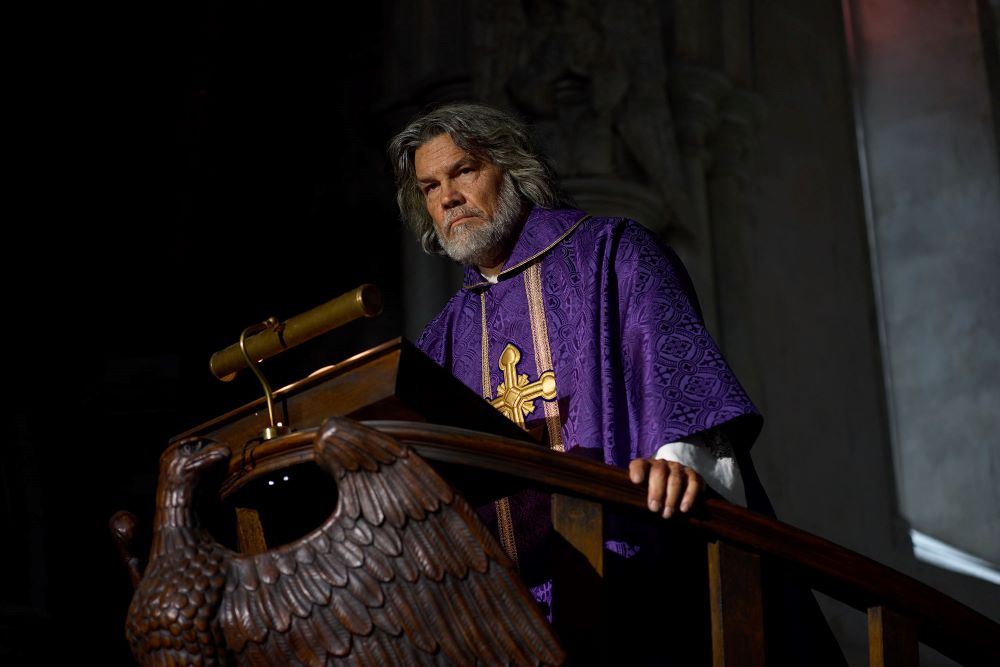
In Rian Johnson's "Wake Up Dead Man: A Knives Out Mystery," Josh Brolin plays Msgr. Jefferson Wicks, who leads a small-town parish whose congregation he is radicalizing to the far right. (Netflix)
Another aspect I appreciated about your film was how you showed how difficult it is to forgive. We can be on our deathbeds and still cling to bitterness. I know you've said you wouldn't call yourself a Christian now, but how do you look back on your 20s? Are you able to view it with a manner of grace or give gratitude for how it formed you, even if you don't ascribe to that worldview?
I'll tell you, making this film was therapeutic just for those reasons you described. When I first started writing Father Judd, it wasn't clicking. I realized it was because I was writing him from my perspective in the present moment as a nonbeliever. Like a method actor, I had to really get myself back into the shoes of when I was a believer in that earlier part of my life because I had to see things through Father Jud's eyes. That was incredibly powerful.
Only good can come out of loving and forgiving your enemy. Whenever I'm scrolling on social media, I get pissed and angry, and the last thing I want to do is extend grace and forgiveness in those moments. Yet it's the thing that I most need to do, and it's the thing that the world needs more of, especially right now.
Would past Rian have described himself, as Jud says about himself, as "young, dumb, and full of Christ?"
One hundred percent. Jud is just bright-eyed and bushy-tailed. There's that great line in the song "You and Me (But Mostly Me)" from "The Book of Mormon" where Elder Price says, "Now that I'm 19 / I'll do something incredible / That blows God's freaking mind." (Laughs) I think it's a wonderful thing to have that kind of idealism. It's also the beginning of a road, and that road is going to bring you through the fire, and it's going to lead you to a place that is maybe a little more realistic but tested at the other end.
Advertisement
Does your next project contain elements of, or sit in conversation with, what you're leaving behind in this film?
One of the reasons I feel lucky to be able to do the thing I'm doing is that for each movie I've done — and I'd say this one especially — is like a growth machine. You learn and grow so much through the process of making. What I had to do with this film was reconnect with a part of my life and channel it into a character like Jud, [and] you don't do something like that, put it in a box under the bed, and move on to the next thing. You carry that with you into the next project, and that also informs what the next thing is going to be about because you come out the other end of filmmaking a changed person every time. I think that applies to making movies, that applies to any big thing that we do in our lives. You're constantly growing, and the point is to just keep doing that for as long as you can.
What does peace look like for you now?
Making movies is the thing I live my life through, but I would say the answer more and more — especially as I get older — is that people and my relationships with people give me life. That's the only thing there is; that's what it's all about for me. I embrace the complexity of it; the depth of relationships, the ways fights can make relationships stronger … that's where more and more I'm looking to in my life to truly satisfy. Everything else can offer wonderful moments and give you insights and lead you down paths that make you grow, but the reality is that your relationships in life are the true things you're going to be left with.
"Wake Up Dead Man" is playing in theaters and on Netflix.