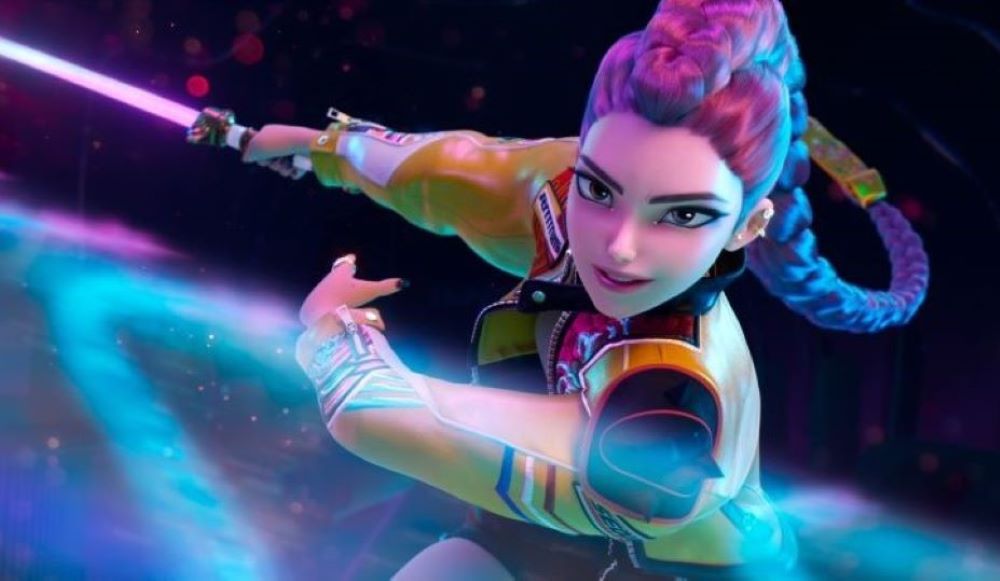
In "KPop Demon Hunters," Rumi is the leader and main vocalist of Huntr/x, a K-pop girl group that also operates as a trio of demon hunters. (Netflix)

An Anglican school in England recently banned students from singing songs from the hit Netflix animated movie "KPop Demon Hunters."
Lilliput Church of England Infant School in Poole, Dorset, notified parents that the songs' references to demons were "deeply uncomfortable" for some members of the school community. According to the BBC, the school was concerned that the song lyrics do not align with "Christian ethos." Further, the school urged parents that their children were "not to sing these songs at school out of respect for those who find the themes at odds with their faith."
In response, some parents voiced their children's admiration for the film and the positive themes it promotes.
Directed by Maggie Kang and Chris Appelhans, "KPop Demon Hunters" is rich with religious themes. The film follows the story of Huntr/x, a wildly popular K-pop girl group with the supernatural mission of defeating the presence of evil in the world. They sing songs and slay demons, all the while strengthening the Honmoon, an invisible barrier that stops demons from entering the human world.
The mere mention of demons isn't egregious. What's harmful is the lingering presence of shame that silences people before they get to discover their own voice.
The group protects their fans from the influence of Gwi-Ma, the ruler of the demon world. Gwi-Ma is the embodiment of evil, ensnaring people by pointing out their insecurities and feeding on their souls.
When a group of demons form a rival boy band called the Saja Boys, they sing about the control that demons have over people's lives, manipulating and shaming their fans.
"I'm thе only one who'll love your sins / Feel the way my voicе gets underneath your skin," they sing in "Your Idol."
Despite their role as demon hunters, the members of Huntr/x all strive for perfection in one way or another and all fall short. But with each song Huntr/x sings, Gwi-Ma loses a bit more of his power.
"I'm done hiding, now I'm shining like I'm born to be / Oh, our time, no fears, no lies / That's who we're born to be," Huntr/x sings in their hit song "Golden."
The film's release marked a cultural moment. It was an instant hit, skyrocketing to the most-watched Netflix movie of all time. The success of the film led to brand collaborations, in-person singalongs and dance parties. The songs remained at the top of global charts for weeks; the single "Golden" was recently nominated for a Grammy award in the "Song of the Year" category. (The film also received nominations for "Best Pop Duo/Group Performance" and "Best Song Written for Visual Media.")
Beyond charming characters and chart-topping songs, there's a reason this film won the hearts of so many people. Music, community and vulnerability operate as channels for being freed from our internal and external demons. "KPop Demon Hunters" offers viewers, especially children, an accessible way to work through insecurity and shame and find a path to the Divine.
"This is a battle for hearts and minds," Rumi, the leader of Huntr/x, says in the film.
In response to the backlash of their initial request, Lloyd Allington, the school's head teacher, said, "We are not asking parents to tell their children that there is anything wrong with enjoying the film or its songs if it aligns with your own views and beliefs." Instead Allington says the school seeks to foster a space that’s "mindful of diversity of beliefs."
Advertisement
The school understands the influence of music, but they get the rest of it wrong. The mere mention of demons isn't egregious. What's harmful is the lingering presence of shame that silences people before they get to discover their own voice.
"We're shattering the silence, we're rising, defiant / Shouting in the quiet, 'You're not alone'," Huntr/x sings in "This is What it Sounds Like."
Darkness works best when it isolates us and causes us to sit in our shame. Instead, we can look for harmony, community and light in the midst of our brokenness.
As the final lines of the film sing out: "Our voices all combined / When darkness meets the light, this is what it sounds like."