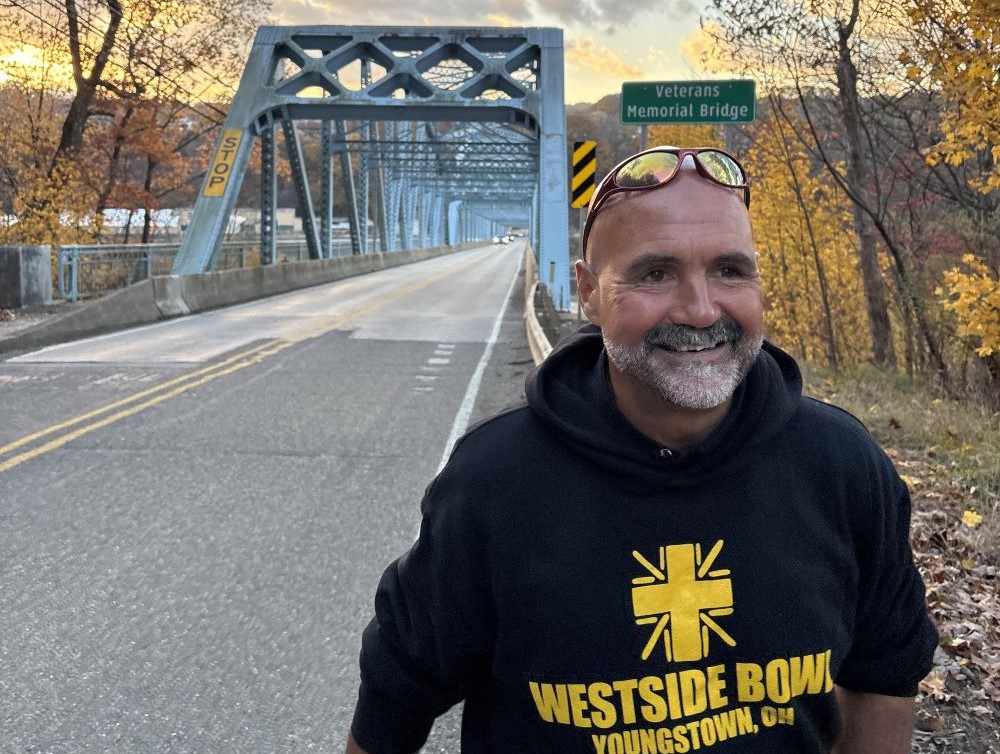
Fr. Gary Graf walks in Pennsylvania on Nov. 3 during his two-month, 900-mile pilgrimage to draw attention to the trauma deportations are causing immigrant families. The Chicago priest began the walk Oct. 6 at Pope Leo XIV's boyhood home in suburban Chicago and concluded on Dec. 2 in New York Harbor. (Courtesy of Lauren Foley)

After more than two months on the road, Chicago priest Fr. Gary Graf completed a 1.65-million-step walk from Dolton, Illinois, to the Statue of Liberty — a march meant to draw national attention to ongoing deportations and the trauma immigrant families are facing.
The 900-mile journey, Step Up Speak Out, began on Oct. 6, at Pope Leo XIV's boyhood home in suburban Chicago and concluded on Dec. 2 in New York Harbor.
Despite injuries, long stretches of rural isolation and a fall from a horse that fractured two ribs, Graf, 67, said he reached the end of the route in unexpectedly good condition.
"The walk itself just gave me lots of time to pray, to be with the Lord that I don't always take advantage of. It was very, very enlightening and very good," he told the National Catholic Reporter during a rare break in the South Bronx, on Dec. 1.
Graf, the pastor of the mostly Hispanic Our Lady of the Heights Catholic Church in Chicago Heights and a longtime member of the archdiocesan group Priests for Justice for Immigrants, said the idea for the walk arose out of frustration and helplessness as he watched parishioners' families endure sudden detentions and deportations.
"I just felt so helpless," Graf said. "I just felt impotent and that I didn't know what to do. My parishioners, I just saw their pain."
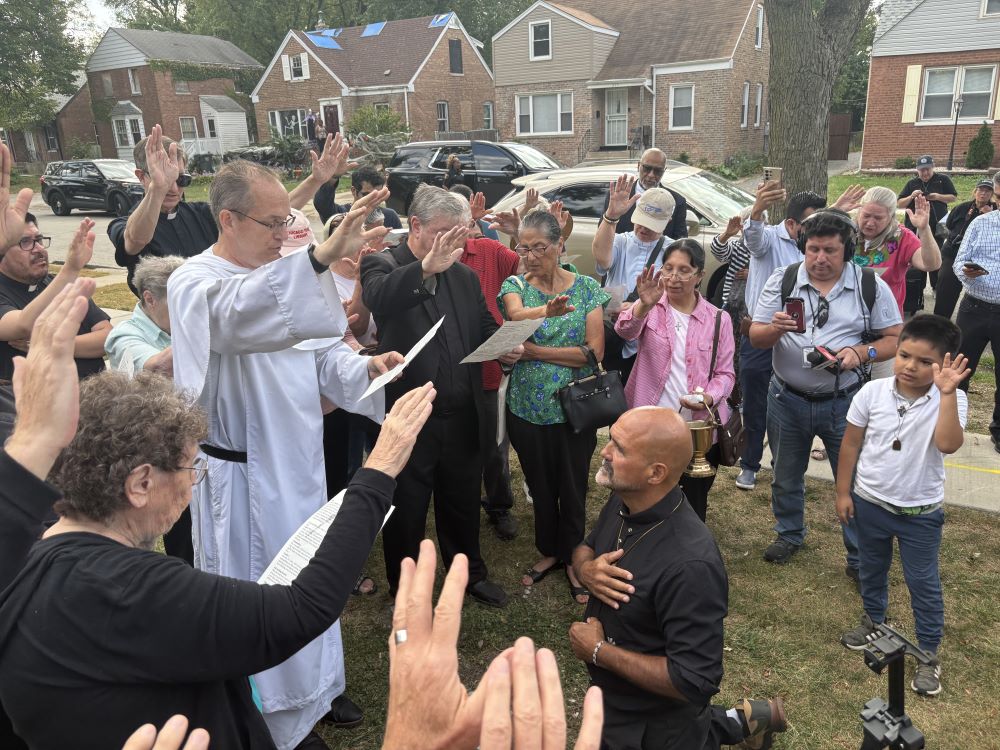
Fr. Gary Graf is blessed by a crowd of Catholic activists, supporters and friends outside Pope Leo XIV's childhood home in Dolton, Illinois, on the first day of his two-month walk, Oct. 6. (Courtesy of Lauren Foley)
One story, shared by children in his parish, stayed with Graf throughout the walk: an 8-year-old boy's poem reflecting fear of immigration enforcement.
"He said, 'If you're Brown/you're going down/ICE is coming/whether you're naughty or nice,' and the pain that an 8-year old must have felt. And I thought, 'What are we producing in our children?' "
Graf has ministered at Our Lady of the Heights for four years. In August 2018, as pastor at San José Luis Sánchez del Río Parish in Chicago, he was removed from ministry following an allegation from a 17-year-old parish employee who accused him of inappropriately touching him, according to the Chicago Catholic. Graf denied the allegations and was acquitted of criminal charges in January 2019. The archdiocese found the claim not credible, the publication reported, and reinstated him in April 2019.
The Step Up Speak Out route took Graf across Illinois, Indiana, Ohio, Pennsylvania, New Jersey and finally New York, largely through rural corridors with few people and fewer distractions. The lack of human presence, he said, forced him to pay attention to the landscape and to the lives that shape it.
Passing through communities with little visible diversity also shifted Graf's perspective.
He said many of the conversations he did have — in small towns, rest stops and parish halls — were marked by curiosity rather than hostility. Graf described his approach as deliberately nonconfrontational, intended to model the same listening he hopes to inspire in debates about immigration.
While he was on the road, the pope spoke publicly about the humanitarian consequences of the deportations, and the U.S. Conference of Catholic Bishops issued a rare unified statement condemning the treatment of immigrant families. Graf said he welcomed those interventions but believes the church must continue to move beyond statements.
"We need to do more than talk. We are an immigrant church. We're a nation of immigrants. We need to engage people in conversation. We need to step into the middle. We need to mediate in a sense," he said.
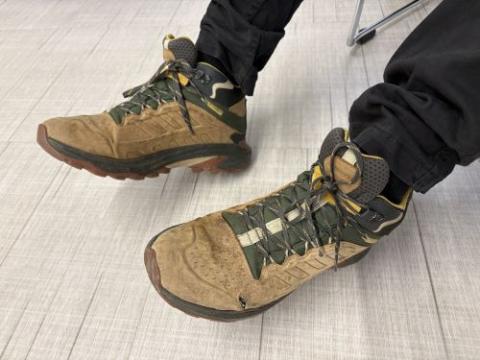
Fr. Gary Graf's shoes on Dec. 1 in New York City, one day before the end of his two-month walk to raise awareness about deportations (NCR photo/Camillo Barone)
As Christmas approaches, Graf expects to hear new stories of fear, resilience and uncertainty from families affected by deportations. But he also hopes that the pilgrimage's emphasis on memory and shared origins will continue in his parish and beyond.
He framed the modern immigration struggle as an echo of earlier waves, including the journeys of his own great-grandparents who arrived in the U.S. through New York's Ellis Island from Ireland and Germany.
For Graf, stepping onto Ellis Island at the end of his two-month march — retracing the arrival point of his own ancestors — brought his message full circle.
"Because of the courage that was theirs, I was able to be born here and now be able to serve and be served by this present generation of immigrants," he said.
Graf plans to return to his parish in Chicago this week.
Statistics and personal accounts
Graf's final days in New York unfolded as a two-day reckoning with the scale of the crisis he walked to highlight. On Dec. 1, at St. Luke's Parish in the South Bronx, he sat beside scholars, faith leaders, legal advocates and labor leaders who laid out the numbers that have shaped so many of the stories he heard on the road.
Rosalie Wells, communications manager at the Center for Migration Studies, said that 66,000 immigrants are currently held in detention facilities and that an estimated 4.70 million U.S.-born children (6.7% of all citizen children) have at least one undocumented parent at risk of deportation. About 8.5 million undocumented immigrants work in the U.S. economy, over 5% of the total workforce, she said, and in certain industries — including parts of the hotel and restaurant sector — they constitute the large majority of the workforce.
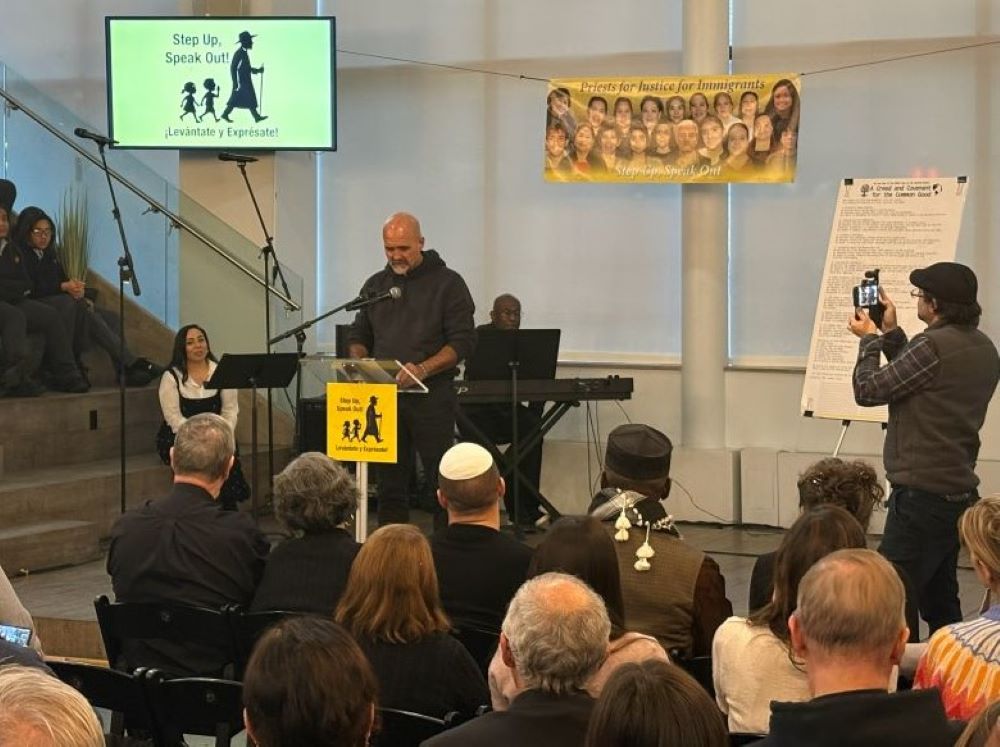
Fr. Gary Graf reads his prayer and testimony during a multifaith prayer service marking the end of his two-month walk from Dolton, Illinois, to New York City, Dec. 2. (NCR photo/Camillo Barone)
Personal accounts at the event reflected the statistics. Several activists, including U.S. citizens, described avoiding daily errands out of fear that federal agents might target them solely for "the color of their skin or their Hispanic accent." Labor representatives reported heightened anxiety among undocumented workers who have long staffed essential jobs but now limit their outings or skip shifts entirely.
Rev. Gabriel Salguero is pastor of The Gathering Place, an Assemblies of God congregation in Orlando and is president of the National Latino Evangelical Coalition. He said people in his pews are also dealing with immigration issues, and said his congregation collaborates with Catholic clergy to run "Know Your Rights" trainings.
One day after the event, on Dec. 2, Graf's walk ended where millions of immigrants once saw their first glimpse of the U.S.: the waters off Battery Park, facing the Statue of Liberty. Inside the Mezzanine on Broadway, clergy from Catholic, Jewish, Muslim, Evangelical and Episcopalian communities gathered for an interfaith celebration marking his arrival.
The program included prayer, reflection and a ceremonial signing of an Interfaith Creed and Call to Action — a document affirming a shared commitment to justice, compassion and human dignity. Leaders prayed not only for immigrants facing removal but also for National Guard members and federal agents deployed in immigration operations.
Short recordings from children in Chicago were played aloud. In their own voices, the children described losing sleep, living in anger and feeling trapped in constant fear as their undocumented parents navigate arrest risks and custody threats. The room fell quiet.
Advertisement
Imam Tariq I. El-Amin of Chicago's Masjid Al-Taqwa offered prayers grounded in the Quran.
New York City Rabbi Hanniel Levenson followed with a reflection rooted in his own family's history. "As a grandchild of Holocaust survivors, my own family arrived here, passing through these very waters," he said. "They carried stories of pain, resilience and the hope for a new beginning. And so I stand here aware that every person who journeys toward safety carries a whole universe of dreams and that welcoming a newcomer is among the most sacred acts we can offer."
Salguero returned to the microphone with a direct message for faith leaders: "We must be prophets and prophetesses to remind the nation that immigration policies are moral documents. It is a time for a faith rising that continues to stand with the vulnerable."
When Graf finally took the podium, he spoke slowly. His voice wavered as he delivered his closing words to the room:
"My feet can rest, but my spirit cannot rest, not while immigrant children cry alone, not while families are torn apart, not while strangers — men, women and children, flesh and bone, heart and soul, passion and courage, holding families together in the midst of government-imposed fear — are treated as anything less than kin."
"To tear families apart is to wound the very heart of God. And now, after all these miles, I say again: It is time to step up. It is time to speak out."