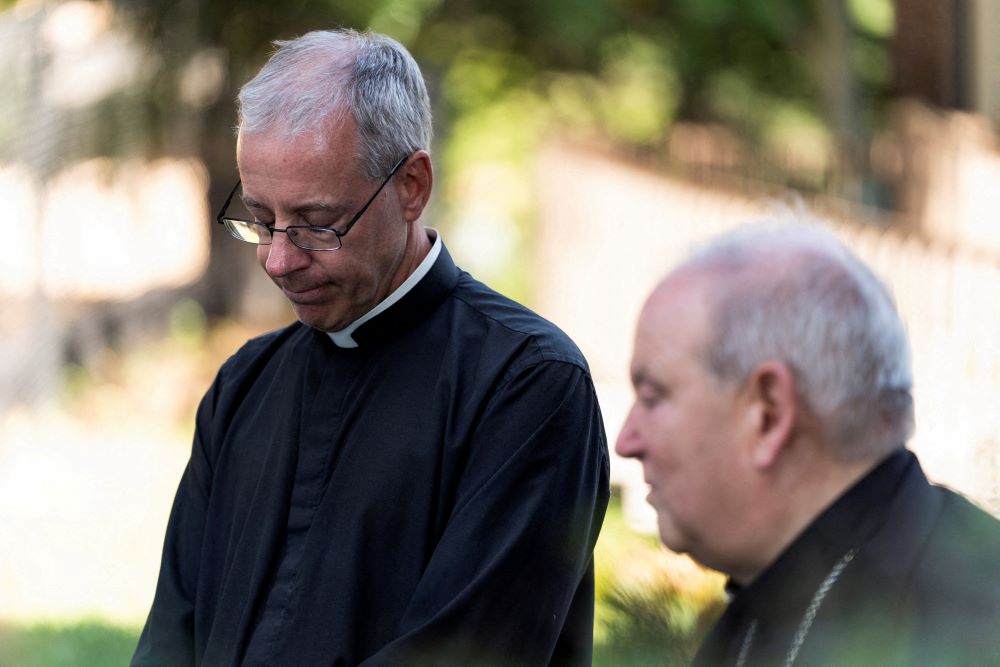
Annunciation Church pastor Fr. Dennis Zehren, left, becomes emotional as he speaks to the media alongside St. Paul and Minneapolis Archbishop Bernard Hebda Aug. 30 about the Aug. 27 shooting at the church. The shooter opened fire through the windows of the school's church and struck children attending Mass during the first week of school, killing two and wounding 21 others. (OSV News/Reuters/Tim Evans)

Editor's note: This is the third of a three-part series on the Annunciation community during the Aug. 27 shooting at the school's church in Minneapolis. It features an interview with Annunciation's pastor, Fr. Dennis Zehren.
You can read Part 1 here and Part II here.
When Fr. Dennis Zehren arrived at Annunciation Catholic Church and School in Minneapolis on July 1, he stepped into a community defined by long-standing friendships, multigenerational ties and a strong parish-school identity. A priest for 21 years, accustomed to serving in school-based parishes, he spent July and August quietly getting to know families, staff and the rhythms of the neighborhood.
That gradual introduction changed abruptly on Aug. 27, when a shooting during the first school Mass he was celebrating shook the parish and wider Minneapolis community. In the days that followed, as Annunciation worked to absorb the shock and begin healing, Zehren's presence and words became a central point of steadiness for many families.
Parishioners often describe Zehren as "the rock of Annunciation," a role that emerged naturally as he guided them through the first gatherings after the tragedy.
Four days after the shooting, he presided at a Sunday Mass moved to the school auditorium while the church remained closed. In his homily, he acknowledged the disorientation many felt — being in an unexpected space, carrying unexpected emotions. "We are in a very low place," he said plainly. "We are in a lower place than we could have ever imagined."
Yet he framed the gathering not only in terms of sorrow, but also as a return to roots: "Jesus speaks about humility, so we come back to our humble beginnings. That's what this day represents. It's a call to begin again."
"Sometimes we have to sit in the dust," he said. "Jesus says, 'Can you just sit with me here, in the dust?' It's the same dust that Jesus fell in when he was carrying the cross. The same dust that he bled in."
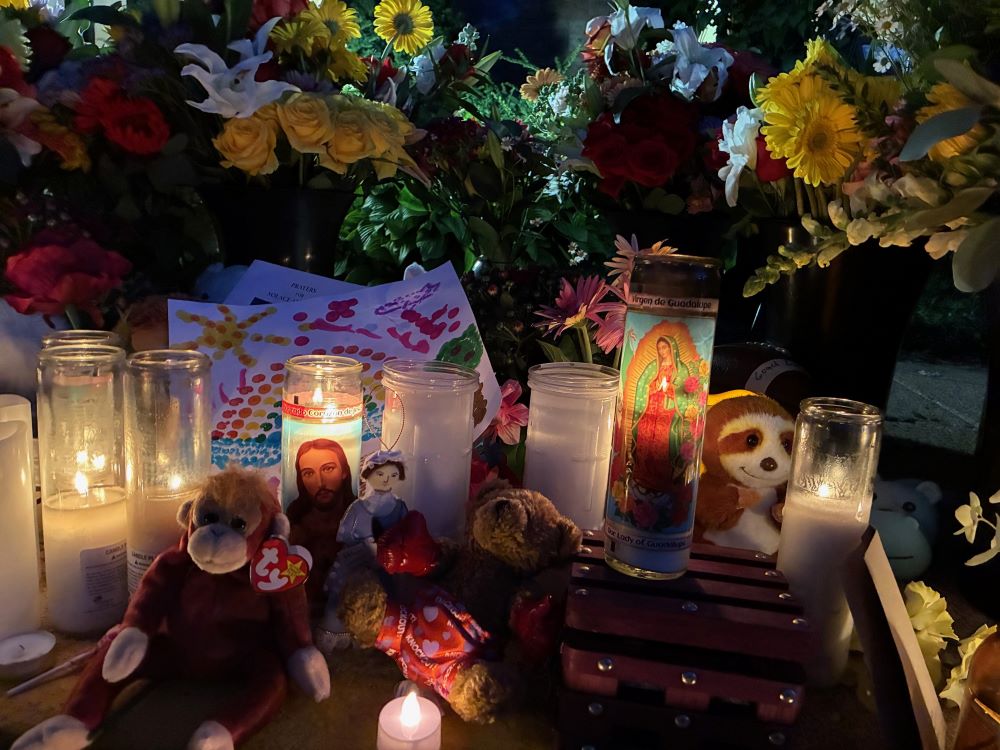
Candles, flowers and stuffed animals fill a community memorial outside Annunciation Catholic Church in Minneapolis Aug. 28. A shooter opened fire Aug. 27 through the windows of the adjacent church during an all-school Mass, killing two children and wounding 21 others. (OSV News/Maria Wiering)
In the Q&A with the National Catholic Reporter that follows — his first interview since the shooting — Zehren reflects on his own background and how the events of Aug. 27 have shaped both his life as a priest and the community he's been shepherding.
NCR: Fr. Dennis Zehren, when you look back on those first moments of the Aug. 27 shooting, what stands out most in your memory? Not just the fear or chaos of those very seconds: Many parents said they witnessed a battle going one between forces of evil and grace. Have you also sensed grace breaking through that confusion?
Zehren: St. Paul says in his letter to the Romans that where sin abounds, grace abounds all the more. So, as difficult as this has been, we have noticed God's hand moving among things and the outpouring of love we received from so many different directions, and in Scripture, all the takes teach us about that peace that surpasses understanding. So as difficult as this life gets, we somehow feel in our heart that there is a peace that can overcome it all.
Who do you think are some of the quiet heroes you witnessed that day — teachers, parents, even children — whose actions you'll never forget? What do their examples tell you about the character of your parish family?
There were definitely people that sprang into action. Some of the parents had this protective instinct and they tried to run toward the bullets and secure the doors. Others had the nurturing instincts that quickly rushed to those children that were wounded. And so it's just people following their God-given instincts, is what I noticed most. And of course, many of the silent heroes were the first responders, how quickly they were able to respond and how they were all, I think, caught off guard. They didn't realize how many children were in the church, but once they realized that they were there, what great shepherds they were too in getting all to safety and helping us to reunite the children with the families again.
If I'm not wrong, you're the very first Catholic pastor who experienced a mass shooting in American history. As a pastor walking with grieving people, in the days and weeks that followed, what did being a priest look like? What have been the greatest challenges in that regard?
We recognize that Jesus is our Good Shepherd. And I think one of the most difficult realities that we've had to navigate here is that the sheep are lost. Sin has a scattering effect. Sin causes division and chaos. It's the job of the shepherd to kind of bring the sheep back again and to reunite them, to bring them back to the fold and to protect them from anything that seeks to harm them and just to help them to know peace and security again.
Talking about your personal experience with the children, how have you been helping the youngest children, understanding what happened without deepening their sense of fear and loss? What images and parables have you used to talk to them about what happened?
We had a prayer service last week in which I read to them the parable of Jesus about the shepherd who had 100 sheep, and he lost one of them. He left the other 99 in the desert to go after that one lost sheep. When I was in Spain, I noticed that the shepherd would hang bells around the sheep's neck, so that if they would ever get lost, the shepherd would listen to them. So I tried to assure the children that, however they feel lost, however they feel confused, however they feel afraid, that Jesus is listening to them, and all they have to do is call out to Him. He will come to them, and he will speak to their hearts and bring them the peace that they need, and just to help them to know that he is always there, always responding to whatever is going on in their heart, they just cry out to Jesus, and Jesus is the Good Shepherd, and he will bring them to greener pastures.
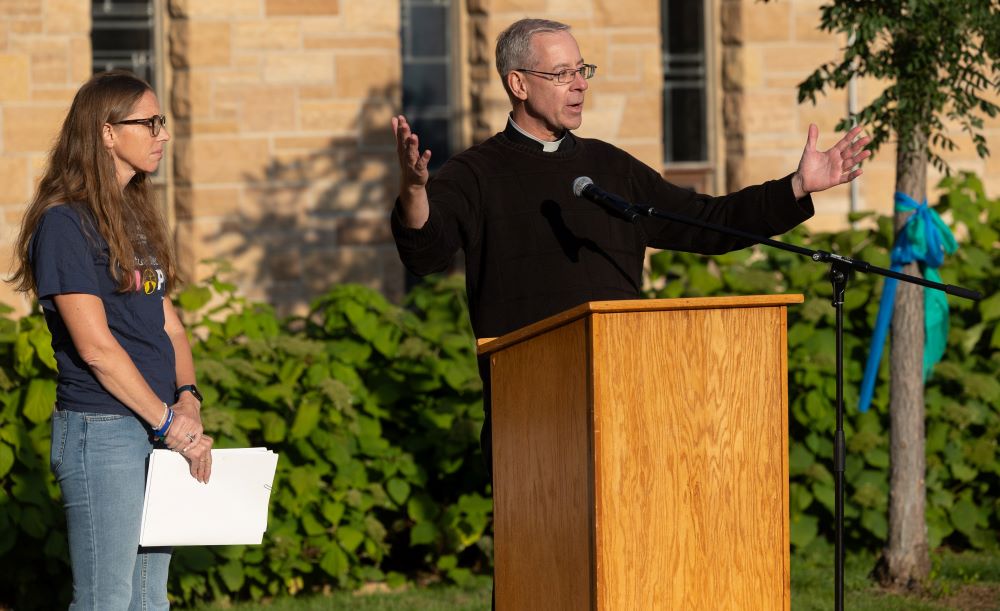
Fr. Dennis Zehren, pastor of Annunciation Catholic Church in Minneapolis, leads a prayer at Annunciation on Sept. 27, a month after a shooting at the church killed two children and injured more than 20 other people. (OSV News/The Catholic Spirit/David Hrbacek)
What does healing look like here now — not only through counseling and support, but through prayer, ritual, and the slow rebuilding of trust in goodness?
I guess healing is nothing new. We recognize as Catholics that we've all been wounded by original sin, that we all have this weakness within us and that there's something not right within us. So our journey has always been towards fullness, towards healing, towards restoration, being in communion with God for the ways that we've been scattered. So in some sense, we recognize that. This is why we need the bread of life. This is why we need the Word of God to bring us the healing for those ways that we have been wounded by original sin, the sins of others that we are continually in need of that healing.
How do you take care of your spiritual life while you yourself are taking care of others' spiritual lives? Where do you find your personal replenishment of hope as a priest who's been through a lot? Who takes care of the person that takes care of others in this community? Also because I learned that you live alone here as a priest.
I believe it's very important for me to take some time listening to the Good Shepherd. If I'm going to point others to the Good Shepherd. I have to come to know His voice too. So I do spend time every day in prayer. First thing in the morning I'll do a Holy Hour just coming to prayer, trying to do a lot of listening. My prayer is less speaking, less talking. It's more about listening to how God is guiding us and recognizing his presence among us. Certainly, the bishops here in the archdiocese have been a tremendous support. Archbishop (Bernard) Hebda has been very supportive and Bishop (Kevin) Kenny and Bishop (Michael) Izen have been very attentive to the needs here. I have priest friends who have been reaching out and they've been very, very helpful to have that sense of brotherhood and community and listening here.
Advertisement
What do you hope this parish story will ultimately proclaim to the rest of the other churches, so not only Catholic churches, but also, what can the message of Annunciation bring to a polarized and divided Catholic Church in the U.S. and a polarized and divided nation?
I think it was Julian of Norwich who once said that Jesus never promised us that we would not be burdened. He never promised us that we would not be belabored or beleaguered. But he did promise us that we could overcome, no matter what comes against us. Jesus said, in this world, you will have burdens, but I have come to help you to overcome the burdens.
Has that ever happened for you over the past two months and a half to pray also for the shooter of Aug. 27?
We just put it all into God's hands. Jesus is the one who's going to set things right. So we commend the shooter to Jesus. We commend his family to Jesus. We commend all the victims, all the families to Jesus. And He can set it right. He's the one who can bring about salvation and make all things right.