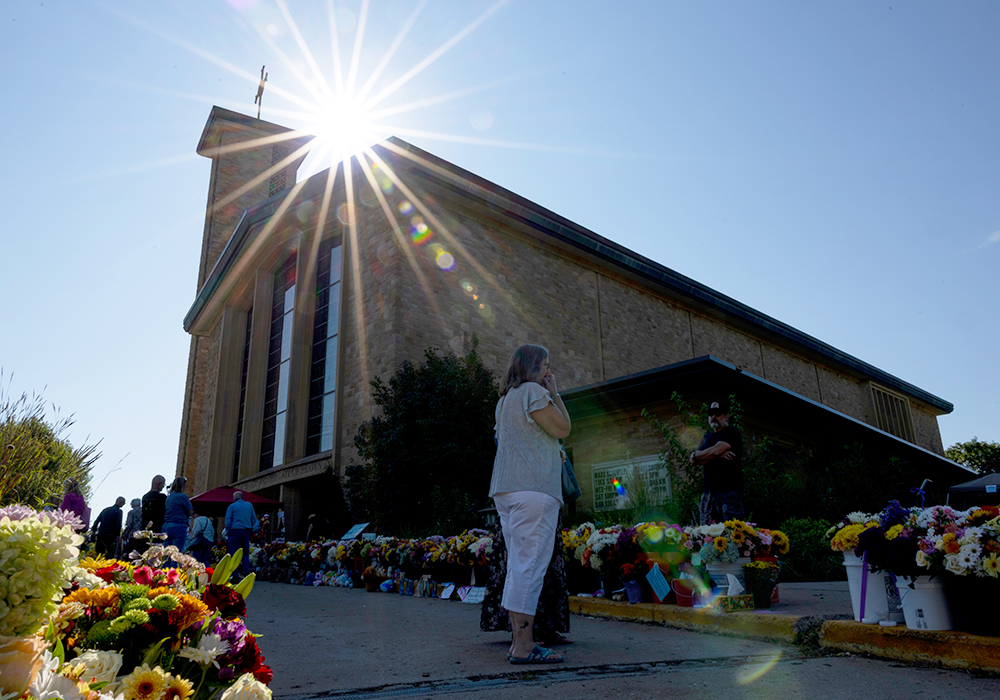
The sun shines over a memorial outside Annunciation Catholic Church during Mass after the Aug. 27 shooting, Sunday, Aug. 31, 2025, in Minneapolis. (AP photo/Ellen Schmidt)

Editor's note: This is the second part of a three-part series exploring the experiences of the Annunciation community during the Aug. 27 shooting at the school's church in Minneapolis. Part 2 examines the aftermath of the shooting: how parents within the Annunciation community began to navigate trauma, sought healing and are finding hope through faith, therapy and each other.
You can read Part 1 here, about the harrowing moments inside the church and the heroic actions of parents trying to protect their children and the entire school community.
When the chaos of Aug. 27 finally ended, the work of recovery began.
For the parents of Annunciation Catholic School, that meant grappling with trauma, seeking solace in faith and rediscovering the steady rhythm of community life. In this quiet struggle, they are finding courage, resilience and hope.
Once back home, Tara Keegan recalled, "We were just like, 'We need to pray.' I told the kids, 'This is the worst thing that will ever happen to you,' " while neighbors and relatives arrived one by one, offering comfort, food and presence.
In the weeks that followed, families naturally gravitated back to the community: grade-specific gatherings, prayer services and early Masses that brought people together.
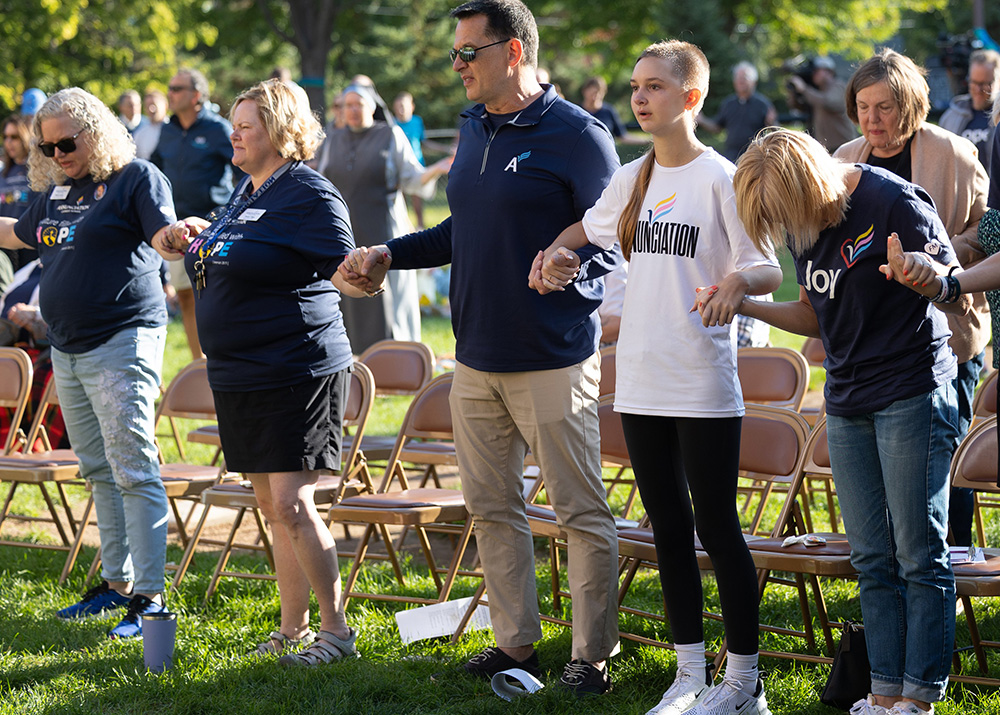
Harry Kaiser, center, prays the Our Father with his daughter, Lydia, second from right, and wife, Leah, right, during a prayer service at Annunciation in Minneapolis on Sept. 27, 2025, the one-month anniversary of a shooting at the church. Lydia is a student at Annunciation Catholic School and was among those injured in the shooting. NCR spoke to other Annunciation parents about their experience in the shooting's aftermath. (OSV News/The Catholic Spirit/David Hrbacek)
For many of the young fathers of the Annunciation community, like Shea McAdaragh, Matt Stommes, Brian Cleary, Sean O'Brien and Devin O'Brien (no relation), new routines formed — including 6:30 a.m. men's group outside church, 9 p.m. rosaries in the same location and communal prayers — creating a way to process trauma and a deeper spiritual connection even amid grief.
In the weeks following the shooting, the parents of Annunciation Catholic School found themselves navigating grief, fear and uncertainty with an intensity they had never known. For many, the path forward was intertwined with faith and the embrace of a community that had suddenly become a lifeline.
For McAdaragh, the journey toward reclaiming normalcy was punctuated by both absence and presence. "I haven't been back to Mass yet. I want to go back. I was gonna go back this past weekend, but last time I was in a church kids were dying. It's gonna be a very difficult thing for me to do," he said.
Yet even as he struggled with the thought of returning to Mass, he found solace in other forms of communal prayer. He joined the men's group, participated in the rosary at night and attended finance committee gatherings where prayer preceded each meeting.
For him, presence in these circles provided a tangible reassurance: "We're all in this. I'm not alone. I think it is the number one tangible benefit of community-based prayer. We're all going through something right now, but I'm not going through it alone."
Luke Carlson, a father of five who had initiated the early morning men's group, described the prayers as both practical and profoundly emotional. Each session began with intentions — prayers for children still in the hospital, for the families of those who had died and for the emotional well-being of parents grappling with grief.
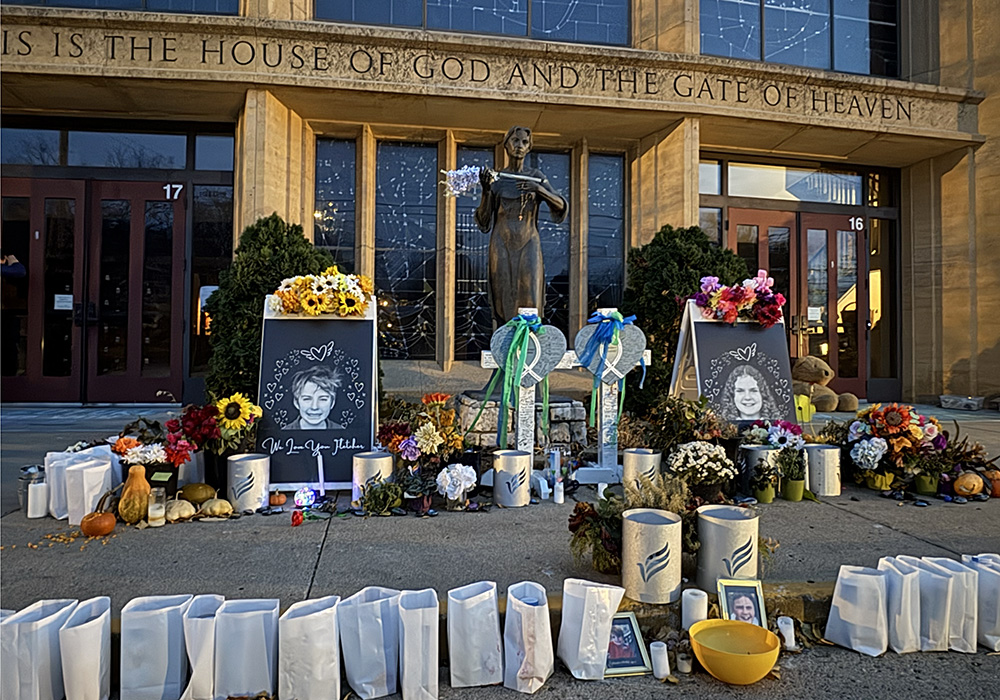
Flowers, candles, and tributes lay outside Annunciation Catholic Church in South Minneapolis for the two students that lost their lives in the Aug. 27 shooting, Fletcher Merkel and Harper Moyski. The Annunciation community has been gathering there every night at 9 p.m. to pray the rosary. (NCR photo/Camillo Barone)
"We prayed for peace in our hearts to remove anger. We prayed for patience a lot because I think the place where you're the least patient is in the people that you love the most," he said.
These morning gatherings, held just outside the church windows shattered by the shooter's bullets, became a sacred rhythm, a space where men could be fully present with one another in faith and where vulnerability was welcomed.
"We've cried together, we've laughed together, we've hugged together. Our vulnerability has definitely increased," Carlson said, noting that even small acts of physical and emotional connection had become transformative.
"I think I've hugged more men in the last two and a half months than I have in all my life. It's the joy — the occasion is that you're in a fraternity with them, a fraternity of Christ. And that's really powerful," he said.
For Stommes, the immediate aftermath was marked by both the trauma of the day and the sustaining presence of his faith community. Watching the parents, neighbors and parishioners gather in prayer and support gave him the ability to hold on even in moments of despair. "It helped me to see how God has always been with me and us at Annunciation prior to Aug. 27. He was with us during that day, and he'd continue to be with us after that day," he said.
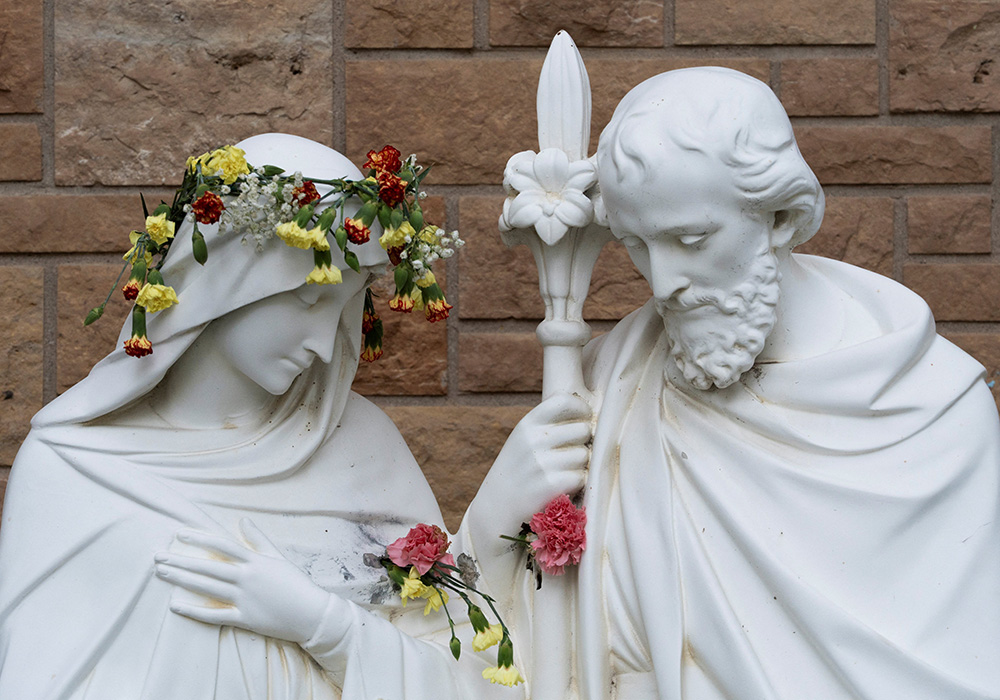
Flowers fill bullet holes on a Holy Family statue outside Annunciation Church in Minneapolis Sept. 2, 2025, which was the scene of a shooting Aug. 27. The shooter opened fire with a rifle through the windows of the church and struck children from the parish school who were attending Mass during the first week of school, killing two and wounding more than 20 others. (OSV News photo/Reuters/Tim Evans)
"I do think that there is a heightened awareness of the delicacy of human life and also the time that we are given as a gift," Stommes added. "It's caused me to reflect more on how I spend my time and who I spend my time with and who I prioritize my time with."
Keegan similarly described clinging to faith in the days after the shooting, praying the rosary daily and attending as many communal services as she could manage. "I'm grasping. I'm clinging to my faith. I can't say that it's stronger, but I think in time it will be. Right now I'm just grasping it and leaning on it really," she said.
"It's 100% because of our faith that we can even carry on. I don't know how anybody could do it without faith," she added.
"I'm a more compassionate person, and as a parent, I'm hell-bent on trying to raise not just my children, but raise good children," McAdaragh reflected.
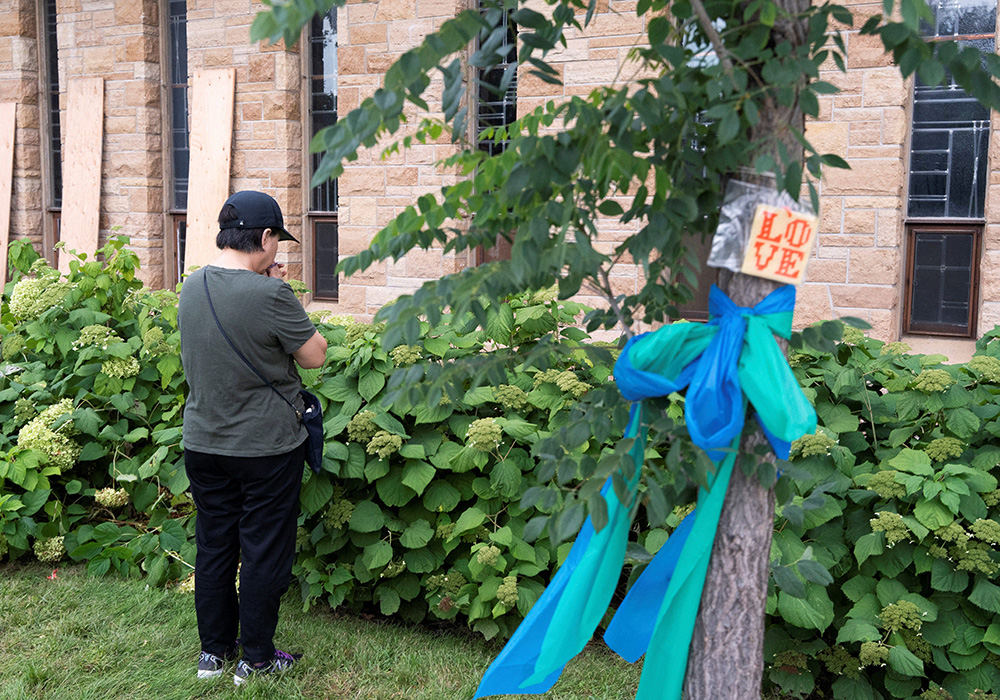
A woman prays outside Annunciation Catholic Church in Minneapolis Sept. 2, 2025, following the shooting Aug. 27. (OSV News/Reuters/Tim Evans)
In the aftermath of the shooting, Devin O'Brien found himself confronting a darkness that felt both literal and spiritual. "I couldn't get [away from] the visions of what I saw. You'd lay down at night in the dark and all I hear is gunshots and all I see is the worst of what I saw," he recalled, saying the first visual perception he had of the two minutes of the shooting was the one of a cloud, "like a thick, black smoke," descending over the church trying to cover and annihilate the children.
Sleep was impossible and each night brought a replay of horror too vivid to ignore. Seeking help, he turned to accelerated resolution therapy, or ART, and eye movement desensitization and reprocessing therapy, or EMDR, methods recommended by veteran friends who had wrestled with post-traumatic stress disorder. Among the therapists he considered, one stood out: a Minneapolis-based licensed Catholic therapist unafraid to integrate spirituality into her sessions.
For him, this was crucial. "I felt like this whole experience was a spiritual experience. Honestly, as horrible as it was, I can't pull the two apart."
That kind of therapy became a space where the unthinkable could be faced, reimagined and processed, he said. In one session, he visualized running down the church aisle as the shooting unfolded. "We just stood and stared at it. We stared straight into the eyes of the devil, and he didn't defeat us," he said. In another session, he experienced a vision at the foot of the cross, feeling Jesus' suffering as a profound, almost mystical, personal presence, he said.
Advertisement
"It was like there was a beam of light coming out of Jesus' heart, like straight to the heavens. I felt the pain, Jesus' pain, in a way I've never related to it." These visions offered not only confrontation but catharsis, he said — sleep returned, and with it a fragile sense of peace.
Alongside therapy, O'Brien leaned heavily on his faith community. Daily 6:30 a.m. prayer with the men's group, evening rosaries with his family and weekly Mass with the Annunciation pastor Fr. Dennis Zehren became acts of courage and resilience. "It opened the hearts of men in the community. What I've seen is a pain too great for anyone to bear alone," he said.
When asked about hope, these Annunciation parents spoke with a careful mix of realism and faith. For McAdaragh, hope is intimately linked with resilience and the nurturing of compassion in his family. He said his vision extends beyond personal healing to the revitalization of the parish itself, the faith community that has provided comfort in the darkest days.
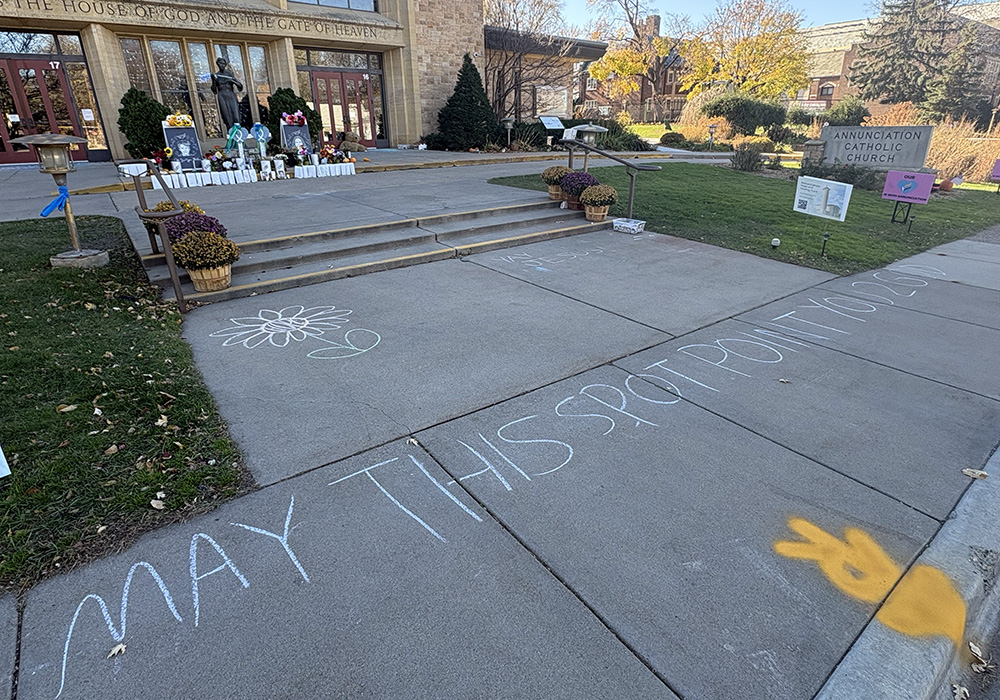
A chalk inscription outside Annunciation Catholic Church in Minneapolis that says, "May this spot point you to God," Nov. 12. (NCR photo/Camillo Barone)
Even amid lingering fears of returning to Mass, the prospect of shared sacred moments offers a beacon, he said. "I really hope the Catholic community helps us get through this incredibly difficult time. I start crying at the thought of Pope Leo coming and [celebrating] Mass at Annunciation," he said.
"If Pope Leo comes, I'll be there. I'll do it," he said with a mixture of laughter and tears.
Stommes said he framed his hope around faith as a living, communal force. Witnessing his neighbors, friends, and fellow parents come together to love intentionally and support one another has strengthened his belief in the redemptive power of faith.
"I see that in everyone around me at Annunciation — they are loving one another as they always did before Aug. 27, and now they are being even more intentional about that love. So that gives me hope, seeing God's influence on everyone around me as well," he said.
Devin O'Brien's hope, however, is strikingly anchored in the children themselves. While adults often dominate the conversation about trauma at Annunciation, he said he finds courage and reassurance in the resilience of the young.
"The kids are the heroes, in my opinion. The first responders and the adults in the room, we did the things we had to do. But the teachers and the kids, I think, are the ones that had to get up and go to school again, get up and go to Mass again. That is a profoundly heroic act," he said.
"This whole experience has just affirmed for me so much that everything good comes from love and sacrifice in community for each other."