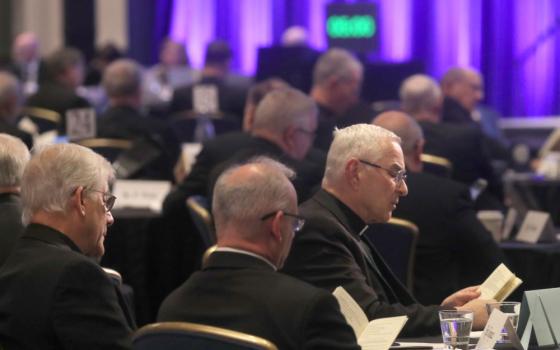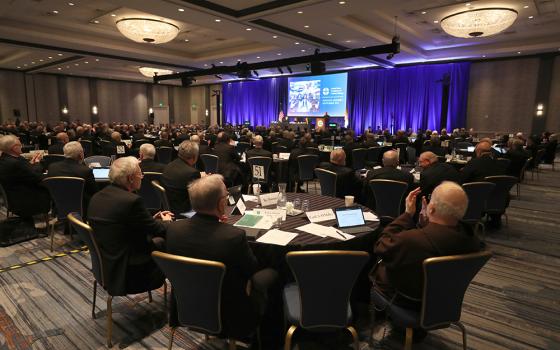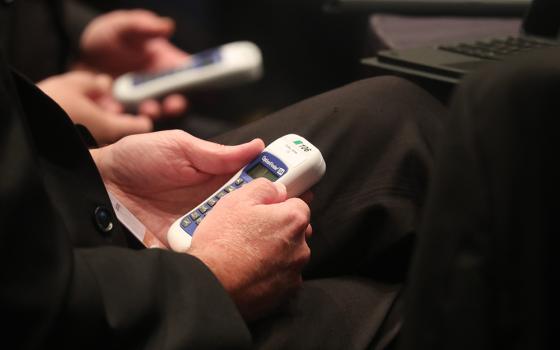
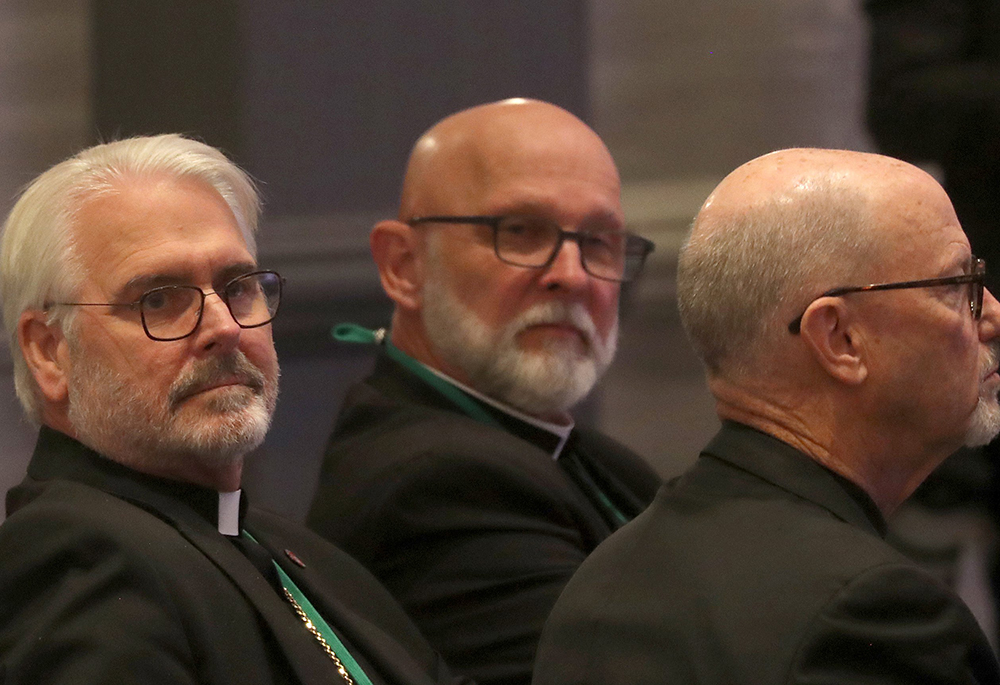
Archbishop Paul Coakley of Oklahoma City, left, looks on moments after being elected president of the U.S. Conference of Catholic Bishops during a Nov. 11, 2025, session of the fall general assembly of the U.S. bishops' in Baltimore. His three-year term begins at the close of the Nov. 11-13 plenary. (OSV News/Bob Roller)
by Brian Fraga
Staff Reporter
The U.S. Catholic bishops on Nov. 11 elected Oklahoma City Archbishop Paul Coakley as the new president of the U.S. Conference of Catholic Bishops during the conference's annual fall plenary assembly.
Coakley, 70, the current conference secretary and chairman of its Committee on Priorities and Plans, will succeed Archbishop Timothy Broglio of the U.S. Archdiocese for the Military Services, who has served as conference president since 2022.
The bishops in attendance elected Coakley after three rounds of voting. Coakley and Bishop Daniel Flores of Brownsville, Texas, emerged as the two leading candidates but neither gained a majority of votes, as the conference's bylaws require.
After a second round of voting failed to produce a clear winner, Coakley won in the third round with 128 votes while Flores garnered 109 votes.
Flores was elected vice president from the remaining slate of nine candidates, which included Winona-Rochester, Minnesota, Bishop Robert Barron, the well-known founder of the Word on Fire media ministry who received the third most votes in the first round of voting with 26.
Coakley has served as archbishop of Oklahoma City since 2010. He previously served as bishop of Salina in Kansas from 2004 to 2010.
In a statement he posted on X minutes after his election, Coakley said he was "humbled by the trust which my brother bishops have placed in me by choosing me to serve as president of our episcopal conference." He referenced his episcopal motto, "Duc in altum," Latin for "Put Out into the Deep."
"Once again, the Lord is inviting me to put out into deep waters in calling me to accept this service and burden of leadership today," Coakley said. "I accept it in faith and with great hope. I ask for the prayers of all of the clergy, religious women and men and the faithful of the Archdiocese of Oklahoma City."
In addition to his diocesan duties, Coakley is also the ecclesiastical adviser to the Napa Institute, a conservative-leaning organization that often showcases a blend of piety and right-wing politics at its annual summer conferences.
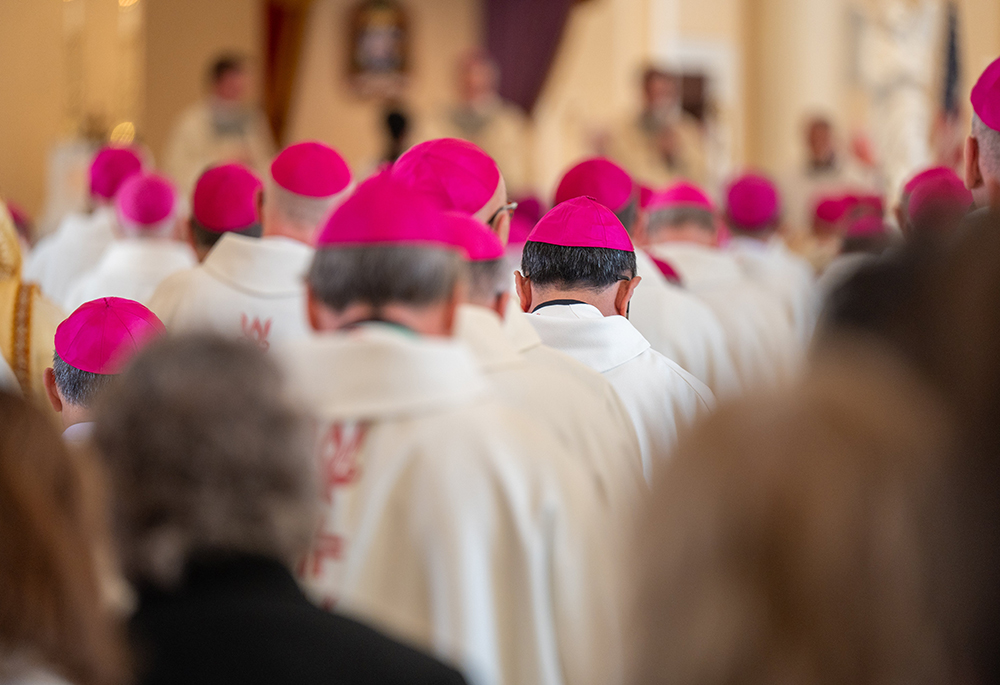
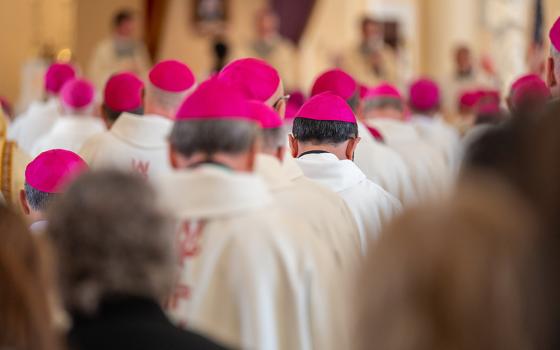
Bishops from around the country gather at the Basilica of the National Shrine of the Assumption of the Blessed Virgin Mary in Baltimore Nov. 10, 2025, for the opening Mass of the U.S. Conference of Catholic Bishops' fall plenary assembly. (OSV News/Catholic Review/Kevin J. Parks)
In a post on the Napa Institute’s Facebook page, Timothy Busch, cofounder of the Napa Institute, described Coakley's election as a "powerful testament to his faith and leadership."
"As President of the USCCB, he will strengthen the Church in the United States, just as he has helped strengthen the Napa Institute," Busch said.
The Survivors Network of Those Abused by Priests, an advocacy group for survivors of clerical sexual abuse, also released a statement following Coakley’s election that accused Coakley of mishanding clergy sex abuse cases in his archdiocese.
Said SNAP: "While it is not surprising that the USCCB has once again chosen a leader who has kept known abusers in ministry and misled Catholic families, survivors are furious that the U.S. bishops will take direction from a man with a history of minimizing criminal sexual assault and endangering the public."
In 2018, Coakley was among several American bishops who expressed support for Archbishop Carlo Maria Viganò after the former Vatican ambassador to the United States accused Pope Francis of covering up sexual abuse and called on the pope to resign.
Viganò has since been excommunicated. Coakley has not retracted his statement where he expressed his "deepest respect" for Viganò's "personal integrity." In that statement, Coakley also called for an investigation and a "purification" of the church.
Coakley has also served as chairman of Catholic Relief Services and on several bishops' conference committees.
Massimo Faggioli, a church historian and ecclesiology professor at Trinity College Dublin, told National Catholic Reporter that the bishops' vote in Baltimore was "the single most important election to an ecclesiastical position of leadership" since the conclave elected Pope Leo XIV in May.
"The election of Coakley as USCCB president seems to confirm that a certain rift or distance between Rome and the USCCB does exist, and it was not because of Pope Francis," said Faggioli, who has studied and written about the American hierarchy.
"It remains to be seen what kind of dynamic there will be in the next three years between the USCCB, Leo XIV and the American political situation," Faggioli said. "All of this is not just American Catholics' business, but has practical and symbolic consequences far beyond the jurisdiction of the USCCB."
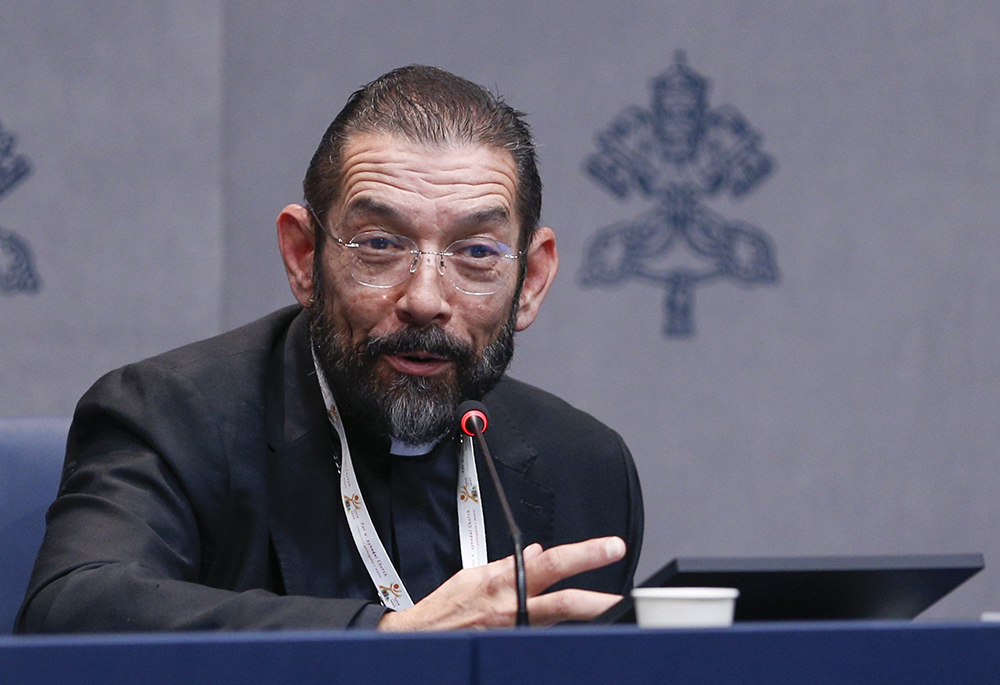
Bishop Daniel Flores of Brownsville, Texas, speaks at a news conference in the Vatican press office Oct. 3, 2024, during the Synod of Bishops. (CNS/Robert Duncan)
Flores, 64, has been the bishop of Brownsville since 2010. He served as an auxiliary bishop in the Archdiocese of Detroit from 2006 to 2009. He succeeds Baltimore Archbishop William Lori, the outgoing vice president of the bishops' conference.
Flores, whose Texas diocese borders Mexico, has been vocal on the issue of immigration over the years. During the first Trump administration in 2019, Flores addressed the bishops' conference and urged it to take a stronger stance in support of migrants.
"I feel that as a [bishops] conference, we must express ourselves more strongly when it comes to the dignity of immigrants, to say that they are not criminals, that they are vulnerable families and we need to invite all the governments involved, not just the U.S., to defend the migrant as a human being, to not cast the person aside as someone who doesn't matter and is a problem," Flores said.
Flores also oversaw the conference's operations on the Synod of Bishops on synodality.
The Trump administration's aggressive tactics on immigration enforcement provided a subtext to some of the bishops' remarks during the first of two public sessions, Nov. 11-12, in Baltimore. Pope Leo XIV has called on the U.S. bishops to speak with a unified voice on immigration.
Advertisement
In reading the conference's message to Leo, Fr. Michael Fuller, the general secretary of the conference, expressed the prelates' solidarity with migrants amid the ongoing ICE raids and Border Patrol operations in several American cities.
"In cities across the United States, our migrant brothers and sisters, many of whom are fellow Catholics, face a culture of fear, hesitant to leave their homes and even to attend church for fear of being randomly harassed or detained," Fuller read.
The bishops' letter added: "Holy Father, please know that the bishops of the United States, united in our concern, will continue to stand with migrants and defend everyone's right to worship free from intimidation. We support secure and orderly borders and law enforcement actions in response to dangerous criminal activity, but we cannot remain silent in this challenging hour while the right to worship and the right to due process are undermined."
In his outgoing address as president of the bishops' conference, Broglio also emphasized immigration as a Gospel imperative.
"Repeatedly in the Old Testament, as well, the chosen people were admonished to have a special care for strangers, aliens and sojourners. It is not rocket science, but the word of God," Broglio said.
"It should surprise no one when we defend the unborn, meet the basic needs of the immigrant, lobby for immigration reform, reach out to those in need outside our borders through CRS, and call upon others to do the same," Broglio added.
Bishop Mark Seitz of El Paso, Texas, the chairman of the bishops conference’s Migration Committee, also addressed the Trump administration’s immigration enforcement policies, which Seitz said have had the effect of "intimidating and dehumanizing the immigrants in our midst, regardless of how they came to be here."
"Our immigrant brothers and sisters, from those who are undocumented to those who are naturalized citizens, are living in a deep state of fear," Seitz said. "Many are too afraid to work, send their children to school and avail themselves of the sacraments."
But adding that the Catholic Church in the United States "stands as a reminder that they are not alone," Seitz described a new national initiative, to be called "You Are Not Alone," that he said will provide accompaniment and show solidarity with immigrants.
"As the Holy Father said last month, the church cannot be silent," Seitz said.
In his presidential address, Broglio also reflected on the ups and downs of his three-year tenure, which included a visit to war-torn Ukraine and the difficulties of communicating to Catholics amid a politically polarized time.
"I have also learned," Broglio said, "and mentioned it to Pope Leo last month, that some of our faithful listen more readily to sound bites, the sirens of political discourse, or whatever confirms their conclusions and partisan leanings than they are to hearing their pastors and us."
In addition, Broglio highlighted the sufferings of Christians in the Holy Land and the recent devastation that Hurricane Melissa caused in Jamaica, Haiti and Cuba. He also referenced the uncertainty surrounding the Supplemental Nutritional Assistance Program, or SNAP, commonly referred to as food stamps.
"I was shocked to learn that 42 million people are dependent on assistance from SNAP," Broglio said. "In a country of such wealth and such possibilities, we should be able to do better so that all are able to share in the bounty of this land."
Cardinal Christophe Pierre, the Vatican's ambassador to the United States, then spoke to the bishops about the legacy of the Second Vatican Council and its continued relevance in the life of the church.
"I'm convinced that Vatican II remains the key to understanding what kind of church we are going to be today and the reference point for discerning where we are heading," said Pierre, who also underscored continuity between Pope Francis and Leo.
Pierre said that Francis, in writing his apostolic exhortation Evangelii Gaudium in 2013, sought a way to express Vatican II's teachings and their application to the church's missionary mandate in the modern world.
"Leo clearly wants us to continue in that direction," Pierre said.
This story has been updated with reactions to Coakley's election, and comments from Bishop Mark Seitz about the Trump administration's immigrant enforcement policies.