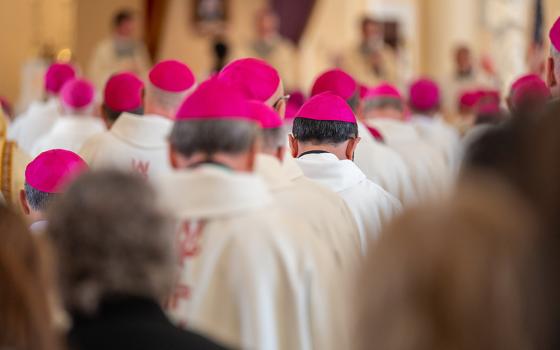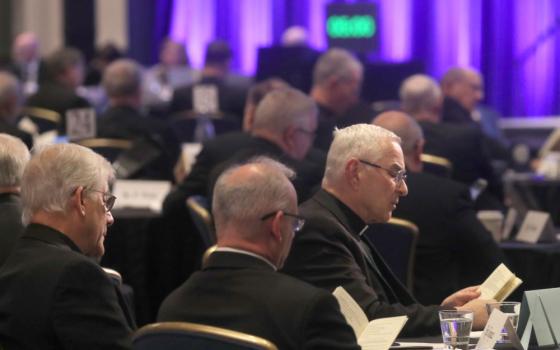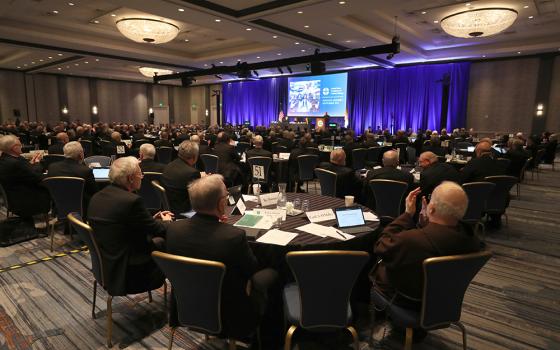
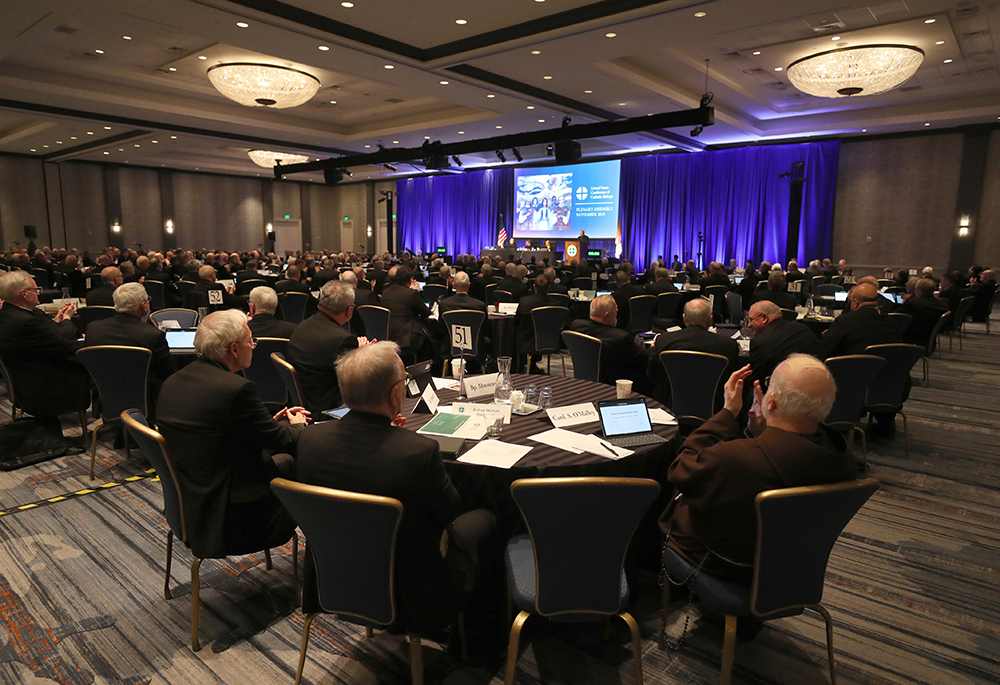
Prelates attend a Nov. 11, 2025, session of the fall general assembly of the U.S. Conference of Catholic Bishops in Baltimore. The bishops Nov. 12 approved a "special pastoral message on immigration" that expresses the conference's collective solidarity with immigrants. (OSV News/Bob Roller)
by Brian Fraga
Staff Reporter
The U.S. Catholic bishops on Nov. 12 approved a "special pastoral message on immigration" that expresses the U.S. Conference of Catholic Bishops' collective solidarity with immigrants amid the Trump administration's aggressive enforcement tactics.
In their 618-word statement, the bishops said they are "disturbed" to see a climate of fear and anxiety pertaining to questions of racial profiling and immigration enforcement. The prelates added that they are "saddened" by the state of the contemporary immigration debate and the vilification of immigrants.
"We are concerned about the conditions in detention centers and the lack of access to pastoral care," the bishops said. "We lament that some immigrants in the United States have arbitrarily lost their legal status. We are troubled by threats against the sanctity of houses of worship and the special nature of hospitals and schools. We are grieved when we meet parents who fear being detained when taking their children to school and when we try to console family members who have already been separated from their loved ones."
Praising the "generations of immigrants" who have made "enormous contributions to the well-being of our nation," the U.S. bishops said they felt compelled to raise their voices in defense of God-given human dignity. The bishops called for comprehensive immigration reform and said they recognized the right of nations to regulate their borders to protect the common good.
"Human dignity and national security are not in conflict. Both are possible if people of good will work together," the bishops said.
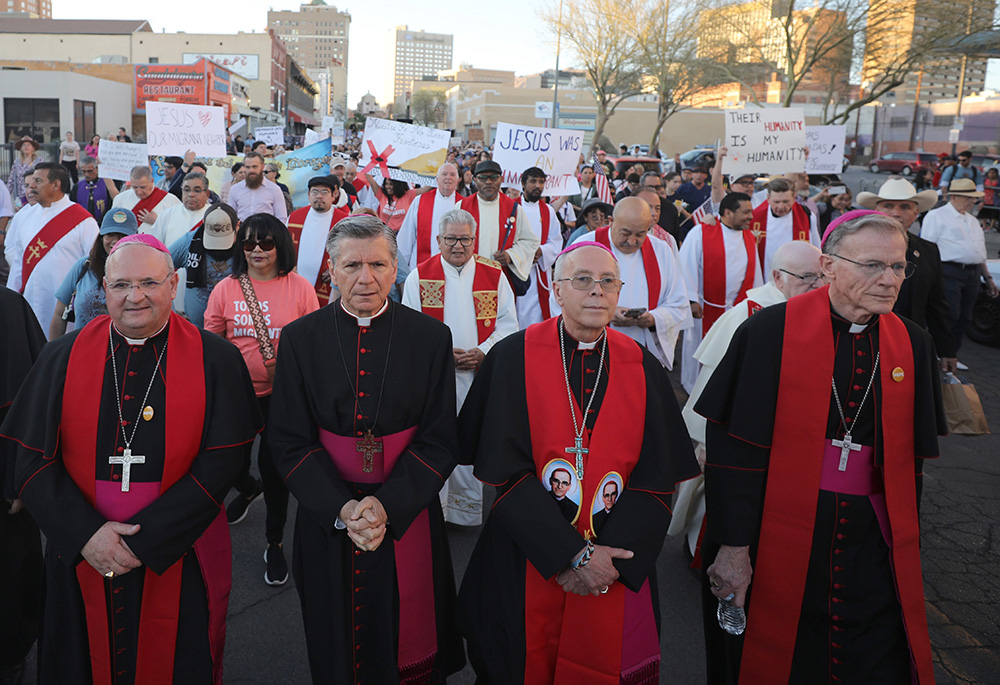
Archbishop John C. Wester of Santa Fe, New Mexico, right, takes part in a demonstration in El Paso, Texas, against mass deportation alongside Bishop Peter Baldacchino of Las Cruces, New Mexico; Archbishop Gustavo García-Siller of San Antonio and Bishop Mark J. Seitz of El Paso. (OSV News/Bob Roller)
According to the bishops' conference's public affairs office, the statement marked the first time in 12 years that the conference invoked the "particularly urgent way of speaking as a body of bishops." The conference last issued such a statement in 2013 in response to the Affordable Care Act's contraceptive mandate.
The bishops also unanimously approved amendments to the immigration statement to stipulate that the conference opposes the "indiscriminate deportation" of people without due process.
"Should we not say that we oppose the indiscriminate deportation of people, which is taking place today? I think that's a central issue," Chicago Cardinal Blase Cupich said.
The bishops' statement also cites several scriptural passages to argue that the Catholic Church's concern for the plight of immigrants "rests on the foundational concern for the human person, as created in the image and likeness of God."
Advertisement
Bishop Thomas Paprocki of Springfield, Illinois, and other bishops praised the statement from the floor as striking a balanced tone.
"I think it is both compassionate for the concerns of migrants and at the same time expressing the call for meaningful immigration reform, which I think is so much needed," said Paprocki, who added: "The immigration system is broken and the laws need to be reformed."
"It is a strong statement. It is a balanced statement" that calls on lawmakers and the Trump administration to offer a meaningful path of reform, said Oklahoma City Archbishop Paul Coakley, the president-elect of the conference.
The bishops voted overwhelmingly to pass the immigration statement, with 216 voting yes, 5 against and 3 abstaining.
In their public session, the bishops also approved the revised text of the Ethical and Religious Directives for Catholic Health Care Services by a vote of 206 in favor, 8 against and 7 abstaining.
The revised directives, which are described as the "authoritative guidance" for U.S. Catholic health care institutions, now mandate that Catholic facilities not provide gender-affirming medical treatment to transgender patients.
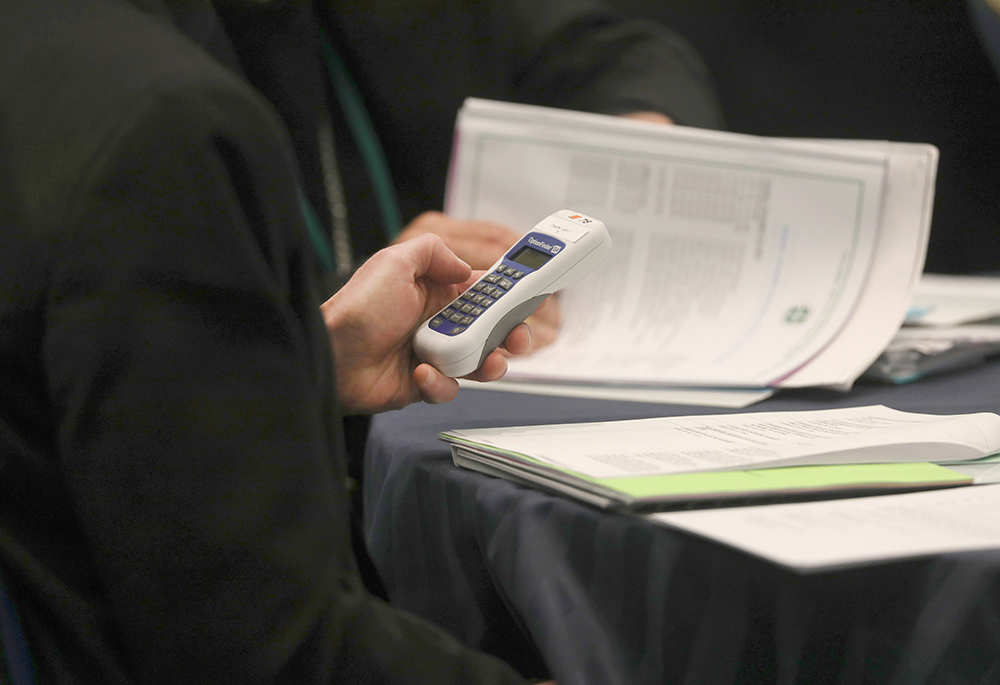
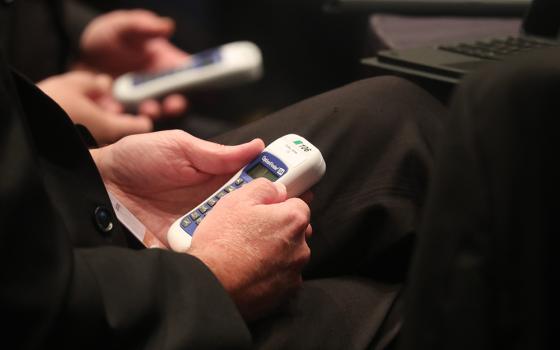
A bishop uses an electronic voting device during a Nov. 14, 2023, session of the fall general assembly of the U.S. Conference of Catholic Bishops in Baltimore. (OSV News photo/Bob Roller)
In Part III of the revised directives, Catholic health care institutions are instructed not to perform any medical interventions "that aim to transform sexual characteristics of a human body into those of the opposite sex."
Catholic health care institutions are called upon to "employ all appropriate resources to mitigate the suffering of those who experience gender incongruence or gender dysphoria," while only using means "that respect the fundamental order of the human body."
If patients or their surrogates request medical interventions not in accord with the church's moral teachings, then Catholic health care professionals will not be permitted to refer them to another professional for the purpose of obtaining those interventions, according to the revised directives.
Bishop Robert Barron of Winona-Rochester, Minnesota, who has been outspoken on issues related to so-called gender ideology, said he supported the revised directives.
"It's very important that the church make a strong statement here," Barron said.
Bishop Thomas Daly of Spokane, Washington, said the revised directives provide "clarity with regard to hospitals and the relationship between bishops and health care systems, knowing that what the church does believe and teach is available and promulgated."
The bishops' vote aligns the directives with a doctrinal note that the bishops' Committee on Doctrine released in March 2023 that focused on what the prelates called the "moral limits to technological manipulation of the human body."
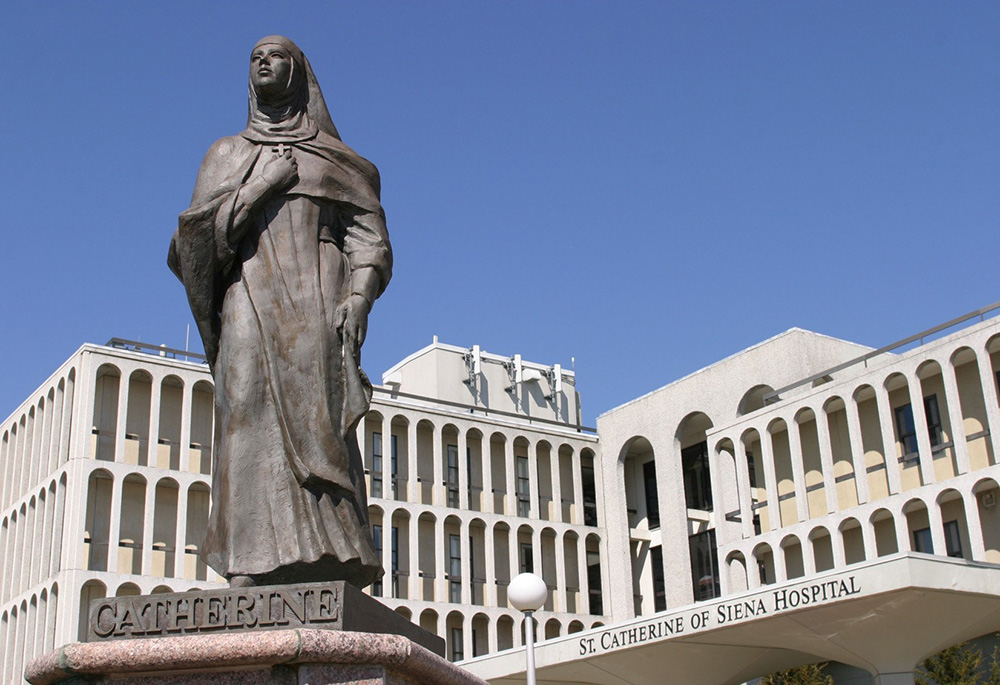
A file photo shows a statue of St. Catherine of Siena at the entrance to the medical center that bears her name in Smithtown, New York. (OSV News/Long Island Catholic/Gregory A. Shemitz)
"As the [doctrine] committee was preparing that document, we were well aware that the guidance it offered would eventually need to be incorporated into our ethical and religious directives," said Brooklyn Auxiliary Bishop James Massa, chairman of the Doctrine Committee.
During his Nov. 11 public presentation on the revised directives, Massa said the committee consulted ethicists, physicians and stakeholders in Catholic health care that included the Catholic Health Association of the United States and the National Bioethics Center. Massa said the doctrinal note underwent seven drafts.
"The feedback we received was invaluable, allowing the committee to reshape and refine the document over a period of almost four years," Massa said.
The doctrinal note said gender-affirming medical treatments — which may include hormonal therapies and surgical procedures — are "injurious to the true flourishing of the human person," and said that Catholic health care services must not perform them.
The note added that such interventions "do not respect the fundamental order of the human person as an intrinsic unity of body and soul, with a body that is sexually differentiated."
Opinions among Catholic theologians, bioethicists and LGBTQ advocates were split about the doctrinal note. Some observers said the document's language reflected a cautious approach in an area of moral theology and doctrine that is not yet fully developed. Others said the note demonstrated a lack of understanding and engagement with transgender people.
"In a church called to synodal listening and dialogue, it is embarrassing, even shameful, that the bishops failed to consult transgender people, who have found that gender-affirming medical care has enhanced their lives and their relationship with God," said Francis DeBernardo, executive director of New Ways Ministry, an organization advocates for LGBTQ Catholics.
DeBernardo said in a prepared statement that the revised directives "will harm, not benefit transgender persons," and added that they will "be seen as part of the continuing disturbing trend in the U.S. to deny the reality of transgender identities."
Before they approved the directives, the bishops elected the new chairmen of six conference committees:
- Milwaukee Archbishop Jeffrey Grob, Committee on Canonical Affairs and Church Governance;
- Portland, Oregon, Auxiliary Bishop Peter L. Smith, Committee on Ecumenical and Interreligious Affairs;
- Pensacola-Tallahassee Bishop William Wack, Committee on Evangelization and Catechesis;
- Ukrainian Catholic Archeparchy of Philadelphia Archbishop Borys Gudziak, Committee on International Justice and Peace;
- Bishop Mark O'Connell, soon to be installed as bishop of Albany, New York, Committee on the Protection of Children and Young People;
- Portland, Oregon, Archbishop Alexander Sample, Committee on Religious Liberty.
The bishops also elected Fort-Wayne-South Bend, Indiana, Bishop Kevin Rhoades as the new conference secretary. Rhoades will succeed Coakley, who was elected the new conference president on Nov. 11.