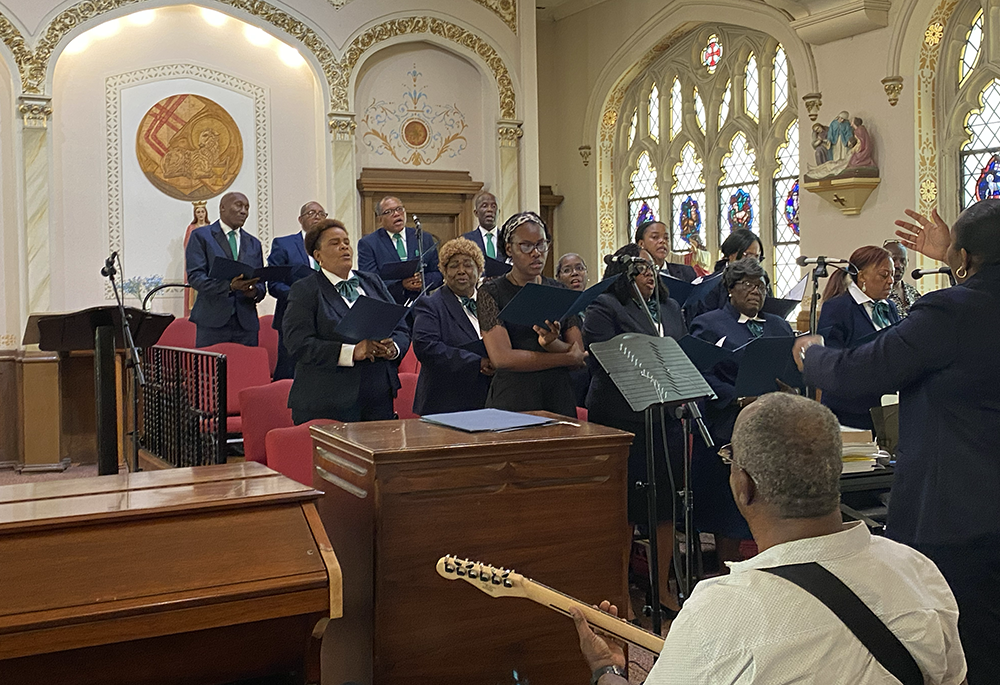
The choir sings at St. Barbara Catholic Church for the Haitian Catholic Community of Philadelphia’s Creole Mass, on July 20, 2025. (NCR photo/Renée Roden)

by Renée Roden
On a July Sunday, a congregation of 60 — grandparents, teenagers and toddlers — gathered at St. Barbara Catholic Church in Philadelphia, one of two Catholic churches in Philadelphia where Haitian Catholics have been worshipping for more than 30 years.
A choir led the congregation in Haitian Creole hymns, accompanied by keyboard, electric bass and drums. A teenage girl after Mass led a rendition of "Amazing Grace" in English. The music was vibrant and the mood was glad, filling the half-full church with life.
But, afterwards, several of the parishioners spoke about how their numbers had decreased recently. Newer immigrants, especially those seeking asylum or on Temporary Protected Status, have not been leaving their homes, not even to come to church.
"They are afraid," said Oblate Fr. Eugène Almonor, pastor of St. Barbara's and chaplain to the Haitian community in the Archdiocese of Philadelphia.
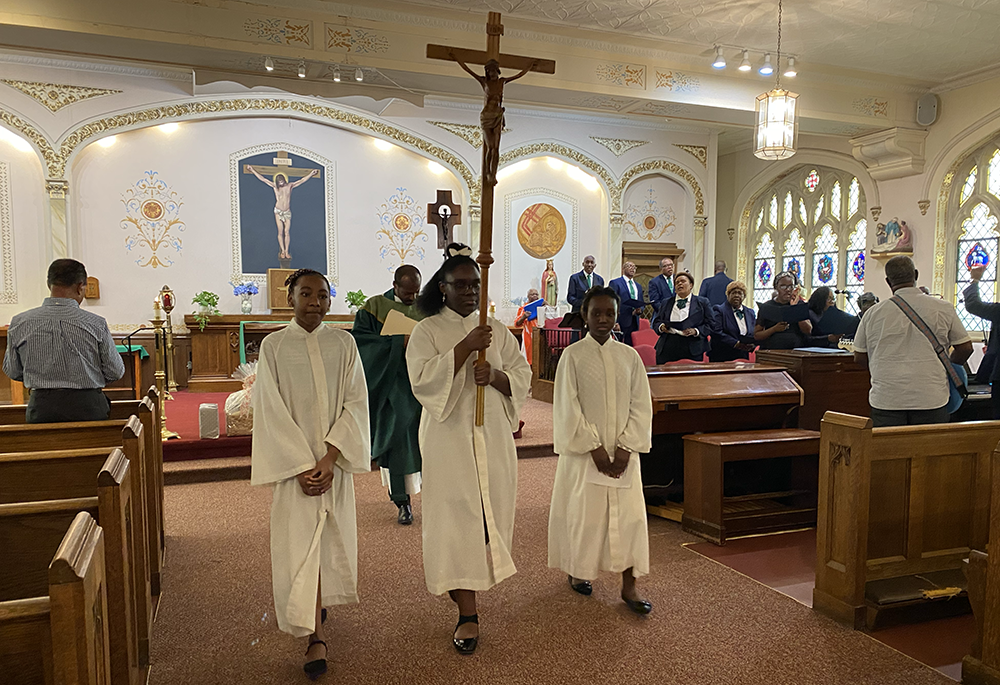
Altar servers join Oblate Fr. Eugène Almonor for closing procession at St. Barbara Catholic Church in Philadelphia, on July 20, 2025. (NCR photo/Renée Roden)
A church in fear
Philadelphia is included in one of the U.S. metropolitan areas with the most immigrants from Haiti, according to the Migration Policy Institute. As of March 2024, the city has been home to roughly 30,000 Haitians, per local media reports. There are more than 850,000 Haitian immigrants in the United States, according to the Center for Immigration Studies, and close to 70% of them are naturalized citizens.
"To be a Haitian immigrant in this country right now; your faith is one of the most important resources you have," said Terry Rey, professor of religion at Temple University in Philadelphia.
One parishioner of the Haitian Catholic Community of Philadelphia, which meets at St. Barbara Catholic Church and Church of St. William, said recently arrived relatives were afraid to apply for political asylum, thinking that putting their names in the system would only attract the attention of U.S. Immigration and Customs Enforcement officials.
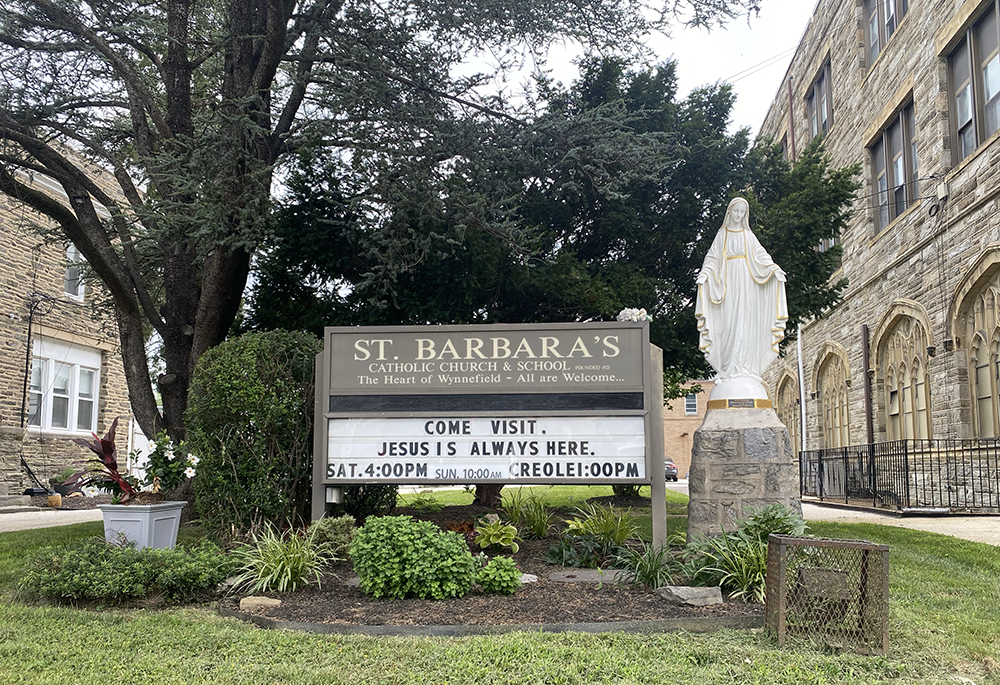
Sign outside St. Barbara Catholic Church in Philadelphia (NCR photo/Renée Roden)
This same tension is felt in other Haitian communities in the United States, including in one of the largest, in the Archdiocese of Miami. "Many people feel threatened by the current policy," said Fr. Reginald Jean-Mary, pastor of Notre Dame D'Haiti Catholic Mission in Miami's Little Haiti neighborhood. "So, out of fear and prudence, many people do not take to the streets."
Jean-Mary, pastor at the church for the past 22 years, was born in Haiti and came to Miami as a seminarian for the Archdiocese of Miami.
Although ICE has not approached the church, the priest said people have seen agents along their streets and it intimidates them, Jean-Mary said.
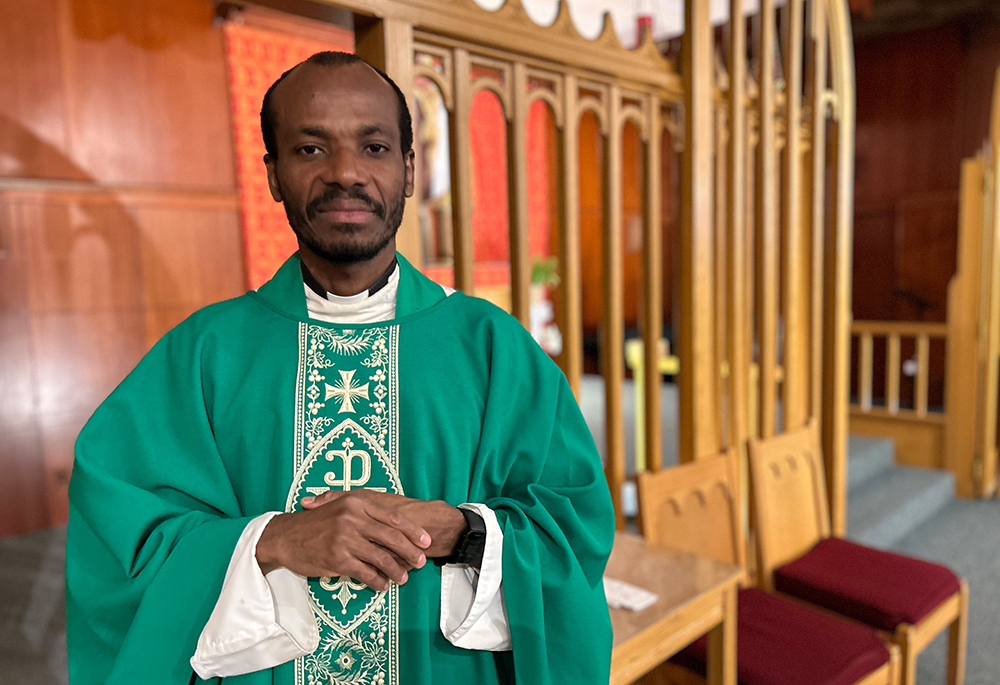
Fr. Eugène Almonor, an Oblate of Mary Immaculate, who is chaplain of the Archdiocese of Philadelphia's Haitian Catholic community, is seen after morning Mass June 30, 2025, at Church of St. William in Philadelphia. Almonor, born in Haiti and now a U.S. citizen, said many in his pastoral community have stopped attending Mass and going out in public as the Trump administration seeks to end humanitarian protections for Haitians seeking refuge in the U.S. (OSV News/Gina Christian)
'We are like Jesus'
"The church has been very active in accompanying the migrants," said Jean-Mary.
Notre Dame D'Haiti hosts the Pierre Toussaint Center, named for the Haitian-American who was declared venerable in 1996. The center offers literacy classes in Haitian Creole and English as a second language, computer skills and legal aid. Jean-Mary said 200 new arrivals would easily show up on the three days a week they are open. But not anymore.
"So many of them do not come out of their houses," he said. "People do not come out any more for services or humanitarian programs." He also said an archdiocesan legal program assisting refugees is no longer operating at the parish.
Jean-Mary said that Haitian priests who come to the states have reported their relatives have been kidnapped or murdered, or have faced political persecution. "Day by day it is getting even worse," he said.
"People don't have a choice but to find a safer place to live," he said. Many Haitian immigrants would visit Haiti frequently but have not been able to return because of the violence there.
Fr. Dieuseul Aidain, coordinator of the Haitian Apostolate in the Archdiocese of Newark, New Jersey, put it this way: "Some of them, they lost their homes and everything; the gangs, they took everything, they left them empty-handed."
After the pandemic, his parish of Our Lady of the Holy Rosary-St. Michael in Elizabeth, was full, and a good number of his parishioners were on Temporary Protected Status.
"Now they are really scared, they don't come. Most of them don't want to be taken by ICE," Aidain told the National Catholic Reporter. "They can't go back home and they can't stay here; they are not welcome. The Haitian people, we are like Jesus, the son of man who doesn't have a place to stay."
Even as fear cuts off Haitians from official channels of aid, individual Catholics have stepped up to house, feed and accompany Haitian immigrants through immigration proceedings.
Lisa and Greg Neuhauser, parishioners at Holy Spirit Catholic Church in Palmyra, Pennsylvania, met a Haitian-Dominican couple while volunteering last year at the U.S.-Mexico border with Del Camino Jesuit Border Ministries and Team Brownsville, a nonprofit started by teachers to welcome migrants who come into Brownsville and provide support for migrants camping out on the Gateway International Bridge.
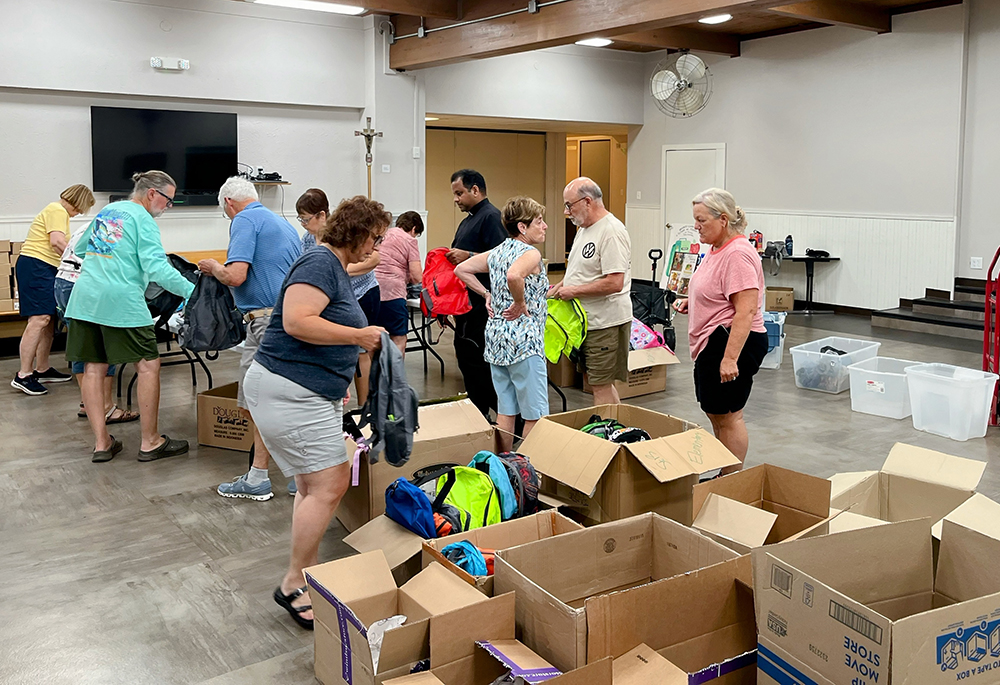
Lisa Neuhauser, far right, volunteers in 2024 with fellow parishioners from Holy Spirit Catholic Church in Palmyra, Pennsylvania to organize backpacks for migrant children. (Courtesy of Lisa Neuhauser)
The migrant couple was originally bound for Springfield, Ohio, but when they arrived, their friend could not house them. Lisa Neuhauser had given them her business card and two weeks later, they showed up at her office in Harrisburg, Pennsylvania.
Neuhauser and several members of her parish's Migrant Justice Ministry and Knights of Columbus' council helped the couple find and furnish an apartment and shared meals together and celebrated their wedding with them.
She told NCR there are many simple ways to help new arrivals, but one of the most important things was to accompany them in finding their own autonomy.
"Our charity doesn't do any good if we don't acknowledge them as people," she said.
Advertisement