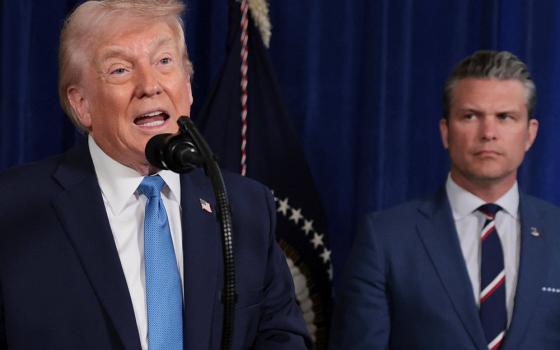
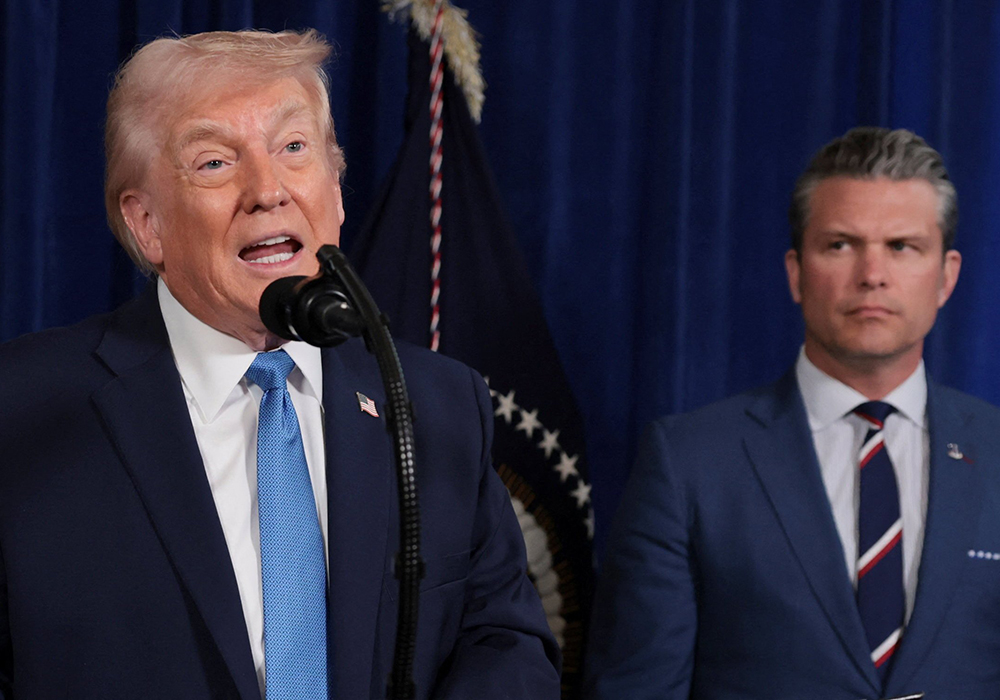
U.S. President Donald Trump speaks from Trump's Mar-a-Lago club in Palm Beach, Florida, 2026, as Secretary of Defense Pete Hegseth looks at him during a news conference following a U.S. strike on Venezuela where President Nicolás Maduro and his wife, Cilia Flores, were captured. (OSV News/Reuters/Jonathan Ernst)
It would be difficult to script a more apt, if disturbing, beginning to the second year of Donald Trump's second term in office: A president carrying 34 felony convictions, held legally liable for sexual abuse, and the prime mover in an insurrection aimed at overthrowing his own government decides, with an air of moral superiority, to invade a sovereign nation and snatch its leader, a noted scoundrel in his own right.
In the long list of Trump's brazen deflections and acts of unbridled arrogance, his invasion of Venezuela and capture of Nicolás Maduro certainly competes for top of the list. It was a breathtaking example of his self-absorbed and illiterate approach to foreign policy.
Finding solace in the fact that Maduro was already under U.S. indictment or that he was, by all reliable accounts, illegally remaining in office, or that an argument might be made for the just compensation owed international companies for their investment in Venezuela's oil industry, is dancing in the margins around the central problem facing citizens of the United States.
The most serious problem is the confrontation with ourselves to which Trump keeps driving us. In his relentless bludgeoning of the rule of law and democratic norms, it may seem impossible to find footing enough to take stock. But failing to do so, overlooking what is so clearly obvious, is far more dangerous in the long haul than the occasional stumble.
In all of his excesses — bizarre, illegal, destructive of norms and often requiring that we buy in to his alternate reality — Trump dares us to take stock, dares us to say that he's gone too far, dares us to engage in acts of resistance equal to his destructive behavior.
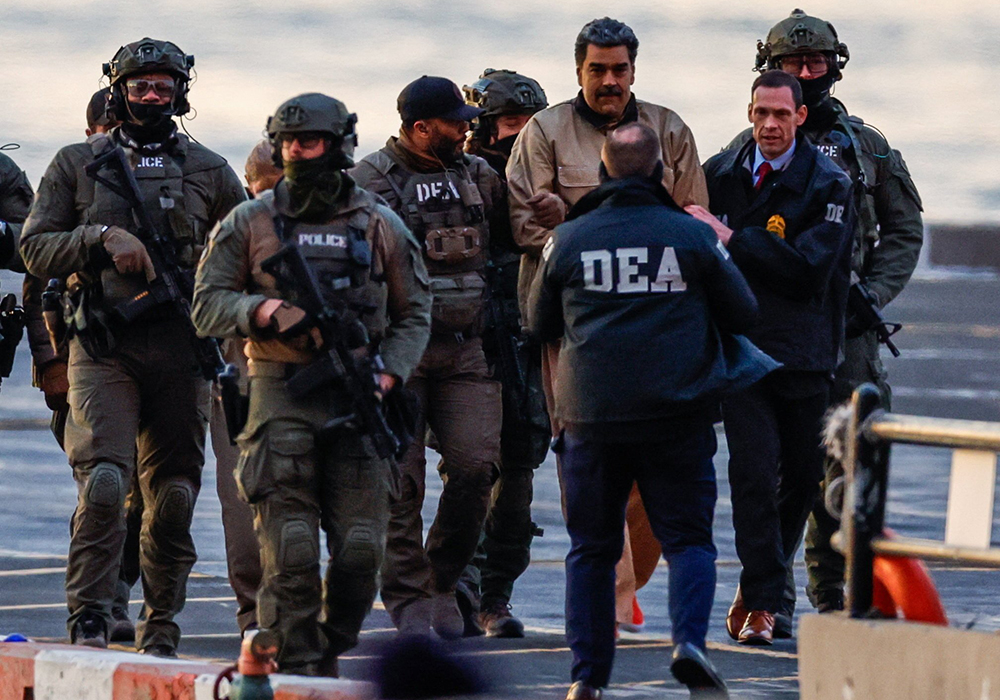
Captured Venezuelan President Nicolás Maduro arrives at the Downtown Manhattan Heliport in New York City Jan. 5, 2026, as he heads towards the Daniel Patrick Moynihan United States Courthouse for an initial appearance to face U.S. federal charges including narco-terrorism, conspiracy, drug trafficking, money laundering and others. (OSV News/Reuters/Eduardo Munoz)
An unintended but excruciatingly obvious irony in the Maduro affair is telling. There are striking parallels between how Maduro became an international bad boy and Trump's ambitions to autocracy.
Javier Corrales, professor at Amherst College and author of Autocracy Rising: How Venezuela Transitioned to Authoritarianism, in a November column in The New York Times, described Maduro's tactics as he established his dictatorship. He went after political opponents, co-opted institutions and other groups, turning critics into supporters. He packed courts with friendly judges, interfered with election processes, and instituted a paramilitary force designed to suppress civilian dissent.
Few precise one-to-one comparisons exist between Trump and Maduro. But there is enough similarity — especially amid the fifth anniversary of the Jan. 6 riot at the Capitol — to raise alarm. We are living through a transition in the United States from what had been the norms of a democratic republic to something quite different and distinctly the product of Trump and his inner circle. We've seen institutions co-opted, individuals who once pronounced the most severe criticisms of Trump now doing his bidding, a Trump-heavy Supreme Court making unprecedented concessions to the executive branch, and Congress ceding its power and responsibilities to avoid confrontations with Trump.
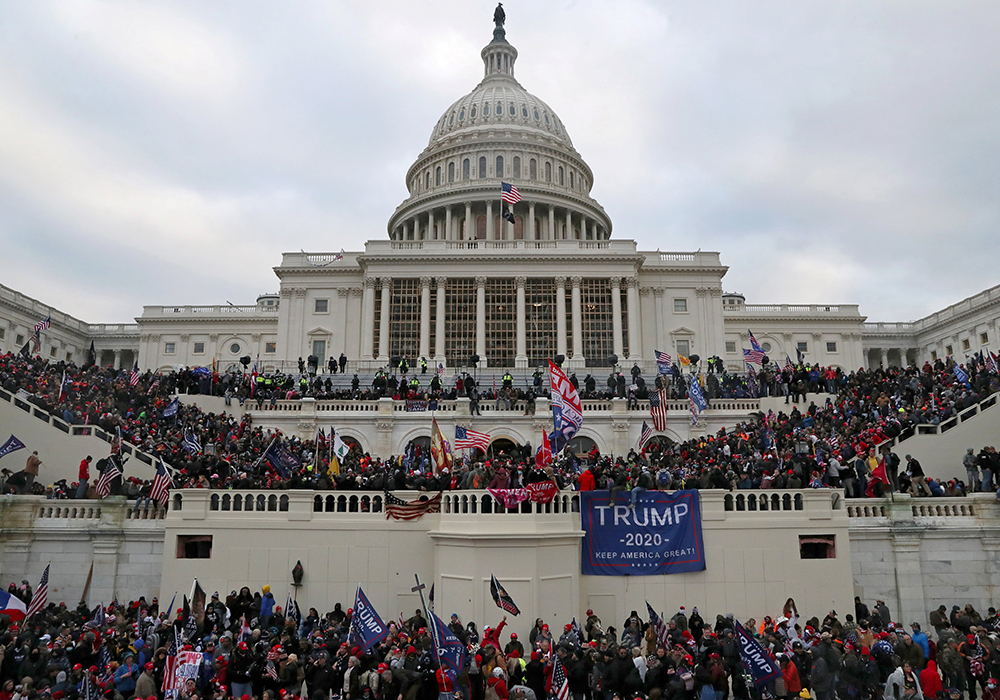
President Donald Trump supporters breach the U.S. Capitol in Washington Jan. 6, 2021. (CNS/Reuters/Leah Millis)
Perhaps most frightening is the administration's establishment of what is turning into an increasingly unbridled paramilitary force. Immigration and Customs Enforcement's (ICE) masked and unidentified agents are beyond accountability even when arresting and sometimes beating U.S. citizens under the guise of immigration control. And the situation will only get worse. The administration is rolling out a $100 million campaign to attract new recruits, targeting those from portions of the society who show a love of guns and militarism. We should be raising a loud and unending alarm.
***
An abundance of history, some quite recent, demonstrates that the United States is highly competent in overthrowing governments but terribly incompetent at what follows. The costs in human life, treasury and standing in the world have far outweighed any benefits.
We went through a period of upending governments to the benefit of U.S. corporate interests seeking access to another country's resources during the Eisenhower era. In 1953, the U.S. orchestrated the overthrow of Iran's democratically elected government and installed Shah Mohammad Reza Pahlavi, largely to gain access to oil. In 1954, the U.S. engineered a coup overthrowing the democratically elected president of Guatemala who had dared to nationalize some of the massive holdings and challenge exploitative practices of the United Fruit Company.
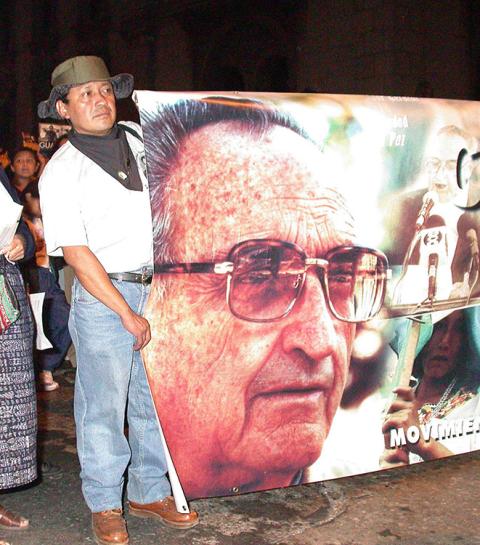
A Guatemalan man holds the end of a banner featuring a photo of the late Auxiliary Bishop Juan Gerardi Conedera April 26, 2003, in Guatemala City. Gerardi was killed April 26, 1998, two days after his release of a report detailing human rights abuses by government security forces during Guatemala's lengthy civil war. (CNS/Paul Jeffrey)
What followed in Iran was the brutal rule of the shah who was finally deposed in the Iranian revolution of 1979. A democracy became a theocracy and, today, a nuclear threat.
What followed in Guatemala was a 36-year civil war that resulted in the slaughter of an indigenous population to the degree that the United Nations officially termed it a genocide. Government-aligned death squads committed countless assassinations of officials and leaders of organizations, including that of a Catholic bishop who dared to compile a report detailing the horrors of the decades of military/oligarchical rule.
NCR did not hesitate to oppose the 2001 invasion of Afghanistan as wrong-headed revenge that would benefit no one. That pointless conflict ended in an embarrassing retreat that concluded an effort costing about $8 trillion and 900,000 lives, not to mention a legacy of physically and emotionally and morally wounded U.S. veterans. And we can't find it in us to muster the resources for universal health care.
NCR came out strongly against both the 1991 Gulf War and the 2003 invasion of Iraq, as well as the 10-year sanctions of that country that resulted in the disintegration of a culture and the deaths of 500,000 children under the age of 5. At that point in our history it didn't take a sophisticated understanding of international relations to comprehend the enormous risks in attempting to occupy another country and change its political and governance culture.
Advertisement
Venezuela, as some supporters of the invasion like to point out, is not the Middle East. But it is also not risky speculation to assert that Trump and company have no idea of what comes next or how that will affect our standing not only in the region but the rest of the world. The easy bet is that once the gloating about a military operation subsides, the complications and unintended consequences take over.
The layers of legal questions alone will keep opposite sides busy for the indefinite future. The unknowns in Trump's bluster about U.S. corporations going in and taking millions out of the ground are beyond daunting.
The utter confusion about what comes next was evident at the highest levels. Trump declared that the U.S. would run Venezuela until there was a satisfactory transition. His secretary of state, Marco Rubio, one of those whose conscience did a 180 on Trump following his first election, was insisting in interview after interview that what Trump really meant was that we would coerce Venezuela into playing nice.
***
Maduro was not, by any rational measure, a threat to U.S. security. Certainly, nowhere near posing the danger presented by Russia's Vladimir Putin. The allegation that he was involved in the exportation of cocaine to the U.S., likely accurate, rings especially hollow in light of Trump's pardon of Juan Orlando Hernández, the former president of Honduras, who was serving time after being convicted of exporting hundreds of tons of cocaine into the United States.
Trump's approach to foreign policy has the transactional quality that might be of benefit in a game of Risk, but in the real world it is naively simplistic and more often than not self-interested or a matter of crude retribution. His venture into Venezuela was a demonstration of all of the above.
He wants the oil. He wants revenge. He wants to distract.
On that last count, his venture has been a success. The disgrace recalled in the fifth anniversary of Jan. 6 and Trump's central role as an insurrectionist has been overwhelmed by the Venezuela escapade. So has the stunning and sharply etched, if quietly spoken, testimony of former special counsel Jack Smith detailing the criminal evidence beyond a reasonable doubt gathered against Trump. Overwhelmed, too, is concern over the Justice Department's continued defiance of deadlines in releasing the Epstein files. And it is difficult to squeeze in even a few words about wildly escalating health care premiums.
In the meantime, Trump has delivered a chilling message to other autocrats: If you have the military capability to grab another country's leader you'd like out of the way, construct a narrative and go get them.
The aspiring autocrat knows how to survive. The Venezuela venture was another act of lawless chaos that further emboldened Trump to look around the hemisphere and wonder aloud at taking over Colombia, Mexico, Cuba and Greenland.
In any previous era such would be considered the unhinged ravings of a madman. Today? He's daring us to look the other way.