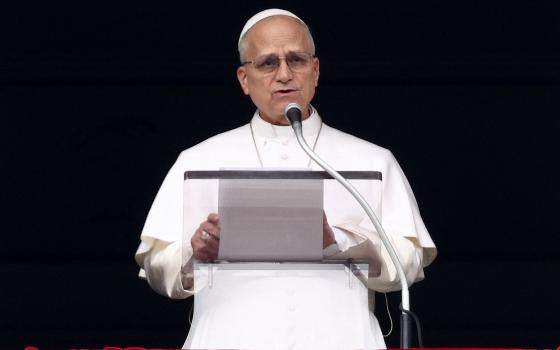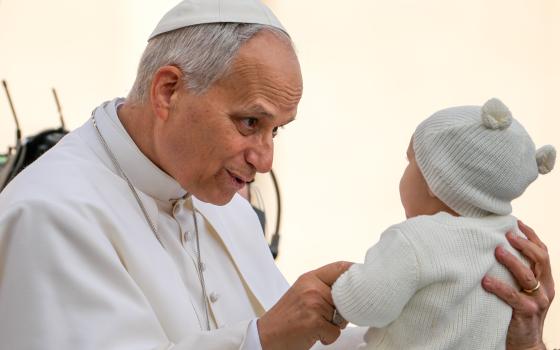
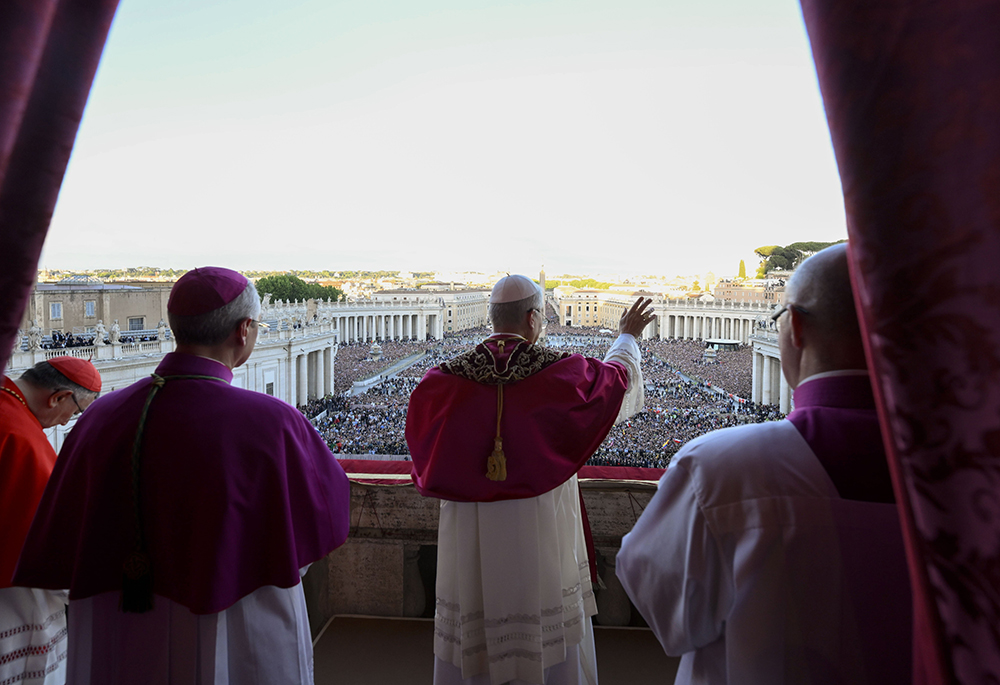
Pope Leo XIV, the former Cardinal Robert Francis Prevost, waves after walking onto the central balcony of St. Peter's Basilica at the Vatican May 8, 2025, following his election during the conclave. (OSV News/Catholic Press photo/Vatican Media)

The first dinner of the conclave was, in a word, forgettable. "Rather plain," recalled Cardinal Joseph Tobin of Newark, New Jersey. After hours cloistered inside the Sistine Chapel on May 7, with the world watching for smoke — almost certainly black — he and the other cardinals returned to Casa Santa Marta on the other side of the Vatican for a meal that matched the mood: subdued, restrained, utilitarian.
"I do remember there was quite a contrast between the meals we were served during the conclave, which were rather simple, and for an Italian kitchen, which is universally exalted for its variety and creativity, rather plain. And then I noticed that the evening of the 8th, after we had done our job, there was a very lovely meal served," Tobin said.
"I could only conclude they didn't want us to get too comfortable."
There wasn't much laughter that first night. The conversations were quiet, searching. "I hope I'm not being naive, but I really believe that most of the cardinals I spoke with were honestly trying to discern the will of God," he said, "by reading the signs of times and places."
Tobin said he remembers the number of his seat vividly: 54. "When I was 14 and went to seminary high school, that was my laundry number. You had to sew it into everything." He paused, reflecting. "I accepted that as a sign, maybe that what has transpired in the nearly 60 years since 1966 wasn't all caprice. That there was part of a plan here. Maybe it was just a way of reassuring me: Be serene, do your job."
This is the story of how then-Cardinal Robert Francis Prevost — an Augustinian missionary from Chicago who had spent most of his priesthood around the world and then as bishop in Chiclayo, Peru — was chosen as the 268th pope and bishop of Rome, taking the name Leo XIV. Over the course of several weeks after his election, NCR spoke in depth with 20 cardinal electors and influential cardinal non-electors who witnessed the inner dynamics of the conclave and the pre-conclave days.
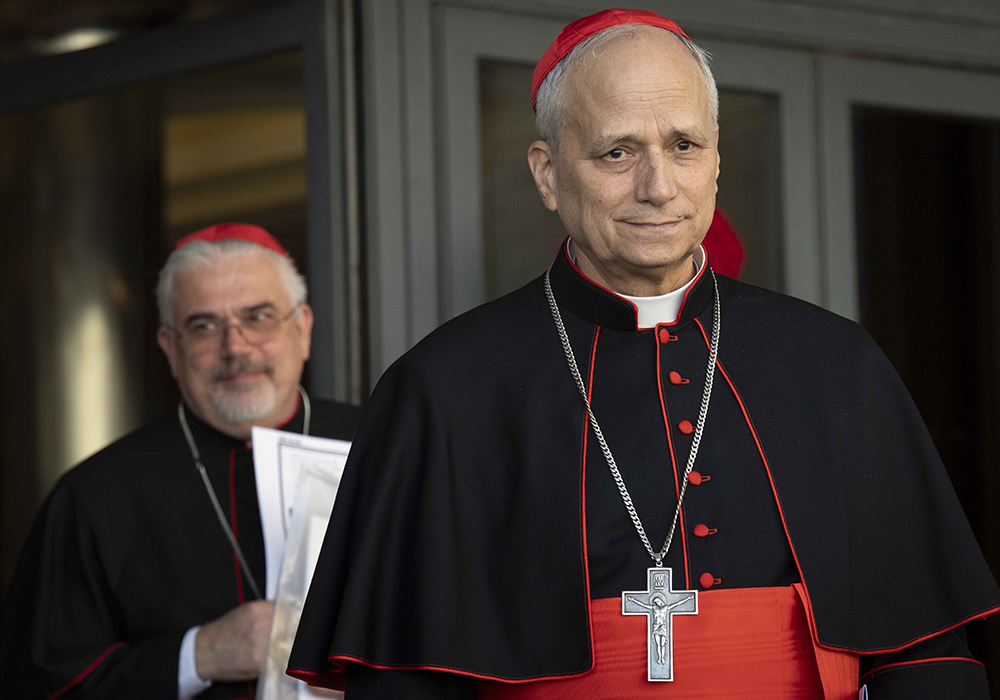
U.S.-born then-Cardinal Robert F. Prevost, then-prefect of the Dicastery for Bishops under Pope Francis, leaves the Vatican Synod Hall April 22, 2025, after the first general congregation of the College of Cardinals. Cardinal Fabio Baggio, undersecretary of the Dicastery for Promoting Integral Human Development, walks out behind him. (CNS/Vatican Media)
Cardinals who spoke to NCR took extreme care not to break the vow of secrecy. That said, they spoke with surprising candor about what shaped their expectations, how instincts and consensus evolved behind closed doors and what ultimately led them to Prevost. This is a step-by-step reconstruction in two parts of those crucial days inside the Vatican, pieced together from the voices of those who lived them — and voted.
Many cardinals, our interviews reveal, were looking for someone who could carry forward the "spirit" of Francis, someone who was like Francis in tone, "but structurally sharp." Few initially looked for an American to fill that role.
It has been six months since that historic conclave. Over this time, the character of Leo's papacy has begun to emerge, allowing cardinals to see if reality matches their expectations. For Catholics across the globe, what the cardinals told NCR about the complicated and surprising process that took place inside the Sistine Chapel will be vitally important to understanding where Leo may take the church.
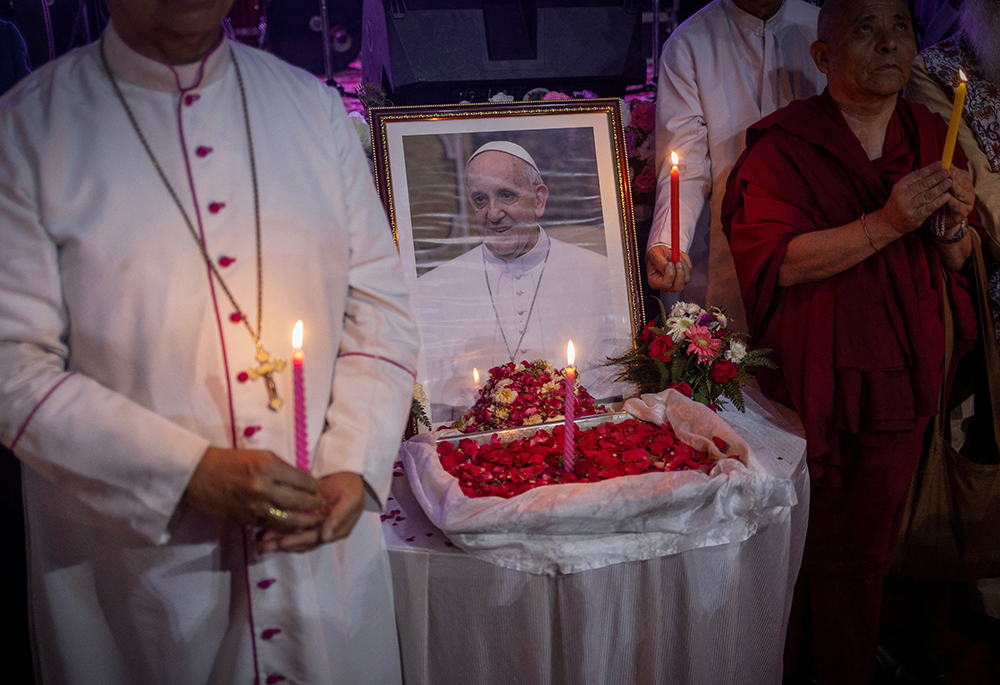
People hold candles in front of a picture of Pope Francis in New Delhi, India, April 21, 2025, after his death was announced by the Vatican. Pope Francis, formerly Argentine Cardinal Jorge Mario Bergoglio, died April 21 at age 88. (OSV News/Reuters/Adnan Abidi)
Grief, grace and quiet path forward
Before any ballots were cast or names exchanged in whispers, there was mourning.
The death of Pope Francis — who had shepherded the Catholic Church through a decade of bold reforms and global turbulence — cast a long emotional shadow over the College of Cardinals. The early days in Rome were not marked by politics or posturing, but by quiet, layered grief. Cardinals gathered in the general congregations — meetings where the cardinals make funeral arrangements, set the date of the new conclave and essentially run the Vatican in the absence of a pope. In these congregations, they began to absorb the weight of an ending.
"I think that roller coaster is not a bad metaphor. There was always grieving in the background," said Tobin. "Francis was not only a mentor, but a friend who instructed me, by his life, how to be a bishop."
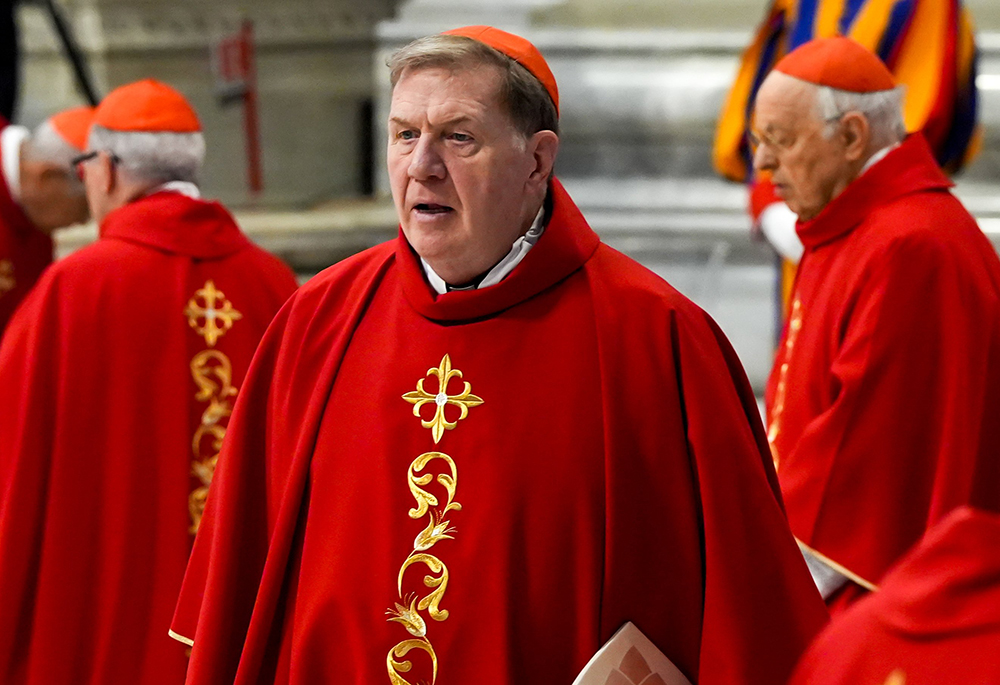
Cardinal Joseph W. Tobin of Newark, New Jersey, processes at the beginning of the Mass on the fifth day of the "novendiali," nine days of mourning for Pope Francis, in St. Peter’s Basilica at the Vatican April 30, 2025. (CNS/Lola Gomez)
For many, the atmosphere was unexpectedly heavy. Indian Cardinal Oswald Gracias of Mumbai, a close friend and collaborator of Francis, admitted he found the days after the funeral "really depressing," struggling to stay in Rome as the reality of the pope's absence settled in. Even seasoned churchmen, with decades in curial circles, were thrown off rhythm by the emotional depth of the moment.
Yet amid that grief, NCR was told, something else emerged — an uncommon sense of calm. As the general congregations progressed, the usual ideological anxieties that sometimes haunt pre-conclave gatherings seemed to quiet. Instead of posturing or faction-building, there was, as Italian American Cardinal Silvano Tomasi put it, "a silent agreement" not to push names too soon. Issues came first: the future of synodality, the needs of the poor, the call to peace, the urgency of credibility.
What surprised some observers — and even some inside the room — was the early consensus that Francis' reforms should not be undone. "After a few days," said Belgian Cardinal Jozef De Kesel of Malines-Brussels, "there was a feeling of great confidence in my heart. I felt that Pope Francis had truly marked the church. There was no going back."
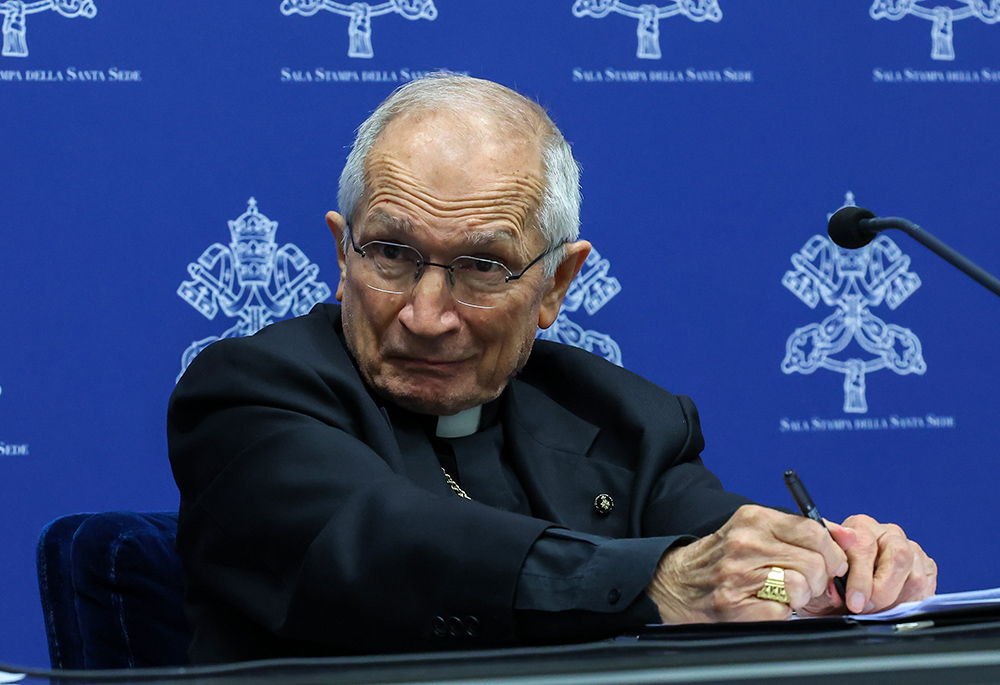
Cardinal Silvano Tomasi, a retired Vatican diplomat, participates in a news conference at the Vatican Dec. 23, 2024. (CNS/Justin McLellan)
Even cardinals who had disagreed with Francis on certain points were, in those early sessions, circumspect. Tomasi said that it would have felt "very difficult" to openly criticize Francis in that room — such was the depth of respect for his legacy and the tone of unity.
The general congregations also served as a stage for lesser-known figures to quietly rise. Cardinal Robert Prevost, a former missionary bishop who had been appointed prefect of bishops only two years prior, spoke during those sessions. "No one ran any kind of electoral campaign. There was no rivalry among the cardinals. There was great reciprocity, great fraternity among us. Prevost also spoke for 10 minutes," De Kesel recalled.
"I remember very well what he said, just to review the situation of the church. And I also felt that for him it truly had to be a continuation of Francis' pontificate."
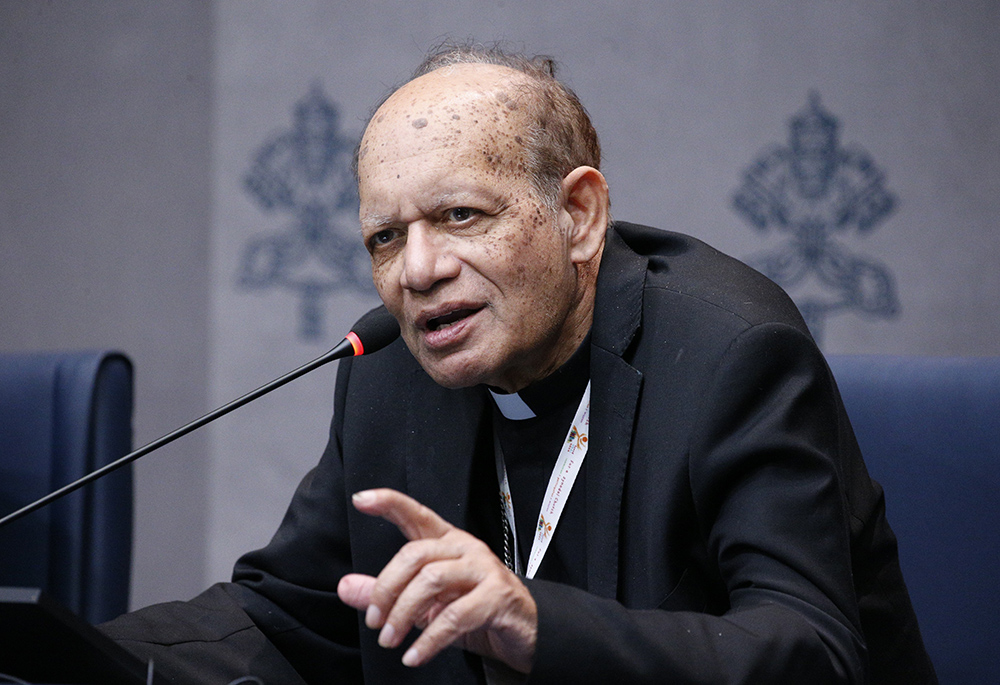
Cardinal Oswald Gracias of Mumbai, India, speaks during an Oct. 7, 2024, news conference on the Synod of Bishops on synodality at the Vatican. (CNS/Justin McLellan)
Gracias as well put it plainly: "One of the sensitive points was, frankly, that we were struggling that Pope Francis just died. He had made a tremendous difference to the church. Now — should we go in the same direction again? That was, I think, the unspoken agenda in the minds of most."
The cardinals listened. And for the most part, they listened to one another. The atmosphere, said Tomasi, was marked by mutual respect, and a kind of collective determination to serve the church in a delicate moment. "Looking back at some pages of church history," he said, "that's not a small achievement."
By the end of those 12 days, orientation lines had begun to form, NCR's interviews revealed. The sense of direction was not about returning to a different past, but continuing a path already set. There was no obvious front-runner yet, but a convergence of mood, memory and mission started to arise.
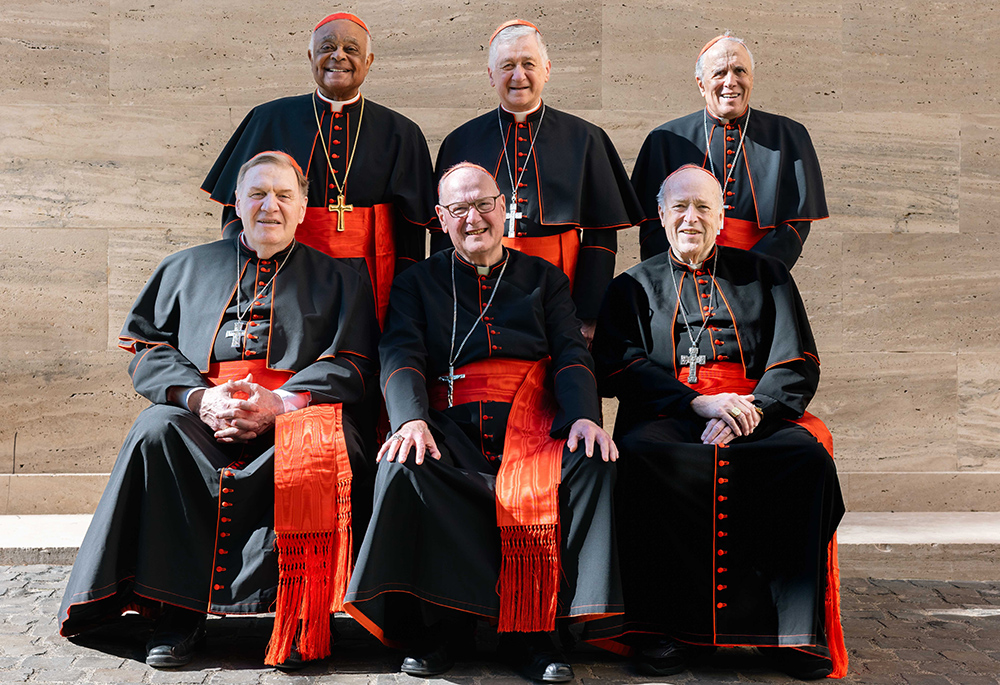
U.S. cardinals pose at the Pontifical North American College in Rome May 6, 2025, before traveling to their temporary residences inside the Vatican where they will stay during the conclave to elect a new pope. Standing are, from left, Cardinals Wilton D. Gregory, retired archbishop of Washington; Blase J. Cupich of Chicago; Daniel N. DiNardo, retired archbishop of Galveston-Houston. Seated are, from left, Cardinals Joseph W. Tobin of Newark, New Jersey, Timothy M. Dolan of New York and Robert W. McElroy of Washington. (CNS/Kendall McLaren)
A time of listening
"A spiritual experience," was how Cardinal Robert McElroy of Washington, D.C., described the conclave. "Almost like a little retreat, in this magnificent setting, with the great artistic renderings of God, the transcendent. You're with other cardinals from all over the world, trying to wrestle with this deep question: What is God asking of the church at this moment? And then, who is a leader who could bring us forward along that path?"
The room was no longer just exchanging updates; it was calibrating priorities. Themes repeated themselves: peace, pastoral care, synodality, reform. Some spoke candidly about their longing for spiritual credibility. Others pressed the need for a leader capable of governing — an organizer, a listener, a man with real pastoral soil under his feet.
Cardinal Blase Cupich of Chicago described the profile many cardinals seemed to share. "Surely moving forward in a synodal way was a factor," he said, "but not the only one. We wanted someone who had actual pastoral experience, who had lived on more than one continent, someone who could get things done — and someone who saw his baptism as more important than his ordination."
It was not about cloning Francis, he insisted, "but carrying forward a spirit."
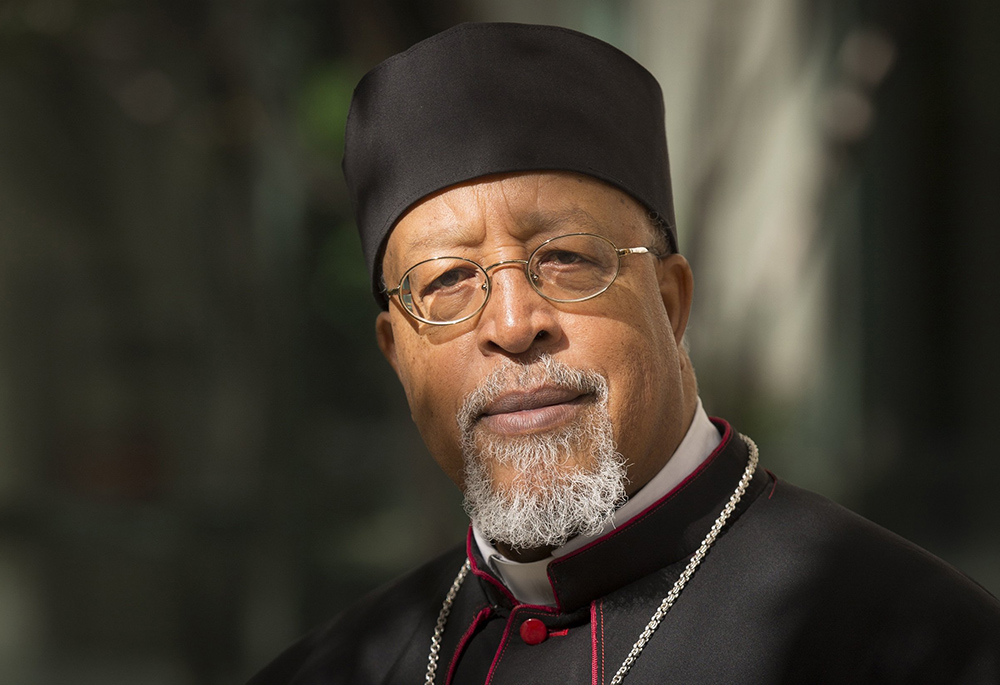
Ethiopian Cardinal Berhaneyesus Souraphiel of Addis Ababa is pictured in a file photo. (OSV News/Nancy Phelan Wiechec)
For the 18 African cardinals present, the moment also carried a distinct urgency. "Africa is now a part of the church to be recognized, and to be reckoned with," said Ethiopian Cardinal Berhaneyesus Souraphiel of Addis Ababa. He said African cardinals emphasized during the general congregations the importance of being heard on cultural and doctrinal matters, from family values to liturgical expression.
"We asked that the universal church see Africa through the eye of the Gospel," he said. "To stay with Africa and to listen."
It was in that complex and converging atmosphere that then-Cardinal Prevost spoke.
Known more in Vatican circles than in headlines, the former Augustinian missionary from the U.S. and Peru, who was at the time the head of the Dicastery for Bishops, wasn't expected to dominate attention. His intervention did something few others managed to do in that hall: It lingered.
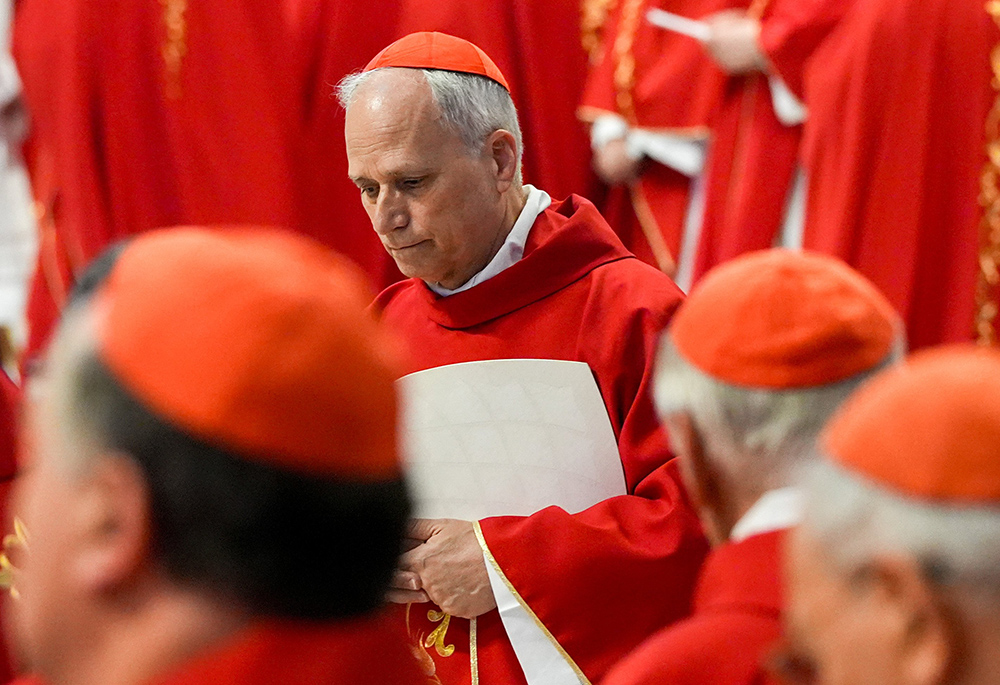
Chicago-born then-Cardinal Robert F. Prevost, then-prefect of the Dicastery for Bishops under Pope Francis, processes at the beginning of the Mass on the fifth day of the "novendiali," nine days of mourning for the late pope, in St. Peter’s Basilica at the Vatican April 30, 2025. (CNS/Lola Gomez)
Italian Cardinal Giuseppe Versaldi, a seasoned curial voice in Rome, remembered Prevost's contribution clearly. "He spoke to outline the guidelines for good governance of the church in response to the ever-new challenges of the world," he said.
"I was not the only one who appreciated his speech," Versaldi said.
Prevost did not campaign. He analyzed. According to several cardinals, he offered a lucid diagnosis of the church's present moment, reflecting on both internal renewal and external credibility. His speech, a Latin American cardinal who wanted to stay anonymous said, was "Franciscan in tone, but structurally sharp" — bridging pastoral compassion with institutional clarity.
Not everyone managed to absorb it fully, NCR was told. Gracias, who was scheduled to speak immediately after Prevost, admitted he regrets he missed most of it while preparing his own notes for his speech. "Unfortunate," he said. "Even at that moment, I felt I really valued his opinion. And now even more."
While no single speech turned the tide, Prevost's remarks were among the few remembered by name. And as the May 7 conclave date approached, the tone among the cardinals began to shift again. "There was an atmosphere of intense spirituality," said Versaldi. "A sense that we were entering sacred ground."
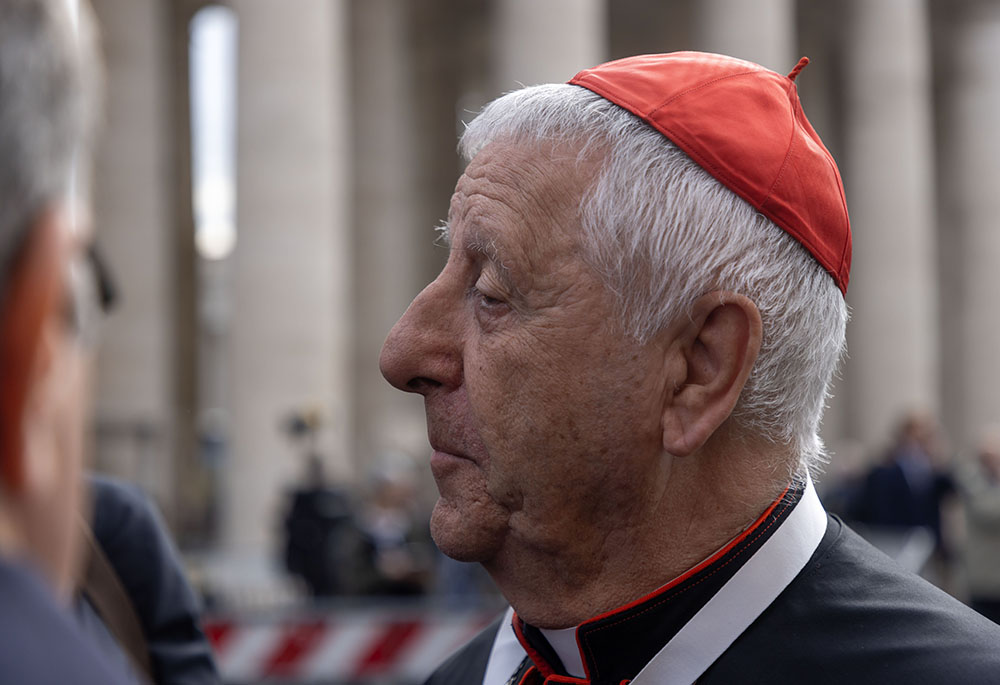
Cardinal Giuseppe Versaldi arrives to attend a general congregation meeting of the College of Cardinals in the New Synod Hall at the Vatican April 28, 2025. The 81-year-old Italian cardinal had been prefect of the former Congregation for Catholic Education. (CNS/Pablo Esparza)
Not a political process
By the time the conclave was about to begin, something had shifted. If earlier days were marked by analysis, networking, even subtle positioning, by the final congregations, cardinals increasingly spoke of grace — not strategy.
"The whole process wasn't political at all," said McElroy. "None of the models of secular politics made sense for what we went through. It was discernment. It really was. Synodality in action. And it unfolded with grace."
Even veteran cardinals — those who had lived through multiple papal transitions — felt this conclave was distinctly spiritual. "It is not the clash of positions," said Italian Cardinal Giuseppe Betori of Florence. "If that were the case, we would still be there, stuck. The purpose of the conclave is to find a point of convergence of all the expectations — of all the expectations, I repeat it — of the different parties, to find an understanding, then a person who can interpret the unity of the church and its path in this time."
Advertisement
Bosnian Cardinal Vinko Puljić of Sarajevo, one of the only five cardinals who had voted in two previous conclaves in 2005 and 2013, echoed the same spirit. "We talked about the church, not about candidates. Each of us studied the others carefully, yes — but when we entered the Sistine Chapel, we voted in silence, under oath, and in faith."
From Casa Santa Marta to the Sistine Chapel, what grew was a quiet awareness of mission. "In truth, we did not experience any external or internal pressure in favor of any candidate," recalled Cardinal Oscar Cantoni of Como, Italy, speaking to the priests of his diocese after the conclave. "While the press indulged in so many predictions, which turned out to be flimsy in the end."
Cardinal Vincent Nichols of Westminster, looking back after the election, believed the speed of consensus said everything. "Just four votes," he said in a press conference after the conclave. "Pope Francis left a college of cardinals that shared lots of his vision, but even more of his spirit of this must be a missionary church."
The time for words was ending. Now, it was time to vote.
Posting Nov. 6 on NCRonline.org: Part 2 - The surprising final moves toward an American pope.
Former NCR executive editor James V. Grimaldi and former NCR Vatican correspondent Christopher White contributed to this story.
NCR’s Rome bureau is made possible in part by the generosity of Bob and Joan McGrath. NCR’s investigative reporting is made possible in part by the generosity of Annette Lomont.