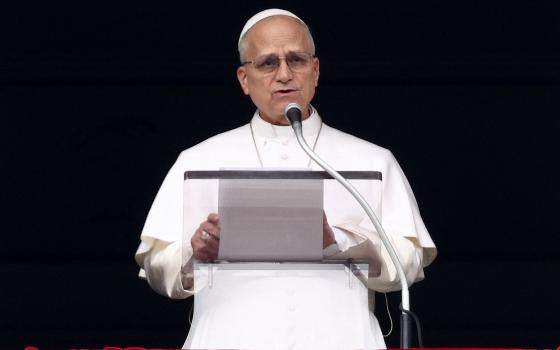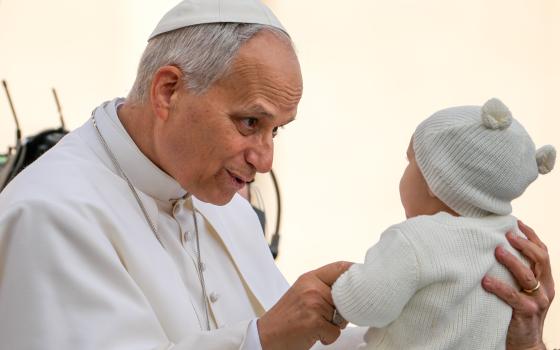
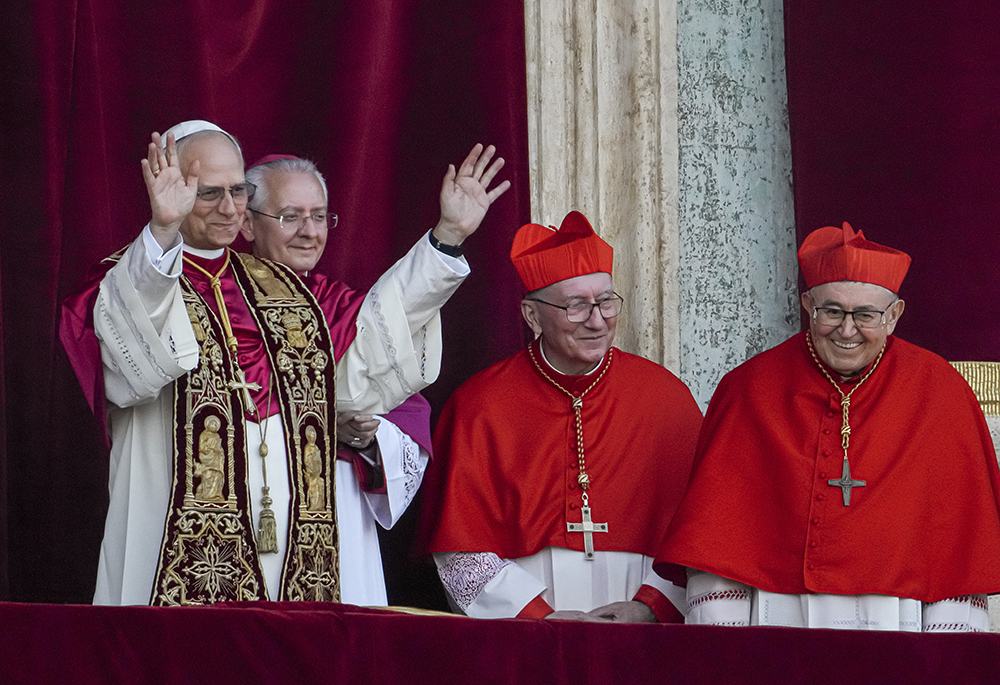
Newly elected Pope Leo XIV, left, formerly Cardinal Robert Francis Prevost, appears with, from left, Archbishop Diego Giovanni Ravelli, master of ceremonies; Cardinal Pietro Parolin; and Bosnian Cardinal Vinko Puljić on the central loggia of St. Peter's Basilica at the Vatican, shortly after he was elected pope, Thursday, May 8, 2025. (AP photo/Domenico Stinellis)

As Pope Leo XIV marks his sixth month in the papacy, Catholics are beginning to see just how he will put his mark on the throne of St. Peter. Leo has spoken out on a range of issues, from artificial intelligence to immigration. He also released his first apostolic exhortation — Dilexi Te — which forcefully reminded Catholics of their need to first serve those who are least among us.
But as cardinals gathered in the Sistine Chapel six months ago, just which path the church would take after Pope Francis was still an open question. They walked into the conclave with no clear favorite in mind.
To understand how then-Cardinal Robert Francis Prevost, an Augustinian from Chicago — a dual citizen of Peru — came to be pope, NCR spoke in depth over several weeks with 20 cardinal electors and influential cardinal non-electors. These prelates participated in and witnessed the inner dynamics of that conclave and the days leading up to it.
Cardinals who spoke to NCR took extreme care not to break the vow of secrecy. Yet they spoke with remarkable candor, revealing how instincts and consensus evolved behind closed doors. In Part 1, the cardinals told NCR about the meetings held in Rome before the conclave began — encounters which started to shape their vision of a post-Francis future.
Now it was time for those discussions to end and for a crucial choice to be made.
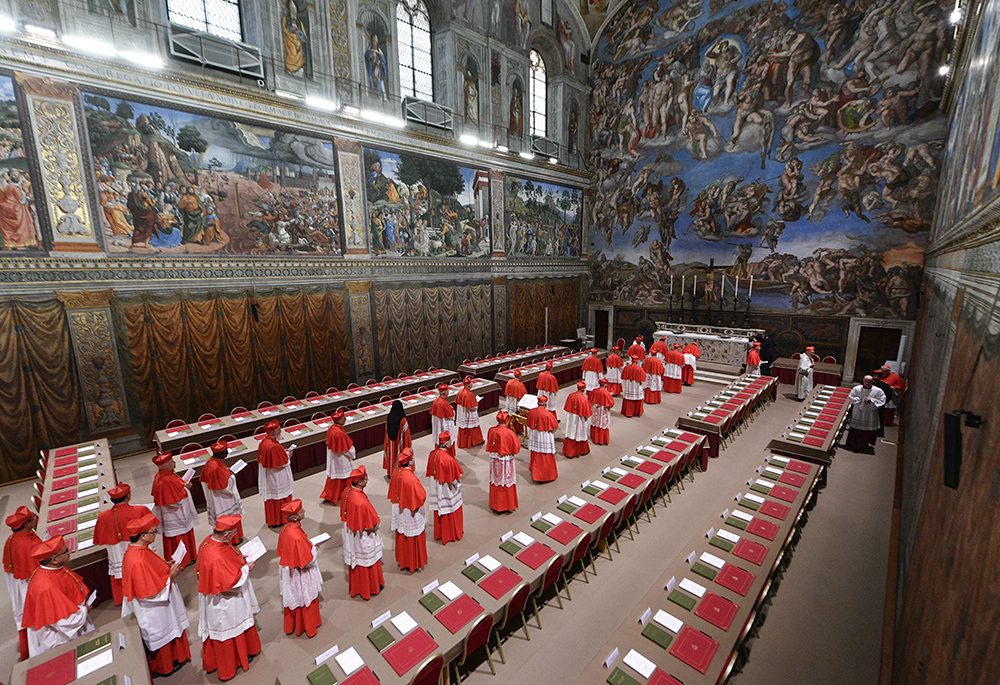
Cardinals process into the Sistine Chapel at the Vatican May 7, 2025, at the start of the conclave to elect a new pope. (CNS photo/Vatican Media)
'An uphill struggle for any American to be elected'
The conclave opened on Wednesday, May 7, with its usual ritual solemnity, but also with a certain physical and spiritual slowness that marked the unique rhythm of this papal election. The first vote came late in the evening, after a long meditation from Cardinal Raniero Cantalamessa, the retired preacher of the papal household.
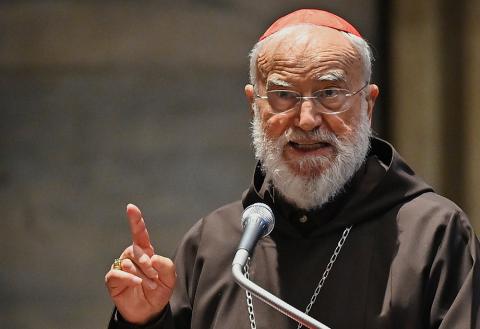
Cardinal Raniero Cantalamessa delivers the homily during the Good Friday Liturgy in St. Peter's Basilica at the Vatican April 2, 2021. (CNS/Andreas Solaro, Reuters pool)
"The first evening, I think it's fairly well known that Father Cantalamessa gave a very long talk. Oh, I was being patient, wasn't I? I would think he was an hour or more," said Cardinal Vincent Nichols of Westminster. "Actually, one person commented, it's his valedictory address. Patience is a good virtue of learning."
The meditation and the ceremonial process took time. As Cardinal Louis Sako of Baghdad recalled: "It took more than 45 minutes to get the ballot papers and proceed with the voting. Some cardinals were very elderly and needed time to walk slowly." Sako was seated in seat No. 5, right next to then-Cardinal Prevost, in seat No. 4, and the two of them ate dinner together that evening.
Despite rumors about fragile health, Bosnian Cardinal Vinko Puljić of Sarajevo corrected what he said were misleading Italian press reports, asserting he had decided to vote from Casa Santa Marta, having three so-called "cardinal nurses" who would have brought his vote to the Sistine Chapel.
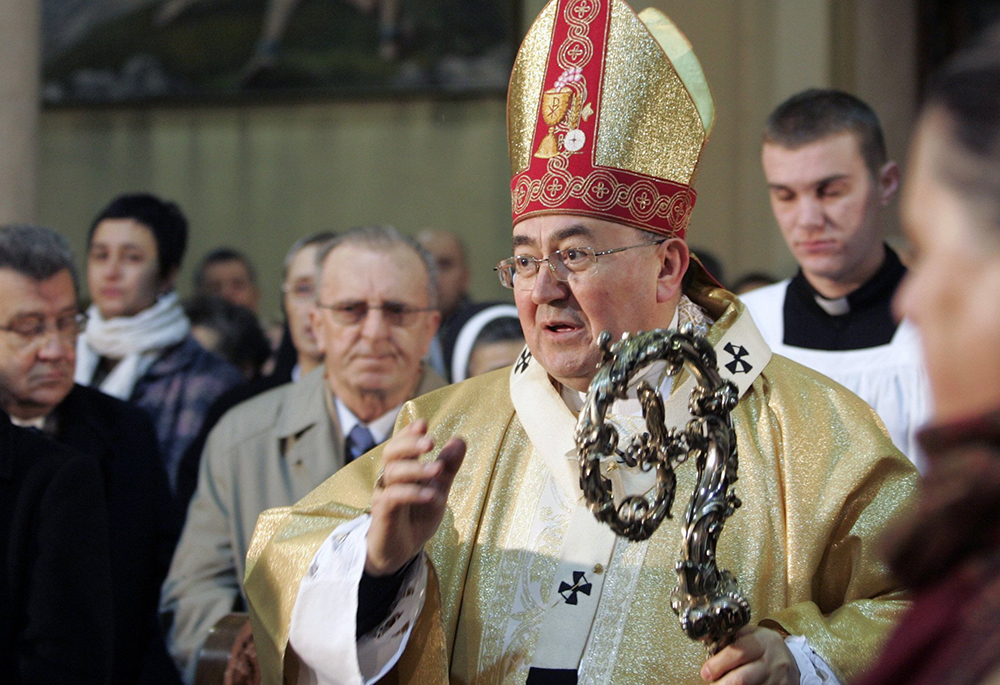
Cardinal Vinko Puljić of Sarajevo, Bosnia-Herzegovina, blesses the congregation as he enters the central Sarajevo cathedral to celebrate Christmas morning prayers Dec. 25, 2008. (CNS/Reuters/Danilo Krstanovic)
"Yes, I voted in the Sistine Chapel. When I arrived in Rome, I immediately said that I was ready to vote in the Sistine Chapel and work like all the other cardinals. When the other cardinals saw me arrive, they greeted me with joy," he said.
The first vote ended after 9:00 p.m. Ethiopian Cardinal Berhaneyesus Souraphiel of Addis Ababa, who was sitting at seat No. 17, between Cardinal John Dew from New Zealand and Cardinal Chibly Langlois from Haiti, in the same line as Prevost, said he remembers vividly the weight of the moment.
"The idea to be there in a prayerful atmosphere, completely cut away from the world and also from the media, gave me the impression I am in front of the Lord. You face all this situation, and you feel the weight of the way the Catholic Church selects its successor of Peter," Souraphiel said.
Advertisement
Eventually, black smoke emerged over the Vatican, and the cardinals made their way back to Casa Santa Marta. By then, everyone was tired. "After supper, what I remember is most of us were tired," said Souraphiel. "So we went to rest in our own rooms."
As for the meal itself, he admitted: "We took whatever was there and then we went to rest."
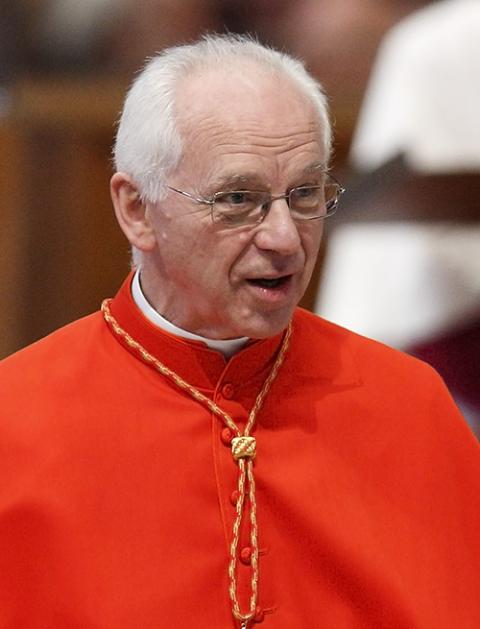
Cardinal Jozef De Kesel of Malines-Brussels, Belgium, arrives for a consistory led by Pope Francis in St. Peter's Basilica at the Vatican Nov. 19, 2016. (CNS/Paul Haring)
Still, the dinner atmosphere held a kind of calm. "At the table, we did not speak directly with everyone," remembered Belgian Cardinal Jozef De Kesel of Malines-Brussels, who was sitting in the Sistine Chapel in front of Prevost at seat No. 51, close to Cardinal Joseph Tobin of Newark, New Jersey.
"There was a great spirit of freedom, but as for the names of the candidates, it was not possible to talk about them with everyone," he said.
Sako echoed the same tone of discretion: "We didn't talk about anything like that. We talked about other things, nothing about the conclave. Just other issues related to the church, politics, the wars in Ukraine and Gaza."
Sako and Prevost had shared both the Sistine Chapel row and the dinner table as well. "The prefect for the Eastern churches, Cardinal Claudio Gugerotti, was also there. I said that the problems of the Oriental churches had to be solved, otherwise, I said, 'I'll go to the pope,' and everyone laughed."
As Cardinal Robert McElroy of Washington, D.C., later said: "I still felt it would be an uphill struggle for any American to be elected."
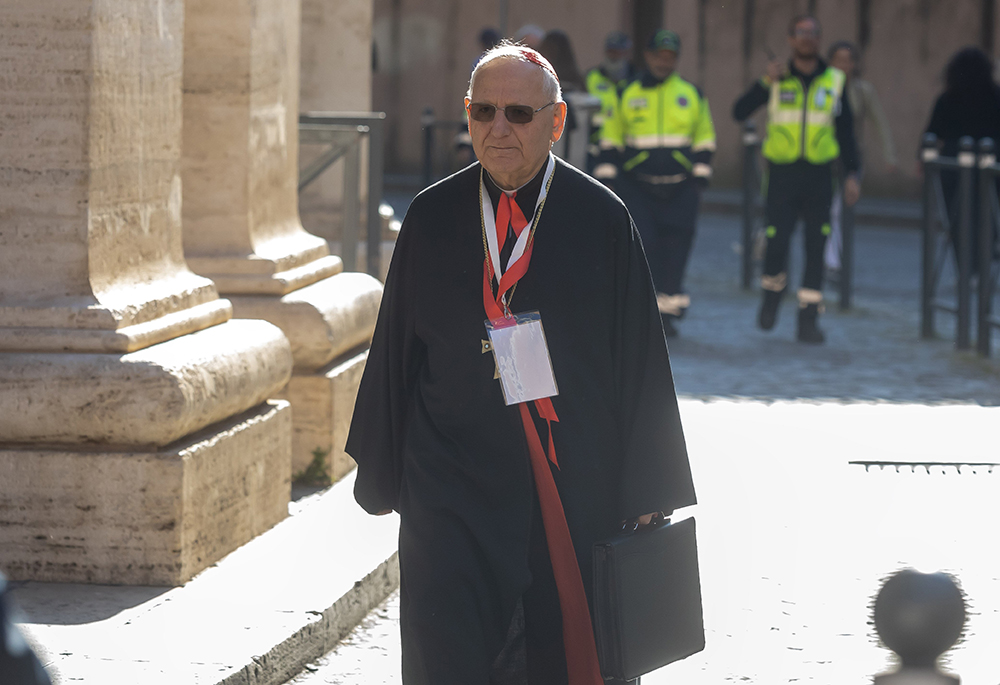
Cardinal Louis Sako, the Iraq-based patriarch of the Chaldean Catholic Church, arrives to attend a general congregation meeting of the College of Cardinals in the New Synod Hall at the Vatican April 29, 2025. (CNS/Pablo Esparza)
'Things really change'
Thursday, May 8, began quietly, with Rome wrapped in the usual spring haze, but inside the Sistine Chapel, the atmosphere carried the weight of discernment. It was the second day of the conclave. The cardinals knew that, by the end of it, one of them might never again walk the streets freely. Yet no one could have predicted how swiftly things would move between the morning and the afternoon.
The early ballots were dispersed, names rising and falling. As Souraphiel recalled, "The first vote and the second vote were sporadic, with different candidates coming up, but around the last before lunch, the name of Prevost is also put under."
Sitting in the same line as Prevost, Souraphiel couldn't quite make out his face in those moments. But he could feel a shift. A gathering stillness.
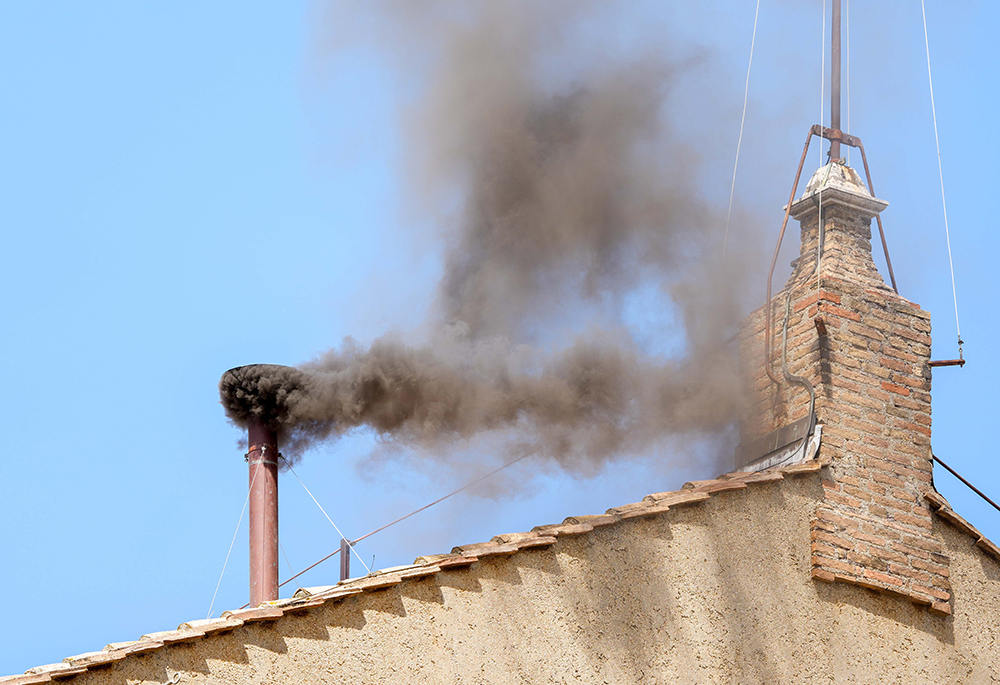
Black smoke billows from the chimney on the Sistine Chapel May 8, 2025, on the second day of the conclave. (CNS/Lola Gomez)
What happened during the break for lunch would remain one of those deeply spiritual turning points no one can fully trace — and yet everyone remembers. The cardinals returned to their rooms with profiles fresh in their minds from the biographical booklets they had received, reflecting on each candidate's journey and character. What began to stand out to many was not Prevost's nationality, but his lived universality.
"More than him being born in the States," Souraphiel said, "what came out was his pastoral services in Peru, being bishop there, and serving there, and also coming up here in Rome, being a superior general for 12 years with his congregation, his closeness to people, closeness to the languages spoken besides English, let's say Spanish, French and Italian."
By the fourth ballot that afternoon, the name Prevost appeared with undeniable clarity. Hands moved. A line was crossed: the threshold of two-thirds. Thunderous applause filled the Sistine Chapel as all the cardinals gave a standing ovation. Some of them were in tears.
Silence swept through the chapel. Tobin said he remembers it clearly, even if he could barely see Prevost's face: "I do remember being so impressed by his voice, when he responded to the question, 'Do you accept?' "
"It was a mixture of strong gratitude and joy, but also compassion for him. He can't just go say to some people, 'I'll meet you at this pizzeria, and we can have a pizza together,' you know. Things really change," Tobin said.
Prevost's response to the fateful question was unwavering. "Accipio," he said, which means "I accept" in Latin.
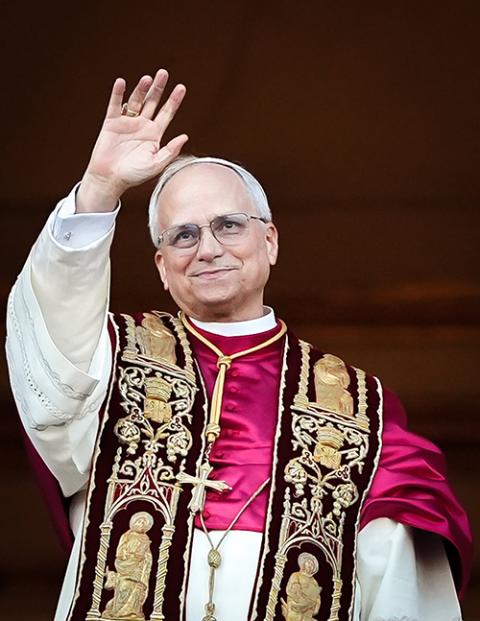
Pope Leo XIV, formerly Cardinal Robert F. Prevost, waves to the crowd in St. Peter’s Square from the central loggia of St. Peter's Basilica at the Vatican following his election as pope May 8, 2025. (CNS/Lola Gomez)
Sako, who was sitting right next to Prevost, said, "He remained serene, simple and calm the whole time. He showed no emotion on his face, and even when he was elected, he remained so serene. I didn't observe anything extraordinary, as if he had been born pope. When he said 'I accept' in a strong voice, it meant that he was aware of the heavy responsibility that awaited him."
"I just can't attribute it to any other factor other than his deep spiritual life, really as part of God's plan for him and for the church," said Tobin.
Behind the Sistine Chapel, Prevost stepped away briefly into the Stanza delle Lacrime — the "Room of Tears" — as tradition and gravity demanded. There was no rush to emerge. "It took him some time," said Souraphiel. But when he did return, dressed in white, wearing the red mozzetta and the stole, it seemed to the cardinals he carried the burden of leadership and the full meaning of the role he was assuming.
When asked what name he would take, the response caught even those closest to him off guard. "He took the name Leo. We were all surprised," said Souraphiel. "I thought he would continue Francis the II because his second name is Francis, Robert Francis Prevost."
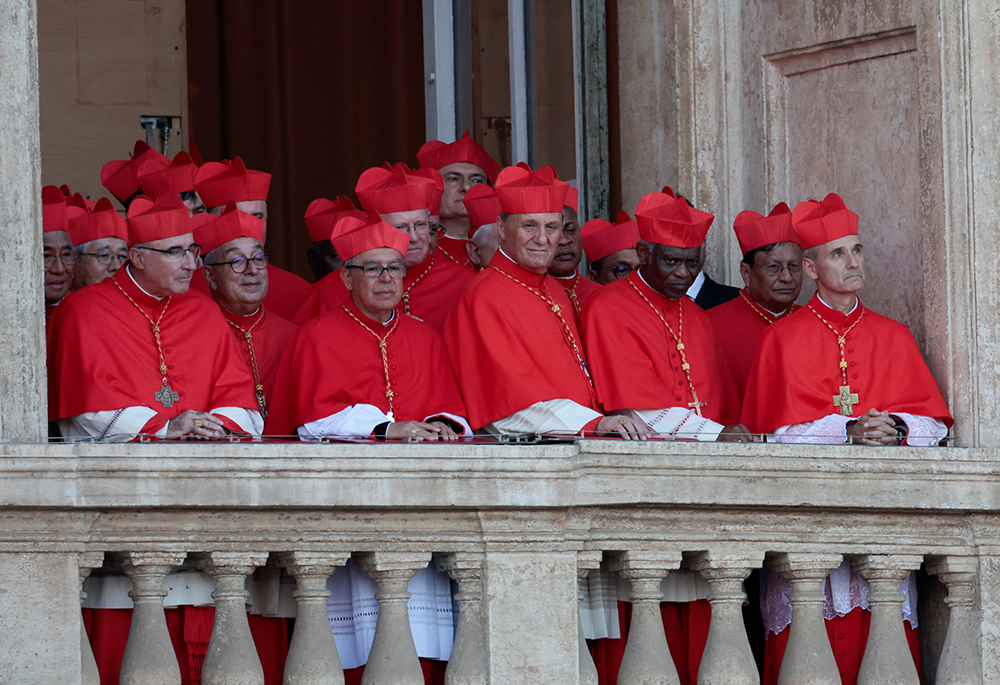
Cardinals stand on the central balcony of St. Peter's Basilica at the Vatican May 8, 2025, after Cardinal Robert Francis Prevost, who chose the papal name Leo XIV, appeared on the balcony following his election during the conclave. (OSV News/Reuters/Remo Casilli)
"We elected him, but at the same time we received him," said De Kesel. He saw in Pope Leo XIV a quiet compatibility with Pope Francis, but also something of his own: "He is a person who does not impose himself, a humble man, a great listener, a great theologian in my opinion, with pastoral experience. A very, very broad knowledge of the situation of the church in the world."
When history paused, communion began
In the quiet aftermath of the election — after the applause had faded and the white cassock had settled on the shoulders of Leo XIV — a deeper sense of communion began to emerge. Those final hours together, before the doors opened to the world again, became moments of extraordinary grace.
Nichols remembered it not as a scene of political maneuvering or ambition, but as something more tender and rare: "There was this sense that he was something of a sacred space. And within that space, it was possible to, at a very profound level, just be myself."
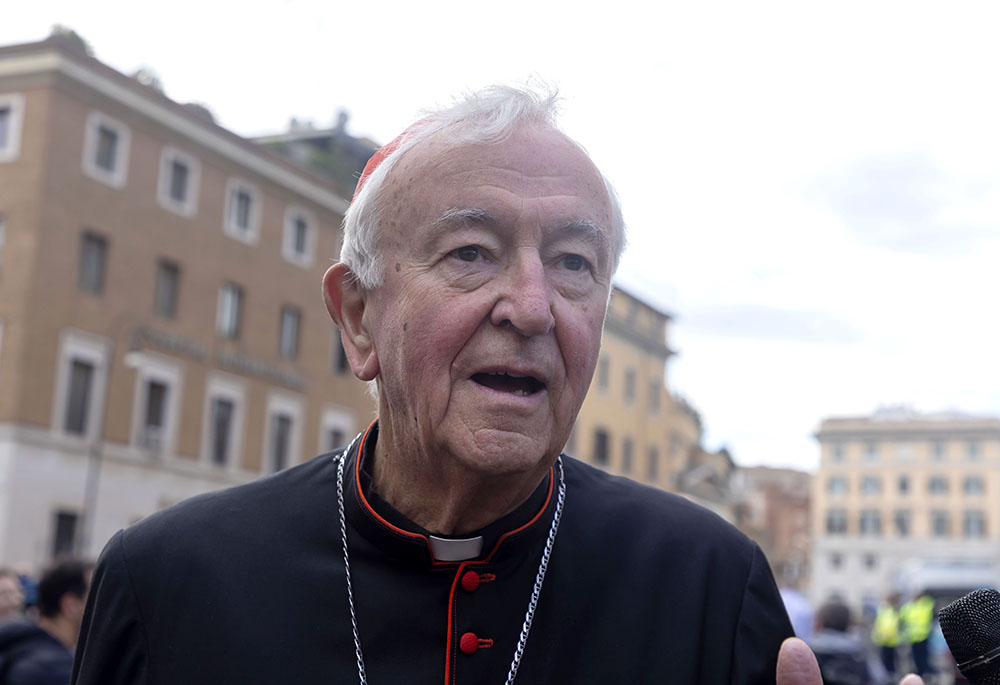
Cardinal Vincent Nichols of Westminster, England, approaches the Petriano entrance to the Vatican next to St. Peter's Square to attend the fifth general congregation meeting of cardinals April 28, 2025. (CNS/Pablo Esparza)
"Unlike the film, I think this was a very, very lovely and congenial and fraternal time together," he added with a smile, referring to the 2024 movie "Conclave."
"This is how I define that period of time: a light but powerful blast of the Holy Spirit, which filled us with joy and freshness, enlarged our hearts and expanded our horizons," said Cardinal Oscar Cantoni of Como, Italy.
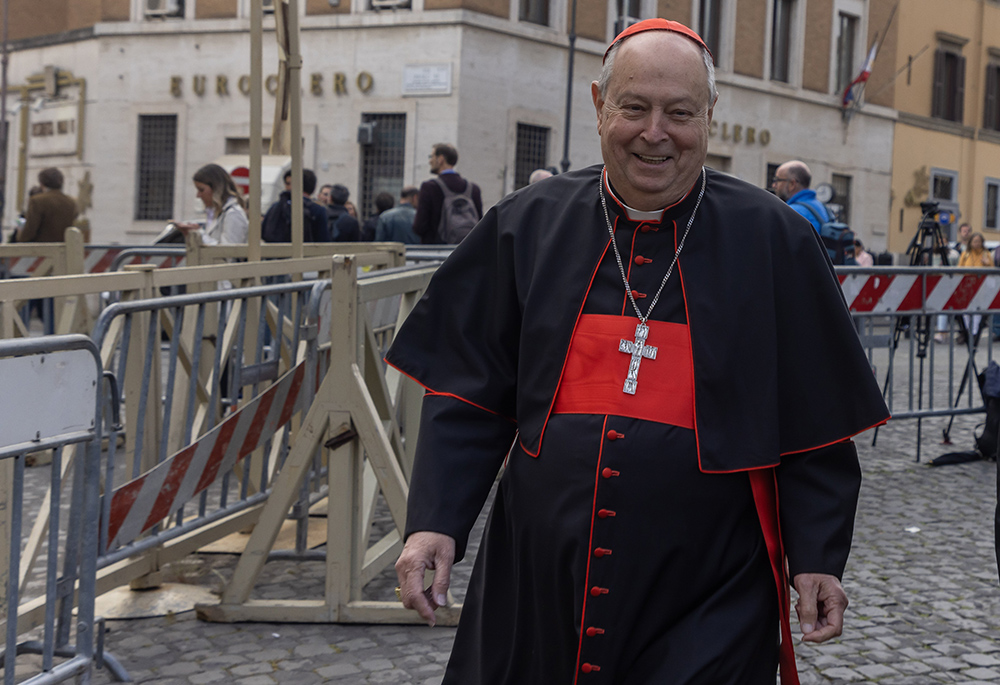
Cardinal Oscar Cantoni of Como, Italy, approaches the Petriano entrance to the Vatican next to St. Peter's Square to attend the fifth general congregation meeting of cardinals April 28, 2025. (CNS/Pablo Esparza)
For Chicago Cardinal Blase Cupich, the election of Leo XIV carried a message meant not just for the church, but for a fractured world in search of unity. "We can deal with differences and diversity," he said.
"We don't have to put a stick in the ground and say to a person who is different than ourselves, 'I can't engage you,' " Cupich said. In his eyes, the conclave itself had become a quiet lesson in communion. "It really was a beautiful sign to the world that the church knows how to bridge differences. And maybe we have something to offer the world in that regard."
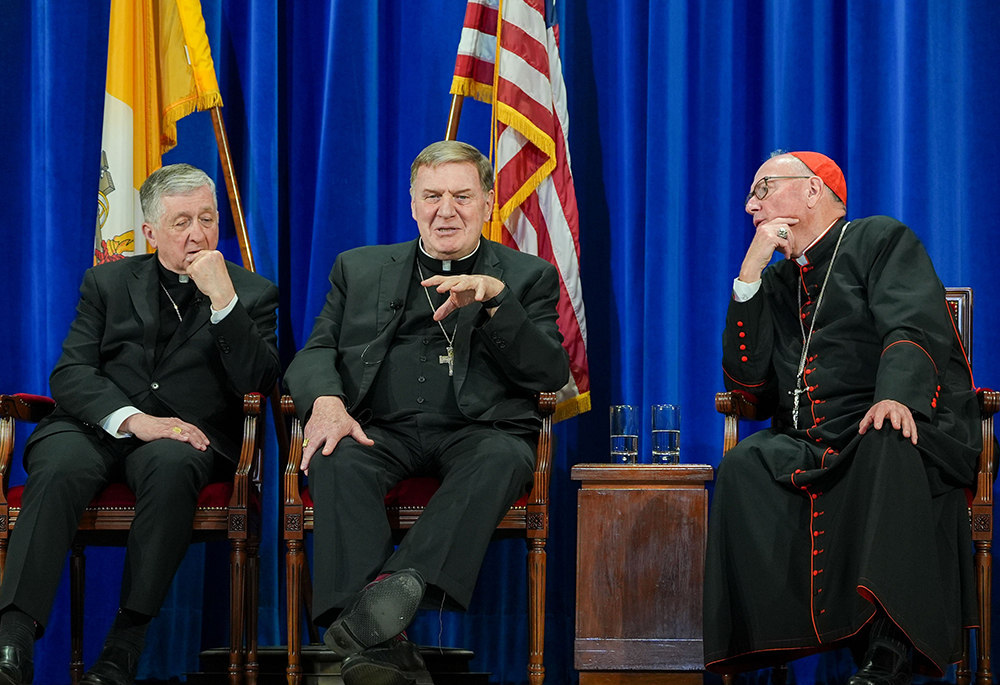
Cardinal Joseph W. Tobin of Newark, New Jersey, speaks during a news conference with U.S. cardinals at the Pontifical North American College in Rome May 9, 2025, as Cardinal Blase J. Cupich of Chicago, left, and Cardinal Timothy M. Dolan of New York, right, listen. The cardinals reflected on the conclave and the election of Pope Leo XIV. (CNS/Lola Gomez)
In those minutes after the vote, while history caught its breath and Leo XIV prepared for the world's gaze, laughter too made its way into the sacred air. The Iraq-based Sako, patriarch of the Chaldean Catholic Church, who was known among the cardinals for his warmth, leaned toward the newly elected pontiff and whispered something only the two of them would ever know. "I said something to make him laugh, but I can't repeat it. It was a joke," he said laughing. "I always joke around to break the tension, but it's better not to repeat what I said."
Others, like Puljić, stepped forward with the hopes of their people already in hand. "Immediately after the conclave, I said to him, 'Holy Father, bless me with my country and my people who live in Bosnia and Herzegovina.' He laughed and said yes."
And then the moment came — the central loggia, the flood of light, the sea of faces in St. Peter's Square. By protocol, Puljić stood beside him, as the most senior cardinal priest, having been created cardinal in 1994. Next to Prevost, there were also the most senior cardinal deacon and cardinal bishop.
From that privileged vantage point, Puljić looked out as both witness and part of history.
"I was genuinely happy," he said.
Read Part 1: How an American missionary became Pope Leo XIV
Former NCR executive editor James V. Grimaldi and NCR former Vatican correspondent Christopher White contributed to this story.
NCR's Rome bureau is made possible in part by the generosity of Bob and Joan McGrath.
NCR's investigative reporting is made possible in part by the generosity of Annette Lomont.