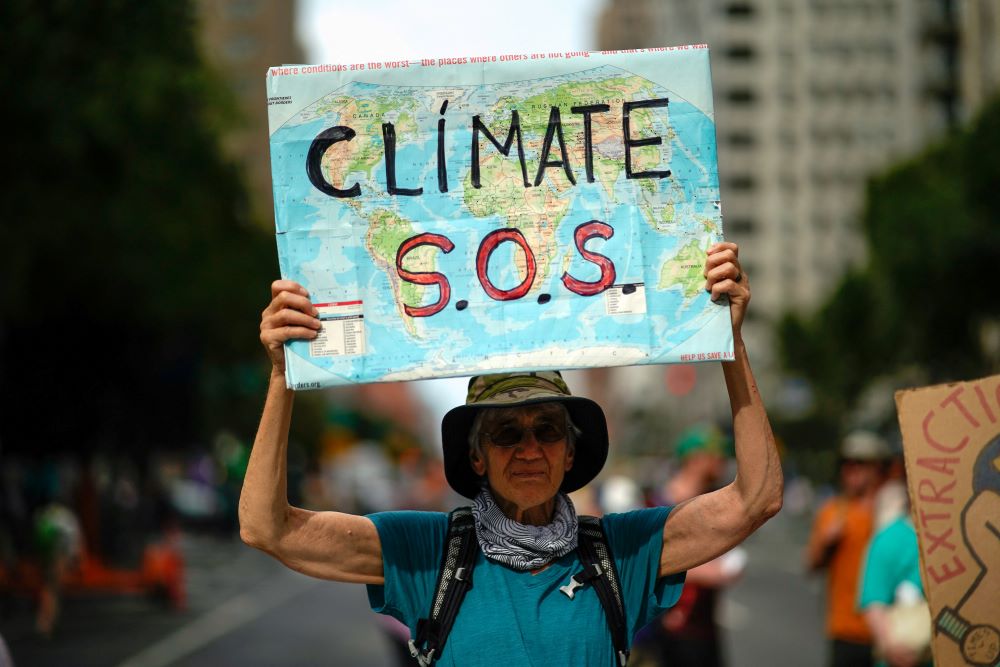
A man holds a sign during a demonstration marking the start of Climate Week in New York City, Sept. 17, 2023. (OSV News/Reuters/Eduardo Munoz)

The U.S. bishops are inviting Catholics to undergo an ecological conversion this Lent, a process of prayer and action that they said includes pressing government officials to protect the environment and address climate change.
The U.S. Conference of Catholic Bishops issued the reflection Feb. 17, a day before Ash Wednesday and the start of the 40-day Lenten season. It was authored by Louisville Archbishop Shelton Fabre, chair of the Committee on Domestic Justice and Human Development, and Bishop Elias Zaidan, head of the Maronite Eparchy of Our Lady of Lebanon and chair of the Committee on International Justice and Peace.
"This time of Lent reminds us that we are in need of conversion," the bishops wrote, before quoting Pope Francis' 2015 encyclical Laudato Si': " 'The external deserts in the world are growing, because the internal deserts have become so vast.' For this reason, the ecological crisis is also a summons to profound interior conversion."
"Indifference and distance from one another have led to devastating consequences for God's creation, including the poor. The conversion that we need is both metaphorical and physical," the bishops wrote.
Advertisement
The bishops' call for ecological conversion echoes one Francis frequently made throughout his papacy and Pope Leo XIV has reinforced. Leo urged a "true ecological conversion" during an October speech at the Raising Hope for Climate Justice conference commemorating the 10-year anniversary of Laudato Si'.
"As it is, we rarely pause to listen to 'the cry of the earth and the cry of the poor,' nor do we regularly reflect on how our choices impact our brothers and sisters around the world," the justice committee chairs said. "Our world is hurtling toward unsustainable climate conditions that will affect the flourishing of people all over the planet. This unsustainable situation is, in part, caused by ever-increasing consumption enabled by the ability to accumulate with a simple click of the button, and incessant marketing to convince us that we all need more."
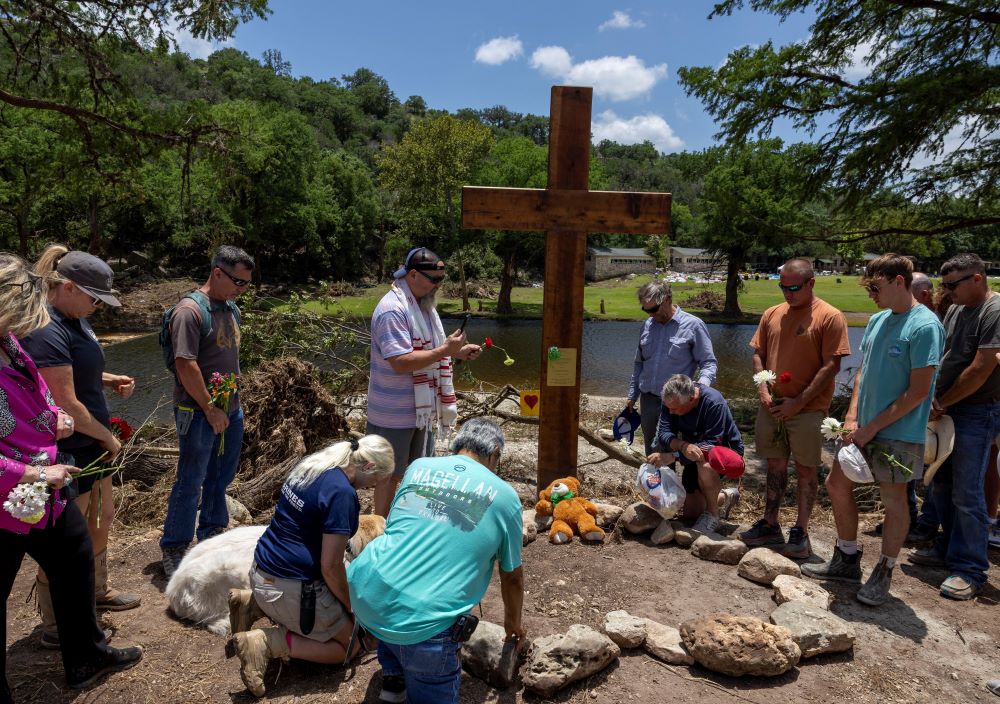
People pray after placing a cross by the Guadalupe River, across from Camp Mystic, following deadly flooding, in Hunt, Texas, July 10, 2025. (OSV News/Reuters/Umit Bektas)
While impacts of climate change — like extreme weather, droughts, wildfires and floods — have become more prevalent, with the last 11 years all ranking as the hottest on record, "Progress to slow climate change remains elusive," the bishops said.
"Receiving the brunt of the burden are people seeking refuge from disasters, farmers struggling to adapt to erratic weather patterns, children suffering from dehydration and hunger, migrants who flee their homes due to loss of livelihood, and species declining in forests and coral reefs. Never has it been clearer that everything is interconnected."
"At the same time," the U.S. bishops continued, "our country is stepping back from global and national efforts to change course."
The reflection on ecological conversion comes less than a week after the Trump administration finalized its repeal of the "endangerment finding," a 2009 scientific determination by the U.S. Environmental Protection Agency that greenhouse gases — emitted from burning coal, oil and gas and the main driver of climate change — endanger public health and welfare. That finding has served as the basis of nearly all federal climate regulations. Environmental groups filed multiple lawsuits this week challenging the move. The Trump administration has withdrawn a second time from the Paris Agreement and moved to exit the United Nations treaty under which the climate accord was adopted.
The U.S. bishops in their reflection repeated a message from a first-of-its-kind joint statement from the Catholic leadership of Africa, Asia and Latin America that stated "without climate justice there is no peace, without ecological conversion there is no future, without listening to the people there are no real solutions."
They also quoted Leo's speech at the Raising Hope conference where the U.S.-born pope said "Everyone in society, through non-governmental organizations and advocacy groups, must put pressure on governments to develop and implement more rigorous [environmental] regulations, procedures and controls."
"Everyone has a role to play in urging leaders at all levels to convert their hearts — and establish policies to better care for God’s creation," the bishops wrote.
In the past decade, numerous Catholic organizations, including Catholic Climate Covenant and the Laudato Si' Movement, have created guides and resources for Christians to integrate ecological spirituality into Lenten practices. Steps have included reducing waste and energy use, praying for communities impacted by climate change and learning how fossil fuel extraction impacts ecosystems.
The bishops' reflection, which includes a prayer asking God's guidance in listening to the voice of creation, also suggests a number of steps individuals and Catholic organizations can take to exercise ecological conversion in their daily lives, among them taking part in the Vatican's Laudato Si' Action Platform. Families and individuals can purchase from sustainably focused companies and consider renewable energy sources at home. Parishes can celebrate Masses for creation care and schools can incorporate it into curricula.
For dioceses, the bishops suggested energy audits of buildings, convening synodal listening sessions around climate resilience and providing formation to clergy and seminarians on Catholic social teaching relating to the environment. Businesses can adopt more sustainable practices and policymakers can listen to those most impacted by environmental challenges and enact policies to protect them.
"We each must recognize the power we have as individuals and in community," the bishops said.
"This Lent is an opportunity for discernment and action," they concluded. "May we quiet our hearts and enter the solitude of the desert, that we might hear the voice of God and listen to the cries of his children around the world whose livelihoods are impacted by our own actions and lifestyles."