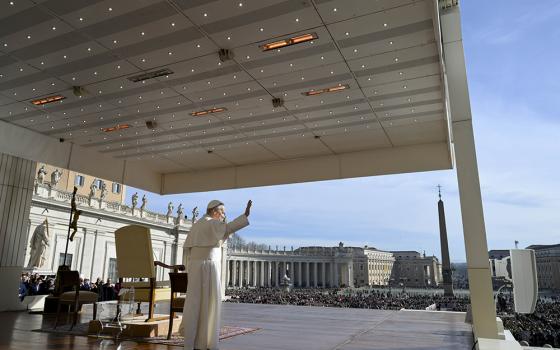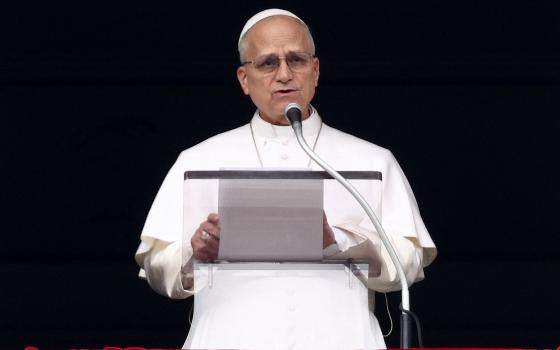
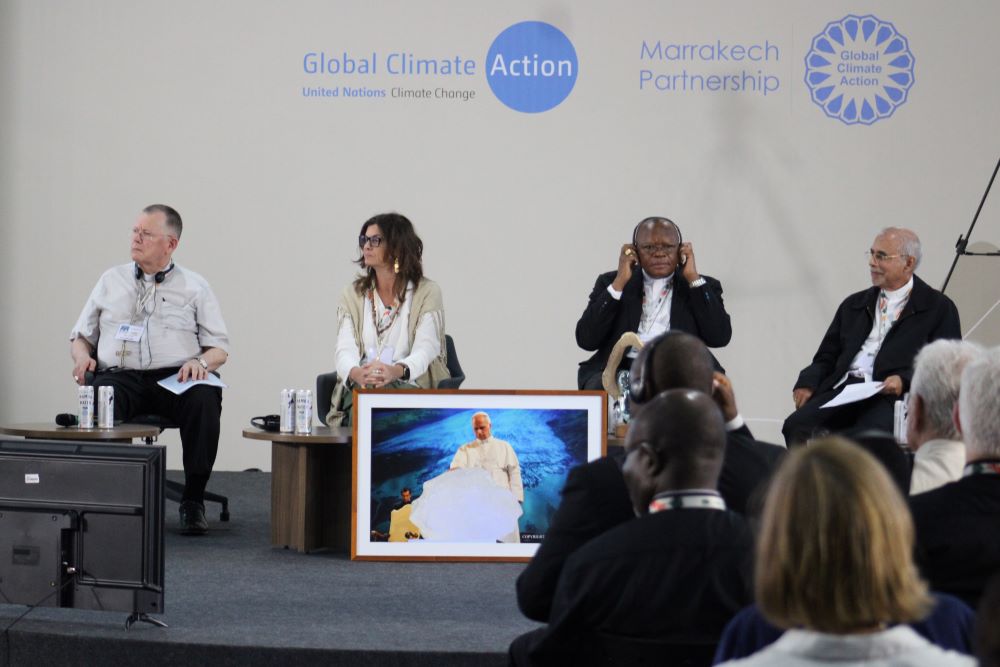
Presenters listen during an event Nov. 13 where Catholic leaders from the Global South discuss a letter demanding climate justice at COP30 in Belém, Brazil. The picture shows Pope Leo blessing a block of ice from a glacier in Greenland during the opening session of an international conference at the Mariapolis Center in Castel Gandolfo, Italy, Oct. 1. (Paulo Augusto)

by Eduardo Campos Lima
Throughout the first week of the United Nations climate summit, a group of cardinals and other Catholic officials have sought to amplify the voice and concerns of the Global South in this latest round of international deliberations on halting and adapting to rising global temperatures.
Primarily, the church leaders' interventions here at COP30 at the edge of the Amazon rainforest have revolved around a first-of-its-kind joint appeal from the continental bishops' conferences for Latin America, Africa and Asia, together representing 821 million Catholics.
The three cardinals who head each of the episcopal federations officially presented the 34-page document — titled "A call for climate justice and the common home: Ecological conversion, transformation and resistance to false solutions" — to the international community during a session Nov. 13 inside the COP's "blue zone" where negotiations are taking place.
At the event were Brazilian Cardinal Jaime Spengler, Congolese Cardinal Fridolin Ambongo and Indian Cardinal Filipe Neri Ferrao. They were joined by Simon Stiel, executive secretary of the U.N. Framework Convention on Climate Change, the body that convenes the climate COPs and under which the Paris Agreement was adopted in 2015.
During the session, the three cardinals outlined the 34-page document's denunciations of the ways climate change is harming life in their parts of the world, emphasizing how already vulnerable communities often bear the first and worst impacts of climate-related catastrophes.
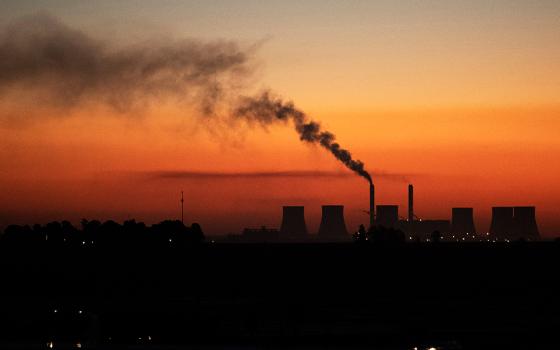
The joint appeal calls for an immediate halt on fossil fuel exploration and for the taxation of endeavors already in progress. In addition, it states that the countries from the Global North should compensate the Global South for the effects of climate change and finance the necessary measures of energy transition and adaptation to the new climate reality.
Their letter was initially disclosed during a press conference in the Vatican, on July 1, and later it was given to the U.N.'s secretary general, António Guterres, and to the bishops' conferences of the United States, Canada and Europe.
Ambongo, who is archbishop of the Diocese of Kinshasa in the Democratic Republic of Congo and leader of the Symposium of Episcopal Conferences of Africa and Madagascar, or SECAM, told the National Catholic Reporter's EarthBeat that he is optimistic about the possibility of gathering support for the initiative.
"We officially presented the letter today, so from now on we'll be able to follow its potential impacts," he said.
Ambongo, whose country is home to the Congo Basin, one of the two "lungs of the planet" as the second-largest tropical rainforest, said he "hopes the churches from the Global North will work along with the churches from the Global South."
"That's what our letter suggests," he said.
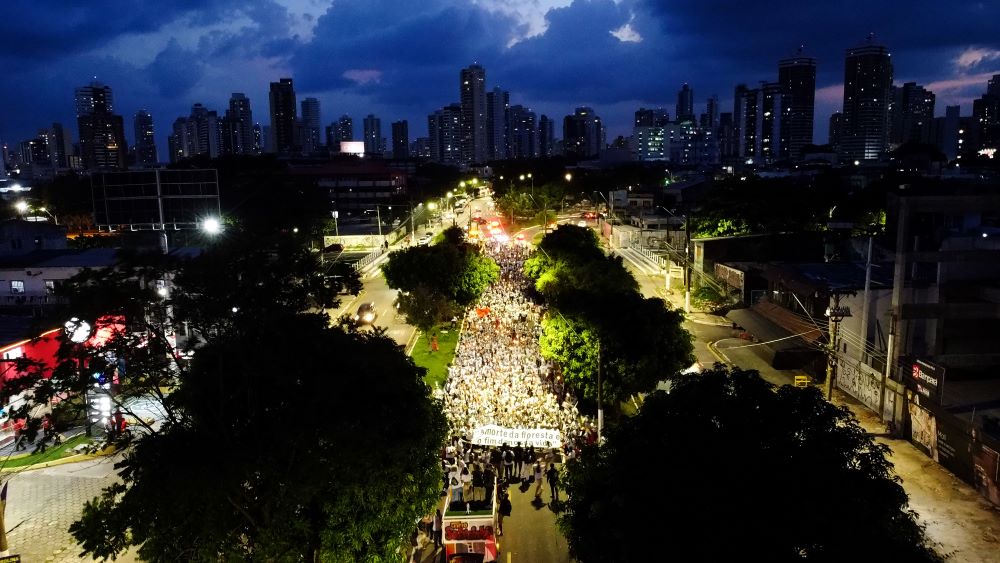
Activists fill the street in this drone image during the "Porongaço" march of the Forest Peoples during COP30 in Belém, Brazil. The name "Porongaço" comes from the poronga, the oil lamp used by rubber tappers during their night work in the forest. (COP30/Alex Ferro)
More conversation about the document took place a day earlier during a symposium promoted by the National Conference of Bishops of Brazil, or CNBB. The three cardinals were joined by church officials from other parts of the world in a discussion about the document.
Cardinal Ladislav Nemet, who is the archbishop of Belgrade, Serbia, and the vice president of the Council of European Bishops' Conferences, was among the panelists.
Nemet said that Europe too has been facing the impacts of climate change, with shorter and harsher winters and longer summers. He noted that Europe has been the largest donor to the Global South, and said European churches have been working for the "ecological conversion" of the continent and assisting developing nations through funding and other resources.
"We want to continue to be part of the solutions," he said.
But the joint letter emphasizes that the Global South needs more. Not only must affected communities be directly supported, the bishops said, but the nations' debts should be revised.
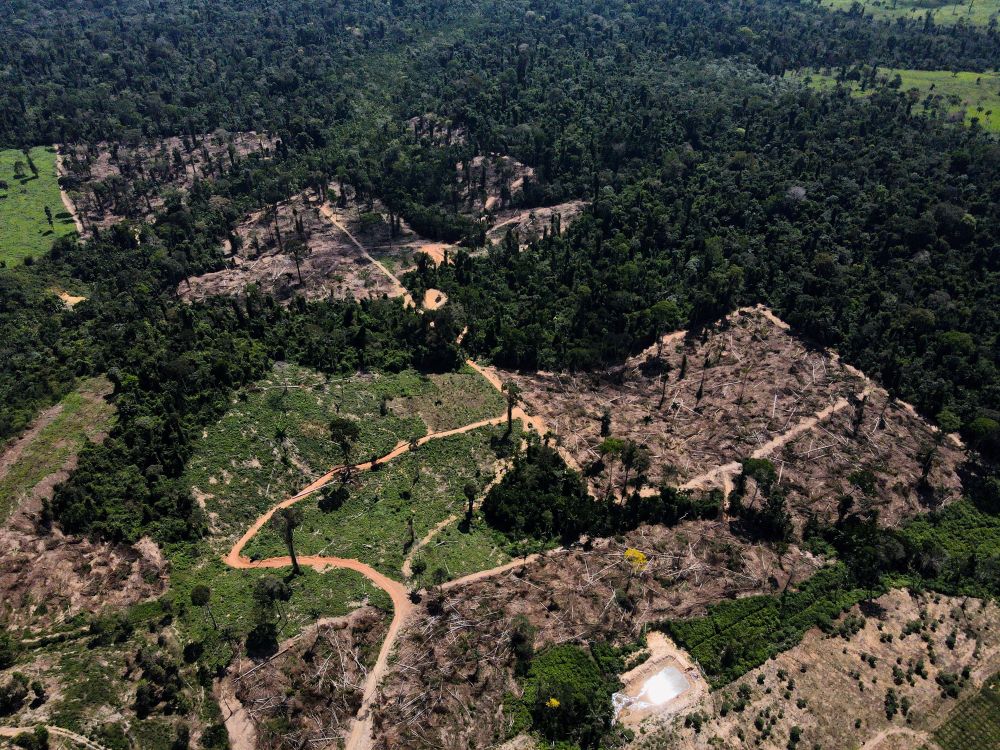
A view shows a deforested area in the middle of the Amazon rainforest near the Transamazonica highway in the municipality of Uruara, Brazil, July 14, 2021. A joint letter from Global South bishops calls for an immediate halt on fossil fuel exploration and for the taxation of endeavors already in progress. (OSV News/Reuters/Bruno Kelly)
Spengler said the letter garnered some responses already, though he acknowledged "a certain discomfort" in some situations in dealing with these environmental, political and economic issues.
"Our letter received some receptivity. The text challenges [the Global North], but it also opens ways for common constructions. It's a tough reality, which demands courageous reactions," he said.
Ferrao, the archbishop of Goa and Daman and head of the Federation of Asian Bishops' Conferences, told NCR after the COP30 session that he hopes the letter will have some influence on the international delegations that are negotiating climate action goals during the conference.
"I'm also sure that our initiative will draw other groups of the ecumenical movement and civil organizations that struggle against climate change," he said.
Already some delegations have responded to the ideas raised in the Global South church leader's appeal.
Brazilian Congressman Elvino Bohn Gass, part of the country's delegation, told NCR that even terms like "common home" and "integral ecology" can be heard here and there during countries' discussions.
"That's especially true for us in Brazil. We have been heavily influenced by Pope Francis' message. [President Luiz Inácio] Lula [da Silva] was very close to Francis and echoed the idea of taking care of the common house," Bohn Gass said.
Bohn Gass said the letter from the bishops of the Global South rang true in its discussion of the responsibility of the most developed nations.
"They were the countries that boosted more aggressive economic models through their industrial policies. So, they have to pay more now," he said.
Advertisement
The Colombian delegation to COP30 has also been marked by church lessons concerning the environment, said Pablo Palacios, a professor at the Xaverian Pontifical University in Bogota and a member of the Colombian negotiation team.
"The church has presented a very clear vision concerning climate justice and state debt. Those are central themes for the Colombian government," he said.
Palacios was one of the organizers of a talk about climate justice and compensation for Indigenous peoples and poor groups at Colombia's pavilion in the blue zone on Nov. 13. Brazilian Bishop Reginaldo Andrietta of the Diocese of Jales, who heads the Workers' Pastoral Ministry in Brazil, participated in the debate.
Through the letter and other messages on environmental matters, Ambongo's voice has been echoing in the African nation, said Kileshe Kisimba Musonda, an adviser to the minister of Environment and Durable Development of the Democratic Republic of Congo.
"Ambongo's remarks regarding his desire to find a balance in the sharing of responsibility have been heard," he said. "Congo is a large country that sequesters a significant amount of carbon and has a strategic future in the energy sector and in the field of carbon credits. But a whole set of very complex, very technical mechanisms creates a distortion [when it comes to benefiting the country]."
Musonda affirmed that Ambongo has relevant authority in Congo and has been playing a positive role in the climate change debate.
"We believe that the Vatican's support can help us even more to achieve a better balance. It's high time that Africa, particularly the Democratic Republic of Congo, is taken seriously," he said.
The letter from the bishops of the Global South yielded yet another outcome — inside the church itself.
Filipino-born Archbishop Ryan Jimenez of the Diocese of Agaña, in Guam, affirmed during the CNBB symposium that he was inspired by the document and will call on his colleagues in Oceania to produce a joint statement about climate change in the continent, a locale where island nations, like Tuvalu, are being increasingly engulfed by the sea.
"This statement will outline concrete steps to address the effects of climate change in Oceania, encompassing strategies for advocacy, education and direct support to affected communities," he said.