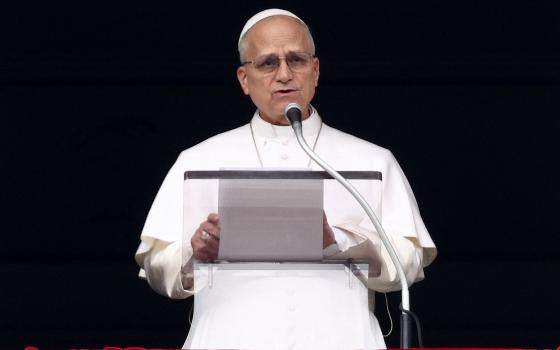
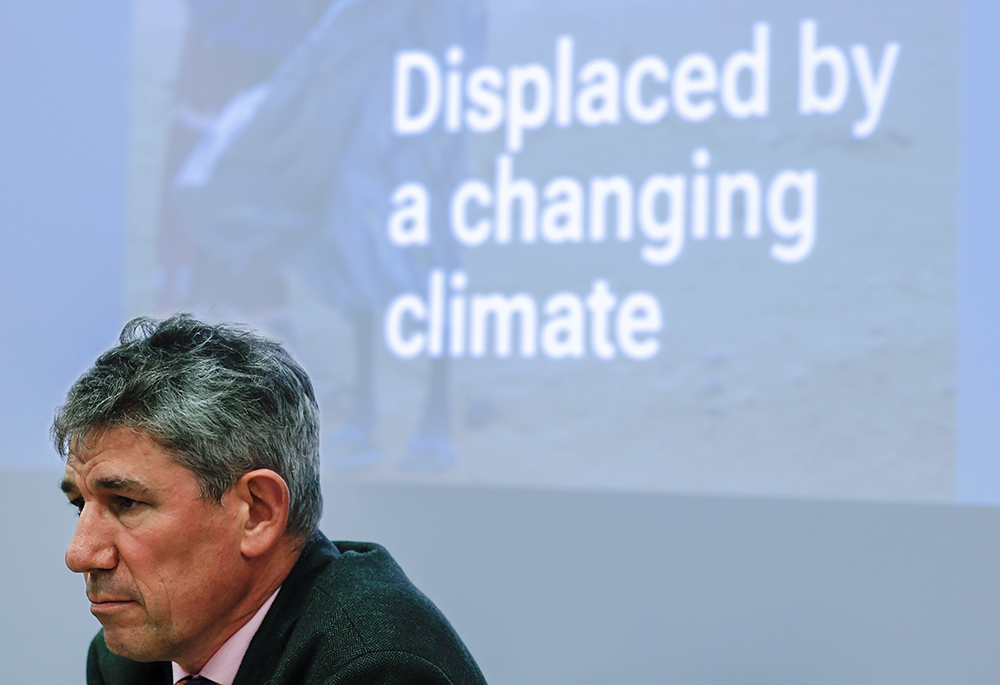
Alistair Dutton, Caritas Internationalis secretary general, reflects during a press conference in Rome Oct. 26, 2023, launching the organization's report on climate change and displacement. (CNS/Lola Gomez)

In Tigray, a northern region of Ethiopia, parched landscapes and high poverty rates offer visible signs of the daily struggle many families face to find water.
Persistent droughts and inconsistent rainfall have only intensified, and are expected to worsen, as temperatures have risen due to climate change.
For decades, Catholic development organizations in Ethiopia — Africa's second-most populous country and in the 1980s the scene of a devastating famine partly driven by drought where about 1 million people died — have worked with local partners and communities in Tigray in an effort to restore life-supporting ecosystems through increased access to reliable clean water, and with it food security and income opportunities.
A series of projects undertaken in the past 15 years by Caritas national chapters Trócaire (Ireland), SCIAF (Scotland), CAFOD (England and Wales) and Catholic Relief Services (U.S.) have constructed canals, check dams, river diversions and irrigation systems to capture and retain rainwater in dried-out riverbeds, thereby increasing soil fertility, expanding arable fields and rehabilitating degraded lands.
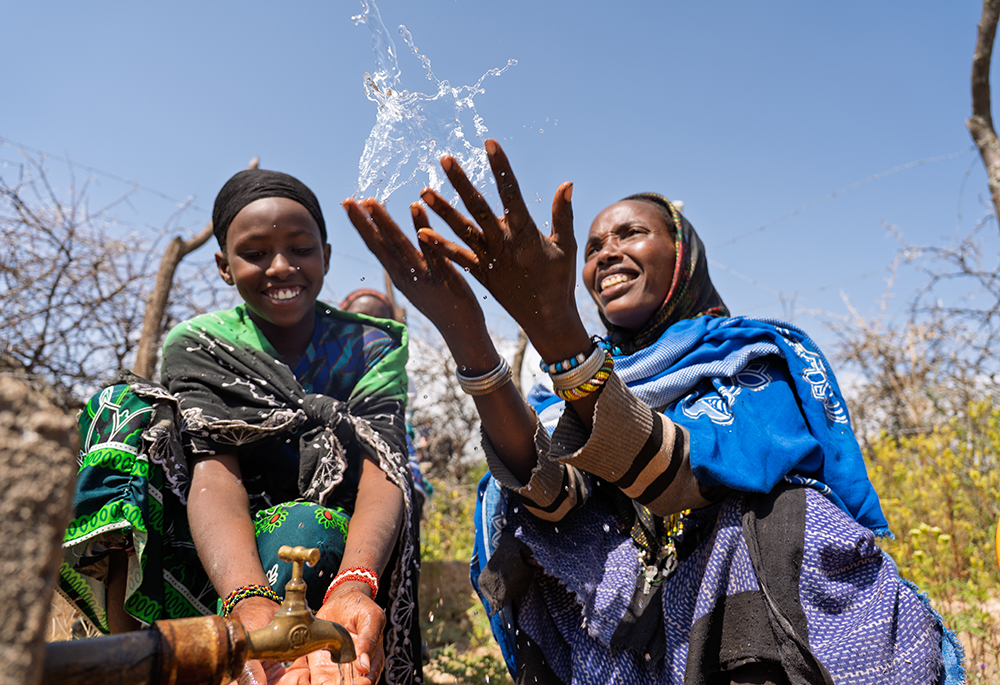
Ware Tune, right, splashes water from a spigot in her village of Kallu Jilo, in northern Ethiopia. The water project was developed by a collaboration of three Caritas organizations, SCIAF, CAFOD and Trócaire. "Clean water has solved a big problem," Tune said. (SCIAF/James Cave)
"Slowly, year after year, the streams in those valleys came back," Alistair Dutton, secretary general of Caritas Internationalis, said of projects he visited in 2019 while executive director of SCIAF. "And so today we have running rivers 12 months of the year. And they irrigate now fields that were not there for the last 30-plus years."
For the communities, the restored watersheds have revitalized the land and offer more consistent water sources to irrigate thousands more acres to grow food for their families year-round and to provide income through additional crops to pay school fees and buy clothes and other necessities. When war broke out in Tigray in 2020, farmers from the area supplied vegetables to people in the capital city of Mekele.
Dutton highlighted the Ethiopia projects during a panel discussion Oct. 2 at the "Raising Hope for Climate Justice" conference outside Rome in Castel Gandolfo, Italy, that celebrated the 10-year anniversary of Pope Francis' encyclical "Laudato Si', on Care for Our Common Home."
In the face of dire forecasts, the Caritas projects offer a sign of hope that solutions to climate change, whether mitigating heat-trapping greenhouse gas emissions or adapting to impacts like more severe heatwaves and storms, can in fact work.
At the same time, they reflect one of the core tensions posed by climate change. While scientific studies continually show the urgency for immediate action, many of the solutions take time — years, even decades — to bear fruit.
"There's always this contradiction, isn't there?" Dutton said in an interview with National Catholic Reporter's EarthBeat. "There's an impatience and an urgency, but a requirement for a patience and an understanding that these things are working in their own timescales."
EarthBeat spoke with Dutton at the "Raising Hope" conference about climate solutions and where he finds hope that the worst impacts of rising temperatures may still be averted. This interview has been edited for length and clarity.
EarthBeat: What were your takeaways from Pope Leo XIV's address to open the "Raising Hope" conference? What are your impressions so far on how he will approach socio-ecological issues?
Dutton: It was a very special moment here in the room. There was a great warmth throughout all of us toward Pope Leo. I think he brings his own character, which is really welcome. And at the same time, he was absolutely clear that he is following the lines that Pope Francis has been saying.
With any change in leadership, there's always that question — what's going to change? I think in celebrating the first Laudato Si' Mass, but particularly in his message, we heard a huge continuity and a sense that we have to go on, go on with the work. … it didn't start with Laudato Si' but to continue with all of this.
And we also saw a willingness and a boldness to step into the political arena and to actually stand strong on the challenge of the climate emergency and the response that's needed at a time when some political leaders would rather they could deny it or it would go away.
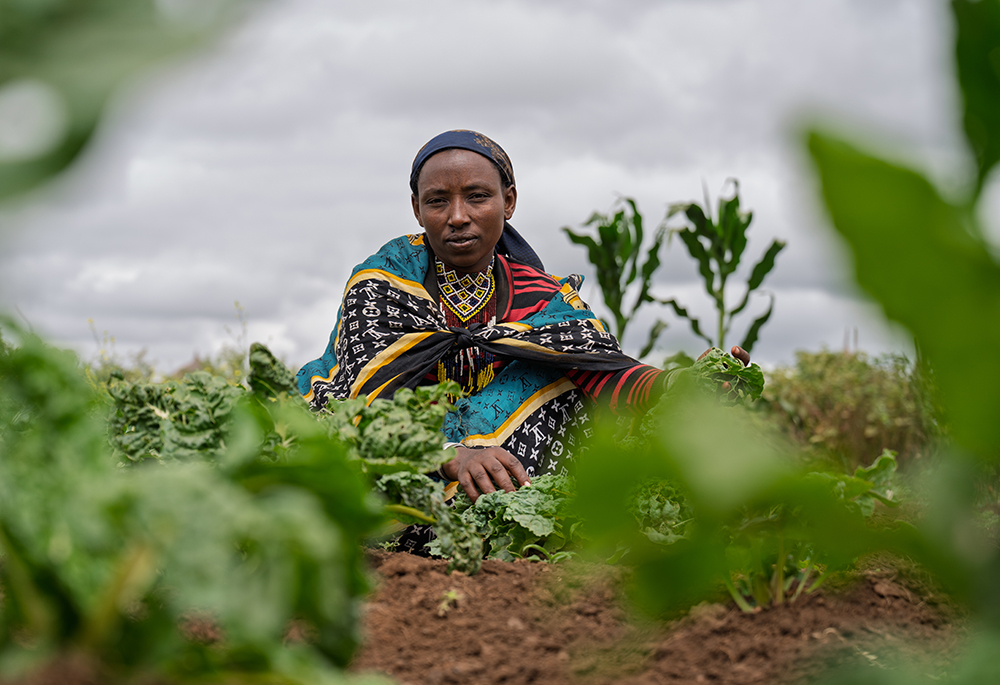
"For women and girls, the new water source has completely changed our lives. I used to spend most of the day just collecting water — sometimes until 3 p.m.," said Kabale Kalicha, a woman whose family benefited from a water project in Ethiopia's Borena region led by a collaboration of three Caritas organizations, SCIAF, CAFOD and Trócaire. (SCIAF/James Cave)
What do the Caritas water projects in Ethiopia you described illustrate about time and climate solutions, where some of these initiatives take years to yield results but the science makes clear the need for substantial, rapid action this decade to limit global warming and avert its more catastrophic impacts?
Particularly in issues of nature, these things happen over centuries, millennia. You know, geological time. When we talk about the rainforests, it takes hundreds of years for a forest to grow.
[In Ethiopia] it has taken a full 10 years for the groundwater to come back because the aquifers have been so depleted. There's always this contradiction, isn't there? There's an impatience and an urgency, but a requirement for a patience and an understanding that these things are working in their own timescales.
We have political systems which work on a four- or five-year election cycle, but the returns we're talking about will take place over decades or centuries. So how do we value goods with the right periodicity so that we can give them the time to mature?
And similarly, if we look at investment patterns … this idea of patient capital and patient investment that understands the timescales that are at play. We need an economy which is still functional as an economy, because we can't work, we can't survive without that, either, but that needs to be at the service of a sustainable view of global ecology.
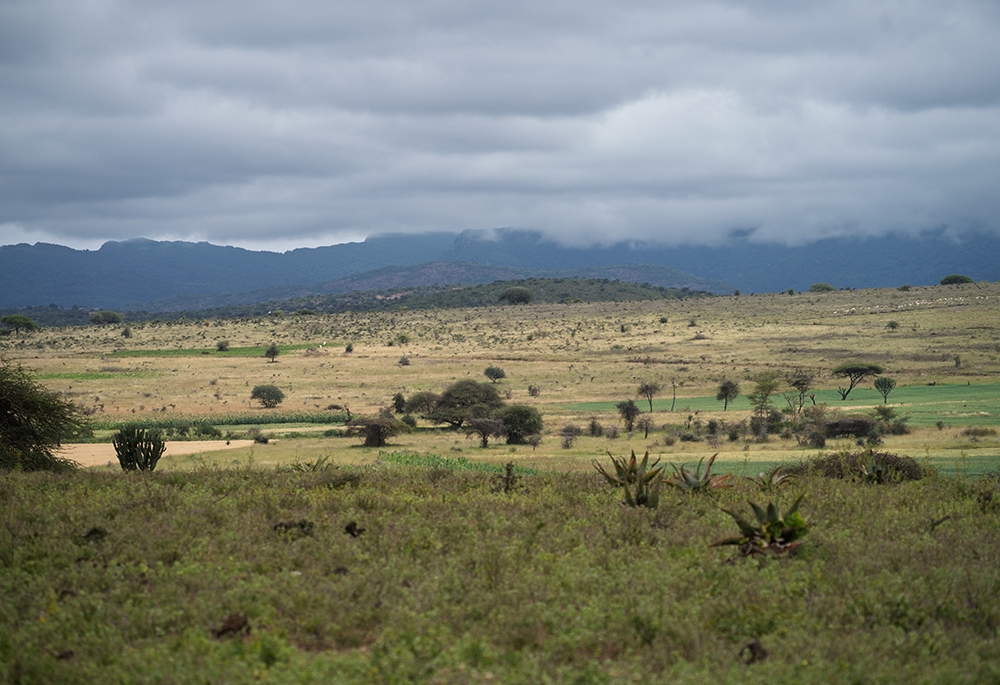
Across Ethiopia, in the Horn of Africa, Catholic development organizations, like SCIAF, CAFOD and Trócaire, have worked with rural communities to access reliable sources of clean water, which can be used to irrigate farm fields and replenish degraded landscapes. (SCIAF/James Cave)
What can the faith community contribute toward that balance of patience to allow solutions to yield results with the urgency to minimize climate risks and impacts?
I think one of the church's superpowers, as well as God and the people of God, is its ability to convene. Its power [is] to bring people together and really facilitate dialogue and conversations.
And as I mentioned [in my comments on the panel], probably the least discussed chapter of Laudato Si' is that last chapter that talks about dialogue. And so we need to create the right spaces so that there are people in the room who can talk about the urgency alongside those who need to take longer-term perspectives, the people who control the political or economic power [and] the people who are on the front line and facing the climate emergency.
We need the economic [powers], the investors, to also hear that voice. And we need political leaders to know that the action that's needed is needed. The action that's needed is possible.
And the third bit is that people, the general public, are willing to support that. Democracy is just the voice of people. If people want to go in one direction, and a few of us want the government to go in another direction, we're asking an impossible problem. If they did it, it wouldn't be democratic.
What we need to do is win the debate, and we need to persuade people. We need to persuade investors and the private sector. We need governments to be confident, and the most important voice in the room to stop it all going back to short-termism, is the one, well, two voices — one is the one that says this is the problem, and the other that says, and these are the solutions, but this is the timescale it will take.
Advertisement
Your position at Caritas offers you a good vantage point to see how climate change is impacting people today at the local levels. From that viewpoint, do you have hope with the states of environmental crises, among them climate change? And if so, what is the source of that hope?
I think it's very difficult, and there's a kind of schizophrenia that both sees the magnitude of the problem, the urgency of the problem and lack of the necessary response. And if you just concentrate on that, then you will go down a wormhole of despair.
But alongside that, where do we find hope? I think we find hope in the sheer irrepressibility of the human spirit. When I'm in even the most difficult places, the local people have never given up. They are still trying. Still trying to feed their family that night. Still trying to make the farm work. Still trying to make and earn a living whatever way they can. Because humanity has this kind of thirst for life, and I think that is inspiring. When I watch people who go through the worst times, I think, well, how can I give up? They haven't. We owe it to them not to.
I also find hope in the things that work. So like that Ethiopian example where you can see that there are things that are possible. And the more we celebrate those, the more we discover there are others, and we put together a richer and richer toolkit.
And then for me also, it's through my faith I have that sense of hope. I finished [my panel remarks] with that quite deliberately, that nothing is asked of us that is too great for us.
Is a sense of hope something you see the Catholic and other religious leaders can bring to these environmental discussions and challenges?
Yeah, very much so. Very much so.
I think one of the ways you do that is by modeling hope. And I think there's a language around optimism that isn't hope. Optimism is a pure assertion that everything will be OK. Hope is a belief that although we don't quite understand what "OK" means, all shall be well, as Julian of Norwich says, and all shall be well, all manner of things shall be well.