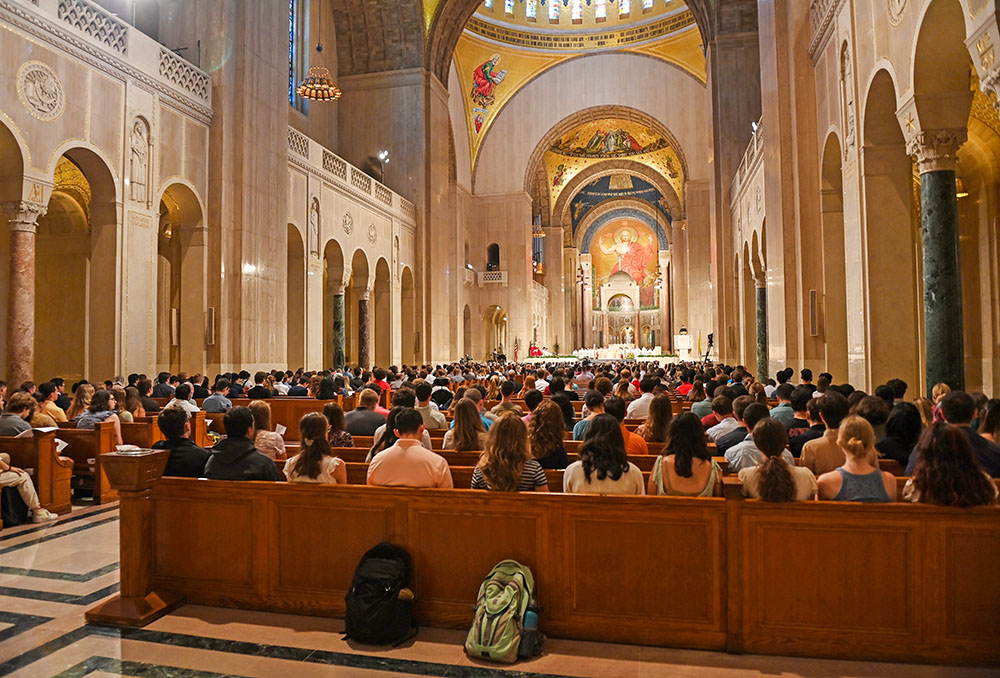
Thousands of students from the Catholic University of America attend the Sept. 1, 2022, Mass of the Holy Spirit at the Basilica of the National Shrine of the Immaculate Conception in Washington, opening the academic year for the school. (CNS/Courtesy of the Catholic University of America/Patrick G. Ryan)

by Katherine Mackenzie
As a freshman at the Catholic University of America, I was unsure of many things: if I would get along with my new roommate, how grading in college worked, or when the dining hall closed. I did not doubt my familiarity with the Mass. Though I never attended Catholic school, my mother marched all five kids to the front row every Sunday.
So during my first Mass on campus, I grew increasingly flustered by new smells, sights and sounds that didn't seem to faze the students around me. I experienced culture shock in my own religion and realized that the Catholic Mass, though standardized, is not identical across America.
Worn out by an orientation week full of new names and having to explain that I was from Kansas City, Missouri (not Kansas), I entered the campus chapel on Sunday ready to recharge in a familiar setting. An upbeat hymn began the Mass, prompting a procession of several priests, even more altar servers (all male), and heavy incense that pricked my nose. Was it a feast day? Or perhaps they were just doubling up to make an impression on the freshmen? No matter, I knew what came next.
To my increasing embarrassment, the next hour was full of surprises. The priests chanted the Gloria in Latin and the Our Father was sung. Everyone else seemed to know it, yet I — the liturgical musician — was lost.
During the consecration, my bowed head shot up at a sudden, piercing bell. Was there a fire or something? My eyes eventually found the altar server ringing a set of bells, seemingly on cue with the elevation of the Eucharist.
Advertisement
When going up to receive Communion, I was likewise confused when the girl in front of me dropped to her knees and opened her mouth to receive, hands folded behind her back.
It felt like everyone else had a playbook that I was missing a page from. It was the same Mass, but with enough small differences to make me feel less Catholic than those around me. A call to my mom explained that many of these were traditional aspects that the 1962-65 Second Vatican Council made optional and now varied by community. She'd warned me before that Mass might look different at the basilica, recalling the "smells, yells and bells" masses at the University of Notre Dame in the 1980s. Still, I expected to find a more familiar service on campus.
Funnily enough, I'd rejected all other familiar trappings when choosing a college. Unlike most Midwesterners, I ignored the state schools and went 1,000 miles away. At the Catholic University of America, I could study music and history, receive surprisingly generous financial aid, and, most importantly, explore Washington, D.C. The whole Catholic thing was a perk, and quite honestly, an experiment.
I was involved at my home parish — cantoring for Mass, teaching Sunday school and volunteering for confirmation prep, but I knew my participation would be different elsewhere. College students are notorious for falling away from their parents' religion, and even in high school, many of my friends who were raised Catholic distanced themselves from the church for political and social reasons. I figured I'd dig deeper into my faith during college and see where it led.
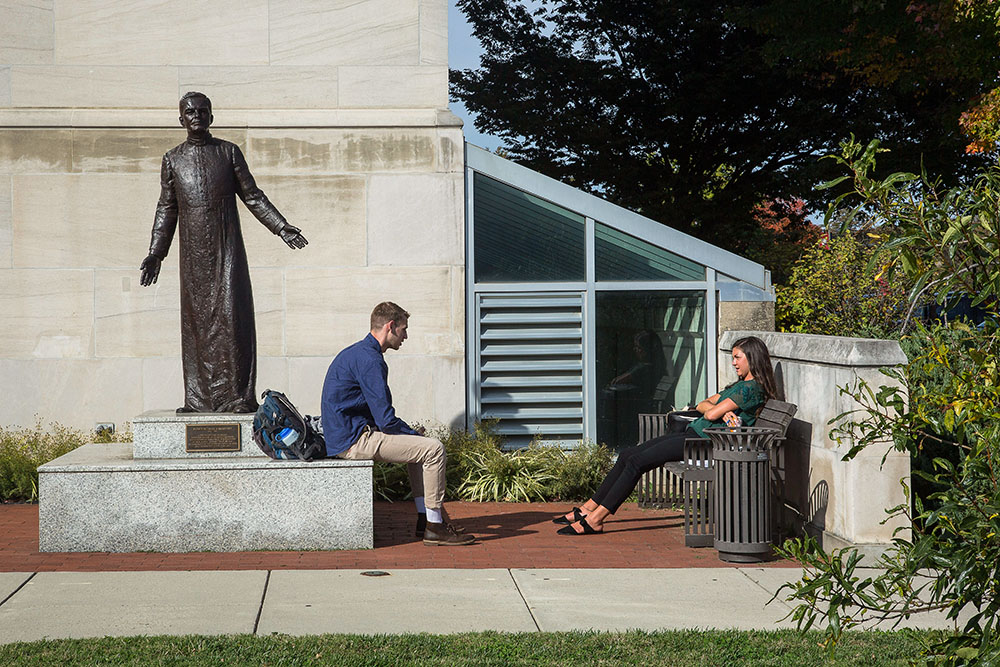
A statue of Blessed Michael McGivney, founder of the Knights of Columbus, is seen at the Catholic University of America in Washington Oct. 20, 2020. (CNS/Tyler Orsburn)
Religious exploration and liturgical differences weren't the only unknowns I was tackling. I knew there wouldn't be many people from Kansas City at Catholic University, but I was shocked at the concentration of people from a few regional bubbles. I quickly learned that "right outside of Philly" meant someone was from New Jersey, not Pennsylvania. Maryland and NoVA (Northern Virginia) were other common responses, triggering a "where'd you go to school?" discussion. This usually led to a laugh of acknowledgement and talk of rival Catholic schools, sports, and some cousin or friend who went there.
I'd entered a tightly knit network without realizing it. Each school had their own reputation and unique traditions, and alumni continued to identify themselves by their high school (whose tuition was higher than some colleges).
I wasn't just imagining it, according to Catholic University's "At A Glance" page, 78% of their students come from the Middle Atlantic, South Atlantic, and New England regions. These regions were full of old Irish and Italian families whose Catholic identity wasn't just religious, but cultural.
I was a minority for being a publicly educated Midwesterner whose Catholicism — passed down by a Slovak grandmother — persisted as a personal, rather than communal, conviction.
Yet during my four years at Catholic University, I grew to love some of the same things that initially confused me. After I got over my embarrassment, I started asking other students why they did what they did. I became good friends with people who practiced these more traditional devotions, and explored whether they might contribute to my own spiritual experience.
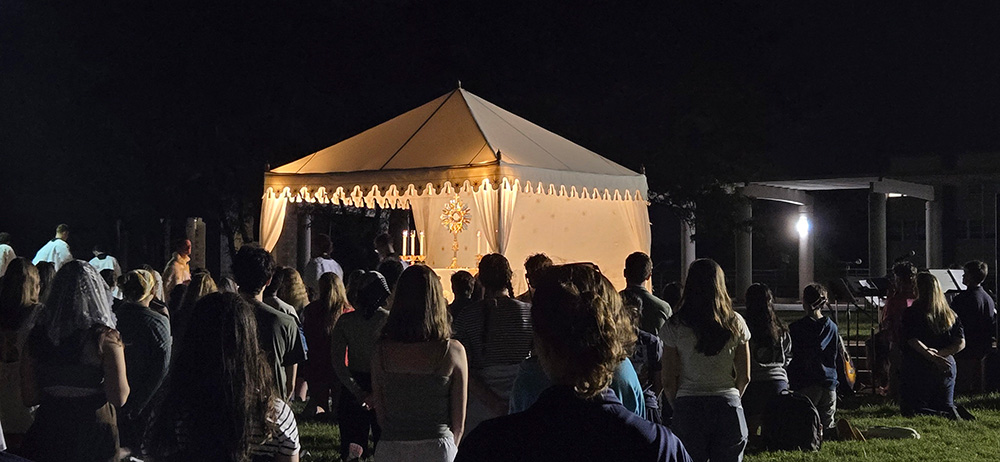
Students pray in eucharistic adoration at the Catholic University of America in Washington in this undated photo. (OSV News/Courtesy of Danielle Zuccaro)
I asked my roommate why she veiled during Mass, joined some guys from the Honors dorm on their evening "brosary" walks, and learned the Latin chants well enough to sing along. I attended Mañanitas at dawn to celebrate the feast day of Our Lady of Guadalupe, delighted to hear a mariachi band provide the Mass music and to enjoy fresh tamales together afterward. I got my first rosary (and second and third) and had it blessed by Pope Francis while I was studying abroad in Rome.
I still do not receive Communion on the tongue (the possibility of licking the eucharistic minister's hand is horrifying), but I now savor the moment of actively reaching for the Body of Christ. I'm still not a fan of Gregorian chants; they propel me into professional musician mode instead of inspiring spiritual reflection. But now, instead of being embarrassed by this, I own that Latin doesn't resonate for me the way it does for others.
Part of the beauty of the Catholic Church is the space for cultural and community expression. Engagement with traditional signs of devotion does not make you more or less holy, but my exposure to them did prompt me to engage more actively with my own faith.
Although it was initially driven by imposter syndrome, this collegiate investigation of Catholicism made me fall more in love with my faith. I'm more confident that I can have a refreshing, spiritually stimulating experience no matter where I attend church, because my faith is grounded in my own beliefs rather than what's happening around me.
It doesn't matter if my expression of Catholicism looks different from others because it is deeply rooted, genuine, and spiritually fruitful. Our shared identity is in Christ, and our daily expressions of this divine love are far more important than any visible differences.