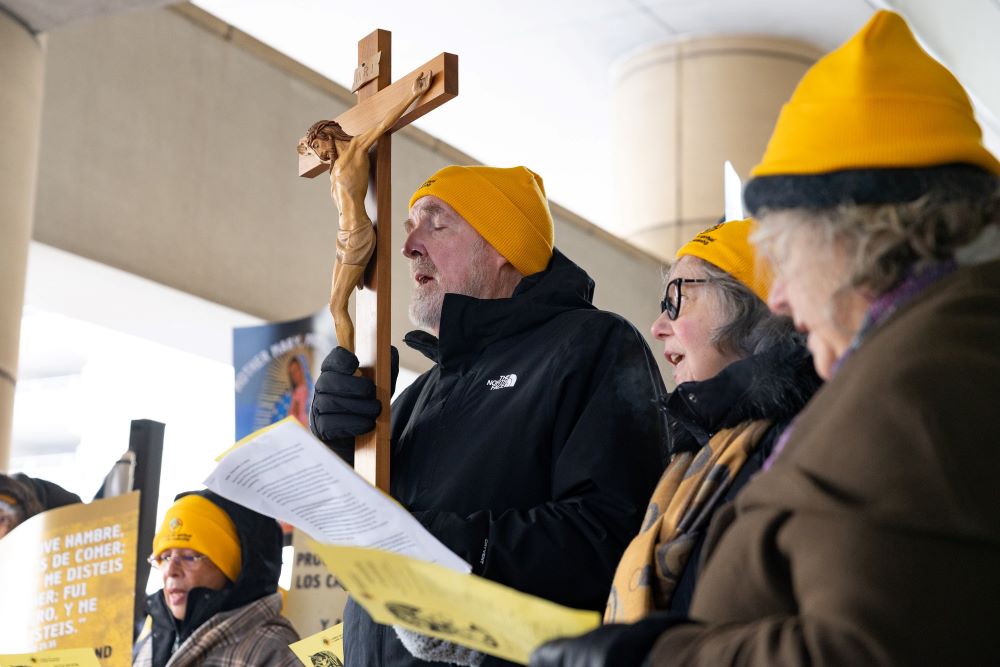
Fr. Dennis Berry, a member of the Missionary Servants of the Most Holy Trinity, holds a crucifix during a news conference outside the Immigration and Customs Enforcement office at the Federal Building in Chicago Dec. 19, 2025. (OSV News/Hailey Hoffman)
As the Trump administration escalated its assault on human dignity, many Catholics have wondered: Where are our bishops? Why don't they do something?
Where were their voices when cuts to USAID consigned millions across the world to hunger, thirst and death? Where were their voices when the Trump administration threatened to cut food stamps for the poor while cutting taxes for the wealthiest Americans? Where were their voices when the administration kidnapped a foreign leader, threatened military action against an ally and invaded American cities? Where were their voices when federal agents gunned down two U.S. citizens protesting inhumane treatment of migrants?
It turns out that during each of these inflection points, some bishops were indeed using their voices, calling attention to the egregious violations against human dignity at the hands of the Trump administration and urging Catholics not to remain silent. Even if theirs weren't the loudest or the most consistent voices, they deserve credit for speaking up — and together they provide a model for other church leaders during this disturbing time.
Consider these examples:
Cardinals Blase Cupich of Chicago, Joseph Tobin of Newark, New Jersey, and Robert McElroy of Washington, D.C., have been vociferous in their condemnation of this new world order that Trump has sought to establish. Each has spoken out on their own, and earlier this year, they coauthored an extraordinary statement rebuking the Trump administration's foreign policy agenda.
We praised that statement, along with Archbishop Timothy Broglio's bold response to a British interviewer wherein he said U.S. military personnel could "within the realm of their own conscience" disobey an immoral order to invade Greenland," and Archbishop Borys Gudziak's powerful video advocating for the church in Ukraine. In their own ways, each of those five prelates offered the prophetic witness to the Gospel the faithful have been desperate for.
Thankfully, such clarity empowers others to use their voices, and together they provide a powerful moral witness.
Take Detroit Archbishop Edward Weisenburger, who released a statement Feb. 9 condemning Trump's social media sharing of a racist image of former President Barack Obama.
"It is very disturbing that anyone, much less the President of the United States or his staff members, should see racist memes as humorous or appropriate expressions of political discourse," Weisenberger said. They are "deeply offensive and must be condemned in the strongest terms," he said.
There's also Bishop Anthony Taylor of Little Rock, Arkansas, who lost extended family in the Holocaust, who penned an impassioned plea for migrants, diplomacy and democracy.
"We have reason to worry about the direction our society has taken in recent years. And we have reason to work to shore up our democracy before it is too late," the bishop wrote.
Bishop John Keehner of Sioux City, Iowa, took on the administration's mass deportation agenda directly.
"As their shepherd, I cannot remain silent when members of our human family suffer," Keehner wrote. He urged "all people of goodwill" to stand in solidarity with immigrant families that he said "contribute so much to the life of our parishes and communities."
Had our church's leaders spoken out earlier against the administration's cruelty toward migrants, with the urgency and unity they once devoted to issues such as same-sex marriage, religious liberty or abortion, perhaps political realities would have shifted sooner.
Archbishop John Wester of Santa Fe, New Mexico, offered fraternal correction to U.S. House Speaker Mike Johnson's use of the New Testament to defend the administration's draconian immigration and border policies.
"The Gospel is not a collection of sound bites for political advantage," Wester wrote. "It is the call to love our neighbors as ourselves, to defend the defenseless, and to remember that every human being bears the imprint of God."
No doubt other shepherds have spoken out either in a homily, a video or a letter, that are not listed here. But still others fail to meet this moment.
What makes these examples so powerful is that they recognize the urgency of this moment and deviate sharply from what has become the norm for many bishops, who issue watered-down statements, seemingly not wanting to offend a president who once appeared poised to deliver on a range of pro-life issues. Statements mired in moral ambiguity or offering milquetoast condemnations of "both sides" fail to live up to the moment. Had our church's leaders spoken out earlier against the administration's cruelty toward migrants, with the urgency and unity they once devoted to issues such as same-sex marriage, religious liberty or abortion, perhaps political realities would have shifted sooner.
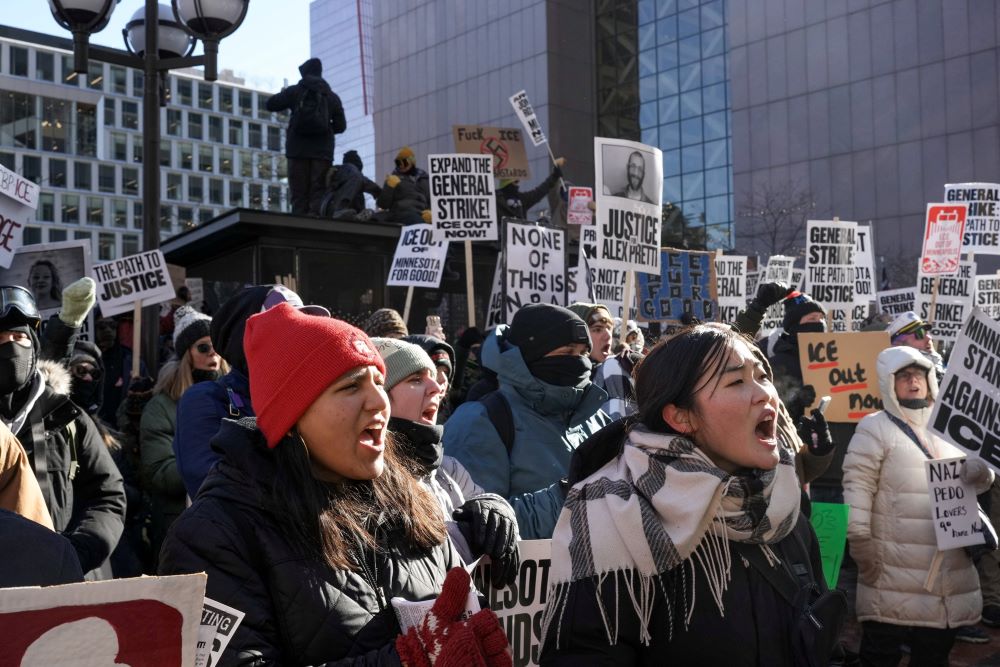
Demonstrators attend an "ICE Out" protest in Minneapolis Jan. 30, after the fatal shootings of Renee Nicole Good and Alex Pretti by U.S. federal immigration agents. Protesters held "no work, no school, no shopping" strikes across the U.S. that day to oppose the Trump administration's immigration crackdown. (OSV News/Reuters/Tim Evans)
Fearless and unapologetic advocacy for the Gospel — like we read in statements from Cupich, McElroy, Tobin, Broglio and others — is needed. Anything else is a betrayal of the Gospel.
We are encouraged by bishops who have spoken out courageously; no doubt, history will remember their witness fondly. We hope these bishops continue to speak out against evil in this administration, wherever they see it. We applaud those who have put their words into actions that help safeguard human dignity and protect the marginalized.
To bishops who have not yet spoken up, those who have opted to simply share someone else's message, those who believe they can wait out this storm, or have offered only passive and vague statements about our current political reality, we say this: It is never too late to speak up. Your brother bishops offer a model of how to describe what's happening in front of our eyes. Should this crisis pass, and normalcy and civility return to our politics, Catholics and others of goodwill will remember where you stood during the storm.
Today's crisis is the mistreatment of people seeking better lives here and the fear instilled in immigrant communities in every corner of this country. In the weeks and months ahead, the administration will undoubtedly create new crises. Its rhetoric around voting is particularly alarming ahead of November elections.
To those bishops who have remained silent, may we suggest turning to the apostles, who spoke with clarity and boldness in support of the truth. Catholics today deserve the same in our leaders: shepherds unafraid to speak the confidence of the good news of the risen Christ.
Advertisement