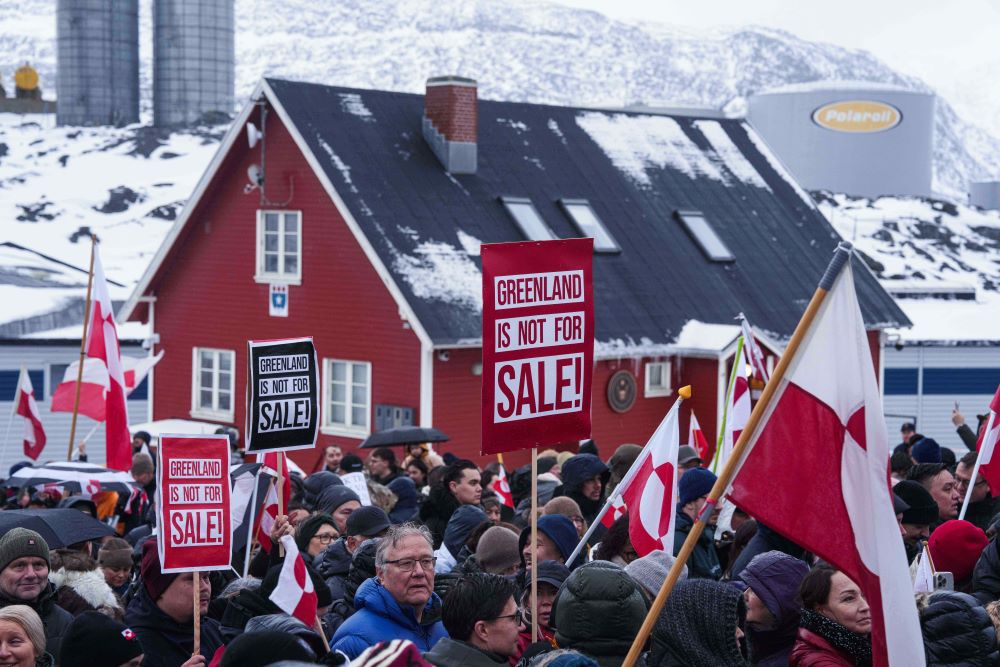
People protest against Trump's policy towards Greenland in front of the U.S. consulate in Nuuk, Greenland, Jan. 17. (AP/Evgeniy Maloletka)
The questions were inevitable within the first weeks of the second Trump administration: When would he go too far? When would the utter destruction of democratic norms, as well as the attacks on human dignity and established law reach a point where even those most averse to public political engagement feel compelled to speak out?
That moment occurred this week on two fronts in the U.S. Catholic world. In a highly unusual statement released Jan. 19, Cardinals Blase Cupich of Chicago, Robert McElroy of Washington, D.C., and Joseph Tobin of Newark, New Jersey, rebuke the administration's approach to foreign policy. Specifically, the cardinals "renounce war as an instrument for narrow national interests and proclaim that military action must be seen only as a last resort in extreme situations, not a normal instrument of national policy."
Perhaps even more stunning, Archbishop Timothy Broglio, head of the U.S. Archdiocese for the Military Services, told a British interviewer that U.S. military personnel could, "within the realm of their own conscience" disobey an immoral order to invade Greenland.
A new era of religious leadership in the U.S Catholic Church has dawned — driven by the immoral and destructive extremes of the Trump administration.
We Catholics in America at this moment face an unprecedented test of the faith we proclaim.
No longer can anyone, but Catholics in particular, infer consent from episcopal silence. No longer can Catholics within the administration's apparatus or supporters of it twist reality to accommodate policies clearly at odds with Catholic social teaching and the heart of the Christian Scriptures.
The cardinals' statement warning against use of military force understandably has attracted the greatest attention given Trump's invasion of Venezuela and capture of its leader without involvement of Congress and his insistent threat to take over Greenland, a NATO ally. But the full statement covers far more in the Catholic tradition than that one concern.
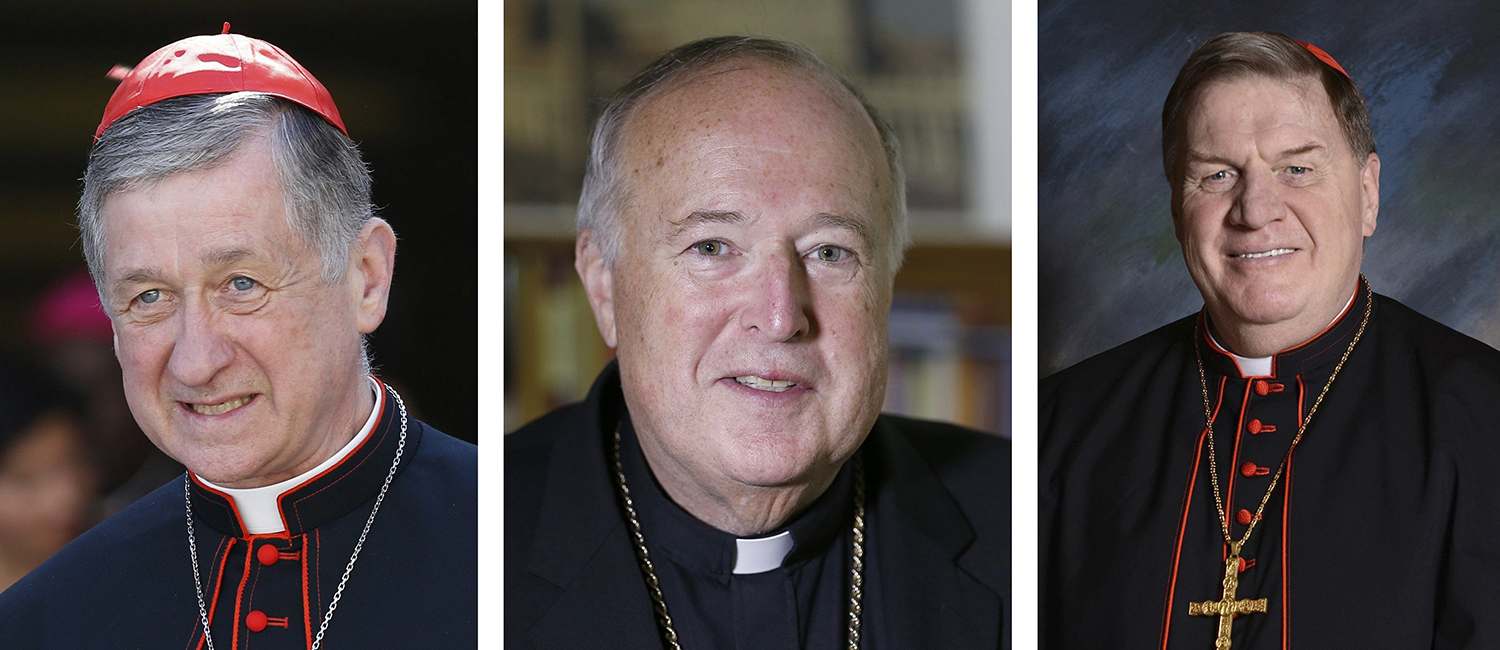
Cardinals Blase J. Cupich of Chicago, Robert W. McElroy of Washington and Joseph W. Tobin of Newark, New Jersey, are pictured in a combination photo. The three cardinals issued a joint statement Jan. 19, 2026, on the morality of U.S. foreign policy under the Trump administration. (OSV News files/Paul Haring, CNS/Archdiocese of Newark)
In total, it takes issue with the administration's Hobbesian view of human nature and the world as articulated by Stephen Miller, Trump's chief of staff on policy. Miller's might-makes-right approach is being executed not only in the international arena but also in our own streets with the unrestrained activity of Immigration and Customs Enforcement agents, an issue the bishops previously addressed as a national body and individually.
According to the British news outlet The Tablet, Broglio's remarks came in answer to a BBC interviewer. He said that U.S. military personnel "could be put in a situation where they're being ordered to do something that's morally questionable" if Trump were to order an invasion of Greenland. In that case, he said, "within the realm of their own conscience it would be morally acceptable to disobey."
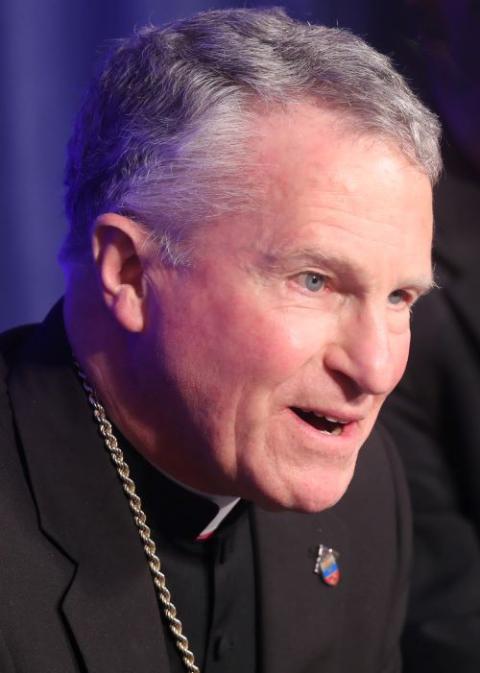
Archbishop Timothy P. Broglio of the U.S. Archdiocese for the Military Services (OSV News/Bob Roller)
It is significant that Broglio was not talking about an illegal order, but rather an immoral order that becomes a matter of conscience for an individual. It is extraordinary — and perhaps one measure of how extreme circumstances have become — that the head of the Military Archdiocese would add conscientious objection so prominently as an option for individual soldiers.
The bishops' prior statements on the treatment of immigrants, given the essential role immigrants have played in the life of the U.S. church, were not unexpected. The recent statements on militarism and the right of soldiers to disobey immoral orders, however, place the U.S. episcopacy in uncharted territory in its relationship with the state.
No longer can Catholics within the administration's apparatus or supporters of it twist reality to accommodate policies clearly at odds with Catholic social teaching and the heart of the Christian Scriptures.
While Pope John Paul II, as recently as 2003, sent an envoy, to no avail, to plead with President George W. Bush against invading Iraq, it is a new level of opposition for American cardinals to formally question the fundamental morality of an administration's engagement with the world.
"In 2026, the United States has entered into the most profound and searing debate about the moral foundation for America's actions in the world since the end of the Cold War. The events in Venezuela, Ukraine and Greenland have raised basic questions about the use of military force and the meaning of peace," the cardinals wrote. "The sovereign rights of nations to self-determination appear all too fragile in a world of ever greater conflagrations. The balancing of national interest with the common good is being framed within starkly polarized terms."
They continued: "Our country's moral role in confronting evil around the world, sustaining the right to life and human dignity and supporting religious liberty are all under examination. And the building of just and sustainable peace, so crucial to humanity's well-being now and in the future, is being reduced to partisan categories that encourage polarization and destructive policies."
The Catholic leaders lean heavily on the thinking of Pope Leo XIV, quoting at length a statement he made recently to the Vatican's diplomatic corps. Leo lamented a fading multilateralism and the rise of diplomacy based on force replacing one based on dialogue. "Peace is no longer sought as a gift and desirable good in itself." Instead, he said, "peace is sought through weapons as a condition for asserting one's own dominion."
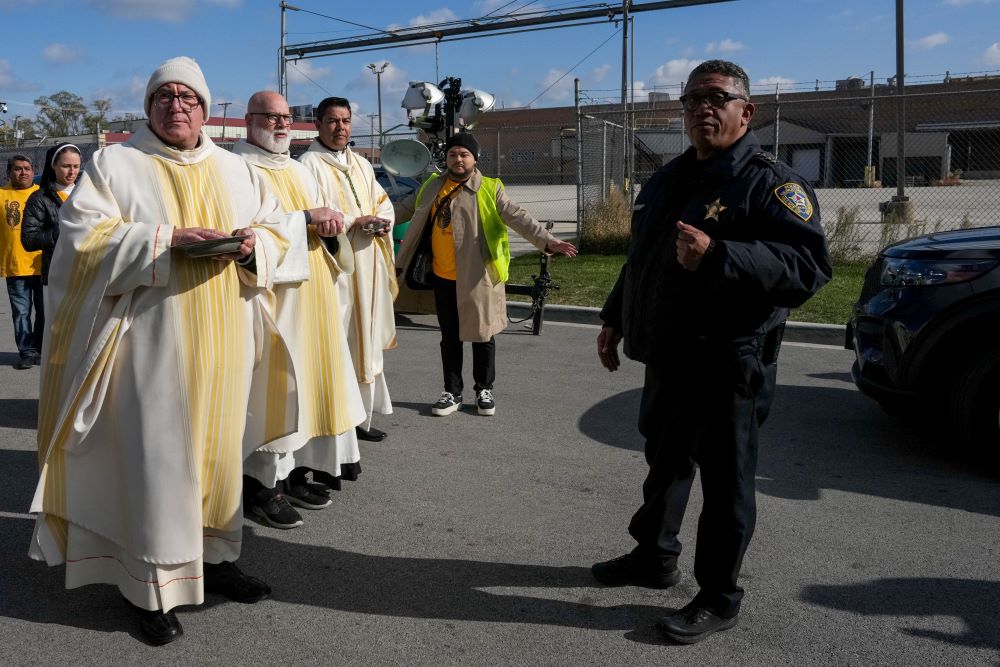
Law enforcement officers prevent clergymen from entering the Broadview ICE facility and offering Communion to immigrants detained inside, during an outdoor Mass in the Broadview section of Chicago Nov. 1, 2025. (OSV News/Reuters/Leah Millis)
We are witnessing a welcome renewal of unity in tone and purpose between the papacy and U.S. Catholic leadership. Leo's critiques of the U.S. cannot be easily dismissed. His words are not those of someone formed in another culture and speaking another language. Leo grew up here as Robert Francis Prevost, he speaks Midwest accented English. He was educated here and he understands what a profound departure the Trump administration is from what had been our political norm.
The cardinals' statement is also a welcome realignment of Catholic engagement in the public square. For too long U.S. Catholic leaders had been captive of single-issue politics that forced them into a tight partisan corner. This statement, while noting the threats to human dignity and life of abortion and euthanasia, does not confine Catholic teaching or action to those issues. In speaking of assaults on human dignity, the cardinals also include Leo's concern for "the increasing violations of conscience and religious freedom in the name of an ideological or religious purity that crushes freedom itself."
Cupich, Tobin, McElroy and Broglio, stepping out in courage, are rescuing the fullness of Catholic teaching in all of its richness and authority. They likely would rather not be in this spot, engaging so publicly in such a deep critique of the state.
Advertisement
But as Thomas More, in that wonderful speech in "A Man for All Seasons," describes the human role in political intrigue: "God made the angels to show him splendor — as he made animals for innocence and plants for their simplicity. But man, he made to serve him wittily in the tangle of his mind! If he suffers us to fall to such a case that there is no escaping … then we may clamor like champions."
We have reached, in our national life, that point of no escaping.
There is no hiding from the inhumanity in depriving the neediest abroad of life-saving medicine and food. There is no longer turning away from the brutal treatment of not only immigrants but also U.S. citizens at the hands of a paramilitary force accountable to no one. There is no rationale that any longer justifies a self-indulgent president and his minions lusting after an irrational and destructive hemispheric hegemony.
We have asked previously what it means to be a Catholic in this country at this moment. The American hierarchy has begun to answer the question and it cannot be surprising that the answer is more challenging than comforting.
This administration's extreme assaults on human dignity and increasingly dangerous threats to peace summon religious practice, in unusually demanding ways, from the confines of the sanctuary to the public square. We Catholics in America at this moment face an unprecedented test of the faith we proclaim.