
Fasting is one of the oldest Catholic traditions, and is honored by most faiths as a way that leads to spiritual enlightenment and discipline. (OSV News illustration/CNS file, Emily Thompson)

by Shmuly Yanklowitz
Religious divides, with overlapping political tension, are not a phenomenon of the past and we should seek unique opportunities to understand each other and collaborate on ethical pursuits.
Note the following in the sacred calendars of Islam, Christianity and Judaism this year. Ash Wednesday, which marks the beginning of Lent, falls on Feb. 18, and Christians will observe the 40 days of Lent through April 2. The holy Muslim month of Ramadan will also begin Feb. 18. For the duration of that month, Muslims all over the world will fast during daylight hours. The Jewish holiday of Passover, which begins on the fifteenth of the Hebrew month Nissan, will this year begin at sundown on April 1, and for diasporic Jews will continue through nightfall April 9. Passover will overlap with Lent.
In their own ways, each of these three holidays is a forceful but gentle reminder of the importance of making incremental personal growth. Ramadan commemorates the revelation of the Quran. In this month of fasting, hunger provides a kind of moral awakening. My understanding is that the Quran frames fasting as a path to taqwa, a God-consciousness. Those who are able to fast abstain from all food and drink from sunup to sundown as a way to become closer to God and cultivate gratitude and self-control. Hunger is also meant to soften the heart, and Muslims are encouraged to be especially charitable during the month of Ramadan.
Lent also has a focus on restraint and abstinence, commemorating the 40 days Jesus fasted in the desert. Many Catholics abstain from meat on Fridays during Lent, and more generally, there is an emphasis on personal discipline and correcting indulgence at this time. It is common to choose a temptation to "give up" for Lent. There is also an emphasis on compassion and the giving of alms during the Lenten period, inspired by the life of Jesus.
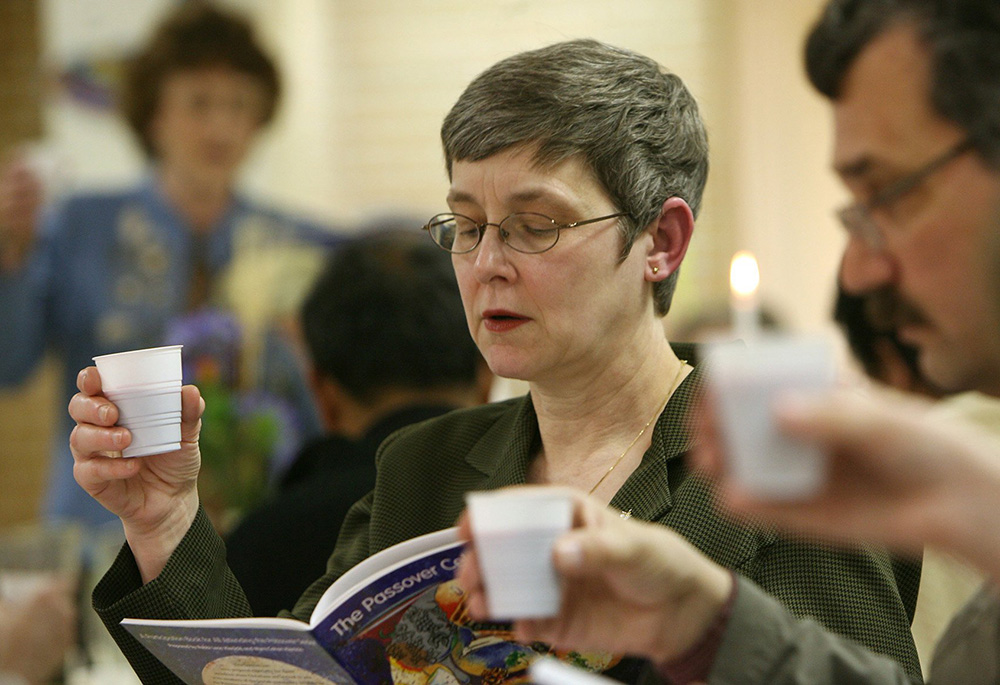
In this 2007 photo, Sandra Steele lifts a cup of grape juice, symbolizing wine, during a Seder meal at St. Thomas More Church in Munster, Indiana, March 24. The Seder is a special ritual during the Jewish festival of Passover, a holiday commemorating Jewish deliverance from Egyptian bondage and the time of the barley season. Many Catholics participate in a Seder during the season of Lent. (CNS/Northwest Indiana Catholic/Karen Callaway)
The holiday of Passover shares themes with both Lent and Ramadan. There is, of course, the total abstinence from chametz — leaven wheat, barley, oats, rye and spelt. During the Passover Seder itself, food becomes a tool for compassion: the bitter herbs give us the experience of suffering as strangers in Egypt, the matzah is referred to as the "bread of affliction," and we are told that we should feel as if we ourselves escaped from bondage under Pharaoh. Charitable giving remains an important tradition of the holiday, especially the giving of food baskets (sometimes called kimcha d'pischa) so that those in need can celebrate Passover. After all, as we recite from the Haggadah, "Let all who are hungry come eat."
Advertisement
What is shared between these three Abrahamic traditions is the idea that food is never just simply food. Rather, food provides opportunities for moral education, personal discipline and collective memory. When we eat (and fast) together, we build community around shared values.
Never has it been more relevant for us to think about food ethics. In the United States alone, 48 million people live with food insecurity — that includes 14 million children. Worldwide, in 2023, about 1 in every 11 people faced hunger: well over 700 million people. Food ethics is about who is fed, of course — about the accessibility of healthful, nutritious foods. But it doesn't stop there. It is about workers, and farmworkers in particular, their dignity and safety; so often made invisible, the people who grow and harvest our food deserve to be seen. It's about animals — their sentience and our mandate to be their guardians. It's about the land and the sustainability of our food practices.
This year, let us renew a discussion in America around food ethics. On a personal level, we can feel the push toward taking on an issue of food ethics to integrate into our own lives more deeply — not just during Lent or Ramadan or Passover, but all year long.
Given the inherent spiritual dimension of food, I believe that food ethics movements need to be spiritual movements. Note that I did not say religious movements. Indeed, while religion can play a role in actualizing the deeper meaning of food, we should not let faith be a barrier to entry. People of other faiths, and of no faith at all, have a place in the conversation.
This year, let us renew a discussion in America around food ethics. On a personal level, we can feel the push toward taking on an issue of food ethics to integrate into our own lives more deeply — not just during Lent or Ramadan or Passover, but all year long. On the national and communal level, let's use this energy to rejuvenate the discourse on the ethics of food: how it is produced, harvested and consumed.
As we sit around the table — be that for Seder, iftar, Easter dinner, or something else entirely — we might ask ourselves, what would it look like to build the world to come here and now, one meal at a time?