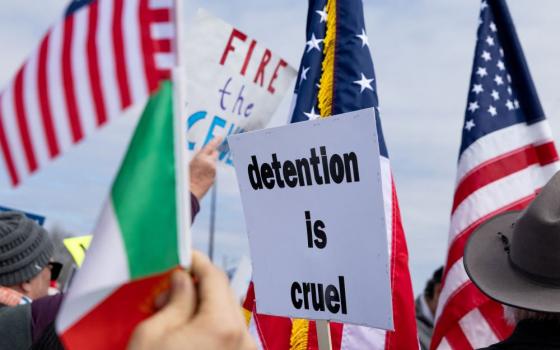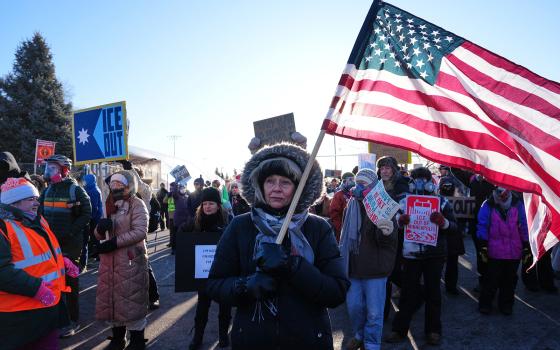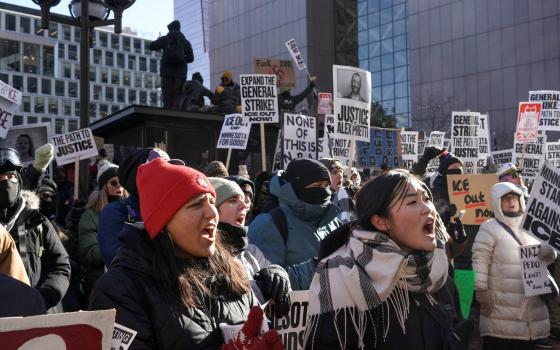
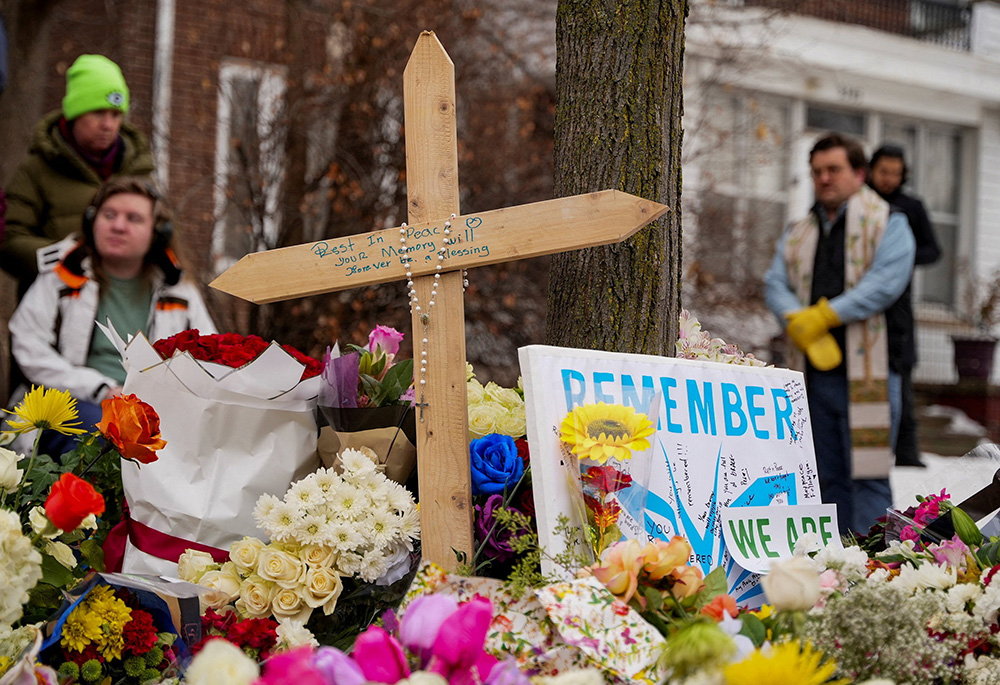
A rosary is draped over a cross as people gather by a makeshift memorial in Minneapolis Jan. 8, 2026, at the scene of the fatal shooting of Renee Nicole Good by a U.S. Immigration and Customs Enforcement agent. (OSV News/Reuters/Tim Evans)

by Meredith McKay
For weeks, I have watched the news out of Minnesota with increasing unease. I grew up in the Twin Cities metro area, and my friends, family and former high school classmates who still live there had been posting about the increased presence of U.S. Immigration and Customs Enforcement culminating in the fatal shooting of Renee Good.
I searched for flights to take me from Spokane, Washington, to Minneapolis, only stopping myself from buying a ticket because the impulse came from a yearning to go home rather than any specific role I could fill.
On Saturday, Jan. 17, I learned of a national call for clergy and faith leaders to come to Minneapolis to learn, witness and serve as a visible presence. With relief at finding a place to channel my energy, I cleared my schedule and bought a plane ticket. Together with eight clergy friends from Spokane, I answered this call put out by MARCH Minnesota (Multifaith Antiracism, Change and Healing).
For three days, we witnessed life in the Twin Cities and learned from those on the front lines, both through MARCH's gathering and our own local connections. We grounded ourselves with the intention of bringing all that we learned back to our own communities.
In Minneapolis, I learned the importance of witness, training and sustained resistance when it comes to facing injustice. Whether ICE comes to occupy another of our cities or not, faithful Catholics ought to take a cue from the work of faith leaders and community organizers in Minneapolis.
These leaders pointed to witness — a persistent commitment to telling the truth — as the most basic, necessary action. We must commit to the holy work of seeing, naming and refusing to look away.
While not everybody can or should witness this firsthand, at the very least Catholics ought not turn away from the witness of those who are present. I share with you this witness of what I experienced and learned on the ground along with invitations for a Catholic way of engaging.
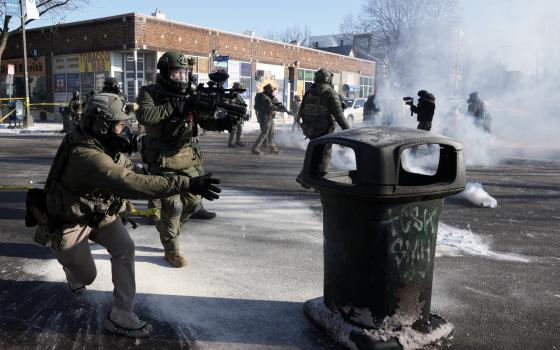
I witnessed the people of Minnesota, especially people of color, living in terror due to the occupation of approximately 3,000 federal agents and responding together in a hyperlocal manner out of love for their neighbors.
While not everybody can or should witness this firsthand, at the very least Catholics ought not turn away from the witness of those who are present. I share with you this witness of what I experienced and learned on the ground along with invitations for a Catholic way of engaging.
The networks that are presently active stemmed from preexisting mutual aid networks and webs of neighbors who know each others' stories. The Twin Cities have been able to activate these networks in the current crisis because they already existed. This is difficult work in a world where we can order nearly everything we need with the click of a button and can avoid leaving our homes or talking to neighbors for days.
As Catholic parishes are less organized by neighborhood and geographical location, Catholics who are engaged in their parish must also work to be connected to their actual neighborhood. In this, we can take literally the Gospel imperative to love our neighbor. It is hard to love our neighbor when we are averting eye contact as we step outside to grab a package off our front porch. It is easier to love our neighbor when we actually know them.
Advertisement
At the MARCH gathering of hundreds of faith leaders across traditions, there were fewer than ten Catholics present. I know that Catholic churches have been engaged in the response to ICE and many Minnesotan Catholics are directly affected by ICE's presence, but the lack of Catholic representation mirrors my experience of other multifaith organizing gatherings. I suspect this stems from the reality that there are many Catholic-specific groups for community action and organizing rather than a lack of Catholic engagement. Yet, I think we miss out on key insights and opportunities for coalition-building when we are not present in these spaces. Faithful Catholics must do more to transcend the boundaries of our own tradition as we seek to love our neighbors.
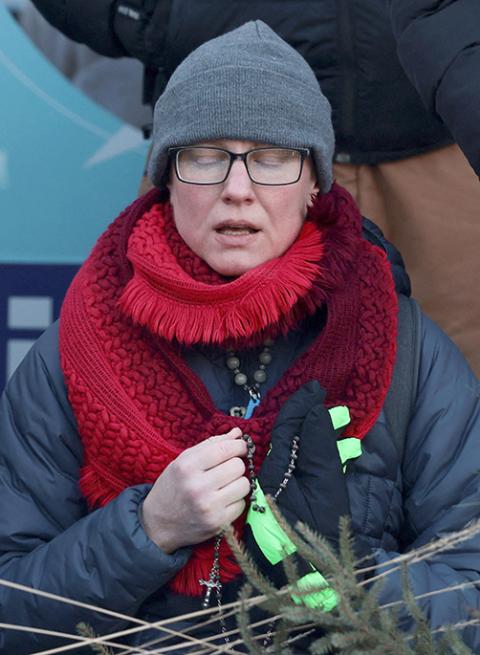
A woman prays with a rosary as people gather around a makeshift memorial in Minneapolis Jan. 25, 2026, at the site where Alex Pretti, 37, was fatally shot by federal agents trying to detain him. (OSV News/Reuters/Evelyn Hockstein)
In Minneapolis, I witnessed firsthand the ways the work of the resistance on the ground is sustained and persistent, driven by disciplined hope and generative creativity. I experienced a greater emphasis on what the community stood for instead of a focus on what they opposed. There was a clear recognition from organizers that even if all ICE agents were to immediately leave, that would not constitute justice for their neighbors who have been repeatedly dehumanized long before the present crisis. The protests and resistance are rooted in something bigger than an insistence for ICE to leave. As Catholics, this model resonates well with our faith — we cannot simply be opposed to violence, we must faithfully follow God's call to love all of our neighbors.
As my group turned to leave on Saturday morning, we heard news over Signal that federal agents had shot another legal observer — we now know this was Alex Pretti. It was a sober reminder that the work continues for us all. I could have stayed in Minneapolis, but the truth is the situation in Minneapolis is not happening in a vacuum, and there is work that I am now equipped to do in my own communities.
As a Catholic whose work is in ministry and public theology, I believe deeply that prayer must move us to action. Presently, I am moved towards witness and capacity building — a firm, persistent stating of the truth of what I have seen, and an urgent invitation to every possible person I can reach to love our vulnerable neighbors through action and resistance to dehumanizing forces. I pray that my Catholic siblings will also be moved to act to witness and work towards creative love for all of our neighbors.