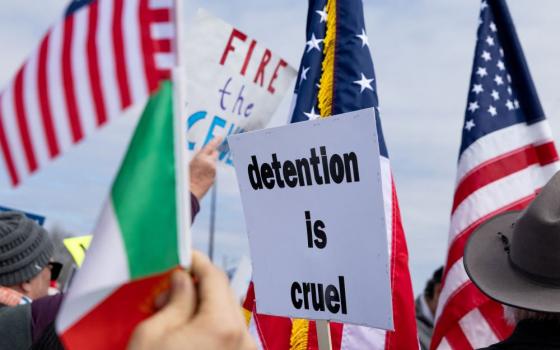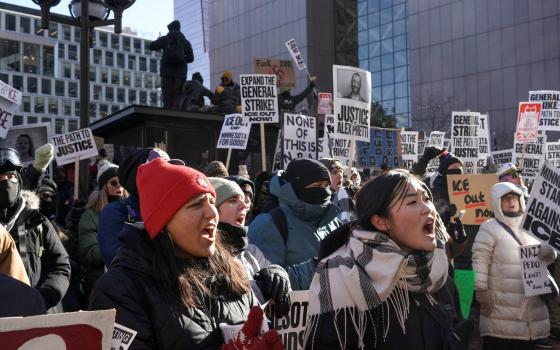
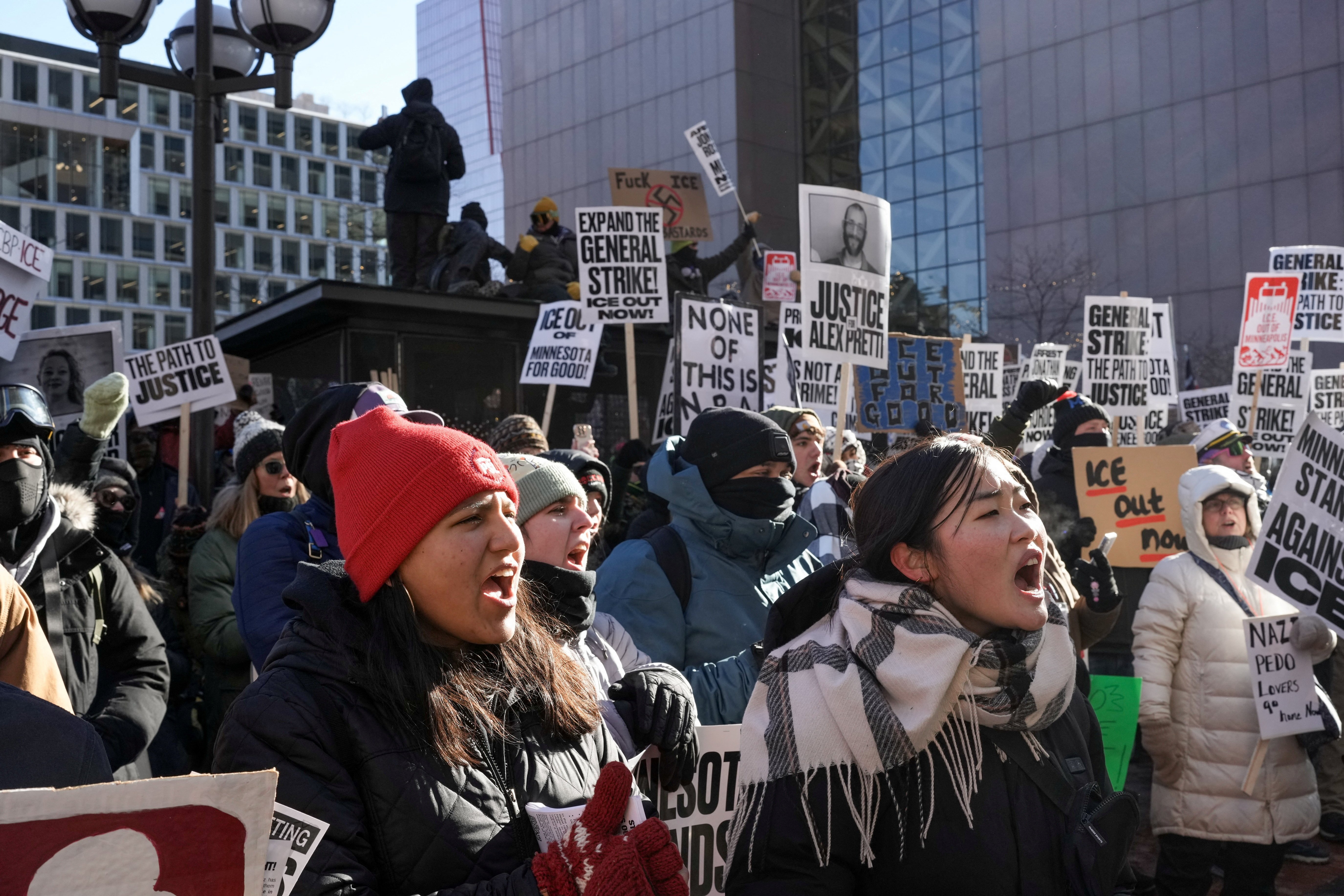
Demonstrators attend an "ICE Out" protest in Minneapolis Jan. 30, 2026, after the fatal shootings of Renee Nicole Good and Alex Pretti by U.S. federal immigration agents. Protesters held "no work, no school, no shopping" strikes across the U.S. that day to oppose the Trump administration"s immigration crackdown. (OSV News/Reuters/Tim Evans)

by Christine Schenk
Over the past year, I — along with many of my Congregation of St. Joseph Sisters and Associates — joined the millions of people participating in huge, peaceful, nationwide rallies organized to resist authoritarianism and protest policy changes affecting the most marginalized among us. Cruel new rules threaten food security for children and their families, as well as affordable health care for poor and middle class people, particularly in rural areas.
Even worse are violent clandestine immigration practices that deny due process rights, unlawfully detain immigrants and, as we saw on Jan. 7 and Jan. 24, tried to condone the horrific killings of U.S. citizens Renee Good, and Alex Pretti for exercising their first amendment rights.
These pitiless, violent policies are against Catholic social teaching and gravely weaken the social fabric of our nation, our towns and our cities. But rather than succumb to a deep anger or depression, millions of people are speaking up and helping out in communities all across the United States. In cities across the country thousands of ordinary citizens are stepping up to support immigrant families and protest ICE raids.
Last October an estimated 7 million people joined peaceful protests across the nation, without protest-related incidents or arrests in major cities. They laughed, sang, and gathered with humor, peace and even joy. Gospel nonviolence is not only a powerful response to injustice, but it can be a source of joy. And the reason? Well, I suggest that any time people of goodwill align themselves with a God of love and of justice, joy will inevitably follow.
Last month we celebrated the birth of the Rev. Martin Luther King Jr., who led the civil rights movement from 1955 until 1968 in the U.S. Inspired by the teachings of Jesus and Gandhi, King, a Baptist minister, is widely regarded as America's preeminent advocate of nonviolent resistance.
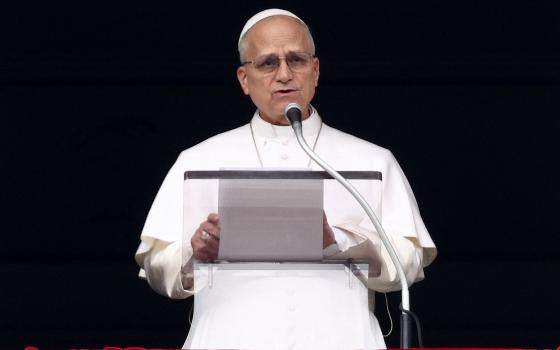
For Jesus and for King, Gospel nonviolence is able to transform the "structures of sin" so eloquently described in Pope Leo XIV's first apostolic exhortation Dilexi Te ("I Have Loved You"). It is worth noting that Leo's exhortation quotes Pope Francis' Evangelii Gaudium ("The Joy of the Gospel") no fewer than 18 times. For Christians, living and proclaiming the Gospel of Jesus can be both challenging and a source of joy. But it is a tough-love kind of joy.

Demonstrators in front of the Russian Embassy Feb. 22, 2022, in Berlin hold placards during an anti-war protest. (CNS/Reuters/Christian Mang)
Both Dilexi Te and Evangelii Gaudium take a hard look at the "social sin" of today's economic structures which increasingly favor the wealthy at the expense of everyone else. "We must continue, then, to denounce the 'dictatorship of an economy that kills,' " writes Leo, who goes on to quote Francis' searing critique in Evangelii Gaudium: "While the earnings of a minority are growing exponentially, so too is the gap separating the majority from the prosperity enjoyed by those happy few." In words that resonate right now, Leo quotes the pointed observation from Evangelii Gaudium: "A new tyranny is thus born, invisible and often virtual, which unilaterally and relentlessly imposes its own laws and rules."
Given the challenging realities facing those who live within economies that do not serve the common good, Leo says, "All the members of the People of God have a duty to make their voices heard … to point out and denounce such structural issues, even at the cost of appearing foolish or naive." He reminds us that Gospel fidelity is more than a person's individual relationship with God. It is also "about loving [a] God who reigns in our world. … Both Christian preaching and life, then, are meant to have an impact on society. We are seeking God's Kingdom." With passionate closing words, Leo proclaims the power of a Christian love:
Christian love breaks down every barrier, brings close those who were distant, unites strangers, and reconciles enemies. … By its very nature, Christian love is prophetic: it works miracles and knows no limits. It makes what was apparently impossible happen. Love is above all a way of looking at life and a way of living it. A Church that sets no limits to love, that knows no enemies to fight but only men and women to love, is the Church that the world needs today.
Living within this limitless love can only bring joy — and inevitably justice. It is what our nation needs today. So let us embrace Gospel nonviolence, and as Leo suggests, work to change unjust structures so the world may know that Jesus' words are meant for all: "I have loved you."
Advertisement