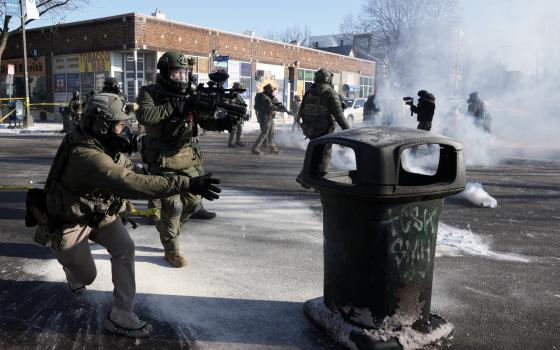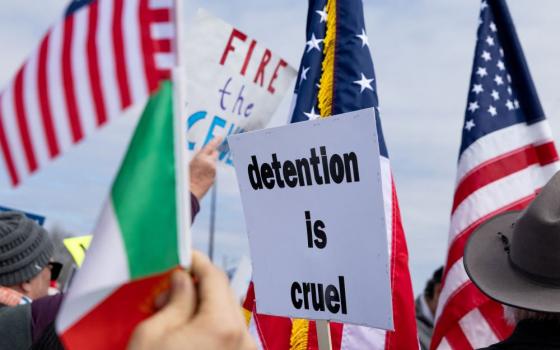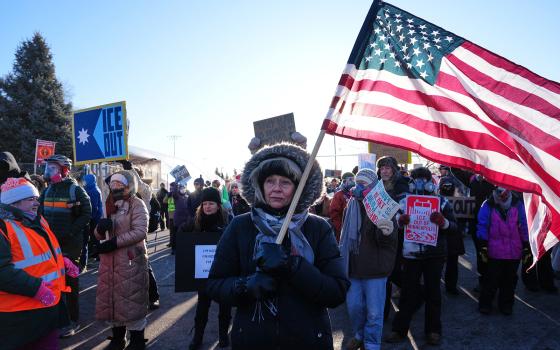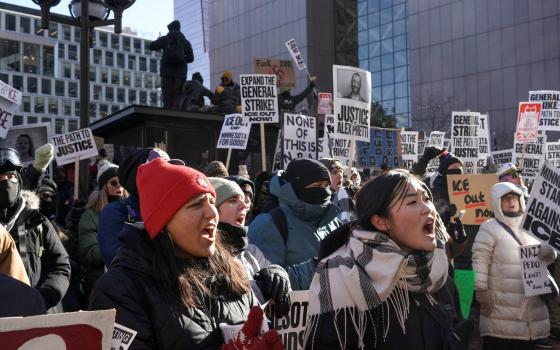
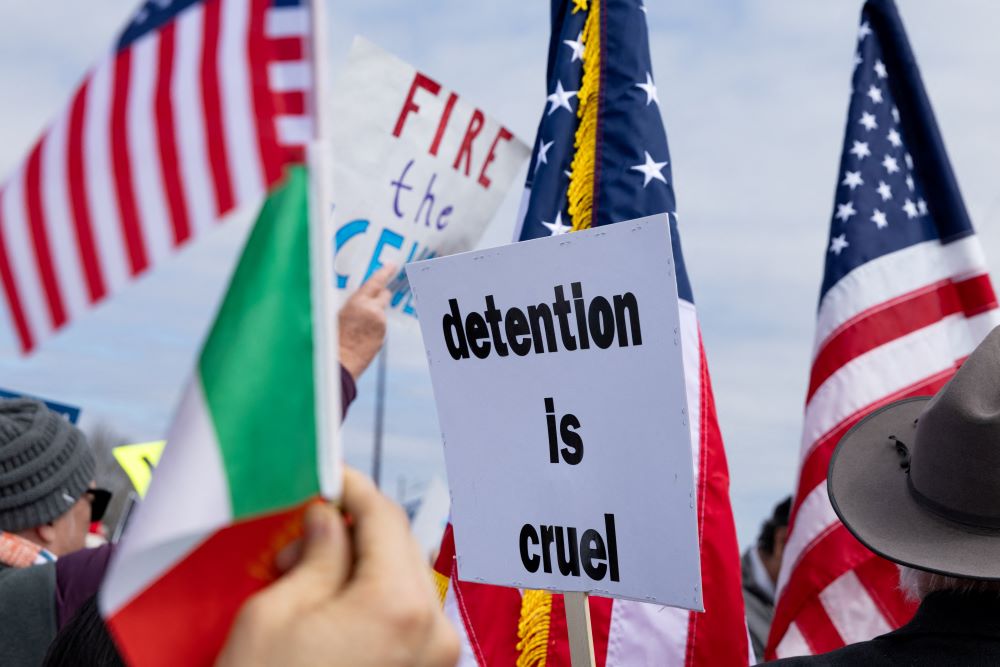
People protest hours after 5-year-old Liam Conejo Ramos and his father, Adrian Conejo Arias, returned home after a judge ordered them to be released from Immigration and Customs Enforcement detention at the South Texas Family Residential Center in Dilley, Texas, Feb. 1. (OSV News/Reuters/Kaylee Greenlee)

by Chris Damian
When my parents dropped me off for my freshman year of college they advised me not to get arrested. They were only partially joking. President Barack Obama had given the commencement address at the University of Notre Dame the previous year — something which I'd told them I would have protested. I entered Notre Dame passionately pro-life, and with a desire to help drive reform at the Catholic university.
I grew up in what I see as the best of the pro-life movement. At the age of 16, I was trained as a sidewalk counselor to warmly and openly invite women entering Planned Parenthood to consider resources supporting the choice for life. At my Catholic school, we examined both the legislative issues surrounding abortion and also abortion's socioeconomic drivers. Well into my adult life I couldn't bring myself to vote for a Democrat who supported abortion, and I also believed that the choice for life needed economic and social support for that life into adulthood.
I now live in Minnesota. This year, my father again advised me to avoid arrest. My mother responded by saying she would bail me out. They were only partially kidding.
Today in Minnesota, you risk arrest by ICE if you are a disabled citizen driving to a doctor's appointment. You risk ICE breaking down your door and arresting you if you are a U.S. citizen without a criminal record, because they didn't do their homework and failed to realize that the person they wanted to target was already in prison. You risk having ICE expose your family to tear gas if you drive home from a basketball game. You risk ICE exposing you to tear gas even if you just sit in your apartment.
If one believes in the dignity of unborn human lives, how can one stand by and be silent?
Of course, my Minneapolis life right now is not limited to doctor's appointments, sports games and sitting at home. My pro-life advocacy was always centered in my Catholic faith, and it's this faith that motivates me now.
As the pro-life movement taught me to focus on factors which drive women to abortion, I have thought frequently of the women who live in fear and hiding today and who may fear bringing a child into this world. ICE continues to rip families apart, separating parents even from toddlers. One woman was separated from her baby 15 days after giving birth. Stories are coming out from the secretive ICE detention facilities of pregnant women receiving inadequate medical care and nutrition, sometimes resulting in miscarriage. One video was released of a pregnant woman pinned to the ground and dragged by ICE agents. Fear of going to the hospital is leading to complications and significant health problems during pregnancy.
If the pro-life movement taught me that one way to reduce abortions is to offer support for the choice of life, what is our Department of Homeland Security teaching us with these practices? Twenty percent of the United States population is Hispanic or Latino, while that group accounts for 30% of those obtaining abortions. While the 2022 Dobbs decision enabled significantly increased legal restrictions on abortion, abortion rates have increased every year since. And while many women, especially Hispanic and Latina women, are living in fear and hiding, often too afraid even to go to the hospital to give birth, one can reasonably expect that abortion will feel like a desperate survival strategy to support themselves and the children they may already be struggling to care for.
If one believes in the dignity of unborn human lives, how can one stand by and be silent?
As Christians, our hope demands action. In his 2007 encyclical Spe Salvi, Pope Benedict XVI writes that hope is not just "informative," but is "performative." We learn hope in "action and suffering," especially with and for our neighbors. If we do not share in others' suffering, we will be a "cruel and inhuman society." This sharing in action and suffering is a demand of the Christian and, as Benedict writes, "must stand above my comfort and physical well-being, or else my life itself becomes a lie."
Advertisement
I learned from the pro-life movement to exercise this hope through action and suffering by serving as a "sidewalk counselor" in high school, organizing baby showers with our local crisis pregnancy center, and overseeing Notre Dame's largest trip to the March for Life the year that we led the national march in 2012. I learned to not just assert my beliefs with my words, but to use my body in solidarity with the vulnerable.
Today, I have carried over this commitment in protesting, helping to pack groceries for families, and engaging in various forms of peaceful protest. I face much more serious risks than I ever had in the pro-life movement. We now know that you risk getting shot by ICE in the street for exercising your First and Second Amendment rights. But our local faith leaders still inspire us to step forward, facing arrest in order to shed light on injustice, in the spirit of Martin Luther King Jr.
My family and coworkers have expressed fear for me. One family member recently encouraged me strongly to avoid arrest and the implications that it could have on my personal and professional life. But I responded with the urgency that was taught to me by the best of the pro-life movement: "If you want to avoid people like me feeling like we need to go to those protests, I'd recommend doing everything you can to help change these conditions. I'm going to work on promoting ways for people to do that."
The pro-life movement taught me to not look away, but step forward and be counted among those who hope in suffering. I am grateful for that lesson. So I make the choice for life. I choose to be counted.