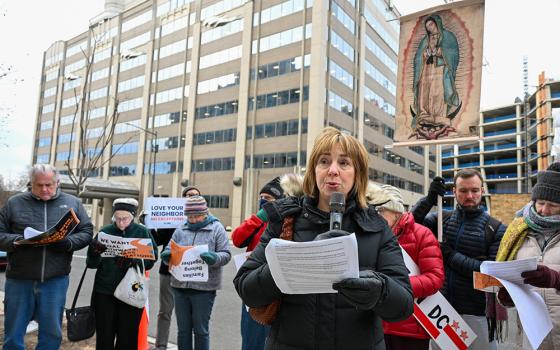
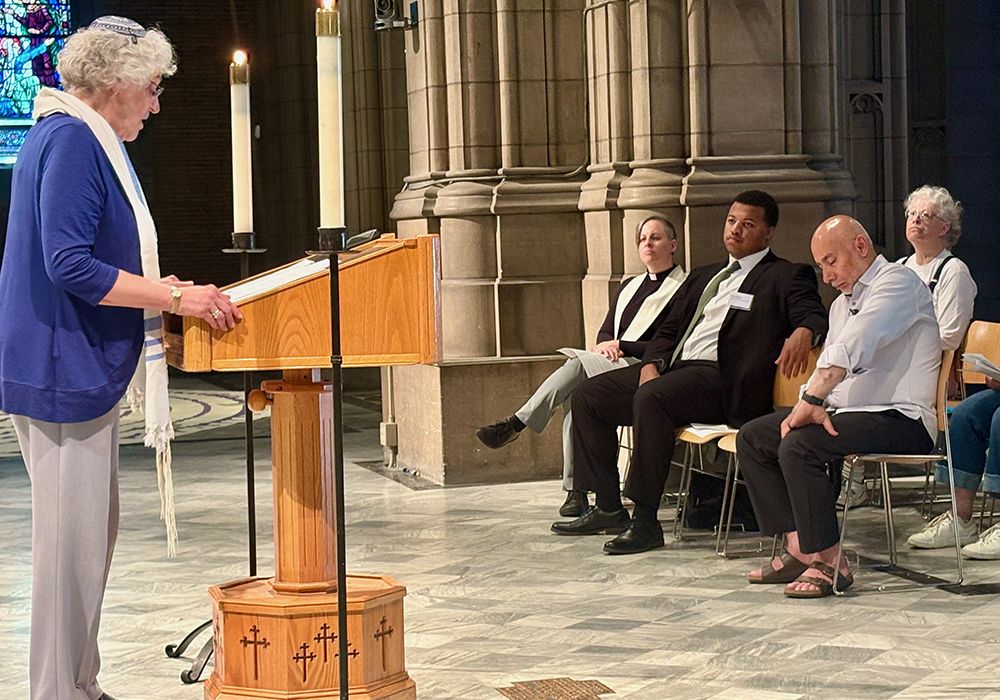
Rabbi Enid Lader of Beth Israel-the West Temple addresses the Cleveland interfaith prayer in solidarity with migrants on June 24. (Christine Schenk)
by Christine Schenk
"I stand before you as an immigrant, a sojourner, and a witness to God's faithfulness," said Fortunate Anele Zondo, a South African who emigrated at the age of 18 due to safety concerns and increasing violence that directly impacted her family. She said she was speaking "especially for the immigrants and refugees of Cleveland and beyond."
Zondo addressed over 115 people who gathered at Trinity Episcopal Cathedral on June 24 for an interfaith prayer service in solidarity with migrants. "This is a message to you — to not give up," she said. "A reminder that you are not alone. That we serve a God who sees all, who knows every struggle, every tear, every prayer — and yet remains with us faithfully, every step of the way."
Today Zondo is a U.S. citizen and the ministry engagement manager at Cleveland's Building Hope in the City, a faith-driven organization supporting underserved Cleveland communities and working for refugee and immigrant integration.
Brian Stefan-Szittai of Cleveland's Interreligious Task Force on Central America, or IRTF, announced that 68 northeast Ohio faith leaders from the Christian, Muslim and Jewish traditions had signed a document pledging their solidarity with the migrant community. The Northeast Ohio Interfaith Statement in Solidarity with Migrants and Refugees decries "recent violations of the human and civil rights of migrants including the arbitrary revocation of visas and green cards, removal of Temporary Protection Status, threats to birthright citizenship, and the forcible deportation and incarceration without due process of people with no criminal records."
Cleveland's interfaith witness is just one of many such gatherings held in U.S. cities large and small as the Trump administration ramps up cruel deportation strategies denying the human and civil rights of immigrants. In Southern California, interfaith leaders, including San Diego's then-Auxilary Bishop Michael Pham, accompanied migrants to court to help keep people from being kidnapped by U.S. Immigration and Customs Enforcement, or ICE, before their cases could be heard. In Tulsa, interfaith leaders gathered on May 13 to pray and raise money for migrants' legal defense.
According to WBALTV.com, in Annapolis, Maryland, an interfaith rally was held on March 24 in support of a legislative package to protect immigrants, preventing ICE from obtaining access to state and local databases without a warrant, ending agreements allowing local police to act as ICE agents and ensuring people have safe access to hospitals, schools and courthouses without fear of being detained.
Despite threats of losing federal funding, the Maryland legislation passed.
Other interfaith prayer and advocacy gatherings have been held in Philadelphia; Los Angeles; Newark, New Jersey; Huntington Station, Connecticut; Morningside Heights in Manhattan; and Oakland, California.
While agreeing that "nations have the responsibility to protect their borders and safeguard their communities," the Cleveland statement cautions that "these policies must not cause undue hate, bias or harms to migrants," and voiced alarm at "the prospect of ICE raids at our churches, schools, health care facilities, and playgrounds."
The statement also praised Northeast Ohio's political leaders who have publicly defended the rights of immigrants and pledged not to use local law enforcement in ICE arrests except when a judicial warrant indicates criminal activity. The special Assistant to Cleveland Mayor Justin Bibb, Jaden Baxter, told the gathering, "We are the strongest when we work together, for safety and opportunity for everyone."
Advertisement
Both the statement and prayer service were sponsored by the Interreligious Task Force on Central America, which was founded in the early 1980s after Clevelanders Ursuline Sr. Dorothy Kazel and lay missionary Jean Donovan were murdered in El Salvador. As a lifelong member of IRTF, it was my honor to prepare the prayer service and help recruit local Catholic signers.
These included three prominent pastors, three retired priests, well known lay leaders and many Catholic sisters. The Cleveland service was modelled on special liturgies from the Virginia Interfaith Center for Public Policy, the U.S. Conference of Catholic Bishops and the European Methodist Council.
Together we turned to God and to one another for courage and for hope.
Trinity Cathedral's Episcopal priest and canon Adrienne Koch quoted a letter sent by Bishop Sean Rowe, the presiding bishop of the Episcopal Church. Rowe wrote that the nation's churches "may be some of the last institutions capable of resisting this administration's overreach and recklessness." As Rowe said in his letter, "We did not seek this predicament, but God calls us to place the most vulnerable and marginalized at the center of our common life . . .. We are now being faced with a series of choices between the demands of the federal government and the teachings of Jesus, and that is no choice at all."
Sharon Hughes, the Director of the Hope Center in Cleveland's West Park neighborhood, shared the story of a woman named Katherine, who escaped murderous gang violence in Peru. She arrived stateside without housing, food or legal representation, but now has all three thanks to the Hope Center. Katherine currently lives in another city and is studying to be a paralegal, yet she is "sheltering in place" out of fear that she will be detained at the bus stop, the grocery store or her doctor's office before her asylum case can be heard.
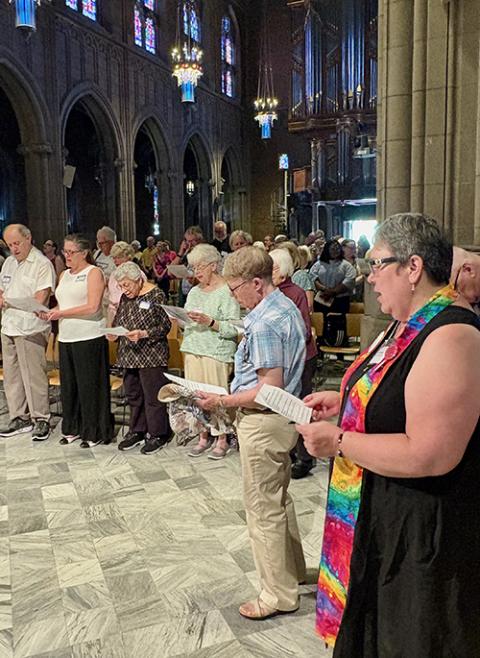
Kate Gillooly, minister at Heights Christian Church (Disciples of Christ) can be seen in the foreground at the Cleveland interfaith prayer in solidarity with migrants on June 24. (Christine Schenk)
Ramez Islambouli, Case Western Reserve University professor and imam, said that advocating for the rights of migrants "is part of the very essence of our Islamic faith." He quoted the prophet Muhammad, "whoever helps those who are stranded, God will help him," and explained that helping the displaced has profound spiritual significance: "For true righteousness is not measured by our external rituals or gestures, but by how we support and help the vulnerable among us."
Reflecting on Leviticus 19:33-34, in which Israel is instructed to "love the stranger as one of your citizens," Rabbi Enid Lader of Beth Israel-the West Temple said, "Having tasted the suffering and degradation to which vulnerability can lead, we are bidden not to oppress – to abuse or to mistreat – the stranger." Especially "since you were exploited and oppressed, you must never be among the exploiters and degraders," she declared. "And God holds you accountable to this obligation."
The 68 northeast Ohio faith leaders who signed the solidarity document also pledged to support local and national agencies that serve and advocate for immigrants, to ongoing accompaniment "in all the ways open to us" and to bring their concerns to local and national political leaders.
Reflecting on the Great Commandment, Heights Christian Church minister Kate Gillooly offered this graced challenge: "Consider how you might shape your life to be an offering of love — to God and to your neighbor. What action could you take to demonstrate that love?"