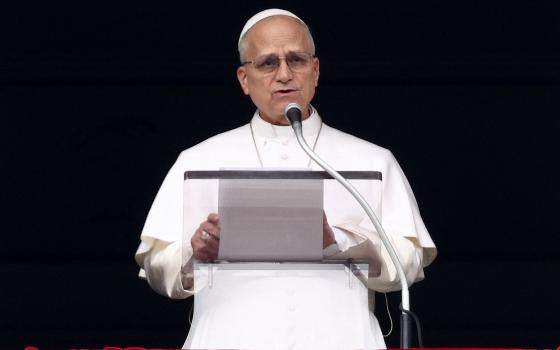
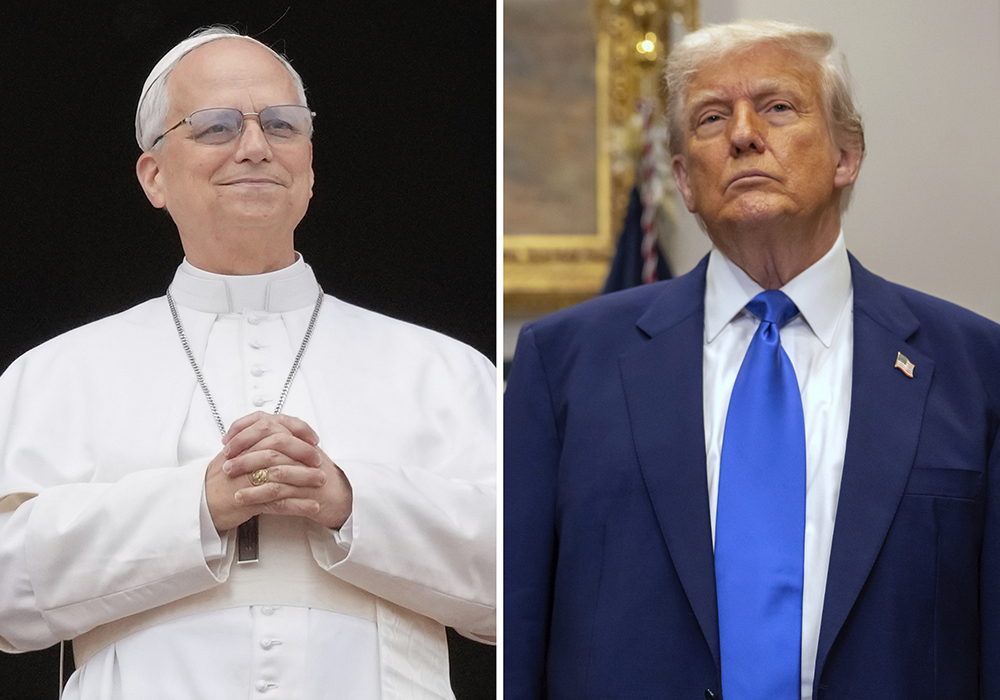
This combination photo shows Pope Leo XIV at the central balcony of St. Peter's Basilica at the Vatican, May 11, 2025, left, and President Donald Trump during an event in the Roosevelt Room at the White House, May 12, 2025, in Washington. (AP photo)

by Stan Chu Ilo
There is a deep yearning for genuinely transformative leaders — leaders capable of drawing out the best in us, repairing our broken and fraying institutions and restoring moral direction to public life. In a wounded world marked by exhaustion, polarization and distrust, people are not merely asking for efficiency or strength; they are searching for leadership that can heal, rehumanize and sow hope where cynicism has taken root.
It is within this longing that many now look, with curiosity and concern, at the two most prominent Americans on the global stage: President Donald Trump and Pope Leo XIV. Each occupies a position of extraordinary influence. Trump presides over one of the most powerful nation-states in history, wielding immense political, economic and military authority. Leo, by contrast, leads what many regard as the most influential religious body in the world, whose reach extends across cultures, continents and centuries. Both men have brought distinct personalities and moral imaginations to their offices, and in doing so have reshaped expectations — positively for some, alarmingly for others — about what leadership looks like in our time.
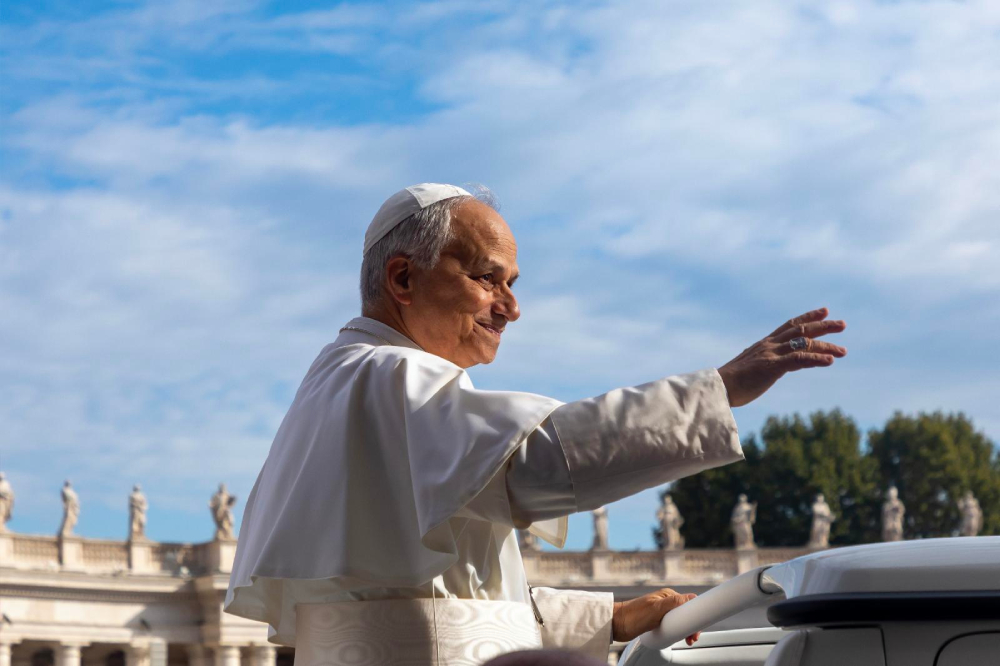
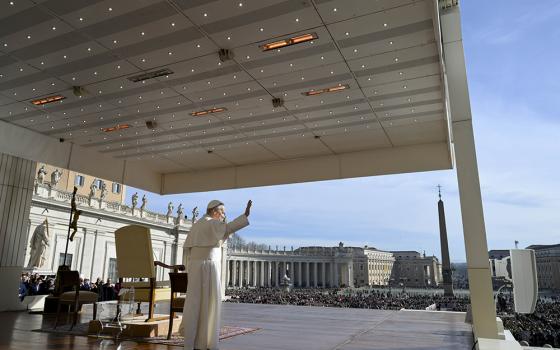
Pope Leo XIV greets visitors and pilgrims from the popemobile before his weekly general audience in St. Peter's Square at the Vatican Oct. 1, 2025. (CNS/Pablo Esparza)
Though both are still within the first year of their leadership — Trump reached the first year of his second term Jan. 20, Leo was elected pope May 8 — the contrast in style and substance is already unmistakable. It is not simply a contrast of temperament or rhetoric, but of vision: different understandings of power and of what it means to lead wounded people in a fractured world. One model of leadership gravitates toward dominance, spectacle and the consolidation of personal authority: The other gestures towards humility, restraint, synodal listening and the slow, demanding work of accompaniment. In the widening space between these two figures lies a deeper question pressing upon our age: What kind of leadership does the world need if it is to be repaired rather than further torn apart?
In less than a year at the helm of the church of Rome, Leo has quietly — but decisively — reframed the papal office through gentleness, reverence for tradition and proclamation of the Gospel. President Trump, by contrast, has brought into the presidency his familiar traits: a commitment to nativism, an apocalyptic "America First" ideology and a renewed pursuit of American power through transactional, coercive and often unilateral means. From Venezuela to Nigeria, from Greenland to Taiwan, Trump's foreign policy signals not partnership but dominance. In this sense, Trump's first year has rendered painfully vivid the warning of Alexis de Tocqueville — that by watching America, the world can discern both the promise and the peril of democracy.
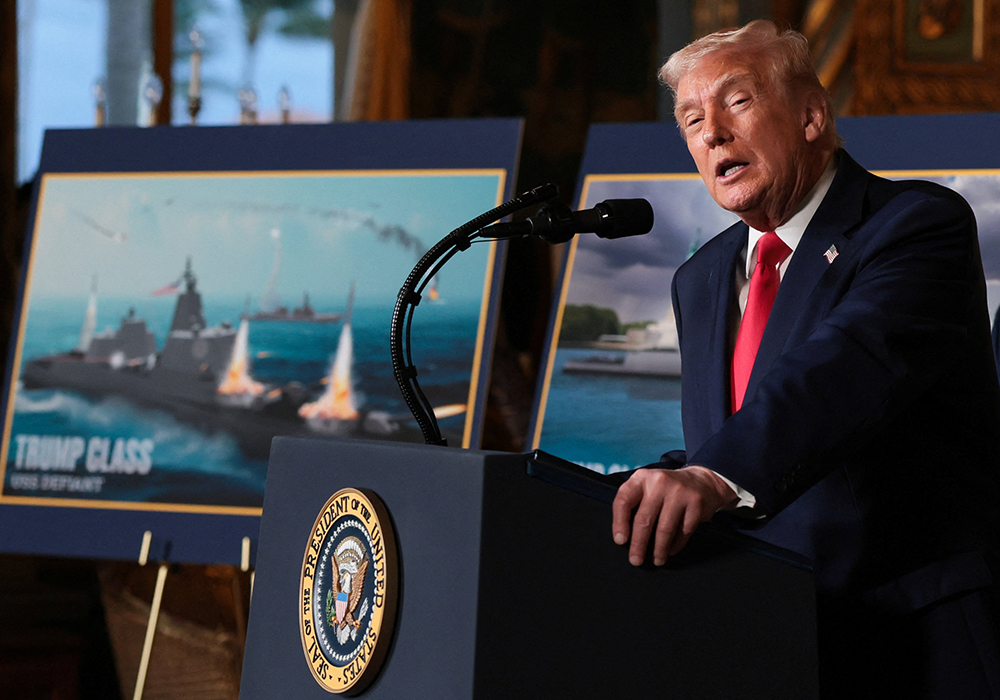
U.S. President Donald Trump makes an announcement at Mar-a-lago in Palm Beach, Florida, Dec. 22, 2025, about a new "Golden Fleet" of Navy battleships he described as a superior war fighting vessel to replace what he called an “old and tired and obsolete” U.S. fleet. (OSV News/Reuters/Jessica Koscielniak)
One lesson Leo offers Trump and other world leaders who govern is the healing use of power. This lesson was brought out so clearly by David Gibson in his recent article in The New York Times, "Pope Leo confronts Trump on his own terms." Gibson presents Leo and Trump as embodying two radically different grammars of power on the global stage. Power for Trump is personal and something exercised over others — often impatient with institutions, norms and procedures that slow what he sees as the need for decisive action.
Leo's power, by contrast, is patient, mediated and institutional. It does not seek visibility or dominance but durability. Trump operates in electoral cycles and news cycles while Leo operates in civilizational time. Leo affirms the agency of others and invites them into an expansive space for dialogue and mutually self-mediating engagement for building bridges of love and friendship to repair the world on the foundations of justice and peace. While Trump treats power as something to wield, Leo treats it as something to steward.
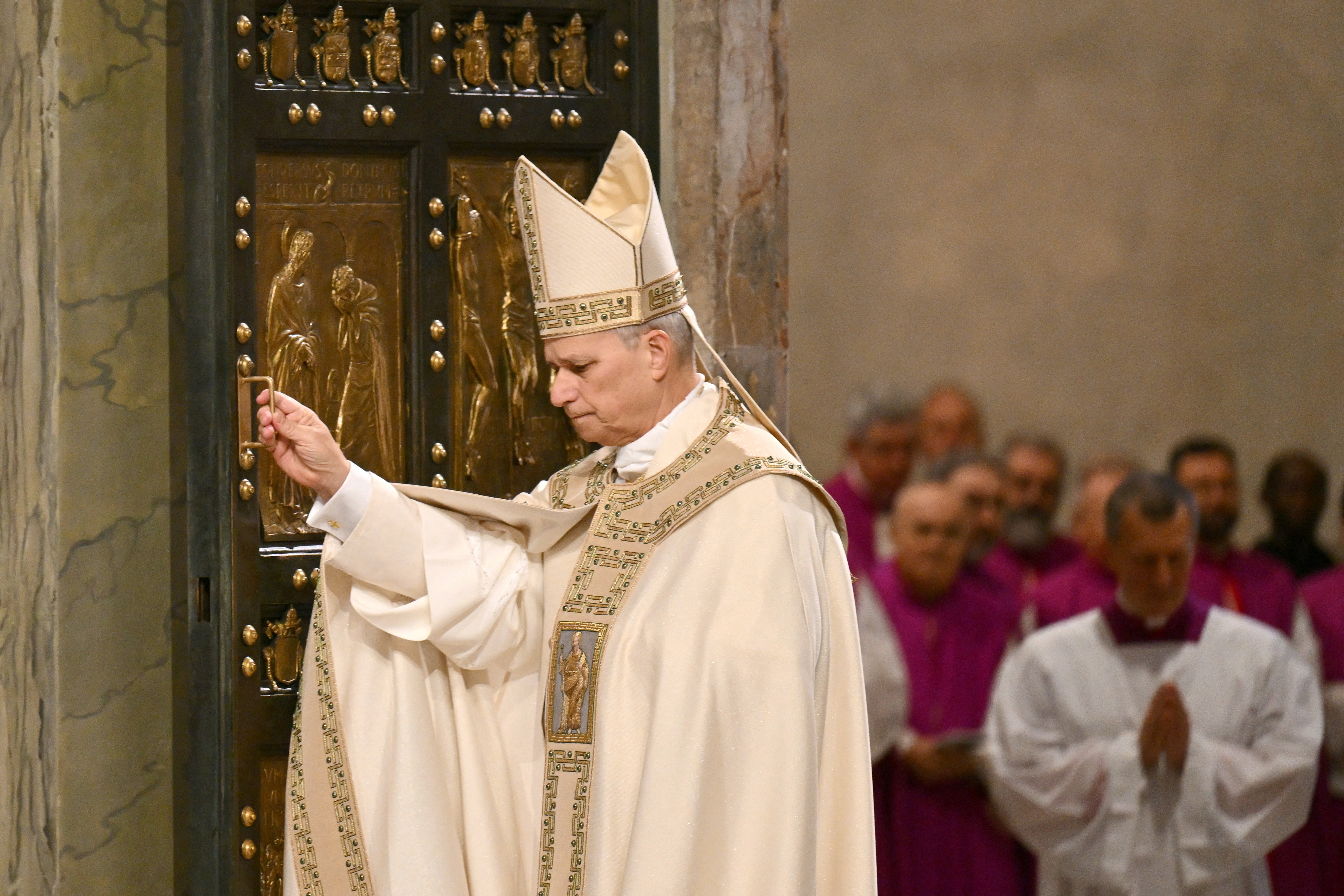
Pope Leo XIV closes the Holy Door of St. Peter’s Basilica on the feast of the Epiphany at the Vatican Jan. 6, 2026, marking the official end of the Jubilee Year 2025. (OSV News photo/Yara Nardi, pool via Reuters)
The contrast here is not simply political versus religious power, but two visions of how authority works in the world: power as forceful intervention versus power as moral orientation and institutional memory, shaping the future not by command, but by preserving the conditions for rebuilding after rupture. Power should be used by today's leaders to expand the boundaries of ideas, wisdom and agency so that the global society is built collectively rather than through the narrow vision of American national interests.
Advertisement
In this dynamic, how can one reimagine power as a force for good in the world? Leo's leadership is evidence that a restorative grace accompanies authority when it is exercised not as domination but as a force for promoting the common good. One of the most luminous lines in Dilexi Te (Paragraph 120) captures the heart of Leo's vision:
A Church that sets no limits to love, that knows no enemies to fight but only men and women to love, is the Church that the world needs today.
This theological framing of the "other" is not sentimental: It is profoundly political. Power begins with perception. How leaders see others determines how they act toward them. How they see the institution they lead will determine how they serve it.
'Time will ultimately judge which vision endures. But already the contrast is visible: a church experiencing renewed hope and cohesion under Leo's leadership and a nation — and world — experiencing deepening tension and fragmentation under Trump's policies.'
Trump could learn from Leo by abandoning retribution as a governing principle. Like Leo, he could rediscover inclusion. America is strongest not when it narrows its identity but when it honors its history as a melting pot — a society enriched by diversity rather than threatened by it.
Trump and Leo represent two American visions of power. Time will ultimately judge which vision endures. But already the contrast is visible: a church experiencing renewed hope and cohesion under Leo's leadership and a nation — and world — experiencing deepening tension and fragmentation under Trump's policies. The paths are clear. One leads toward healing and life. The other toward chaos and domination. And history, as it always does, will render its verdict.
A previous version of this column first appeared at VoiceAfrique Catholic, where Stan Chu Ilo is editor-in-chief and publisher.