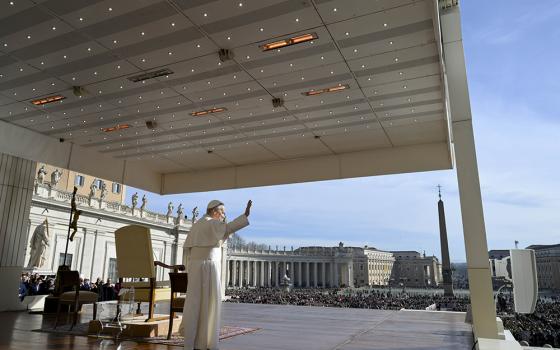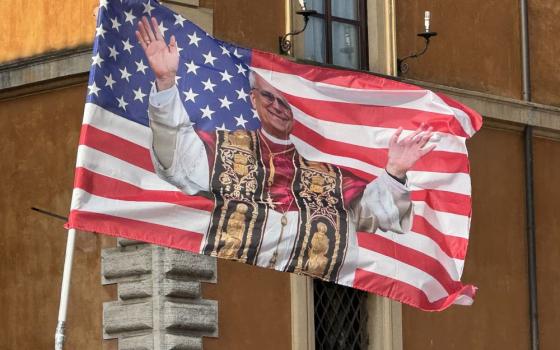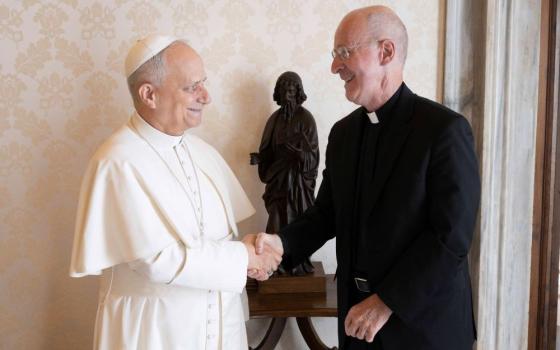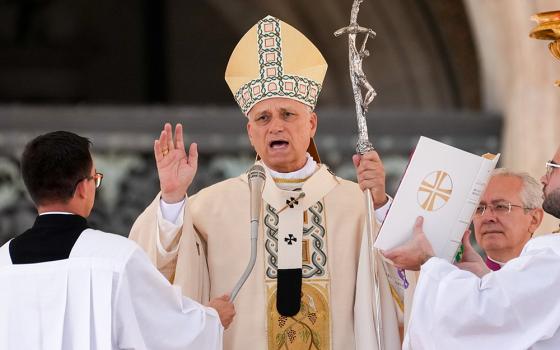
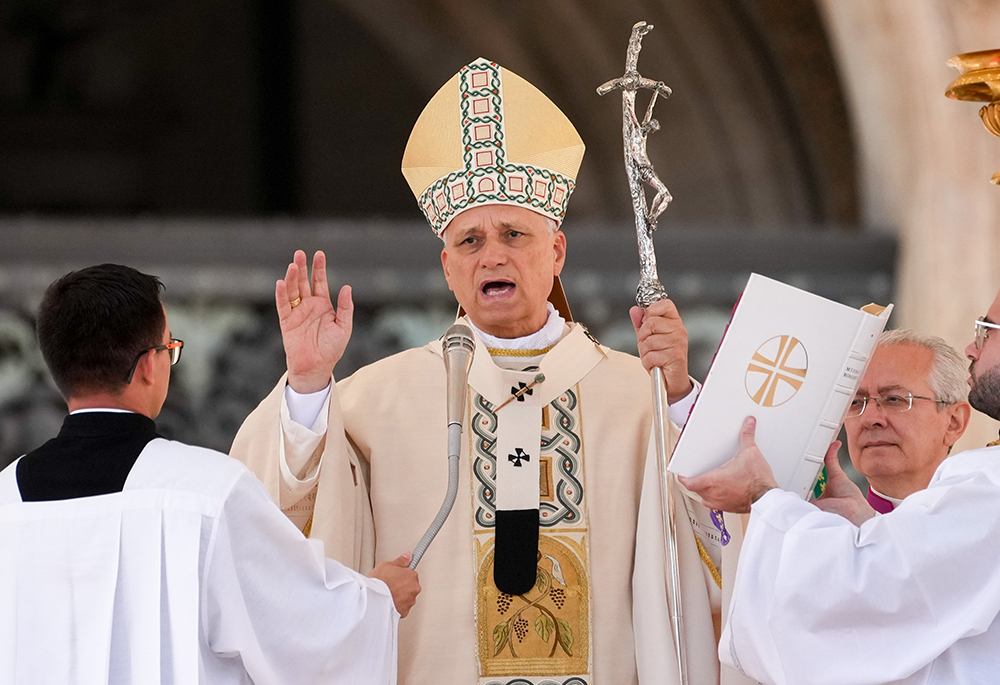
Pope Leo XIV gives his blessing at the conclusion of his Mass for the canonization of seven new saints in St. Peter's Square at the Vatican Oct. 19, 2025. (CNS/Lola Gomez)

by John Grosso

(NCR graphic/Angie Von Slaughter)
Questionable behavior on social media transcends party lines. In this column, we have written about Bishop Robert Barron; fact-checked Tim Busch; and condemned online heresy emerging from the Trump administration. However, progressives are not immune to the temptations of fame, fortune and adulation that social media can provide.
A prominent example is Christopher Hale: a former candidate for Congress in Tennessee's 4th District, a political consultant, budding liberal social media personality, and a Catholic.
Hale's latest project is a Substack entitled "Letters from Leo - the American Pope and US Politics" which describes itself as a chronicle of how Pope Leo XIV's papacy intersects with American politics, faith, and the digital age during the presidency of Donald Trump.
"Most of my audience aren't Catholic and don't typically engage with religious content, which makes their engagement all the more meaningful. For many, this is their first real exposure to the pope — or to anything positive about the Catholic Church," Hale said in an email interview with NCR.
The only problem? They're falling in love with a version of Leo that does not exist — and one that the pope explicitly rejects.
"I don't plan to get involved in partisan politics. That's not what the church is about," Leo said in his first major interview with Crux.
Hale's blog is seemingly an attempt to co-opt the papacy to fit into a progressive political agenda. In trying to do so, he paints a picture of Leo that is not true to his thousands of readers — many of whom do not know any better.
In our exchanges, Hale told me he considers himself "a missionary Democrat: someone who tries to communicate the best values of our movement to the places least inclined to trust us."
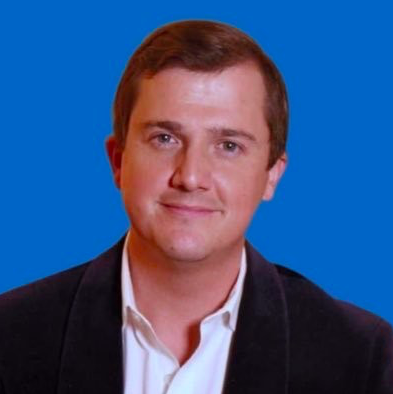
Christopher Hale in December 2019 (WIkimedia Commons/615politico)
A self-identified "political consultant," Hale has become something of a fixture in progressive Catholic circles, amassing a sizable following on social media — with over 50,000 followers on X and thousands subscribing to his Substack. He has written op-eds on Leo for both Time and Newsweek, and on MAGA's "Catholic problem" for MSN.
During the June 14 "No Kings Day" rallies that opposed Trump's increasingly anti-democratic agenda, Hale tweeted an image of Leo with a caption " 'Jesus Christ is our only king.' — Pope Leo."
Someone unfamiliar with the situation could easily stumble upon that post and assume Leo said that in direct opposition to Trump — or that Leo endorsed the rallies. But he didn't. There's no evidence that Leo said this at all and certainly not in this context. And yet, Hale's tweet has nearly 500,000 views.
This is what Hale does on his social media and his "Letters from Leo" blog: he frames everything as binary: Leo vs. Trump and the Republican Party. Good vs. evil. It's a highly effective way to gain social media engagement, but it is a disingenuous way to preach the Gospel. Hale takes what Leo says and explains to his readers how it is anti-Trump instead of pro-Jesus. In seeking to make Leo more appealing to progressives, he frames Leo as simply another prominent supporter of the Democratic Party.
Hale is not the only one to do this.
Occupy Democrats, a prominent progressive media outlet has recently become a champion of Leo, posting videos of the pontiff with inaccurate clickbait titles like "Pope Leo DROPS TUESDAY BOMB on Trump and Republicans," or "Trump FUMES As Pope Leo Just DESTROYED Him Over THIS."
Throughout the video, media personality Anthony Vincent Gallo makes broad statements about Leo and his political views using combative language and an argumentative tone.
In the "Tuesday" video, Gallo cast Leo versus Trump and the Republican Party as two factions opposed to one another. Leo has been "hammering away at Trump and the Christian right that supports him," said Gallo, adding that Leo "smashed the walls down on Donald Trump and the Republican Party" and that the pope's social media posts "cut Trump and the Republicans right off at the knees as if he had used a sword."
Advertisement
What did Leo really say to prompt such a staunch endorsement from Occupy Democrats?
Asked to weigh in on the controversy over Chicago Cardinal Blase Cupich's decision to award Illinois Sen. Dick Durbin a "Lifetime Achievement Award" for his work on immigration issues, Leo offered this:
I'm not terribly familiar with the particular case. I think that it's very important to look at the overall work that a senator has done during, if I'm not mistaken, 40 years of service in the United States Senate. I understand the difficulty and the tensions but I think, as I myself have spoken in the past, it's important to look at many issues that are related to what is the teaching of the church. Someone who says, "I'm against abortion," but says, "I'm in favor of the death penalty," is not really pro-life. Someone who says that "I'm against abortion, but I'm in agreement with the inhuman treatment of immigrants in the United States," I don't know if that's pro-life.
Leo concluded:
They're very complex issues. I don't know if anyone has all the truth on them, but I would ask first and foremost that there be greater respect for one another, and that we search together — both as human beings, in that case as American citizens or citizens of the state of Illinois, as well as Catholics — to say we need to really look closely at all of these ethical issues and to find the way forward as church. Church teaching on each one of those issues is very clear.
Not a word about Trump. Not a word about Republicans. Just clear, nuanced, thoughtful commentary from a man clearly intent on seeing unity amid the divisiveness in the church.
However, the viewpoint of Leo as Trump's foil continues to pick up steam — secular news outlets like ABC have framed Leo's interventions as "political" in their social media reporting, and reporters have even asked White House Press Secretary (and Catholic) Karoline Leavitt about comments from Leo during a press briefing.
And fake AI videos of Leo are posted on YouTube daily — some getting tens of thousands of views — where a generated version of Leo's voice can be heard condemning Trump and his policies.
Despite Leo not mentioning Trump by name (and explicitly saying he did not want to wade into partisan politics) progressives like Gallo and Hale believe that it's all about reading between the lines to find what Leo really means.
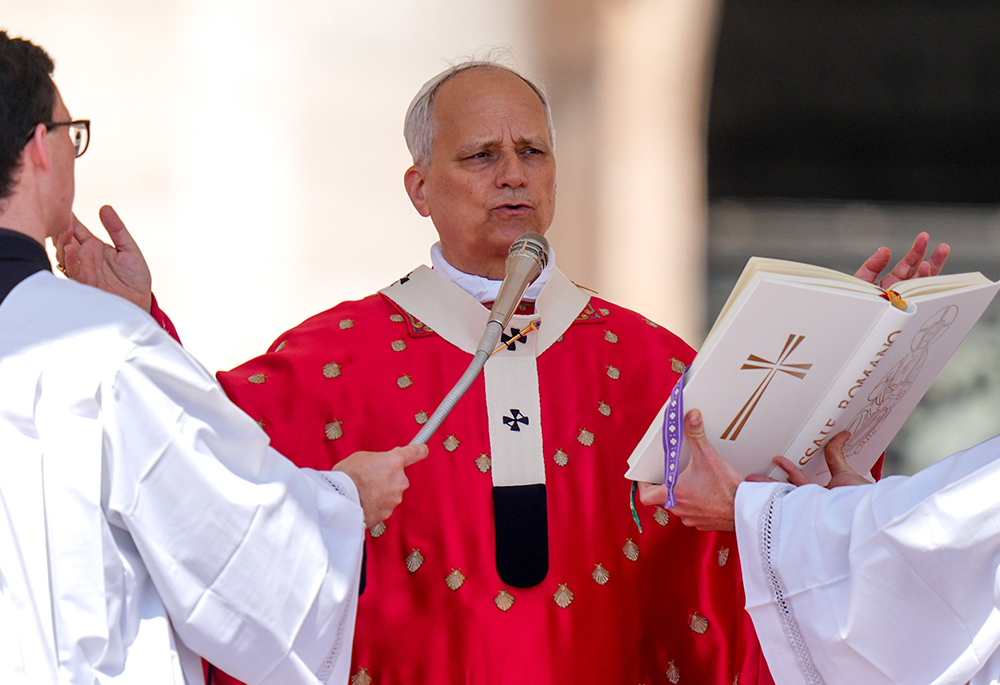
Pope Leo XIV celebrates Pentecost Mass in St. Peter’s Square at the Vatican June 8, 2025, concluding the Jubilee of Ecclesial Movements, Associations and New Communities. (CNS/Lola Gomez)
"When Pope Leo calls for disarmament, welcomes migrants, decries nationalism, denounces the arms race, and calls peace a moral imperative, that stands in direct opposition to the worldview Donald Trump promotes," said Hale. "I'm not inventing the conflict — I'm illuminating it."
In a sense, Hale is correct — the Catholic worldview that he so often cites is in direct opposition to many core policies of the Trump administration. Hale's presentation of these issues, however, is misleading.
Leo intentionally does not frame those interventions as Catholics vs. MAGA, but as existential threats to our shared human solidarity. Leo frames these conflicts as moral because that is how the church sees them. Hale and other progressives see them only as political.
Hale devised Leo's Pentecost Sunday homily as a "a profound critique to what's going on today in the United States." The homily certainly condemned nationalist movements and called for the Holy Spirit to "open borders" and "break down walls" but it does not mention Trump or the United States. In fact, Leo spends a great deal of time preaching on how the spirit opens interior borders — in our hearts and in our relationship with others. He goes through great lengths to present a unitive message that transcends politics.
Hale also constructed Archbishop José Gomez's positive intervention on behalf of immigrants as "inspired by Pope Leo."
Gomez's intervention is a remarkable step in the church's ongoing solidarity with immigrants, but Gomez does not mention either Leo or Trump in his statement. It is worth noting that Gomez — an immigrant himself — has consistently ministered to the migrant population in his diocese. He did not have a conversion of heart after Leo — or Trump's — elections.
Even the title of Hale's substack, "Letters from Leo," implies that he is receiving locutions from the Holy Father and relaying them to us for the low price of your email address. He believes it his mission to "translate" Leo's message.
"I'm not misrepresenting Pope Leo," said Hale. "I'm translating his message for a political culture that's lost its moral compass. I'm opening up the church, the pope, and the full breadth of Catholic teaching — from left to right — to audiences that have historically had no engagement with the church at all."
Those who attempt to politicize the pope are engaging in partisan wish-casting, and attempting to mold Pope Leo in their image just as conservatives have done to previous popes.
"I'm not trying to distort, but to deliver," summarized Hale during an email exchange. "I want to make sure Pope Leo's message reaches not just the choir, but the curious and the skeptical."
No doubt, those of us opposed to the denigration of the human dignity perpetuated by the Trump administration want to see the church speak prophetically as a counterweight. Under Leo's leadership, the church has stood up for migrants, advocated for peace, and condemned political violence. But that's not the church engaging in partisan politics. That's just the Gospel.