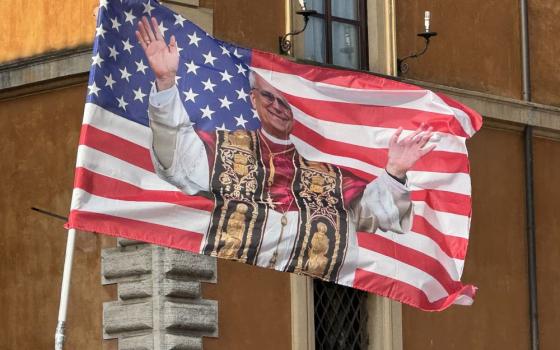
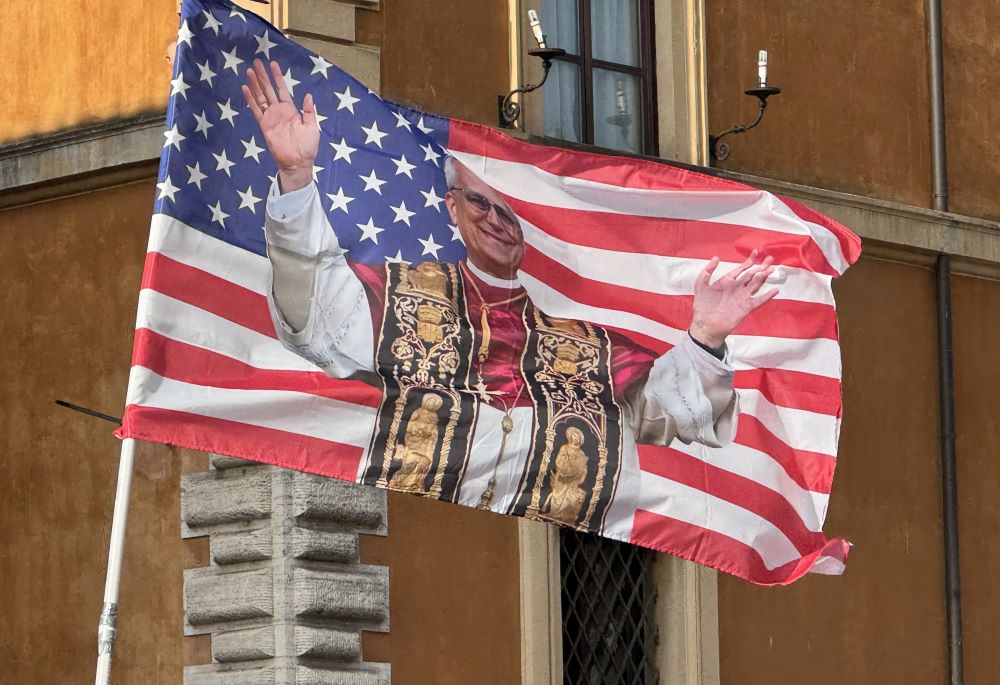
A U.S. flag with a photo of Pope Leo XIV is seen on the Via della Conciliazione near the Vatican June 17. The flag was being carried by pilgrims from Jesuit High School in Tampa, Fla. (CNS/Cindy Wooden)

John Grosso

For a pope who has chosen to make unity the defining hallmark of his pontificate, Pope Leo XIV's most viral moments often include those in which his words and actions are, ironically, painted as exclusionary, tribalistic or even bigoted.
Or, to use the internet slang increasingly attached to the leader of the Catholic Church: when he is supposedly acting "based."
The term, often deployed approvingly online, is used to praise those who refuse to bend to the prevailing cultural consensus, particularly on issues related to gender, sexuality and religion. It places a premium on confrontation and favors rigid condemnation over genuine discernment or good faith disagreement.
It is a term that has become a hallmark of internet culture — a language used and understood by a core group of a small but increasingly vocal minority rewarded by the algorithms of social media.
Applied to Leo, it has become shorthand for a version of the pope that exists entirely online and which bears little resemblance to the pontiff himself. It has become yet another way that Catholics are trying to mold Leo in their own image, one that fits in neatly and conveniently with their theological, liturgical and political sensibilities.
Whereas Leo has emphasized unity, listening and the quiet practice of disciplined faith since his election in May, a steady stream of posts have seized on isolated moments involving the pope to paint him as a culture war figure finally willing to push back against the left.
The problem is that those narratives don't align with reality.
The conservative claiming started almost instantaneously. Pope Leo had barely stepped onto the loggia wearing the mozzetta and papal stole before social media was ablaze with traditionalists claiming "we're so back."
Less than four days later, one viral post praised Leo for allegedly ignoring "the rainbow flag of evil" which appeared similar to an LGBTQ+ pride flag, when greeting a group of pilgrims. That flag was actually an Italian flag for peace, one which the pope clearly did not even see since he was greeting pilgrims on the opposite side of the aisle. The post racked up nearly 775,000 views on X before getting formally corrected by a "community note" on the platform. The political action group aligned with MAGA — Catholics for Catholics — also amplified the false post.
Other content celebrated Leo for supposedly snubbing transgender people during the Vatican's annual lunch with the poor. Under Pope Francis, a group of transgender people from Rome had been seated at the pope's table for the last two years, making their absence at the pope's table during Leo's lunch ripe for online speculation. They were still, however, in attendance.
Cardinal Konrad Krajewski, the papal almoner, explained that seating for the lunch was determined by randomly distributed tickets and that those who ended up at the pope's table had simply arrived earlier. The pope did not choose who sat beside him, but the moment was nonetheless considered a "win" for conservative online commentators.
'Let us disarm communication of all prejudice and resentment, fanaticism and even hatred. We do not need loud, forceful communication but rather communication that is capable of listening.'
—Pope Leo XIV
The latest spew of "based pope" content online came after Leo responded to a question over his visit to Istanbul's Blue Mosque where, unlike Popes Benedict XVI and Francis, he did not pray, at least visibly.
"I prefer to pray in a Catholic Church in the presence of the Blessed Sacrament," he told reporters when asked why he did not pray in the mosque. Though one of the most provocative responses we've heard from Leo, it likely was not meant to be as incendiary as those who framed it as a rebuff of interreligious dialogue desired.
"Who said I did not pray?" Leo began his response. "Maybe I am praying right now." Far from galvanizing those who disparage acts of outreach, Leo left the door open to his having prayed in the mosque and he even called all the fuss made about whether or not he prayed "curious."
A particular account on X, ironically named "Pope Respecter," has made the concept of "based popes' their online brand, using a presumably AI-generated photo of Leo wearing sunglasses and lighting up a cigarette as its profile picture.
Pope Respecter's response to the question of Leo praying at the mosque was to meme-ify the moment, posting an image of a buff, bearded gentleman wearing a traditional tiara with the caption "I prefer to pray in a Catholic Church." That just might be a brand new sentence — but that post has nearly 370,000 views and 11,000 likes.
Time and again, then, posts celebrating a "based pope" have taken Leo's words and actions and recast them as acts of exclusion and turned nuance into provocation. It is not the first time digital conservatives have done this.
Like clockwork, nearly every time Francis said or did something that supposedly aligned with "Catholic Twitter's" exclusionary and often sex-obsessed brand of theology, social media zealots would bestow upon him the title of "the most based pope ever." It seems that title has been passed to Leo alongside "successor of Peter."
That framing stands in stark contrast to the communication style Leo himself has consistently urged. From his earliest days as pope, Leo has warned against the very online culture now claiming him as a symbol.
Advertisement
"Let us disarm communication of all prejudice and resentment, fanaticism and even hatred," he told the roughly 1,000 journalists who reported on the conclave during his meeting with the press. "We do not need loud, forceful communication but rather communication that is capable of listening," he added.
And addressing Catholic influencers, Leo urged them to foster "an encounter of hearts" online and to resist the "logic of division and polarization" that drives digital engagement.
Leo has allowed both his words and example to speak as a counterweight to the ever-growing culture war toxicity that has polluted our discourse and poisoned our relationships. If the culture wars reduce people and their teachings into caricatures used to score points against perceived enemies, Leo has made it clear: He has no interest in being "based."
Meanwhile, many of those praising Leo for being "based" appear to be ignoring, or actively undermining, his most consistent message, namely, the need to work for unity in all contexts.
Leo has been clear in the church's support for migrants, defense of the unborn, the preferential option for the poor, condemnation of war and need to strengthen the family unit. He's placed emphasis on dialogue, unity and synodality. But that doesn't mean he's "based." It means he's Catholic.
The National Catholic Reporter's Rome Bureau is made possible in part by the generosity of Joan and Bob McGrath.