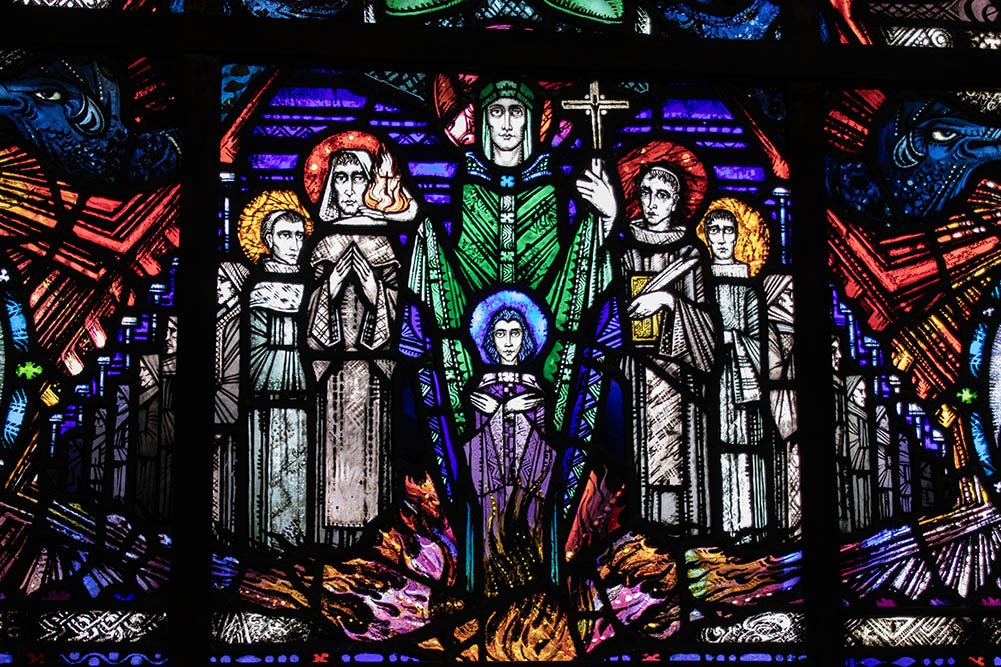
St. Patrick is depicted in stained glass at the Church of Sts. Peter and Paul in Athlone, Ireland. (Teresa Malcolm)

by Nancy Fitzgerald
Long before the first Spirit Halloween store opened, there were spirits afoot in the cold, sparse, sad days of late October.
Our spiritual ancestors in Ireland called this time Samhain (SOW-wen), when the veil between heaven and earth disappeared and tombs were opened "to allow the spirits of the dead to emerge and mingle with the living," as writers Carmel McCaffrey and Leo Eaton put it in In Search of Ancient Ireland. It was a time of feasting and celebration — the most popular holiday of the year — when the living appeased the dead with treats to avoid mischief from beyond the grave.
It's no surprise that when Christians arrived in the fifth century, they kept this pagan practice but baptized it with a new name, morphing it into the sugar-laden trick-or-treat day we know as Halloween, followed by the Christian feasts of All Saints' Day and All Souls' Day, when we remember the great cloud of witnesses gone before us, living in the glow of light perpetual.
Many of the ancient Irish holy men and women came to us from the early, misty days of Christianity in Ireland. And most of them have been forgotten. On All Saints' and All Souls' Days, it's a good time to remember some of them.
Here's a quick look at a few of the famous (and not-so-famous) saints from the place that gave us All Saints' Day. After all, as Catholics, members of the communion of saints, we're reminded at every Mass that the act of remembering is important.
Colmcille (also known as Columba)
Colmcille, born in County Donegal in 521 to a prominent political family, answered a spiritual call and became a monk, founding dozens of monasteries. He was ignited by the message of the Gospel — and enamored by the beauty of illuminated Scripture manuscripts — which got him into a bit of trouble.
He is said to have envied the beautifully illustrated psalter of a monk named Finian and began copying this work on the sly. He was almost finished when Finian found out. Bloody battles ensued and, finally, a legal decision: "To every cow her calf," the king proclaimed. "To every book its copy." It was the birth of intellectual property law and the beginning of Colmcille's exile.
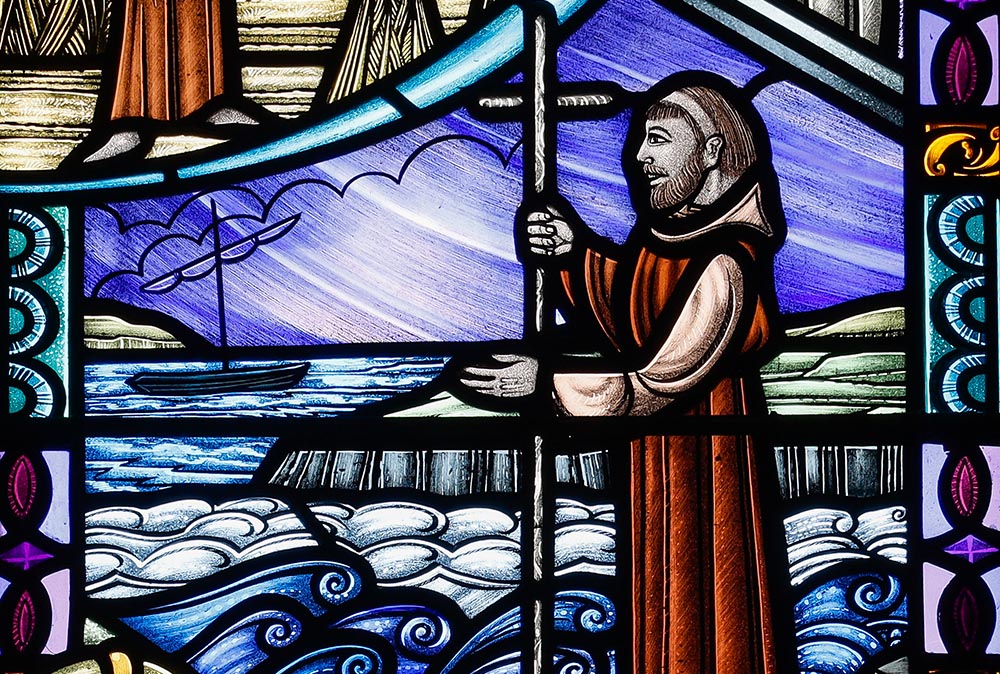
St. Colmcille, also known as St. Columba, is depicted in stained glass in St. Patrick's Cathedral in Armagh, Northern Ireland. (Wikimedia Commons/Andreas F. Borchert)
Banished from Ireland, he gathered a band of followers and sailed to Iona, an island off the west coast of Scotland. There he founded a monastery whose monks traveled throughout Europe, preaching the word of God. Pilgrims still flock there, seeking the light of the Gospel and the spirit of Colmcille. Generations of Christians trace their faith back to this traveling monk from Donegal, known as the Dove of Ireland, who is also one of Ireland's three patron saints.
Dahalin
In early Christian Ireland, women (much as now) were made of sturdy stuff. For the love of God and their neighbors, thousands became nuns or consecrated virgins. Leaving homes and families, they lived in small groups in remote places to pray, study and do good works. St. Patrick writes in his Confession that "their number keeps increasing ... the more they are forbidden to imitate the Lord, the more they boldly do this."
It was a vocation, for sure, but also a declaration of independence. Medieval historian Katherine DeCoste wrote: "By establishing religious communities, women created social spaces for themselves separate from the economic and social dependence on men to which they would otherwise have been bound."
Dahalin and her sisters settled at a tiny stone chapel on the northwest coast of County Kerry. It's a remote place to this day: No matter how you valued your independence and your quiet life of prayer, you were on your own, with the roar of the Atlantic and the wide Shannon estuary as your constant companions.
But these women rose to the challenge, in the certain faith that God was with them — especially on one stormy night, in a story retold for generations and recounted by Kerry schoolchildren who compiled folklore in the 1930s:
An army of soldiers came on to kill her. ... When three of the soldiers were about to lay hands on her, she fired a fist of earth at them and immediately blinded them.
After a little while they begged mercy of her and she granted them their sight again. After a while one of the three same soldiers again attacked her and she again blinded that soldier. The two others in the mean time showed her the greatest of respect and they begged of her mercy for the other soldier. She made a little well on the slope of the mountain in the little glen where she lived. She told the two soldiers to wash the eyes of their blind companion in the waters of this little well. ... The two soldiers washed the eyes of their blind companion in this well that she made and he immediately got back his sight.
People pay rounds at this well at the dawn or very late on Fridays.
Local lore says it was Vikings who marauded Dahalin's convent — but it was more likely fishermen or pirates. Whoever they were, Dahalin and her band of virgins, bolstered by their faith in God, prevailed.
Glendahlin is a remote place to this day. But the people in the neighborhood still remember Dahalin; pilgrims still travel to see the ruins of her little chapel and the holy well with a cure for eye maladies. For Dahalin and the other early Irish saints, isolation by the pale light of the Shannon placed them deep into the heart of God, and faith protected them in the darkest times.
Brigid of Kildare
Brigid was born at sunrise on the threshold of the house of her father, a druid. Her Christian mother immediately baptized her — and Brigid went on to spend her life preaching the Gospel and building bridges between the old and new religions. In all the accounts of her life, flashes of light and acts of generosity accompanied her wherever she went. Spreading her famous mantle, she tricked the king into giving her extra land for her monastery, knowing that God would be on the side of the poor who knocked at her door.
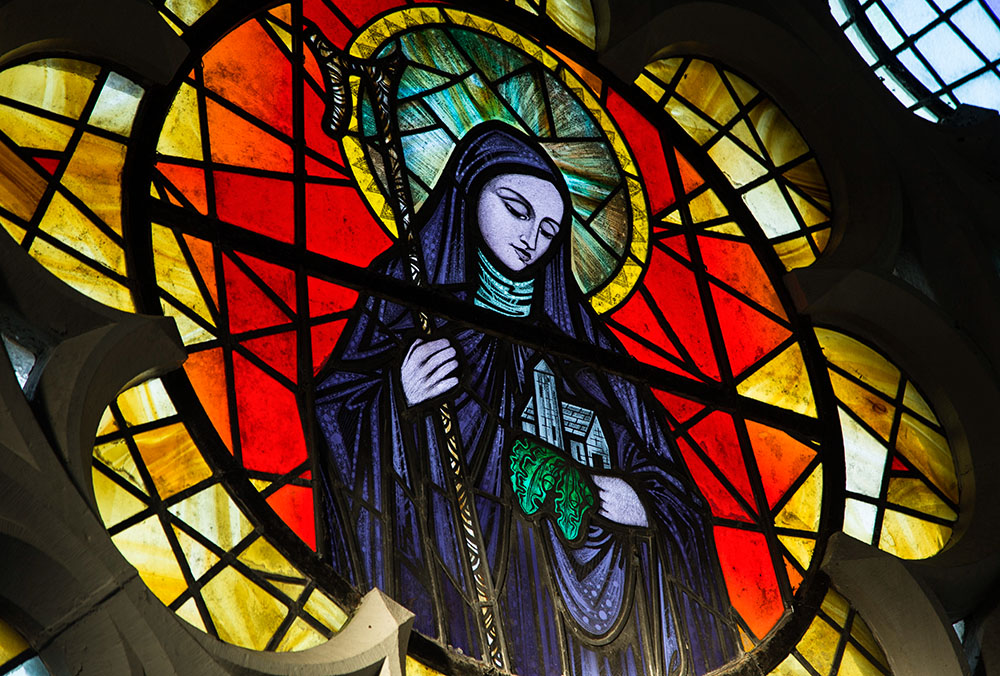
St. Brigid of Kildare is pictured in a stained-glass window in St. Brigid's Church in Crosshaven, a village in County Cork, Ireland. (CNS/Cillian Kelly)
Brigid was a miracle worker who is said to have turned a lake into "beer with the fragrance of wine." She was also a free spirit who practiced Christianity in an unorthodox way, using her own version of the ordo (the official order of service for the Mass) and repeatedly standing up to Roman authorities. One version of her life story shows her being ordained a bishop. You can pick her out in stained-glass windows; she's the one carrying an episcopal crozier.
Brigid was a powerhouse of the early Irish church. She negotiated peace treaties, entertained bishops and out-preached Patrick. She founded a double monastery of monks and nuns where a perpetual fire burned. Some sources show that she heard confessions, granted absolution and even celebrated the Eucharist.
Over the millennia, we've come to know Brigid as someone a lot like Jesus, who lived out the Gospel in a blaze of glory, in her own time and place. Brigid, one of the three patron saints of Ireland, died in about 524.
Patrick
Here's what you don't know about St. Patrick: First, he wasn't the first to bring Christianity to Ireland. When he began his mission in 432, Bishop Palladius had already set up shop. Second, there's no record of Patrick using a shamrock to teach about the Holy Trinity (though it does seem like a useful device). Finally, those snakes? They never existed. The story of Patrick driving them into the sea illustrates Christians ridding the island of the old pagan snake-gods.
Here's the real story: A boy named Patricius, son of a noble, nominally Christian family in Britain, was captured and sold into slavery in Ireland at age 16. We know a lot about what happened; Patrick left an account of his life written by his own hand. In his Confession, he writes about his longing for home and his sorrow that his education was interrupted by an all-expense-paid internship as a shepherd.
But in his despair, he remembered his nearly forgotten faith, saying he turned "with all my heart to the Lord my God. For it is he who looked on my lowliness and had mercy on the ignorance of my youth, and who looked after me before I knew him and before I gained wisdom."
Advertisement
Patrick's Confession is filled with light and determination and a singular focus on spreading the Gospel. It's also filled with a deep love for the people he adopted as his own. It's the heartfelt account of a man who counts himself as "unskilled in everything," who nevertheless established the good news in a land beyond the edges of empire.
Ireland wasn't fully Christianized until a few hundred years later, but at the end of his life, Patrick, more Irish now than the Irish themselves, wrote:
May it never happen to me that my God should separate me from his people which he has acquired in the outermost parts of the earth. I pray God that he give me the perseverance and deign to grant that I should render him until the moment of my passing from this life to the life to come."
Ireland,"the land of saints and scholars," has more holy men and women than you can count. Most of them have faded into oblivion, especially after the church, eager to bring the wayward Irish into line, suppressed local saints in favor of universal luminaries, like Mary and Joseph.
But the Irish still remember their own. Folktales and legends — charming and outlandish — about their much-loved saints, are still repeated, especially in the West of Ireland. After all, those saints are the ones who brought the light of Christ to Ireland, and light perpetual still shines on them.
This dark, late-autumn season, when the veil is thin, is a good time for all of us to share that light as we remember those who have gone before us.