(Unsplash/Josh Applegate)

by Jeromiah Taylor
I am one of many thousands of Gen Z converts to Catholicism.
In the middle of the pandemic, a long discernment came to a head and I found myself calling the catechism director at the cathedral. That gray-haired catechetical doyenne and a relic of St. Faustina at my university's campus ministry building were my companions through initiation.
I was confirmed on the Saturday before Pentecost 2020, though not without a great deal of familial confusion and displeasure. I am hardly alone however, as since 2019 an increasingly large amount of Gen Z converts have swelled the church's ranks, particularly in the West.
Much has been written about Gen Z's religiosity, especially about why exactly so many members of our generation have converted to Catholicism. Most often, the phenomenon is framed in terms of young people seeking an unshakeable foundation in the midst of a tumultuous world. Or else as a renunciation of modernity's failures.
If I'm honest, my motivations were similar. I too was disgusted by consumerism, hedonism and individualism, and saw no way to resist them without a robust metaphysical worldview. I too desired to join a communion of saints who had contributed to a concrete, historical community. And I too became convinced that that community subsisted in the Roman Catholic Church.
All of those things are still true, and yet in the intervening years, shaped by liturgy, prayer and penance, I've come to realize that the faith is not a refuge from or a weapon against the brokenness of the world. Rather, the faith is the living witness to the reality that the world's brokenness has been entered into and redeemed by the Word made flesh, and it calls us to allow ourselves to be broken.
Simone Weil was correct when she wrote in her notebooks, "Religion insofar as it is a consolation is a hindrance to true faith."
Advertisement
The danger in seeking answers and finding them in the church is that we may develop a fear of questions — may view change as a threat, the past as pure and ourselves as superior. We may settle for fundamentalism when we were made for faith. We spent so much time and energy examining our world, ourselves and Catholicism's offerings that we may be tempted to say, "Look, we found it, and now we're going to hold on for dear life."
But our desire for satisfying alternatives to modernity and a sense of meaning shouldn't turn us against all questioning. Questioning is what brought us to the faith in the first place, and asking questions, even those that we're afraid to answer, is the hallmark of spiritual maturity.
In a wonderful column in NCR, Stephen G. Adubato summarized the thoughts of Italian priest Luigi Giusanni on the tendency to reduce the faith to a reactionary identity:
The church is not a safe haven from, nor weapon to be wielded against, the modern world, but rather a loving mother and teacher who forms the child to discover Christ's saving love in the midst of the circumstances in which one finds oneself.
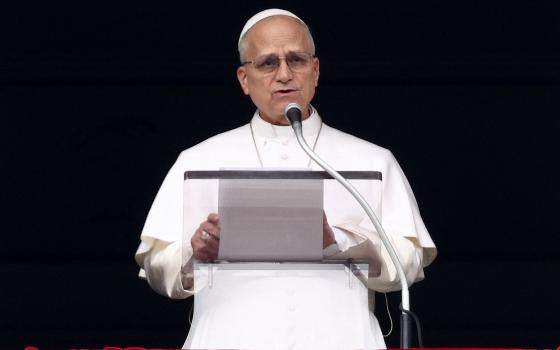
In recent remarks to young American Catholics, Pope Leo XIV explicitly reminded us that the church's role is not to tell us what to do, but to form our consciences. The awesome freedom implied in that statement requires an equally vast responsibility — to humbly submit our consciences to the church's maternal instruction, and to follow our consciences where they lead. Such responsibility is understandably intimidating, and it is tempting to relinquish it in favor of fundamentalism. But what is fundamentalism?
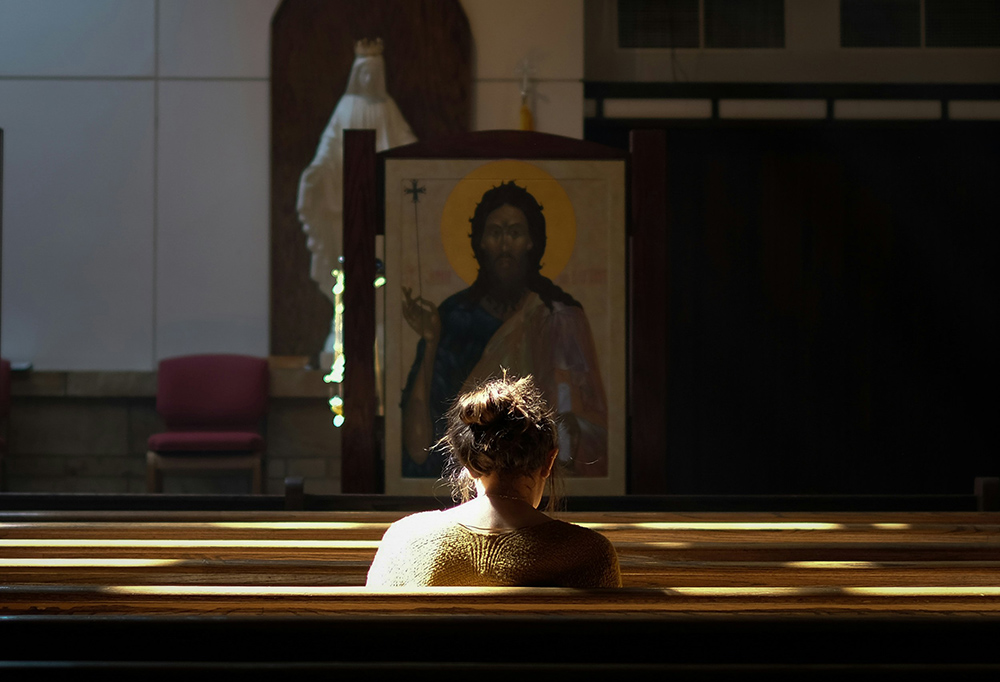
(Unsplash/Josh Applegate)
In his loving review of Jesuit Fr. Mark Massa's Catholic Fundamentalism in America, NCR columnist Michael Sean Winters outlines the priest-scholar's paradigm of Catholic fundamentalism as defined in part by a "strong sectarian impulse" whereby Catholic faith becomes merely Catholic identity — an identity to be policed and assessed according to a rubric designed by the in-group.
Such an attitude is completely at odds with Catholicism, a tradition that, as Massa said in a recent lecture, has always been the "big tent" of Christianity, wherein, as James Joyce observed, "here comes everybody." My mother, an MS NOW-watching Protestant, when scandalized by JD Vance's Catholicism, asked me, "Don't you guys ever not let someone in?" I was overjoyed to inform her that no, we do not ever not let someone in.
While I might find Vance's — or any number of other Catholics' — public life reprehensible, the mystery of church and communion is that we are bound to one another mystically and visibly. To confess such an idea, and if one can manage, to actually believe it, requires faith. Such faith is a grace, to be requested with prayerful humility, and total dependence on God. It has nothing to do with the stratagem, ideology and culture wars of fundamentalism. It has even less to do with identity or qualifiers like traditionalist or progressive.
When we identify with one camp or another, or when we begin to measure others against a standard, we begin to lose our catholicity — our universality. When we become more proud of being the right kind of person than we are grateful to God for our lives and his work in them, we lose our missionary credibility. We ignore the counsel of Pope Benedict XVI in Spe Salvi that Christians are God's fellow workers, called to respond to his gifts with actions that engender hope in the world.
If we want to share our lives with others, and our faith, we must reject a fundamentalism that views the church as a fortress, and embrace Pope Francis' vision of the church as a field hospital. Let us not be afraid. Let us reach for what we said we wanted, which was communion. Let us embody what we claim to have, which is faith. Let us become what we were made for, which is more. And let us be what we say we are, which is Catholic.