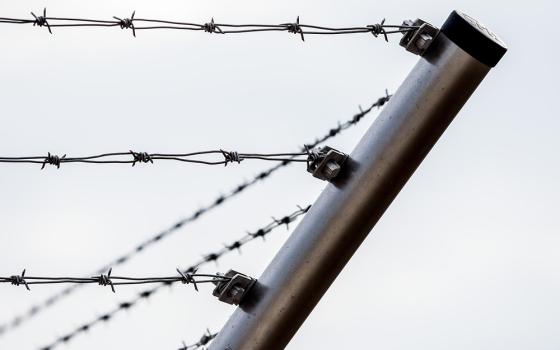
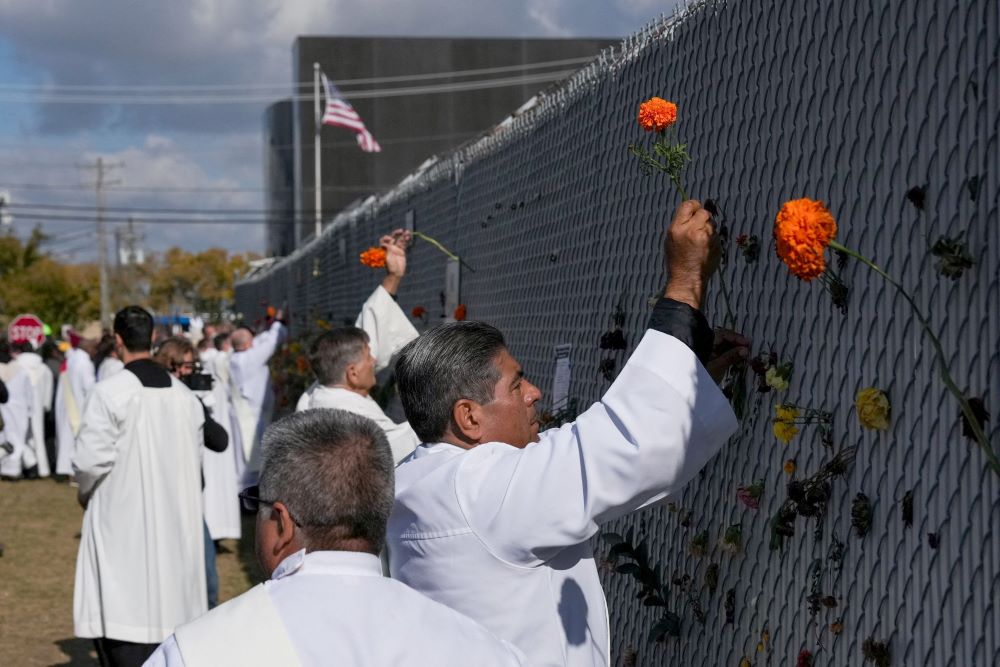
Religious leaders place marigold flowers used on the altar during the service into the fence surrounding the Broadview ICE facility in Chicago Nov. 1 on the day of an outdoor Mass observed by interfaith leaders, community members and volunteers. The Mass was led by Chicago Auxiliary Bishop José María Garcia-Maldonado. (OSV News/Reuters/Leah Millis)

by Michael J. O'Loughlin
NCR executive editor
How might Catholics respond should a dystopian, authoritarian regime intensify here? That question has been on my mind in recent weeks, especially in light of reading two novels imagining the collapse of once-free societies.
Journalist George Packer's new novel, The Emergency, set in a fictional failed empire, shares many parallels with today's United States. The conflict seems to have been precipitated by the eponymous emergency, a calamity that shut down the urban center and led to the embrace of wild conspiracy theories in the country. Packer's novel condemns the leftist regime that controls the city, the right-wing militias taking over the countryside and the discredited elites who failed to take rising tensions seriously.
Paul Lynch's 2023 Booker Prize-winning novel, Prophet Song, inspired by the civil war in Syria, chronicles a future, dystopian Ireland. It recounts the regime's disappearance of a union leader and the fallout on his family as they are too slow to accept the reality of their new situation.
I was spooked by how both plots felt not all that implausible, especially as the Trump administration hollows out institutions, polarization intensifies, and clashes between federal agents and ordinary citizens proliferate. Being a religion journalist, I also noticed a gap in each novel: the role faith communities might play.
A quick glance at the news offers some ideas.
On the one hand, it's easy to speculate that Catholic leaders might lend some support to the rising regimes. Just this week, the group Catholics for Catholics announced they will honor President Donald Trump's border czar, Tom Homan, complete with a blessing from Bishop Joseph Strickland, the controversial former bishop of Tyler, Texas. Word on Fire founder Bishop Robert Barron of Winona-Rochester, Minnesota, amplified the Trump administration's rationale for the immigration crackdown in Minnesota. And some high-profile Catholic influencers sympathetic to fascist policies have turned the rosary into a political weapon.
Advertisement
But I'm more interested in stories that show how Catholics remain committed to standing up for the oppressed and helping promote a version of society faithful to Catholic social teaching.
Some recent high-profile examples include a statement from three U.S. cardinals warning about foreign policy goals that are based on self-interest rather than global peace, a rare declaration of the church's principles taking direct aim against the Trump administration. Around the same time, though apparently not coordinated with that statement, the U.S. archbishop who oversees the military said that U.S. soldiers could rely on their consciences to refuse to obey immoral orders, specifically in the context of military action against Greenland.
There are also examples of Catholics publicly dissenting on domestic issues, including in Minneapolis, where some Catholics have taken to the streets to protest, highlighting the fear present in immigrant communities. Elsewhere, San Diego Bishop Michael Pham, once a refugee himself, attends court hearings with immigrants facing deportation. More recently, Bishop Bruce Lewandowski led a prayer service outside an ICE detention center in Rhode Island. I'm also thinking of the Initiative on Catholic Social Thought and Public Life at Georgetown University, which this month invited me to join a group of Catholic leaders considering ways to take up Pope Leo XIV's call to place the poor at the center of public life. And of course, there are the countless examples of ordinary Catholics who work hard each day to live out the Gospel's call to care for the least of these, whether through prayer, service or in the public square.
It's not uncommon to hear people say that the flood of images we consume each day makes us feel like we're living through our own dystopian novel. But Prophet Song and The Emergency remain warnings rather than histories and Catholics still have both the opportunity — and the responsibility — to shape our story.