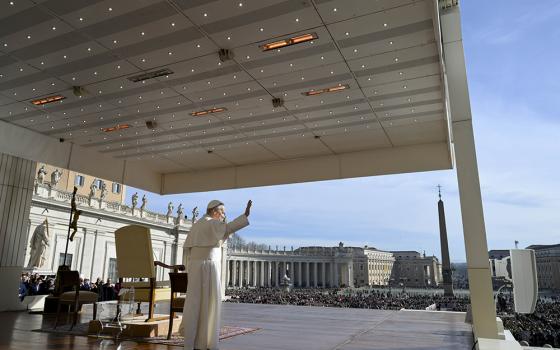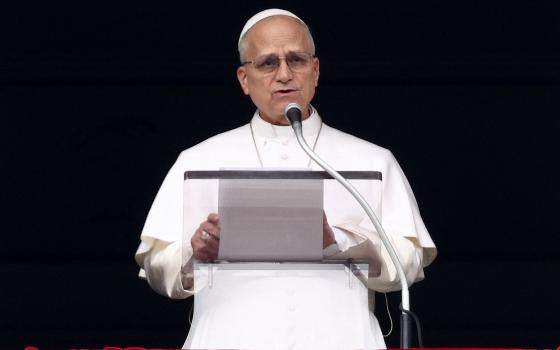
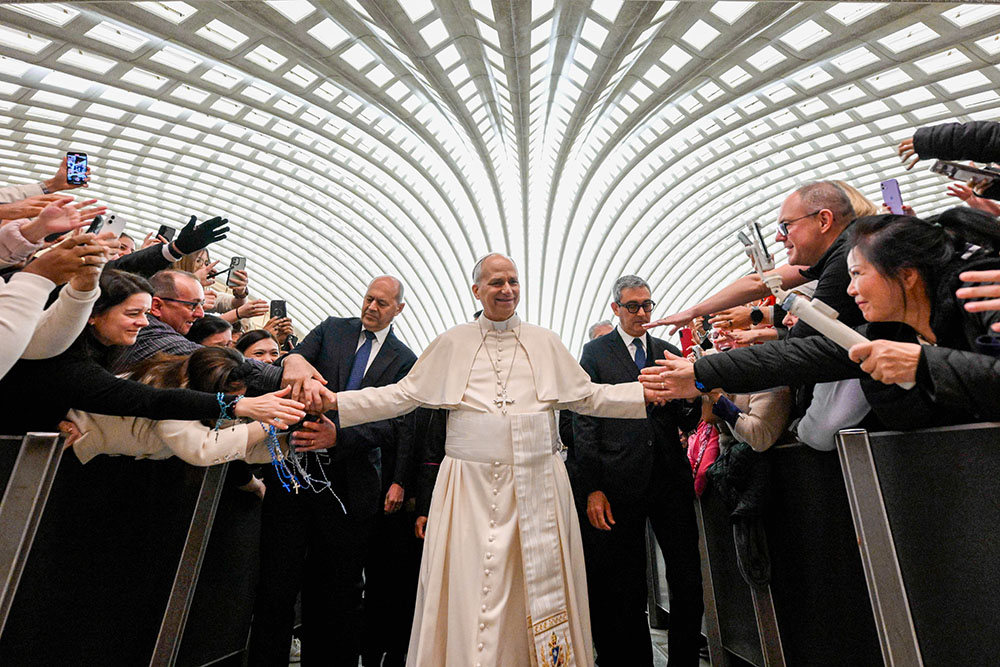
Pope Leo XIV greets people at the conclusion of his weekly general audience in the Paul VI Audience Hall at the Vatican Jan. 7, 2026. (CNS/Vatican Media)

Last Wednesday, Jan. 7, Pope Leo XIV gave two talks, one at the weekly general audience and the other to the cardinals at the start of their consistory, that focused on the reception of the Second Vatican Council. It has been 70 years since the close of the council, but as he reminded us in the words of St. John Paul II: "I feel more than ever in duty bound to point to the Council as the great grace bestowed on the Church in the twentieth century."
Leo is aware of the different interpretations that have been given to the 1962-65 council. There are "John Paul II Catholics" and "Francis Catholics." Leo artfully reminded all of us that while each pope in the postconciliar era lent a different emphasis to the reception of the council, all were faithful to it. In both texts, he quoted John Paul II and Francis, St. Paul VI and Benedict XVI. In his general audience address, he even quoted the often-overlooked Pope John Paul I, who, at the close of the council, expressed this hope: "As always, there is a need to achieve not so much organizations or methods or structures but a deeper and more widespread holiness. ... It may be that the excellent and abundant fruits of a council will be seen after centuries and will mature by laboriously overcoming conflicts and adverse situations."
Leo briefly sketched the major accomplishments that Vatican II achieved, things we now almost take for granted. "After a rich biblical, theological and liturgical reflection spanning the 20th century, Vatican Council II rediscovered the face of God as the Father who, in Christ, calls us to be his children; it looked at the church in the light of Christ, light of nations, as a mystery of communion and sacrament of unity between God and his people; it initiated important liturgical reform, placing at its center the mystery of salvation and the active and conscious participation of the entire people of God," the pope said. "At the same time, it helped us to open up to the world and to embrace the changes and challenges of the modern age in dialogue and co-responsibility, as a church that wishes to open her arms to humanity, to echo the hopes and anxieties of peoples, and to collaborate in building a more just and fraternal society."
Advertisement
Speaking to the cardinals at the start of the consistory, Leo noted that both Paul VI and John Paul II, in the first years after the council, led the church with a distinctly conciliar perspective, "which sees the mystery of the Church as entirely held within the mystery of Christ."
The Christocentrism that characterizes all of Leo's pronouncements produced the single most memorable, and challenging, line in the address: "It is not the Church that attracts, but Christ; and if a Christian or an ecclesial community attracts, it is because through that 'channel' flows the lifeblood of Charity that cascades from the Heart of the Savior." Obviously, he is not drawing a facile distinction between Christ, the head of the Church, and the much despised "institutional church." There are not two churches, one spiritual and one institutional. The challenge, and it remains a challenge, is for all of us who constitute the institutions, as priests and parishioners, as clergy and laity, to recognize more and more that we are mere glasses into which the new wine of Christ is poured. We are not the wine. We are not pouring the wine. We are the glasses and we receive it. Our job is to be, like any good glass, clean and spotless.
Then, echoing the great Swiss theologian Hans Urs von Balthasar, Leo developed the Christocentric theme further, saying, "To the extent that we love one another as Christ has loved us, we belong to him, we are his community, and he can continue to draw others to himself through us. In fact, only love is credible; only love is trustworthy."
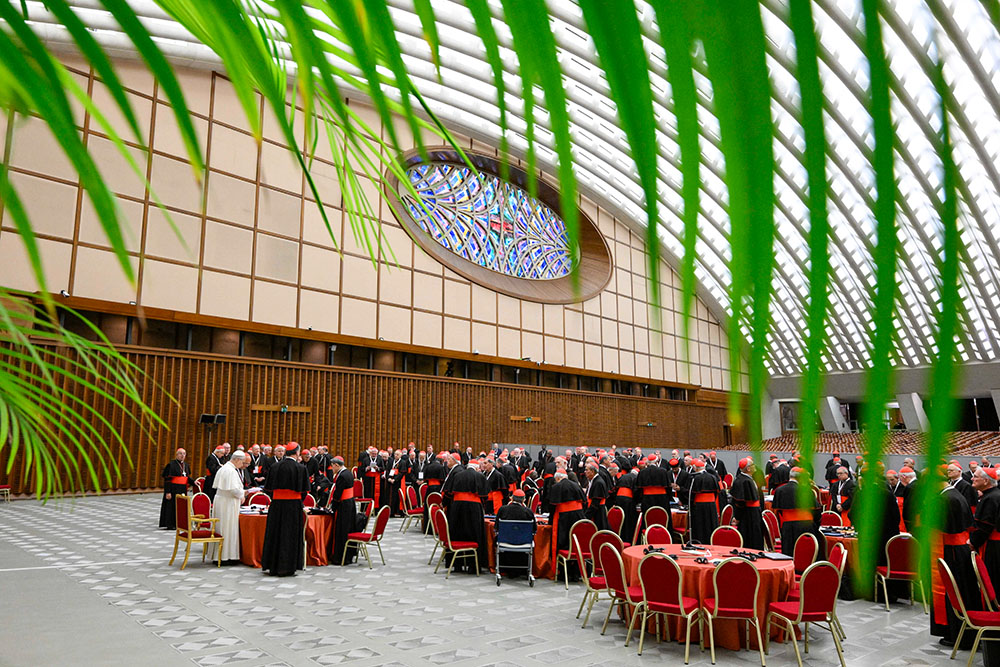
Pope Leo XIV holds a consistory with cardinals from around the world at the Vatican Jan. 8, 2026. (OSV News/Vatican Media/Simone Risoluti)
The pope was speaking to the cardinals, and it will be fascinating to find out what they said to one another in their discussions. The beautiful and inspirational words of the Holy Father need to take root in the words and deeds of our church's leaders. But how? One clue emerged from the photos of the consistory: The cardinals were seated at round tables, as they were at the twin synods on synodality. If we are to learn how to love one another as Christ loved us, we first have to learn to listen to one another, to stop dismissing or even caricaturing each others' ideas and concerns. The cardinals' vote to make synodality one of the two main themes to be examined confirmed this ecclesial fact: Synodality has become the principal way the church realizes the collegiality for which Vatican II called.
The pope was also speaking to all Catholics. Do we favor love over our own perspectives? Do we surrender ourselves, our bodies and our minds, to Christ as he is proclaimed to us in the church? Do we let our human grievances drive our actions or do we receive God's grace and let that drive us? When we encounter a difficulty in the teaching of the church, do we try and convert ourselves or do we demand that the church convert to us?
The pope said he was beginning a series of catechetical reflections on Vatican II that will be delivered at his general audiences. And he invited us all to reread the actual texts of the conciliar documents "not through 'hearsay' or interpretations that have been given, but by rereading its documents and reflecting on their content." The documents are accessible. Also eye-opening. So many interpretations have been foisted onto the council that reading the actual documents is like a draught of fresh water on an oppressively hot day.
How will the Catholics of the United States respond to this invitation? Will the bishops' conference provide catechetical materials on the conciliar texts? Will bishops draft pastoral letters that help priests preach and help the lay faithful dig more deeply into the texts of the council? Will our Catholic colleges and universities find ways to reflect upon the Holy Father's catechesis in their curriculum? Will seminary rectors use their weekly rector's conferences to unpack the pope's catechesis? Will parishes form study groups, especially for young people, to reflect on Leo's always accessible words? It is time for the workers in the vineyard of the Lord to get cracking.