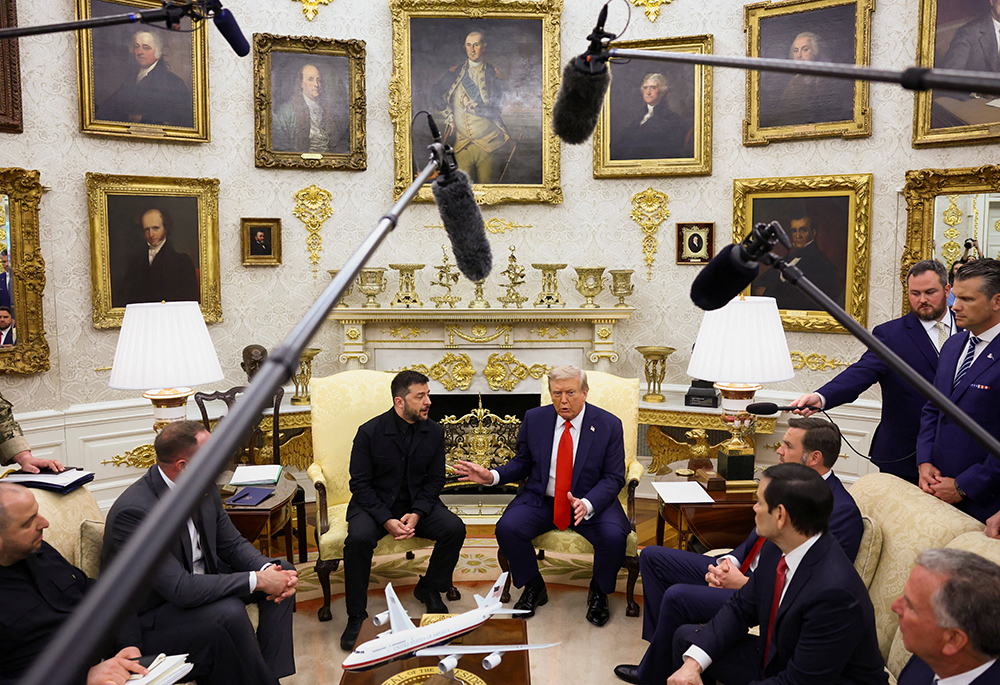
U.S. President Donald Trump and Ukrainian President Volodymyr Zelenskyy meet in the Oval Office of the White House in Washington Aug. 18, 2025, amid negotiations to end the Russian war in Ukraine. (OSV News/Reuters/Kevin Lamarque)

Last week, we looked at the analogy between President Donald Trump's summit with Russian President Vladimir Putin in Alaska and British Prime Minister Neville Chamberlain's disastrous negotiations in Munich in 1938, how the analogy did and didn't work.
Monday (Aug. 18), Ukrainian President Volodymyr Zelenskyy and the leaders of several European countries came to the White House for a meeting with President Trump. It felt a lot like Yalta in 1945.
On New Year's Day 1945, the Soviet Army still stood east of Warsaw. Having encouraged the Polish patriots to rise up against the Nazis, Stalin then refused to come to their aid. He also refused landing rights in Soviet airstrips to British and American air forces that wished to drop supplies to the struggling Poles. The Warsaw Uprising was crushed by the Germans. Warsaw was leveled. Most of the outstanding potential Polish leaders were killed. Only on Jan. 17 did the Soviets enter the city. This act of moral turpitude was the prelude to the Yalta Conference.
The conference met in February. President Franklin Roosevelt was housed in the grand Livadia Palace, built for the tsars, and the plenary conferences were all held there to spare the president having to move around too much. In addition to his handicap, FDR was suffering from congestive heart failure. He died in April, a little more than two months after the conclusion of the conference in the Crimea. British Prime Minister Winston Churchill was housed at the Vorontsov Palace, built by a Russian prince who had once been the imperial ambassador to Great Britain. Soviet Premier Josef Stalin lavished his guests with hospitality. One day, at cocktail hour, someone in the British delegation commented that there were no lemon peels for the drinks. A couple of days later, a lemon tree appeared in the villa.
Advertisement
The Big Three as they were called discussed many issues relating to the soon to be established United Nations. The Soviets also promised to enter the war against Japan two to three months after the conclusion of hostilities in Europe.
The biggest, most problematic issue was the postwar order, especially in Poland. Great Britain had entered the war when Hitler invaded Poland on Sept 1, 1939. Stalin had secretly agreed to carve the Polish nation up with Hitler and the Red Army entered from the east on Sept. 17, what Poles still refer to as "the stab in the back." The Polish government fled to London in exile. For Britain, restoring a free Poland was a matter of honor. For the Soviets, who were at that moment liberating Polish territory, it was a matter of security.
The conference agreed on new borders: Poland would shift approximately 40 miles to the west, ceding land in the east to the Soviets but gaining new lands in the west from Germany.
British calls for a free and independent Poland ran up against the fact that Russia had already established a provisional government in Lublin, composed of communists only. No members of the legitimate prewar government were allowed back into the country. Compromise diplomatic language called for a new "Polish Provisional Government of National Unity" and left the details to the future. Stalin promised Polish elections would be free. He lied.
For years after Yalta, many Poles felt that FDR had sold them out at Yalta. In fact, he had acquiesced in the fact that the Red Army had expelled the Nazis from Poland before the conference even finished. The "details" about the new provisional government eluded the diplomats because Stalin had no intention of allowing a free and independent Poland on his border. The Western powers had no appetite for going to war with the Soviet Union over control of Eastern Europe. The seeds of the Cold War were not planted at Yalta. They were planted in the way World War II played out.
Ukraine shares many affinities with Poland. Both had vibrant national cultures but had enjoyed freedom from their more powerful neighbors intermittently or not at all. Ukraine had long been under tsarist control, and in the 1930s, Stalin inflicted a famine on the country, the Holodomor, to kill off more affluent peasants known as kulaks. It only gained its political independence with the collapse of the Soviet Union in 1991. Like the Poles, Ukrainian hearts and culture cannot be conquered by armies.
Today, Putin's army controls large swaths of Ukrainian territory. Had the U.S. and other NATO powers delivered more military assistance to Ukraine and done so sooner, perhaps Ukraine could have staved off the Russian attacks. It is regrettable that the Biden administration did not give Ukraine the weapons it needed sooner, especially fighter aircraft and missiles that could reach into Russian territory. Even more regrettable is that the West failed to admit Ukraine to NATO.
Now, as in 1945, there is no appetite in the West to risk war with the Russians over control over territory on Russia's border. Unlike 1945, however, Russia is now a second-rate power. As long as the Ukrainians are willing to fight, if the West gives them the best weapons we have, they can win the war.
Now, as in 1945, the diplomats will engineer vague language about "security guarantees" akin to Stalin's promise for a free and independent Poland. The proof of the pudding will be in the eating. Will the Europeans and Trump be on the same page about security guarantees? Does anyone think Trump will be bound by solemn pledges?
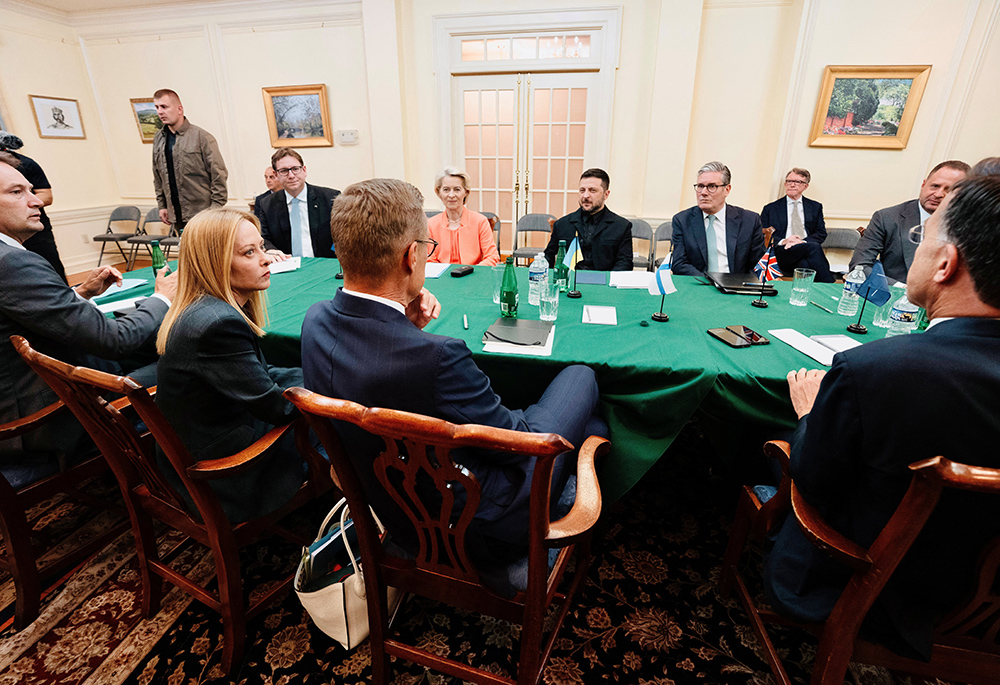
Ukrainian President Volodymyr Zelenskyy, center, meets some of the European leaders at the Ukrainian Embassy ahead of their meeting with U.S. President Donald Trump in Washington Aug. 18, 2025. (OSV News/Reuters/Italian Prime Ministry handout)
The biggest difference between now and 1945, however, is the utter absence of idealism in the conduct of U.S foreign policy. President Trump spoke about security guarantees and that the European nations were the first line of defense but he never gives voice to the democratic commitments on which NATO was founded. He speaks often about the need to stop the killing, but rarely acknowledges that Russia is the aggressor. Great nations can never entirely abandon realpolitik but they do so in the name of values and virtues. For Trump, it is all just a power play — and a nice diversion from the Jeffrey Epstein saga.
Where do things stand? Monday's meetings at the White House were better than Zelensky's last visit, to be sure. The phrase "Article 5-like guarantees" could be promising, or it may prove inadequate. We all want the war to stop, but there can be no reward to Putin. We may have to live with the fact that significant territories in Ukraine, perhaps for a long time, will be under Russian control, just as we lived with Soviet domination of Eastern Europe, but Putin's territorial claims should be denied legal recognition.
After the Yalta Conference concluded, Churchill returned to London and spoke in the House of Commons. He acknowledged the difficulties over Poland but hoped for the best. Towards the end of the speech, he said: "We are now entering a world of imponderables, and at every stage occasions for self-questioning arise. It is a mistake to look too far ahead. Only one link in the chain of destiny can be handled at a time." Those are wise words. Compromises now that lead to peace can be indulged but not concretized.
Putin will not live forever. American prestige and leadership are severely damaged, but not forever. Ukraine will live forever.