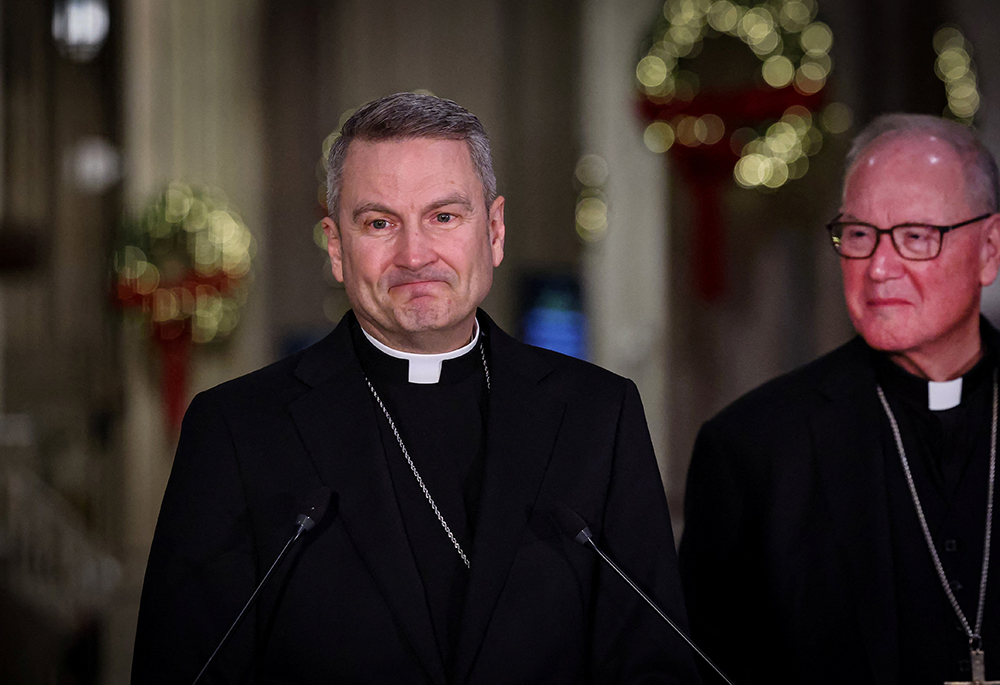
Archbishop Ronald A. Hicks, flanked by New York Cardinal Timothy M. Dolan, pauses while speaking during a news conference at St. Patrick's Cathedral in New York City Dec. 18, 2025, after Pope Leo XIV accepted the resignation of Dolan, and appointed Hicks as his successor. Archbishop Hicks was previously the bishop of Joliet, Illinois. (OSV News/Reuters/Brendan McDermid)

The appointment of Bishop Ronald Hicks to be the next archbishop of New York apparently took a lot of people by surprise. It shouldn't have. For two years now, whenever religion reporters would play the parlor game of predicting who would succeed Cardinal Timothy Dolan as archbishop in the Big Apple, I always ended up thinking, "It's gonna be Ron Hicks."
I had no inside information. Pope Leo XIV does not call me every week to pick my brain about possible episcopal appointments. (Regrettably!) But when you think about the needs of the Archdiocese of New York, and the enormity of the task of leading its 2.4 million Catholics, Hicks seemed tailor-made to fill that niche.
More than a million of those Catholics in New York are Hispanic. The new archbishop is someone I call "an honorary Latino." Like Cardinal Sean O'Malley, the archbishop emeritus of Boston, Hicks not only speaks fluent Spanish, he knows and loves Latino culture. His time in Mexico and El Salvador shaped him profoundly.
The Archdiocese of New York is not only large in terms of the number of people it serves, but it is a massive organization with infrastructure and investments, liabilities and lawsuits, and all the things that come with running a large organization. Hicks was vicar general and moderator of the curia in the archdiocese of Chicago which, with a little more than 2 million Catholics, is the third largest diocese in the country. That means he was in charge of the day-to-day operations, working closely with the ordinary, Cardinal Blase Cupich. If anything can prepare someone for the administrative responsibilities, the meetings, the tough decisions, the relationship building, that leading such a vast archdiocese entails, it is serving for five years as the vicar general and moderator of the curia in a similarly large and diverse archdiocese.
In an interview last Thursday (Dec. 18) with NBC Chicago's Mary Ann Ahern, Cupich recalled interviewing Hicks for the post of vicar general shortly after Cupich's own arrival in Chicago. "He also seemed to get things on the first bounce," Cupich said. That, too, is key to effective leadership of complex organizations.
Advertisement
Hicks is the third Midwesterner to be appointed to lead the New York Archdiocese. Dolan was from St. Louis originally and served as archbishop in Milwaukee before coming to the Big Apple. Cardinal Edward Egan was a priest of the Archdiocese of Chicago before serving in Rome and then as the bishop of Bridgeport, Connecticut. Across the river, in Newark, is Cardinal Joseph Tobin, who comes from Detroit. It seems that Midwesterners land well in Northeast dioceses. The church in the Midwest is less clerical than the church in, say, Boston, or New York or Philadelphia. A priest from Pittsburgh once told me the presbyterate there gave thanks for the Allegheny Mountains which kept the clericalist winds away from his hometown.
Chicago, especially, stretching back to the tenure of Cardinal George Mundelein from 1915 until 1939, has been especially strong in its commitment to Catholic social teaching. Mundelein's right-hand man, Auxiliary Bishop Bernard Sheil and, later, Msgr. Jack Egan, were champions of Catholic social teaching. Egan championed civil rights with Dr. Martin Luther King Jr., and all three prelates maintained strong ties with organized labor. Mundelein all but endorsed President Franklin Delano Roosevelt for reelection in 1936. Hicks is the heir to this tradition.
Most importantly, Hicks is a fine pastor. In the video made at the March Fratelli Tutti conference at Fordham University, Hicks said, "One of the things I'm walking away from this conference is saying oftentimes we want to start with our ideology, our idea, or pushing what I want. Communion means we're in relationship with one another. It doesn't allow for us just to stay in our own worlds of comfort or our own narratives. It demands that we listen, see, communicate and do so in a spirit of love." That ability to listen and to empathize is the heart of effective pastoral leadership. It is the essence of the synodal reform that Pope Francis advocated and to which Pope Leo remains committed.
A little more than two years ago, I was helping to organize a Way Forward gathering at the University of San Diego. Hicks had been invited but RSVP'd he could not attend. I called Auxiliary Bishop Kevin Birmingham, who was a great fixer for ecclesiastical problems in Chicago. I asked if he would call Hicks and encourage him to attend the conference. Birmingham called back a short while later to say that Hicks would attend, but would miss the first panel because he had a hard commitment the previous night. Then, Birmingham said something that rang in my ears when we got the news about New York last week: "Ron is the best of us."