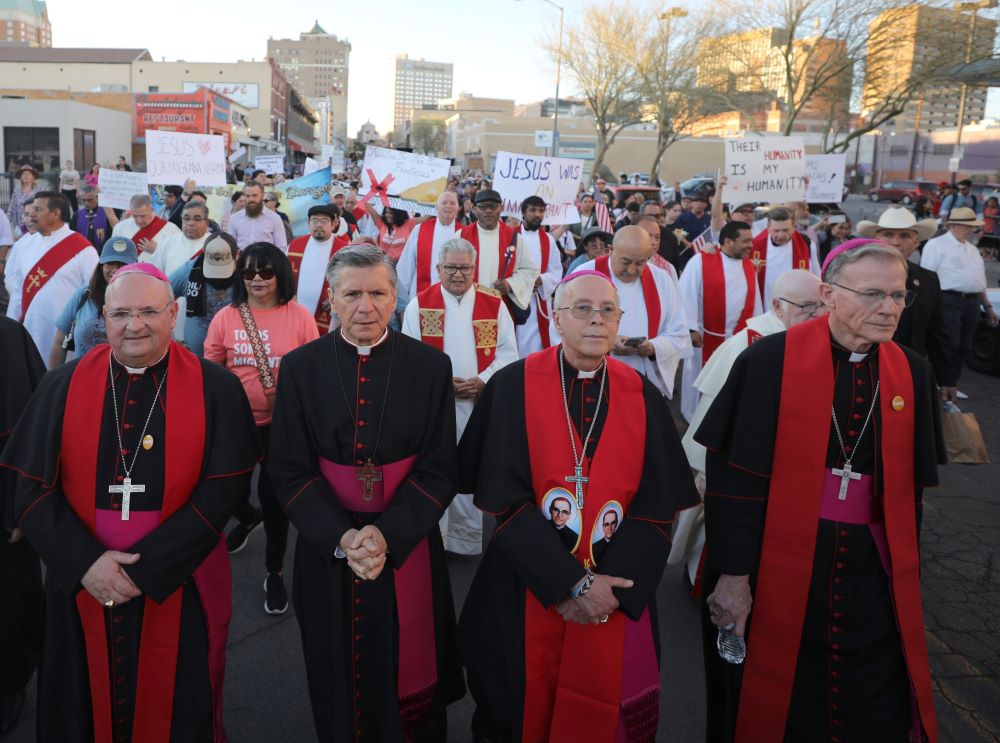
Archbishop John Wester of Santa Fe, N.M., (right) takes part in a demonstration in El Paso, Texas, against mass deportation March 24, 2025. With him are Bishop Peter Baldacchino of Las Cruces, N.M.; Archbishop Gustavo García-Siller of San Antonio and Bishop Mark Seitz of El Paso. (OSV News photo/Bob Roller)
The growing response by Catholic leaders to the deliberate and persistent government cruelty imposed on the most vulnerable in our society represents a new moment for U.S. Catholics. It is a moment fraught with no small measure of risk.
It is a very different moment in U.S. Catholic experience when the cardinal archbishop of Chicago, Blase Cupich, celebrates an outdoor Ash Wednesday Mass attended by 3,000 people in solidarity with immigrants being detained, a direct condemnation of U.S. government policy.
It is a different moment when Cardinal Joseph Tobin of Newark, New Jersey, says it was a priority to celebrate Ash Wednesday Mass inside an immigrant detention center before the usual Mass of that day at the cathedral.
The record is accumulating. Other bishops and priests, joined by hundreds of laity, march to detention centers and issue pastoral statements decrying the activity of a paramilitary force, masked and accountable to no one, that is terrorizing whole cities on orders from the highest levels of government.
No script, no precedent, exists for what we are seeing. The statements and actions of Catholic leaders are not the result of months of planning for a multimillion-dollar eucharistic extravaganza or a tightly orchestrated demonstration in Washington. This is not a campaign for or against a policy or a piece of legislation. The bishops are under no institutional requirement to act.
What we are seeing is a genuinely prophetic answer to a call from the heart of the Gospel. It is an urgent response to an extreme moment. The answer is delivered with language and action that attempt to counter an out-of-control government and its multiple assaults on human dignity and the rule of law.
"We are witnessing a comprehensive governmental assault designed to produce fear and terror among millions of men and women," Washington Cardinal Robert McElroy said in September in a homily during a Mass observing the annual World Day of Migrants and Refugees. The policy, he continued, "embraces as collateral damage the horrific emotional suffering that is being thrust on children who were born here, but now face the terrible choice of losing their parents or leaving the only country they have ever known."
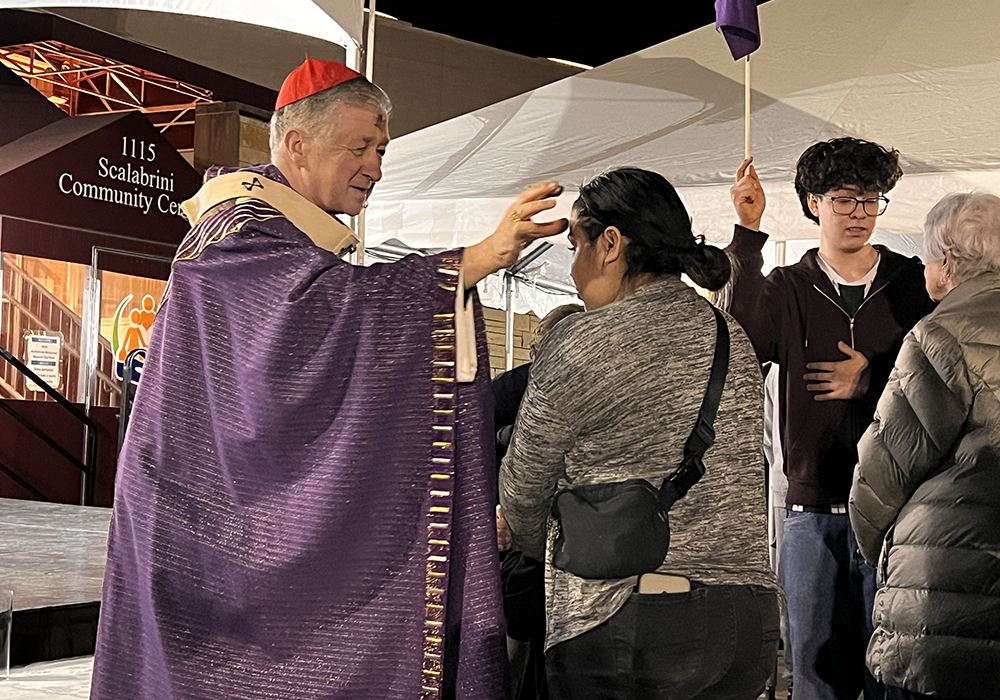
Chicago Cardinal Blase J. Cupich places ashes on the forehead of an attendee at the Ash Wednesday Mass near Our Lady of Mount Carmel Parish, Feb. 18, 2026, in Melrose Park, a Chicago suburb. (Courtesy of Coalition for Spiritual and Public Leadership/Gordon Mayer)
More recently, in response to government plans to spend $38.3 billion to construct multiple "mega centers," each capable of holding 7,000-10,000 people, the U.S. Conference of Catholic Bishops said: "The thought of holding thousands of families in massive warehouses should challenge the conscience of every American. Whatever their immigration status, these are human beings created in the image and likeness of God, and this is a moral inflection point for our country."
The statement noted that the bishops in November "unequivocally opposed the indiscriminate mass deportation of people and raised concerns about existing conditions in detention centers."
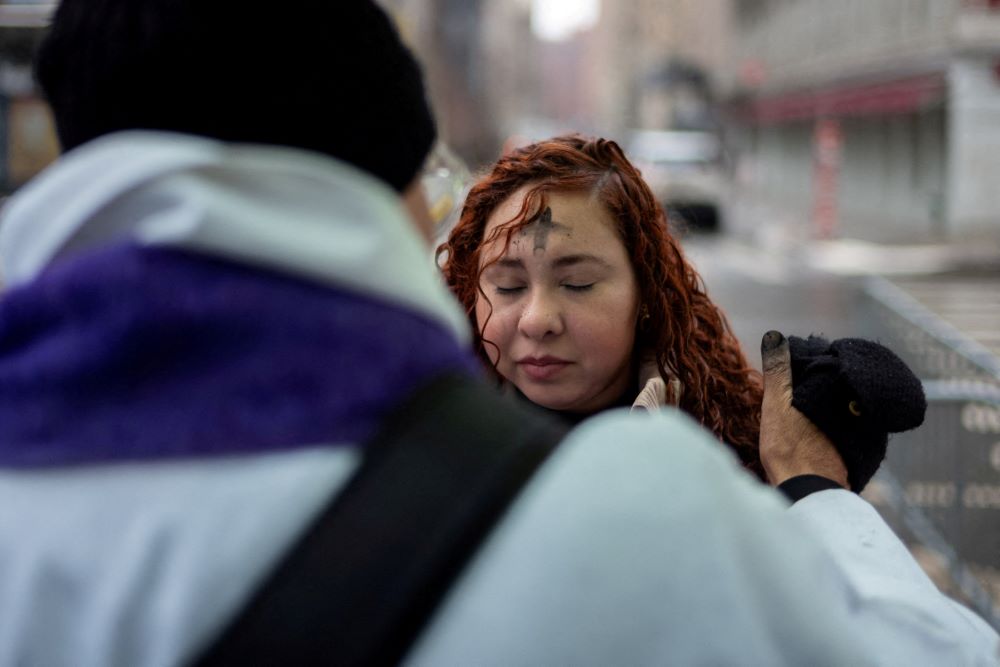
Fr. Fabian Arias marks a cross with ashes on the forehead of a woman outside a U.S. immigration court in the Manhattan borough of New York City Feb. 18. (OSV News/Reuters/David 'Dee' Delgado)
In the tradition of the prophets of the Hebrew Scriptures, the clear example of Jesus, and the long and well-defined social justice teachings of the Catholic Church, the bishops are speaking truth to power. They are in the public square answering a summons that is issued from the heart of the Christian Gospel.
That response, however, is laden with risk. One risk is that the challenged power will seek retribution. Given the vengeful nature of the current administration, the bishops have placed themselves — and by extension, the church — at risk of retaliation. We should not be surprised if Catholics are asked to pay a price for what their leaders are compelled to do in service of the Gospel. Sometimes the Gospel requires that we bear a burden.
While taking to the public square in such bold terms may bring reprisals, it also raises the opposite and equally dangerous risk of being seduced by power. It can happen subtly.
The bishops have recent experience of that kind of seduction. In the decades since the Roe vs. Wade decision legalizing abortion, the bishops transformed from announcers and explainers of church teaching to highly partisan actors. Abortion took precedence over all other issues that the social justice tradition demanded receive attention. Catholic bishops were among the most responsible for the 2022 Supreme Court decision that ended Roe but also sparked a 50-state culture war that will go on indefinitely. To achieve that outcome, the bishops conceded much of their integrity and spent most of their political capital.
What we are seeing is a genuinely prophetic answer to a call from the heart of the Gospel. … [It attempts] to counter an out-of-control government and its multiple assaults on human dignity and the rule of law.
The lure is ever-present. While President Donald Trump has destroyed most norms that undergird our democracy and increasingly acts as an authoritarian, other power centers remain. And some of those may wish to use the bishops to their advantage.
We would urge the bishops to remember the recent past and, in the present circumstance, remain teachers and exemplars of what they're teaching.
The current moment has pulled the U.S. hierarchy back to pronouncing the whole of our justice tradition. It has spurred, whether intentional or not, a revival of the late Cardinal Joseph Bernardin's "seamless garment" approach to difficult issues.
If there is no U.S. script for meeting the current moment, papal guidance exists on how Catholics should handle themselves in relationship to the state and public issues.
In Deus Caritas Est ("God Is Love"), Pope Benedict XVI described the place of Catholic doctrine in the mix of political life. "Its aim is simply to help purify reason and to contribute, here and now, to the acknowledgment and attainment of what is just," he wrote in 2005.
The responsibility of the church, Benedict further states, is to "help form consciences in political life and to stimulate greater insight into the authentic requirements of justice" and "readiness to act … even when this might involve conflict with situations of personal interest."
Pope Francis time and again called for engagement in public issues as a natural extension of one's spirituality, an engagement particularly in solidarity with and on behalf of the most marginalized in society. Pope Leo XIV has, in his short tenure, repeatedly supported U.S. bishops opposing government policy on immigration.
Advertisement
We are heartened by the response of our religious leaders to this time of national crisis. Our hope is that the bishops avoid the lure of the seat at this politician's event or that power broker's dinner. We hope they do not become adornments of those who would use such associations as a tool for attaining power. Resist the lure of deal making, legislating, political power brokering and vote getting. Leave that to politicians and involved citizens.
It is enough to ask of our bishops that they make sure they've done all that's possible to inform the consciences of those who vote and who are responsible for making political decisions. It is enough that they continue to demonstrate how to act even when it might conflict with personal or institutional interests.
Like the cardinals mentioned above, our leaders should take to public space in defense of the most vulnerable and in that way — with actions and words — persuade the faithful.
Our hope runs deep that the Catholic opposition to Trump's cruel immigration policies continues to grow in volume and number.
We are in a new moment of threat and crisis. It begs the wisdom — and work — of our ancient tradition.