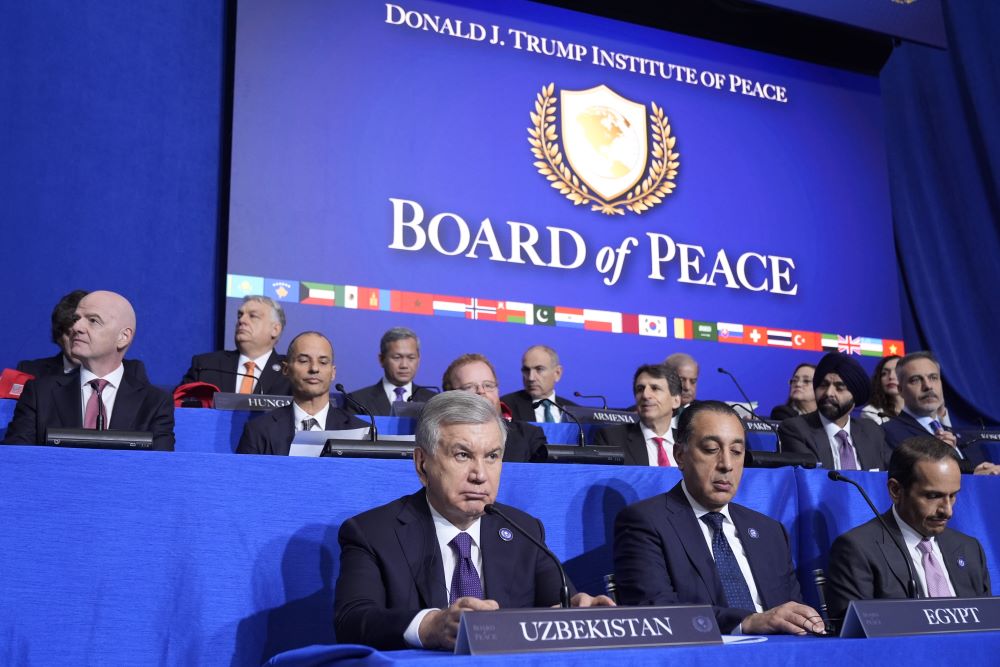
World leaders listen as President Donald Trump speaks during a Board of Peace meeting at the U.S. Institute of Peace Feb. 19 in Washington. The Vatican has declined to join the group. (AP/Mark Schiefelbein)

by Joshua Villanueva
The Vatican's refusal to join President Donald Trump's Board of Peace is a quiet move with a strong meaning. By refusing to lend its name to a leader-centered initiative, the Vatican is drawing a line between peace as a durable, rules-based order and peace as a headline-driven display of power. The message is clear: Peace that depends on a single figure may move fast, but it will not last.
The board, first announced by the White House on Jan. 16, is intended as an oversight body for the president's "Comprehensive Plan to End the Gaza Conflict."
Speaking on the sidelines of a meeting with the Italian government at Palazzo Borromeo, Cardinal Pietro Parolin said Feb. 17 the Holy See "will not participate" in the board "because of its particular nature, which is evidently not that of other States." He added, "The important thing is that an attempt is being made to provide a response." But, he continued, there are "critical points" that must be resolved — including the concern that "at the international level it should above all be the U.N. that manages these crisis situations."
The Vatican leads in a way that defies today's political playbook. It moves with intention and values continuity over quick wins. It speaks the language of principles and institutions, not personalities and trophies. In a world focused on spectacle, this can look timid. In truth, it is how the Vatican protects its freedom to act as a principled voice.
The Vatican leads in a way that defies today's political playbook.
This stark difference from Trump's style is what gives the Vatican's refusal its weight. Trump's approach feeds on dominance, speed and personal control, often flattening the slow, careful work of institutions. The Vatican, in contrast, is in it for the long haul. It trusts in peace rooted in rules that endure beyond any leader, and in institutions that stand guard long after the spotlight fades.
Pope Leo has consistently promoted an institutional approach. In his January address to diplomats, he warned that dialogue and consensus are being replaced by "diplomacy based on force," and criticized the decline of multilateral cooperation as a threat to peace based on law.
The Vatican's refusal has implications beyond Gaza. Trump's board is launching with significant political attention and specific commitments. Trump hosted the group's first meeting on Feb. 19 in Washington, D.C., and pledged $10 billion for Gaza reconstruction and humanitarian aid. He also indicated that several nations have agreed to commit troops and police "to stabilize Gaza."
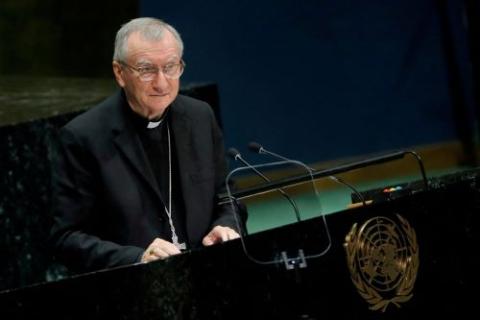
Cardinal Pietro Parolin, Vatican secretary of state addresses the 74th session of the General Assembly of the United Nations at U.N. headquarters in New York Sept. 28, 2019. (OSV News/Reuters/Brendan McDermid)
One of the Vatican's concerns is that the board is taking over the U.N.'s role in managing crisis situations. The board claims legitimacy through its association with U.N. action, but it is not a U.N. subsidiary body. It operates independently, alongside but not within U.N. structures. The Vatican prefers peace through durable, rules-based multilateral institutions, not parallel, leader-driven bodies that borrow U.N. credibility while shifting authority outside established frameworks.
The language of the board's charter is also very broad, suggesting the ability to intervene whenever conflict arises. Trump has confirmed that he thinks the board is "going to go far beyond Gaza," but said "we're working in conjunction with the United Nations." In his remarks during the first board meeting, Trump said, "The Board of Peace is going to almost be looking over the United Nations and making sure it runs properly." If the U.N. connection is narrow while the board's own mandate is wide, arguments over legitimacy, mission creep and politicized decision-making are sure to follow.
For the Vatican, this is a needless snare. If the board works in one situation, it could be drawn into others. If it stumbles, everyone involved shares the fallout. In every case, the Vatican's name would be used to burnish the board's reputation because its moral standing is so widely recognized.
That is precisely the kind of situation Leo cautioned against, and the reason Parolin insists these crises should be handled, above all, through the U.N.
One of the likely "critical points that would need to find explanations," as Parolin puts it, is how swiftly the board's legitimacy could be shaped by the whims and branding of a single leader. Even with other nations at the table, the charter hands Trump sweeping authority. He alone can invite or exclude members, dissolve the board at a moment's notice and decide what the charter truly means.
The Vatican has always championed peace rooted in justice and legal principles, not whatever the most powerful think it should be. Peace may have many faces, but the Vatican's understanding of peace is not merely the end of violence or an order enforced by strength. It is a lasting order built on rights, accountability and the rule of law.
Advertisement
The Vatican's refusal is a clear warning. This arrangement should alarm anyone who values legitimacy and accountability. When a high-profile "peace" effort wraps itself in moral language and commands the world's gaze, silence can be mistaken for approval. That is probably why Parolin stressed the importance of making an attempt to respond. Peace cannot flourish without trust, and trust is born from clear rules, collective decisions and checks on individual power. When one person acts as judge, jury and executor, the board risks becoming a personal stage rather than a true forum for peace.
Some may say Gaza's pain is so dire that the Vatican should take any seat at any table if it could help. But urgency does not excuse poor judgment. The Vatican can press for humanitarian aid, denounce collective punishment, support rebuilding and foster talks without joining a body that centralizes power, muddies legitimacy and opens the door to political manipulation.
So what does the Vatican's "no" really mean? It declares that peace must be guided by rules, transparency and accountability, and that true freedom lies in working with all, beholden to none.