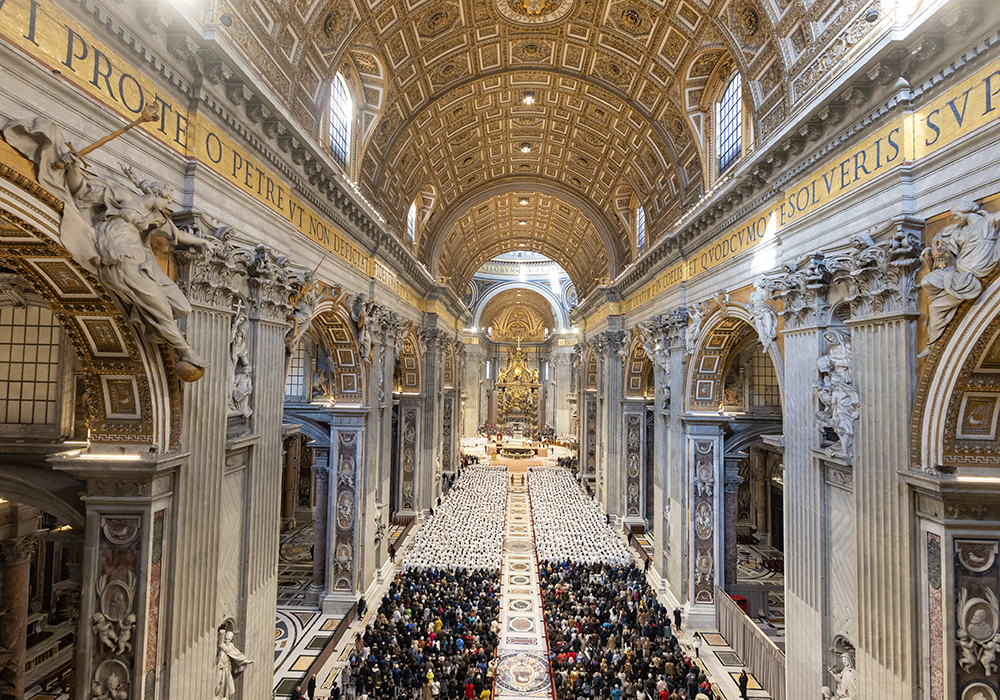
Deacons vested in white with their families and the public behind them attend a diaconate ordination Mass in St. Peter's Basilica celebrated during the Jubilee of Deacons at the Vatican Feb. 23, 2025. (CNS/Pablo Esparza)

by Christine Schenk
The all-male Catholic magisterium is caught between a rock and a hard place.
Despite a worldwide synodal process naming women's inclusion in church ministry and decision-making as an "urgent" issue to be addressed at the 2021-2024 Synod of Bishops on synodality, a papal commission recently made public a 2022 decision in which they ruled out admitting women to the diaconate.
Even so, commission president Cardinal Giuseppe Petrocchi said the issue still remains "open to further theological and pastoral study."
Before the 2023 synod session, I conducted an informal study of 18 national syntheses or media summaries of grassroots synodal input from all over the world, some of which included whole regions such as Asia and the Amazon and Latin America. Virtually every synthesis named "women's role in the church," as an urgent consideration. Over 70% included women's ordination to the diaconate or priesthood as a way of including women in leadership.
That is a lot of hope and expectation rising up from the people of God.
Is the Holy Spirit telling us that female exclusion from ordained ministry and church decision-making is no longer acceptable and that something needs to be done about it?
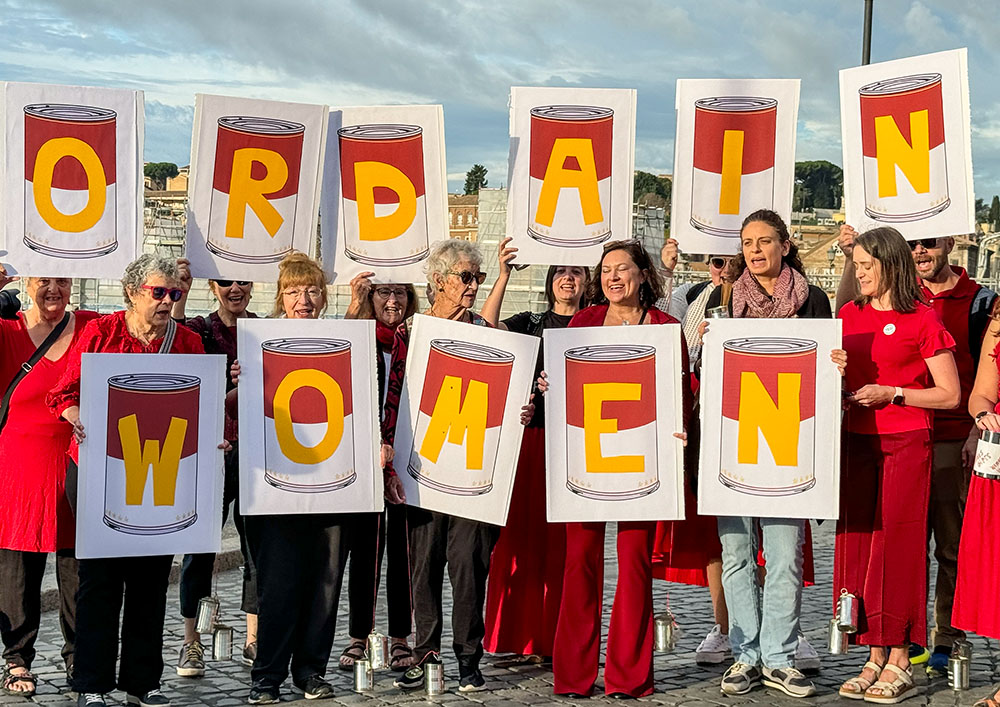
Members of the Women’s Ordination Conference, Women’s Ordination Worldwide, Roman Catholic Womenpriests-USA gather near the Vatican to pray for the Catholic Church to open up the priesthood to women as the worldwide consultation known as the synod begins Oct. 2, 2024. (GSR photo/Rhina Guidos)
Women's diaconal ordination was a synod hot potato. Consider the following chronology:
- In a May 2024 interview with CBS' Norah O'Donnell, Pope Francis gave a hard no to female deacons "if it is deacons with holy orders." Yet synod delegates persisted.
- In July 2024, synod study group five — whose members were not identified — entrusted the issue of studying women's leadership roles to the Dicastery for the Doctrine of the Faith, or DDF.
- On Oct. 18, 2024, the synod delegates expressed "palpable outrage" when Cardinal Víctor Manuel Fernández, prefect of the dicastery, and other members of the study group failed to arrive for a previously scheduled meeting. Instead they sent two officials, neither of whom were study group members with authority to answer delegates' questions.
Synod representatives demanded that Fernández report to the assembly as planned. Cynthia Bailey Manns, a delegate from the Archdiocese of St. Paul and Minneapolis (and now a member of NCR's Board of Directors), remembers the group reminding Fernández they expected the study group "to adhere to the same tenets of synodality — co-participation, co-responsibility, transparency and accountability that were expected of all synodal delegates: 'We all need to be synodal. If not, it leads to misinformation and mistrust.' "
- On Oct. 21, 2024, Fernández told nearly 400 synod delegates and organizers that his study group was being led by DDF deputy Msgr. Armando Matteo, and promised to give delegates a full list of the group's membership. He also announced that Pope Francis' 2020 women deacons commission — led by Petrocchi — would continue its work and invited delegates and others to submit materials.
- By an over two-thirds vote, the synod's final document included the female diaconate in Paragraph 60: "There is no reason or impediment that should prevent women from carrying out leadership roles in the Church: what comes from the Holy Spirit cannot be stopped. Additionally, the question of women's access to diaconal ministry remains open. This discernment needs to continue."
- On Oct. 26, 2024, Pope Francis signed the synod final document in its entirety, thereby making it part of his magisterium "not as a binding norm, but as a set of guiding principles," as explained in Vatican News.
Ten study groups continued their work, including the one on the female diaconate assigned to the Dicastery for the Doctrine of the Faith. Which brings us to the present moment:
- In mid-November 2025 — just weeks before Petrocchi's Dec. 4 statement — it was announced that the Dicastery for the Doctrine of the Faith synod group on the female diaconate ceded their responsibility to Petrocchi's 2020 commission. It is likely that they did so with full knowledge that the commission had already voted against a female diaconate.
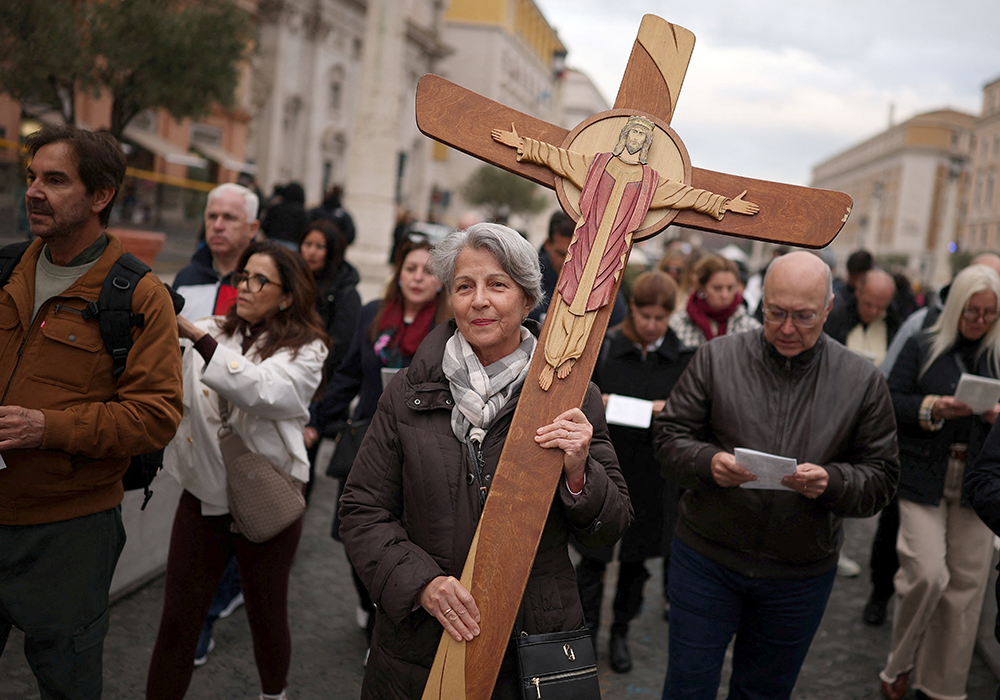
A pilgrim carries a crucifix in Rome near the Vatican's St. Peter's Square Dec. 4, 2025, after a high-level Vatican commission voted against ordaining Catholic women to serve as deacons while also supporting more study on the issue, according to a report addressed to Pope Leo XIV and released by the Vatican that day. (OSV News/Reuters/Guglielmo Mangiapane)
Given the above scenario one can only wonder what happened to transparency and the much vaunted synodal process.
Until now, all papal commission proceedings on the female diaconate were kept secret. Requests from synod delegates to review the outcomes of previous diaconate commissions fell on deaf ears. Kudos to Pope Leo XIV for at least making the commission's 2022 vote public.
It is noteworthy that in 1974 Cipriano Vagaggini conducted an exhaustive study on the history of female deacons for the Vatican's International Theological Commission. His findings (which were apparently suppressed at the time and then later released) concluded that women could be ordained to the diaconate and that their ordination rites were the equal of male ordination even if the work they did was different from that of male deacons.
Advertisement
The preceding convoluted — and painful — chronology suggests that the issue of women's diaconal leadership — indeed women's ecclesial leadership and juridical agency — are far from settled.
And for good reason. The statement published Dec. 4 is rife with dubious theology, not only about women deacons but about the nature of salvation through Jesus Christ. Consider this proposition:
The masculinity of Christ, and therefore the masculinity of those who receive Holy Orders, is not accidental, but is an integral part of sacramental identity, preserving the divine order of salvation in Christ. To alter this reality would not be a simple adjustment of ministry but a rupture of the nuptial meaning of salvation.
The gist of course is that women are not men and therefore they cannot be ordained.
This line of thinking echoes the same problematic theology that appears in other church documents denying ordination to women.
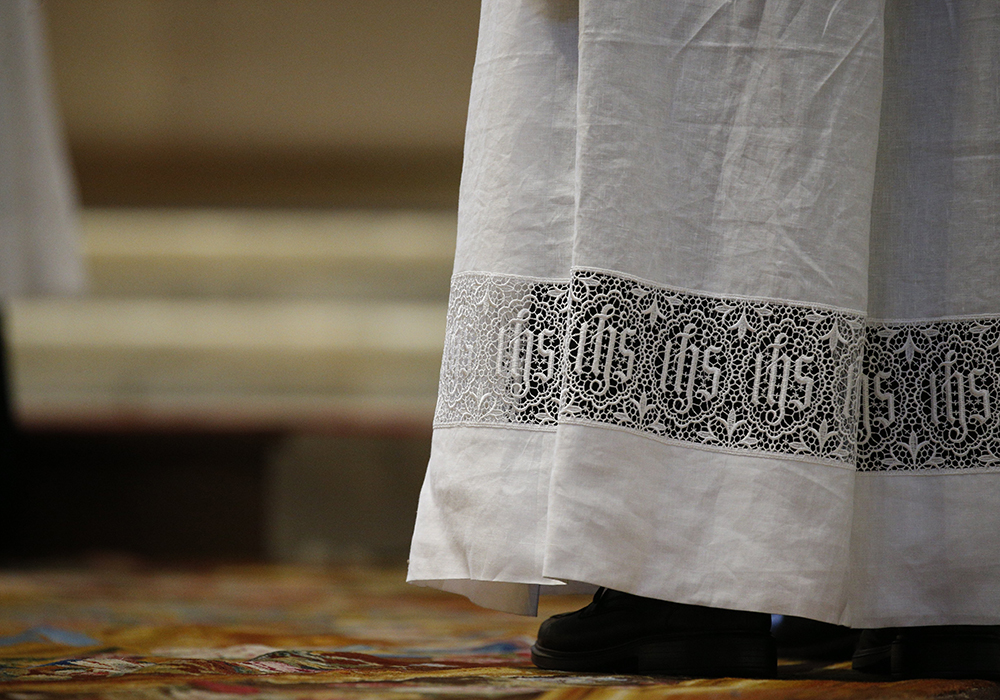
A seminarian from the Pontifical North American College in Rome stands at the Altar of the Chair for his ordination in St. Peter's Basilica at the Vatican Oct. 3, 2024. (CNS/Justin McLellan)
Are Christians saved by maleness or by the Word of God, enfleshed in Jesus, human and divine? Jesus' maleness is irrelevant to our salvation. Framed more positively we need to understand "Christ as representative of all humanity, not of biological maleness," to quote Mary Grey.
Using nuptial arguments to deny holy orders to women is also highly suspect. It fails to understand the nature of metaphorical language in speaking of the Divine. The function of a metaphor is to convey meaning beyond our capacity for literal expression. Describing Jesus as a "bridegroom" is metaphorical speech evoking the beauty of spousal love. By definition metaphors are not to be taken literally. To literalize a metaphor kills its power to evoke something far greater than words alone can convey.
Petrocchi's commission split down the middle about including the "masculinity" argument. One wonders if the five female commission members voted against it.
It is important to note that members of Petrocchi's commission did not participate in the synod, presuming current members are those named in 2020. No "conversations in the Spirit" for them. Furthermore, it reached its conclusions two years before the 2024 synod closed. While it did cite material sent after the final document was signed by Pope Francis, it discounted worldwide synodal calls for expanded roles — including ordination — for women.
It is good to remind ourselves that this recent commission report/statement is consultative, not juridical. Pope Leo has yet to speak.
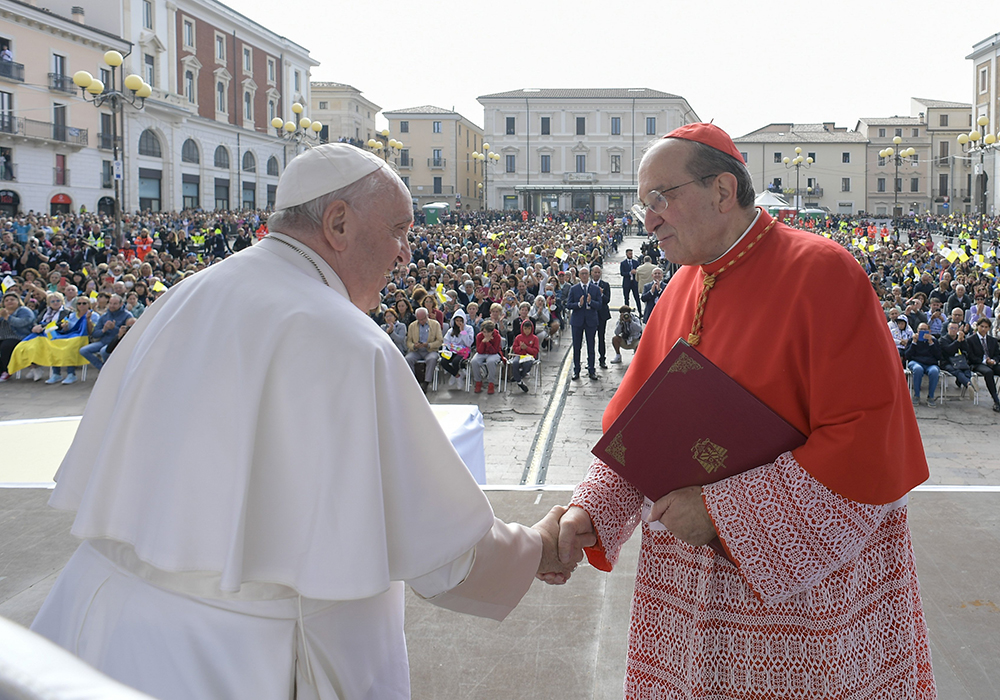
Pope Francis greets Cardinal Giuseppe Petrocchi of L'Aquila during an encounter in Piazza Duomo in L'Aquila, Italy, Aug. 28, 2022. (CNS/Vatican Media)
Which brings me to another point. Petrocchi said the commissions were unanimous about the need for women to "express adequate participation and co-responsibility in the decision-making bodies of the Church, including through the creation of new lay ministries."
So who determines what is "adequate?" As long as church decision-making rests solely with ordained men, women's juridical agency — indeed that of all the laity — is denied.
This is a core issue with which the synod is grappling. Will our church expand the deliberative voice for all the people of God?
For my part I'm unconvinced that continuing the clerical system as it now exists is to anyone's benefit. We need a renewed ecclesial ministry cleansed of patriarchal privilege.
Maybe synodal processes will seed a future in which that can happen.
Meanwhile, for my sisters and brothers who are ready to bail, I heartily recommend reading (or rereading) theologian and Immaculate Heart of Mary Sr. Sandra M. Schneiders' book, Beyond Patching: Faith and Feminism in the Catholic Church.
Schneiders had this to say about her prophetic title: "The title Beyond Patching is deliberately ambiguous. By it I want to suggest, first of all, that the old garment is beyond repair and that only a thoroughgoing reform of the church can respond adequately to the feminist critique."