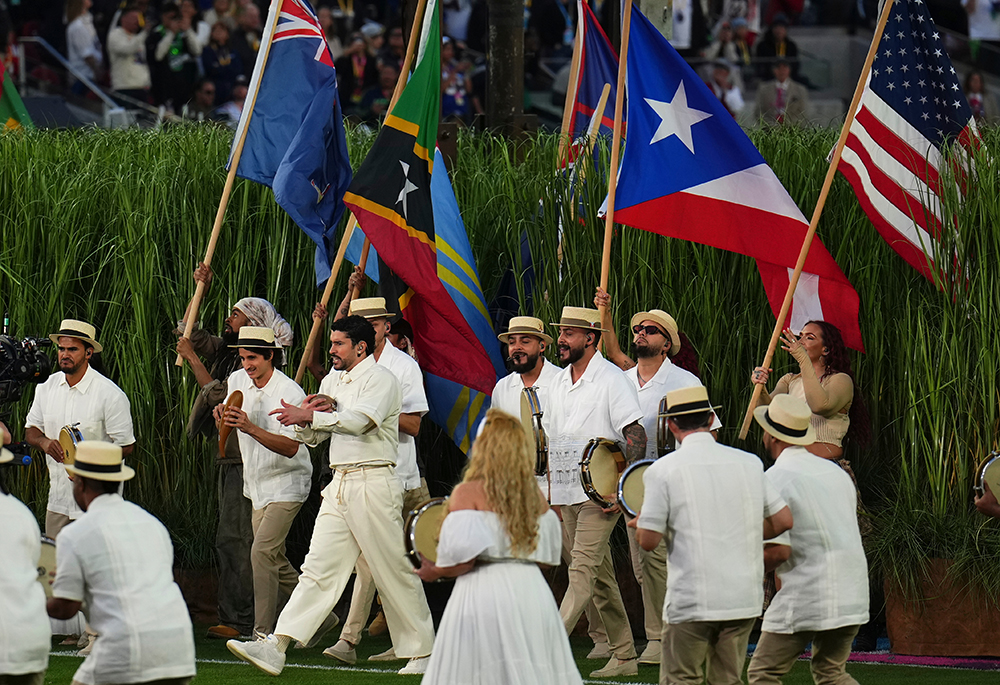
Bad Bunny performs during halftime of the NFL Super Bowl 60 football game between the New England Patriots and the Seattle Seahawks, Sunday, Feb. 8, 2026, in Santa Clara, California. (AP photo/Godofredo A. Vásquez)

by Helga Leija
On Feb. 8, 2026, Bad Bunny made history as the first solo Latin artist to headline the Super Bowl halftime show, singing mostly in Spanish. For him, this was a tribute to Puerto Rican culture and history. For me, it was a chance to see Latino identity recognized in one of the biggest stages in the United States.
Bad Bunny's performance challenged the idea that English and Anglo culture are the only voices welcomed at the table. By singing in Caribbean Spanish, he brought Latino culture into the national spotlight.
His performance is even more meaningful in today's harsh immigration climate, as many Latino families live with fear of deportation, including those that have legal status in the country. The tension between celebration and struggle runs deeply through Bad Bunny's music and, I believe, was evident in the performance.
The show opened with a scene of people cutting sugar cane. The scene, with danceable lyrics, honors the hard work and backbreaking labor of enslaved people under colonial rule. They are the ancestors of many Puerto Ricans today who had to leave their house to move on to better opportunities.
The song "NuevaYol" tells stories of migration, longing and the lasting relationships between Puerto Rico and those in the diaspora, shaped by Puerto Rico's colonial history.
It is important to understand that boricua Spanish, as heard in the song "NuevaYol" — where the "r" is shifted for an "l" — has often been stigmatized, even by other Latino Spanish speakers. Puerto Rican Spanish is frequently dismissed as "not proper" or "broken," and its speakers are sometimes mocked. This stigma also reflects American legacies of colonization that continue to shape attitudes today. By bringing boricua Spanish to a stage as visible as the Super Bowl, Bad Bunny challenges these harmful colonial ideas head-on.
Another song, "Lo Que Le Pasó a Hawai," ("What Happened to Hawaii") — sung in the halftime show by Ricky Martin — continues this conversation, addressing colonial legacies and the economic pressures that force families to migrate and separate.
Songs like "Café con Ron" ("Coffee with Rum") and "El Apagón" ("The Blackout"), which Bad Bunny performed while standing atop replicas of electrical poles from the private company that provides electricity to Puerto Rico, speak directly to the ongoing struggles on the island after Hurricane Maria, including slow recovery and persistent power outages. These songs are also a wink to other countries across Latin America who face similar struggles, like Cuba, Nicaragua, Ecuador and more.
"Debí Tirar Más Fotos" captures a deep love for Puerto Rico; a call to hold onto memories before they slip away. The song resonates with all those who had to leave their homes for reasons beyond their control and who are now holding tight to what they lost.
The halftime show was a huge Latino party, one that included a real wedding, a child sleeping on plastic chairs during a party, and flags of the Americas waving during "Debí Tirar Más Fotos" – all against a billboard that read: "The only thing more powerful than hate is love."
As a translator, I believe language is more than words. It is an act of cultural and political resistance. Bad Bunny honored both a language and a culture that has been marginalized and stigmatized for generations.
As a translator, I believe language is more than words. It is an act of cultural and political resistance.
For me, hearing my mother tongue celebrated on such a public stage and seeing the flags of the Americas felt so affirming. Watching the halftime show, I held mixed feelings: pride in cultural representation, discomfort with some lyrics. But that tension represents the complexity of being Latina in the U.S. I too was once a little child sleeping on white plastic chairs.
When the Grammy was handed to the little boy, many viewers thought of Liam, the child taken by ICE. The child actor may have been a reference to him. He could also have represented Bad Bunny as a child, honoring his early dreams. The scene suggests a beautiful message to his younger self: See, I told you you would make it.
Advertisement
And he has made it. His influence goes far beyond Puerto Rico; this was especially evident in the show's intimate casita scene, where a group of artists and influencers came together to support him, including Jessica Alba, Pedro Pascal, Karol G, Young Miko, David Grutman, Cardi B, Alix Earle, Ricky Martin and Lady Gaga, who also performed. Their presence showed the strength of community and solidarity in celebrating Latino culture. So strong is Bad Bunny's influence that even Archbishop Ronald Hicks of New York mentioned his lyrics during his installation on Feb. 6, showing how these words speak to the experience of migrants and the city's diverse culture.
Bad Bunny's performance was more than a show, it was a political statement: Latinos belong. We're here to stay. It was a message for those that don't want us here, as well as for us. It called us to remember who we are and where we come from. Despite migration, colonialism and prejudice, our stories will continue to be told, heard and honored.
As Bad Bunny told us in Spanish when he embraced Lady Gaga: "Mientras uno esté vivo uno debe amar lo más que pueda."
"While we're alive, we must love as much as we can."