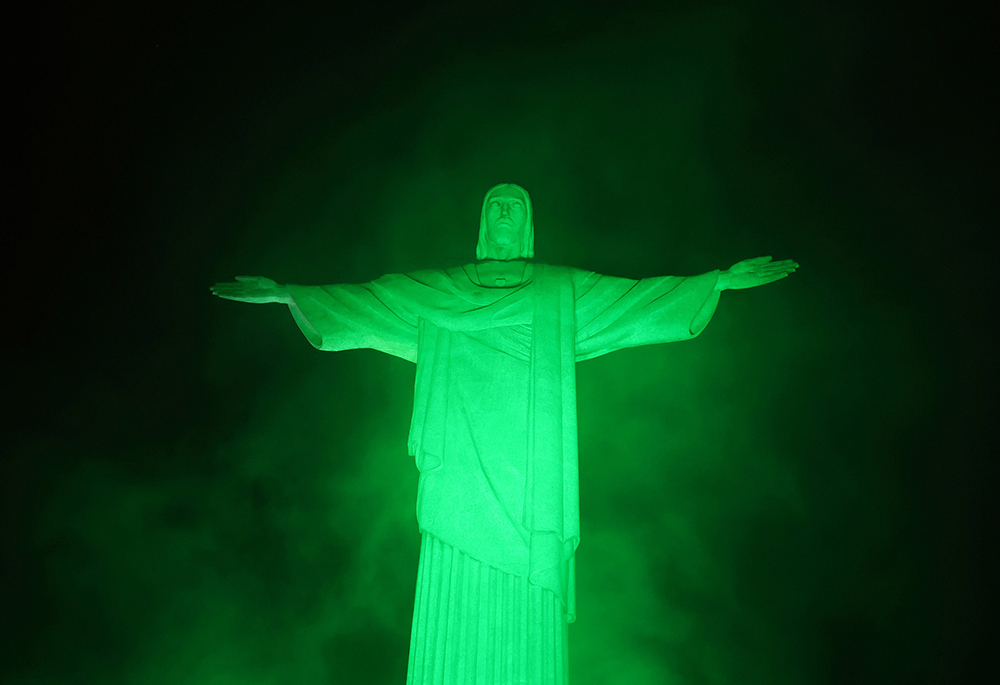
The statue of Christ the Redeemer is lit up in green on World Environment Day in Rio de Janeiro, June 5, 2025. Brazil is playing host to the COP30 United Nations climate change conference Nov. 10-21 in Belém. (OSV News/Reuters/Pilar Olivares)

by Eduardo Campos Lima
For more than two years, the Catholic Church in Belém has been preparing for this moment.
While the South American country hosts the United Nations climate change conference, known as COP30, in Belém, Nov. 10-21, church leaders intend to bring a powerful faith presence there. An unprecedented number of cardinals and bishops are set to take part in sessions, aiming to instill hope amid accelerating climate change and a moral plea for actions that address rising temperatures while respecting nature and human dignity.
"The conference is happening in the Amazon and, to a great extent, the debates also involve the Amazon. For the Brazilian church, it's been historically a very special topic," Archbishop João Justino de Medeiros Silva of the Diocese of Goiânia, first vice president of the National Conference of Bishops of Brazil (known by the acronym CNBB), told the National Catholic Reporter.
The Brazilian bishops have been leading the Latin American church's preparation for the event, alongside the Pan-Amazonian Ecclesial Network (REPAM), the Episcopal Conference of Latin America (CELAM), the Conference of Religious of Brazil, the Brazilian chapter of Caritas Internationalis and the Laudato Si' Movement.
The Catholic Church aims to play a significant role all over the conference, from within the official negotiating space known as "the Blue Zone" to a number of other parallel panels and events. At COP30, the Holy See delegation officially includes 10 Vatican officials, led by secretary of state Cardinal Cardinal Pietro Parolin. In addition, eight cardinals, 47 bishops and 97 people connected to several Brazilian ecclesial organizations will also be present in Belém.
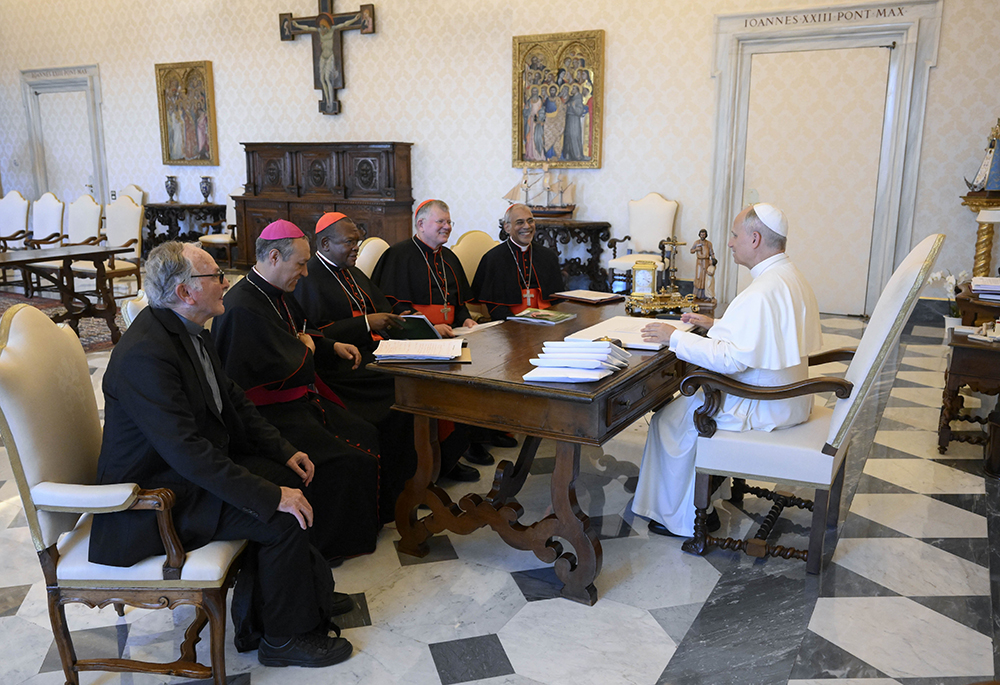
Pope Leo XIV meets with the heads of several bishops' conferences July 1, 2025, at the Vatican. From left are Indian Cardinal Filipe Neri Ferrão, president of the Federation of Asian bishops' conferences; Brazilian Cardinal Jaime Spengler of Porto Alegre, president of the Latin American bishops' council, known as CELAM; and Congolese Cardinal Fridolin Ambongo Besungu of Kinshasa, president of the Symposium of Episcopal Conferences of Africa and Madagascar, or SECAM; and other prelates. (OSV News/Vatican Media/Mario Tomassetti)
Among Catholic leaders in attendance will be: Cardinal Jaime Spengler, president of both the Brazil bishops' conference and CELAM; Cardinal Filipe Neri Ferrão of Goa, India, president of the Federation of Asian Bishops' Conferences; and Cardinal Fridolin Ambongo Besungu, archbishop of Kinshasa, Democratic Republic of Congo, and president of the Symposium of Episcopal Conferences of Africa and Madagascar.
In July, the three continental bishops' conferences, representing 821 million Catholics, issued a first-of-its-kind joint appeal laying out a Catholic vision and priorities for COP30, including an end to the use of fossil fuels and avoidance of false "green" climate solutions that further exploit people, communities and natural resources.
"At COP30, we demand that States take transformative action based on human dignity, the common good, solidarity and social justice, prioritizing the most vulnerable, including our sister Mother Earth," the continental bishops wrote, describing the U.N. gathering as a moment for the church "to reaffirm its prophetic stance."
"The Church will not remain silent," they wrote.
Climate summit in the Amazon
The 30th meeting of nations under the U.N. on climate change is taking place in the state of Pará near the edge of the Amazon rainforest — a critical biome for life and key regulator of the planet's climate.
The event gathers world leaders, scientists and civil society activists who will debate the actions to deal with climate change. The Brazilian government estimates 50,000 people will attend the proceedings.
A focal point in Belém will be countries' climate action plans (officially known as nationally determined contributions, or NDCs) that they are required to update every five years under the terms of the 2015 Paris Agreement. That landmark document marked the first time all countries agreed to take actions to reduce heat-trapping greenhouse gas emissions that are primarily released from burning coal, oil and gas and are the main driver of climate change.

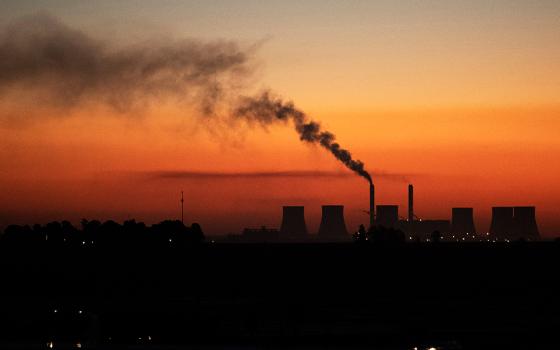
A drone view of the chimney of the Candiota III coal-fired power plant in Candiota, Brazil, May 9, 2025. A delegation of cardinals, bishops and lay activists gives the Brazil church a strong presence at the 30th United Nations climate change conference, or COP30, taking place Nov. 10-21 in Belém. (OSV News/Reuters/Diego Vara)
Under the Paris accord, nations set a goal of limiting average global temperature rise to "well below" 2 degrees Celsius (3.6 degrees Fahrenheit) and ideally to 1.5 C (2.7 F). An International Court of Justice advisory opinion this year stated that 1.5 C is "the scientifically based consensus target" recognized under international law. To meet that goal, nations have targeted reaching carbon neutrality by midcentury.
As Nov. 10, a total of 110 countries submitted new NDCs ahead of the Belém summit, representing 70% of global emissions. A U.N. analysis of the 60 plans submitted by October found that, if fully implemented, they would limit temperature rise between 2.3 and 2.8 C, representing progress from past forecasts but well short of the 1.5 C target. Debates on nations' climate commitments are expected to continue in Belém.
Delegations will also discuss climate finance, the necessary annual investment in measures aiming at tackling climate change.
Advertisement
At COP29, in Baku, Azerbaijan, developed nations agreed that by 2035 they would help to provide at least $300 billion each year for climate actions in developing nations — a figure many Catholic officials and developing nations called far too little. A report called "Baku to Belém Roadmap," which was released by Brazilian and Azerbaijani officials Nov. 5, put forward a blueprint to increase climate finance to at least $1.3 trillion per year.
During the Belém Climate Summit that gathered heads of state and ministers ahead of COP30's official opening, Brazil's President Luiz Inácio Lula da Silva launched the Tropical Forests Forever Facility as a financing tool for the conservation of tropical forests existing in more than 70 countries. The fund aims to raise $125 billion.
COP30 will also include the Action Agenda, which encompasses voluntary commitments by governments, companies and civic organizations to invest in decarbonizing, renewable energies and climate adaptation.
Church in Brazil prepares
While COP30 comes 10 years since the Paris Agreement's adoption, it also marks a decade since Pope Francis issued his social encyclical "Laudato Si', on Care for Our Common Home."
That document, along with his follow-up Laudate Deum "on the climate crisis," have guided the Brazilian church in their preparations for the U.N. climate conference.
On its COP30 website, the Brazilian church highlights paragraph 139 of Laudato Si' as guiding its engagement in the international climate negotiations: "We are faced not with two separate crises, one environmental and the other social, but rather with one complex crisis which is both social and environmental. Strategies for a solution demand an integrated approach to combating poverty, restoring dignity to the excluded, and at the same time protecting nature."
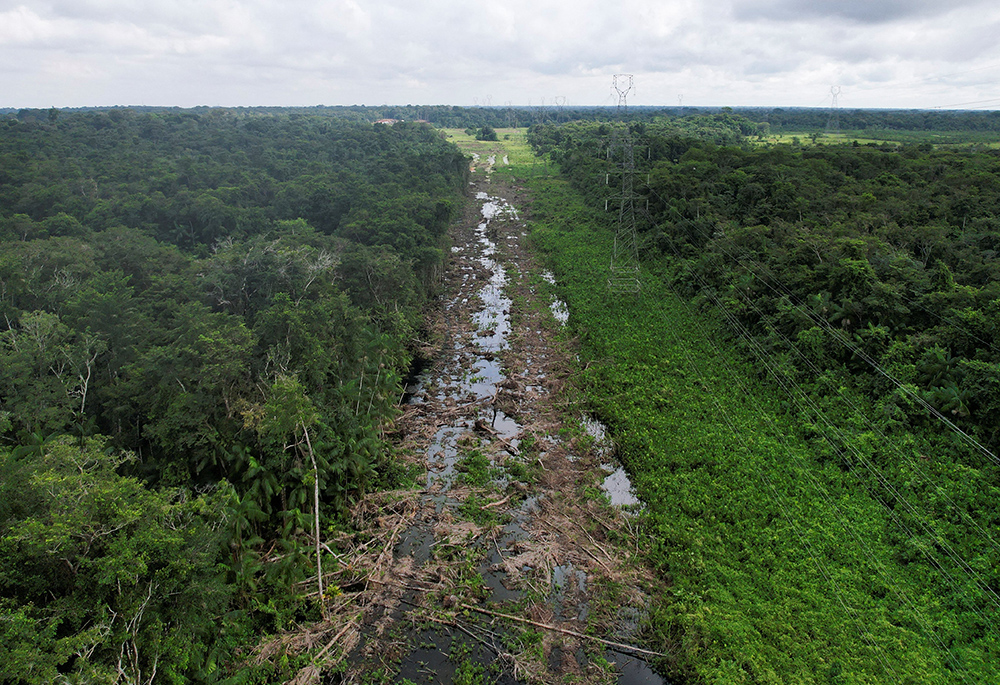
A drone view Feb. 4, 2025, shows the 8-mile-long Avenida Liberdade being constructed through protected rainforest to Belém, Brazil. (OSV News/Reuters/Adriano Machado)
Those papal documents and the 2019 Vatican synod for the pan-Amazon region, helped center the Amazon Basin in Catholic life in Brazil, said Silva. Together, he said, they spurred renewed church attention to socio-environmental concerns and the birth of new organizations like the Ecclesial Conference of the Amazon (known as CEAMA), established in 2020.
In its mobilization ahead of COP30, the Brazilian church held a series of "pre-COPs" listening sessions with Catholics all over Brazil, promoting the discussion of the challenges connected to climate change and of the church's stances and proposals.
"People from almost every diocese in the country have participated. That movement stimulated Catholics to talk about such issues and to organize for Belém," Silva said.
The Brazilian church also built bridges with its counterparts in other countries, promoting a vast international articulation for COP30.
The Integral Ecology and Mining Commission of the Brazilian bishops' conference wrote a letter containing the denunciation of the damages to the common planetary home caused by a markedly anti-environment economy, especially activities like mining and oil drilling, logging and agribusiness. That letter was then shared with CELAM and received contributions from other nations. After that, the commission decided to ask for contributions from the African and Asian episcopal conferences.
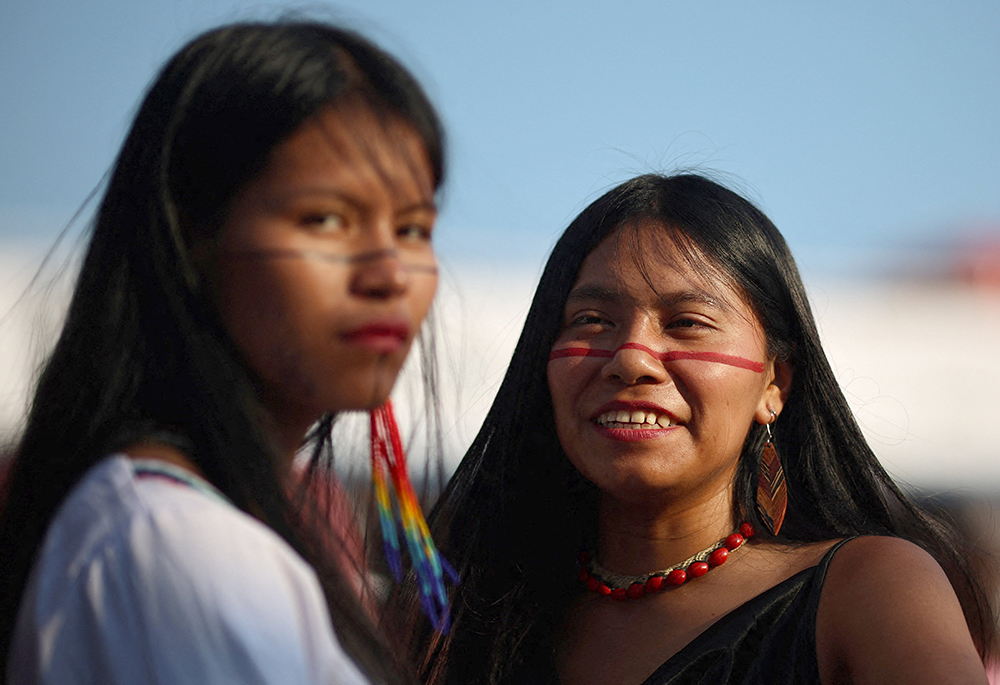
Women look on after a flotilla carrying Indigenous representatives from across Latin America arrived in Belém Nov. 9, 2025, ahead of the U.N. climate change conference, or COP30, in Brazil. A delegation of cardinals, bishops and lay activists gives the Brazil church a strong presence at COP30, taking place Nov. 10-21 in Belém. (OSV News/Reuters/Adriano Machado)
The result was the joint declaration from the Catholic Church of the Global South, addressed to the U.N. and to the churches of the Global North, in which the developing world's major environmental challenges were presented, along with potential solutions.
The letter laid out priorities of the Catholic Church of the Global South for COP30 deliberations, beginning with the protection of ancestral territories and domains and respect for the sovereignty of Indigenous, traditional, peasant and artisanal fishing peoples.
The church leaders also championed agroecological family farming, equitable climate finance (giving special attention to the needs of women) and the need to address climate migration while rejecting "the financialization of nature" and further expansion of fossil fuel exploration and degradation of ecosystems.
"We share a common conviction," the bishops wrote. "Without climate justice there is no peace, without ecological conversion there is no future, without listening to the people there are no real solutions."
Catholic plans in Belém
Throughout COP30, high-ranking church officials will take part in official events in the so-called Blue Zone, as well as in civic organizations' activities in the publicly accessible Green Zone.
The National Conference of Bishops of Brazil will hold a symposium Nov. 12, at a Catholic school in Belém, where it will have the chance to detail its proposals for dealing with climate change.
Thousands of church people from across the globe are expected to be in Belém as delegates from their ecclesial organizations to take part in several parallel events. The most important of them is the People's Summit, which has been promoted since Eco92, which happened in Rio de Janeiro in 1992. Its organizers think it will gather at least 15,000 attendants.
The People's Summit, taking place at the Federal University of Pará, will gather tens of dozens of NGOs, popular movements and traditional populations' groups to discuss solutions for the climate crisis. Members of CNBB's social pastoral ministries, like the Land Pastoral Commission and the Indigenous Pastoral Council, will attend along with priests and a few bishops.
"The People's Summit is in no way secondary for the church. A great mobilization would be promoted to attend it even if we were not going to the COP," said Silva, who attended the first People's Summit in 1992 when he was still a deacon.
Another parallel event is the Ecumenical and Interreligious Tapiri Towards COP30. Tapiri, an Indigenous Tupi word, means a hut for walkers. The event was organized by leaders of different churches and faiths in order to discuss the impact of religious intolerance on traditional populations.
Many Catholic activists in Brazil don't expect COP30 to produce significant answers for climate change. Instead, they hope to bring a prophetic voice to the discussion with their suggestions.
"Nevertheless, we have to be hopeful," Silva said. "We know that climate denialism is strong and resistance to climate action is well organized. But we have a concrete crisis. We can only hope that more daring measures can be taken."