
The COP30 United Nations climate change conference ended Nov. 22, a day late as nations debated a possible roadmap to phase out the use of fossil fuels. (COP30/Ueslei Marcelino)

Eduardo Campos Lima

Nearly 200 countries at the United Nations climate talks did little to counteract papal criticism that "failing" political will is undermining global efforts to stave off dangerous levels of global warming, say Catholic officials who attended the COP30 summit in Belém, Brazil, at the edge of the Amazon rainforest.
Ten years after adopting the Paris Agreement as a blueprint to curtail the greenhouse gas emissions heating the planet, countries omitted the words "fossil fuels" — the primary source of heat-trapping emissions — from any of the final texts, and could not agree to a proposed roadmap for a just and fair phaseout of coal, oil and gas for energy.
"COP30 left us with an outcome that refuses to confront the fuel feeding this global fire and withholds the financial resources needed to put the flames out," said Lisa Sullivan, senior program officer on integral ecology for the Maryknoll Office for Global Concerns.

Environmentalists walk through the Caxiuana National Forest, in Para state, Brazil, on March 22. (AP photo/Jorge Saenz)
While the climate plans that countries brought to Belém avert more catastrophic warming scenarios, those efforts are not enough to prevent a now-likely overshoot of 1.5 degrees Celsius (2.7 degrees Fahrenheit), a chief Paris accord goal.
"We have to accept that stepwise progress is not sufficient," said Rodne Galicha, executive director of Living Laudato Si' Philippines. "COP30 did produce some progress, but not the full, brave and strategic progress needed to care for the dignity of all and for our common home."
An upcoming convening in Colombia to devise a phaseout of fossil fuels offered some hope to overcome impasses at the U.N. meetings, Catholic officials said. They added the deals that were reached at COP30 (Nov. 10-22) — tripling adaptation funding for developing countries and accelerating emissions mitigation efforts — offered some confidence that countries still could reach some agreements amid challenging geopolitical times.

COP30, the United Nations climate change conference, took place Nov. 10-22 in Belém, Brazil. Nations gathered 10 years after adopting the Paris Agreement to reduce greenhouse gas emissions that are heating the planet. (COP30/Raimundo Pacco)
"There was no illusion of an easy agreement among nations … but the final document took a step forward and created a progressive culture of solidarity among nations," said Bishop José Reginaldo Andrietta of the Diocese of Jales, Brazil.
"The spirit of multilateralism, tested but not broken, proved resilient," said CIDSE, a network of 18 Catholic development organizations mainly based in Europe.
Hundreds of Catholics representing 80-plus organizations and more than 30 countries — including eight cardinals and more than 40 bishops — were among the 50,000 registered delegates at COP30, the largest church contingent many participants could recall.

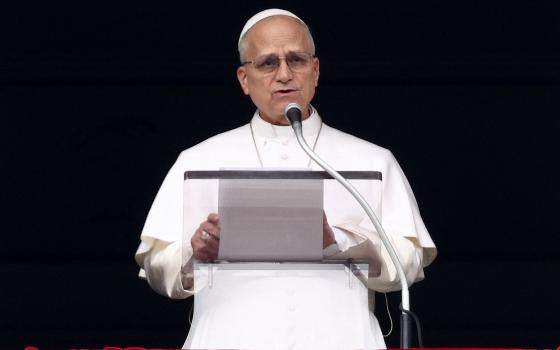
Pope Leo XIV is seen in a screen grab reading his message to Christian representatives and activists at the U.N. Climate Conference, COP30, in a video released by the Vatican Nov. 17. (CNS screen grab/Vatican Media)
Guiding much of their time over the two weeks were three documents: a first-of-its-kind joint appeal from the bishops of the Global South, representing nearly 821 million Catholics; and Pope Francis' decade-old encyclical "Laudato Si', on Care for Our Common Home" and his follow-up exhortation Laudate Deum "on the climate crisis." In addition, Pope Leo XIV delivered two messages of his own to participants in Belém, lamenting "failing" political will and stressing urgent need for "concrete actions" on behalf of the millions of people vulnerable to catastrophic climate impacts like more extreme storms, droughts, wildfires and flooding.
"To them, climate change is not a distant threat, and to ignore these people is to deny our shared humanity," the pope said in a video message at the midway point.
More than 300 Catholic organizations, along with five cardinals and 21 bishops, issued their own statement at COP30's conclusion, representing "a Church ready to speak up alongside people and the planet."
"As we continue this journey of ecological conversion, we ask for the grace to care more tenderly for creation, to walk in deeper solidarity with one another, and to grow in the courage needed to respond faithfully to the urgent challenges of our time, which affect us all, but especially women, youth, migrants, Indigenous peoples, and the most marginalized," the statement read.

People visit the green zone at the COP30 United Nations climate change conference in Belém, Brazil, on Nov. 20. (COP30/Alex Ferro)
Fossil fuel roadmap impasse
By the end of COP30, 119 countries submitted new climate plans, known as nationally determined contributions, as required under the Paris accord. An analysis of 86 of those plans, representing nearly 70% of global emissions, found together they would cut global emissions by 12% by 2035, far short of the 43% reduction by 2030 that scientists say is necessary for a 1.5 C pathway. Temperature rise is expected to reach 2.3 C-2.8 C — improvement from the 3.5 C forecasts 10 years ago but still well off track from 1.5 C.
For the first time in a COP final text, nations acknowledged the likelihood of an "overshoot" of the 1.5 C target, which scientists forecast could come in the next decade.
The inevitability of surpassing 1.5 C, even temporarily, represents a "moral failure and deadly negligence," said U.N. secretary-general António Guterres in his remarks at the world leaders' summit Nov. 6 that preceded the official opening of COP30.

André Corrêa do Lago, COP30 president, presides at the closing plenary meeting of the United Nations climate change conference in Belém, Brazil, Nov. 22. (COP30 Brasil Amazônia/PR/Rafa Neddermeyer)
Much of the discussion at COP30 swirled around how to close the gaps in emissions and ambition.
Delayed a day by stalled negotiations and a small fire, the final package of deals, called the "global mutirão" — a term from the Indigenous Tupi language meaning "collective efforts" — urged nations to keep such an overshoot limited in time and magnitude. Nations also agreed to launch a Global Implementation Accelerator and other mechanisms "to keep 1.5 C within reach."
A total of 86 countries, including the European Union, rallied around a roadmap to phase out fossil fuels, proposed by Brazilian President Luiz Inácio Lula da Silva in the summit's early days. But the proposal, while never a part of the official agenda, was left out of the final texts, which under U.N. processes require consensus for adoption. Saudi Arabia, Russia and India led in opposing the fossil fuel roadmap.
Instead, André Corrêa do Lago, the Brazilian minister heading the proceedings, pledged to develop two roadmaps — one on phasing out fossil fuels, another on reversing deforestation — ahead of COP31 next year in Turkey, offering support to a meeting in Colombia and co-led by the Netherlands set for April around a proposed treaty to eliminate the use of fossil fuels.
Some Catholics see the Colombia meeting as a possible tipping point to overcome obstacles in the U.N. processes with 24 countries at COP30 committing to a just transition from fossil fuels.
"This may prove to be the beginning of a real solution," Sullivan said, calling the countries a "multilateralism of the willing."
Bishop Juan Carlos Barreto of the Diocese of Soacha, Colombia, and head of Caritas Colombia, said: "Continuing the debate on climate change without addressing the issue of fossil fuels in a direct and forceful manner is practically resigning ourselves to having financial discourse impose itself over the ethical imperatives of protecting the planet and defending humanity."

Indigenous people sell products at the entrance to the blue zone at the COP30 United Nations climate change conference in Belém, Brazil on Nov. 12. (COP30/Sergio Moraes)
The Laudato Si' Movement, a lay-led network of 900-plus Catholic organizations, for several years has supported the prospects of a fossil fuel phaseout treaty.
"We really hope that the Holy See will use its political capital to put its weight now behind the Fossil Fuel Non-Proliferation Treaty," said Lorna Gold, Laudato Si' Movement executive director.
"We feel there's no time to lose now, and that the wind is in the sails of the citizens and in the coalition of the willing who are prepared to move forward with greater ambition toward tackling climate injustice," she said.
The proposed roadmap to halt and reverse deforestation, backed by 90-plus countries, also gained momentum in Belém but too was left out of the final documents. A Tropical Forest Forever Facility launched by Brazil garnered $6.6 billion to compensate developing countries for forest conservation.
Countries in the final texts agreed to triple funds, to $120 billion annually by 2035 for developing countries to adapt to climate impacts and approved a set of 59 indicators to measure adaptation progress. They also committed to urgently ramp up climate finance to $1.3 trillion annually by 2035.
Budi Tjahjono, international advocacy director with Franciscans International, said many of the financial pledges are non-binding and should place greater responsibility on Global North countries.

Activists take part in the "Porongaço" march of the Forest Peoples in Belém, Brazil, during the COP30 United Nations climate change conference on Nov. 13. The name "Porongaço" comes from the poronga, the oil lamp used by rubber tappers during their night work in the forest. (COP30/Ueslei Marcelino)
"They should be accountable for their environmental debt toward developing countries," he said.
Nations also agreed to develop a "Belém action mechanism" to facilitate just transitions to clean energy for workers and communities, and adopt a gender action plan to address the disproportionate challenges women and girls face from climate impacts.
The Holy See drew a chorus of boos during the adoption of the gender action plan over an objection, shared with several other countries, that references to gender be understood as only male and female.
The United States did not send a delegation to COP30, as President Donald Trump moves to again withdraw from the Paris climate accord.

Cardinal Pietro Parolin, center, applauds a speaker during the opening session of the leaders' summit of COP30, the U.N. Climate Change Conference, in Belém, Brazil, Nov. 6. (CNS photo/COP30/Rafa Neddermeyer)
Synodality in action at COP30
For more than two years, Catholics in Latin America and beyond prepared for the U.N. summit in Brazil, one of the world's most Catholic countries. Many of those who journeyed to Belém were part of a meeting a month earlier with Pope Leo, where they pledged to bring hope to COP30 despite the state of the climate and flagging political ambition globally.
At COP30, Catholics held events, joined panels, observed official proceedings and advocated with country delegates. The Network of Catholic Climate and Environmental Actors devised strategies and unified messaging across Catholic organizations and also consulted with the 10-person Holy See delegation.
Many Catholics also attended the People's Summit and joined in the first global climate march at a COP in four years, with organizers estimating 70,000 people in the streets of Belém. Indigenous groups brought a strong presence at COP30, with many arriving by boat as part of a flotilla. Indigenous protesters at varying points forced their way into the official "blue zone" and barricaded its entrance.

Catholics with the Laudato Si' Movement carry the "River of Hope" banner through the streets of Belém, Brazil, at the global climate march Nov. 15 during the COP30 United Nations climate change conference. (Eduardo Campos Lima)
The Belém conference also introduced the Global Ethical Stocktake, an initiative by the U.N. and Brazilian government to elevate ethics and morals in climate negotiations, where scientific, technological and economic viewpoints often dominate deliberations.
The three cardinals who head the continental bishops' conferences for Latin America, Africa and Asia presented their joint appeal for climate justice to U.N. officials. Likewise, the Laudato Si' Movement brought to Belém more than 2,000 "people's determined contributions" — a series of individual and community commitments to climate actions modeled as a complement to national climate plans.
The actions of Catholics in Belém demonstrated synodality in action, said Gina Castillo, senior climate policy adviser for Catholic Relief Services.
Advertisement
"I think a lot of groups left inspired by the role of the church in Brazil and in the Amazon," Castillo said. "A church that is listening to the people — witness and walking with them — and advocating with them for justice."
Gold said that Catholics displayed a powerful, unified presence inspired by Pope Leo and Pope Francis "to be leaders on this journey toward climate justice."
Looking ahead to COP31, to be held in Turkey and led by Australia, Laudato Si' Movement is aiming to complement the Holy See's climate plan with a more extensive "Catholic determined contribution" in the form of thousands of plans submitted through the Vatican's Laudato Si' Action Platform.
"If there are skeptics who thought that Laudato Si' had somehow died with Pope Francis, the answer was loud and clear at COP that his spirit lives on, and our movement is embedded now in the churches across the world," Gold said.